 Academia
 Ai
Ai
 Astronomy
 Biology
 Chemistry
 Climate
 Conspiracy
 Earth-science
 Engineering
 Evolution
 Geology
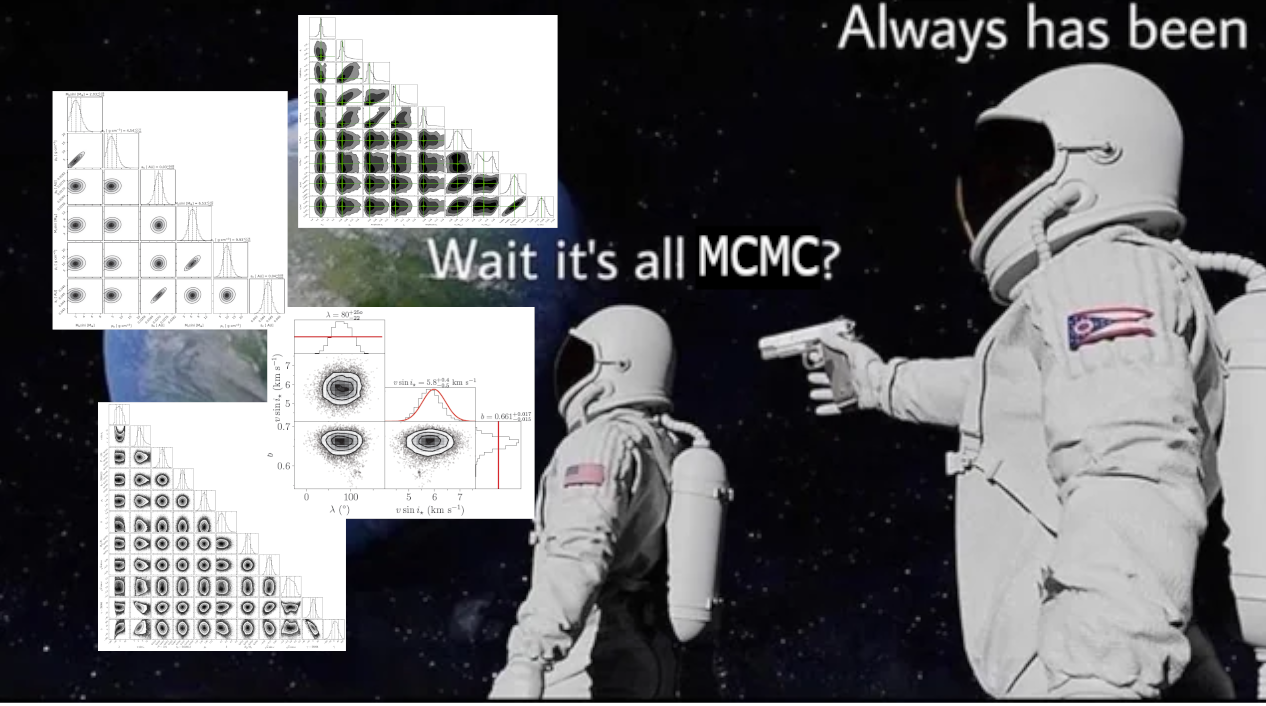
So you've been painstakingly collecting exoplanet data, running sophisticated detection algorithms, analyzing light curves, and generating beautiful statistical distributions. You're feeling pretty good about your diverse catalog of planetary discoveries—different sizes, different orbits, different characteristics. Science is happening!
Then reality hits: they're basically all detected using MCMC (Markov Chain Monte Carlo) methods. Your "diverse" dataset is really just the same statistical hammer hitting different nails. The astronaut's existential crisis is justified—when your entire field relies on one computational method to validate discoveries, are you really exploring the cosmos or just exploring parameter space?
MCMC is the bread and butter of exoplanet detection because it's brilliant at exploring probability distributions when you have noisy data and complex models. But it also means every discovery comes with those characteristic contour plots and corner plots that all look suspiciously similar. It's like realizing every restaurant in town uses the same recipe book.