
Y Chromosome's Incredible Shrinking Act

Y Chromosome's Incredible Shrinking Act
The Y chromosome is out here looking like it's on its last legs! This meme is highlighting the scientific fact that the Y chromosome (which determines male biological sex) has been shrinking over evolutionary time. Once upon a time, it was as big and robust as the X chromosome, but now it's this tiny genetic wisp with only about 55 genes left. Meanwhile, the X chromosome is strutting around with 900+ genes. Geneticists estimate the Y has lost about 1,393 genes over 166 million years. But don't panic just yet, fellas! The shrinkage has actually stabilized in recent millennia. The remaining genes are pretty crucial for male development and fertility, so they're likely sticking around. Evolution's way of saying "these are the keepers!"

Population Of Celestial Bodies By Subreddit Size

Population Of Celestial Bodies By Subreddit Size
The internet has spoken, and apparently the Moon is the most popular celestial body in the solar system! This pie chart hilariously measures planetary "populations" by subreddit subscriber counts instead of actual scientific metrics. The Moon crushing everyone with 119,000 followers while poor Mercury sits at a measly 450 is peak internet astronomy. Notice how Mars has 79,000 - clearly all those rover photos and colonization dreams are paying off in the Reddit karma department! Meanwhile, Pluto still hanging in there with 6,000 loyal fans despite being demoted from planet status. The true cosmic hierarchy isn't determined by mass or orbital position, but by upvotes and meme potential!

Same Units, Different Nightmares

Same Units, Different Nightmares
Same notation, WILDLY different implications! For mechanical engineers, "10 rad/s" is just angular velocity—how fast something spins. Chill, normal, everyday physics. But for nuclear engineers? That's 10 radiation units per second —basically a one-way ticket to Glow-in-the-Dark Town! No wonder the nuclear engineer looks terrified while the mechanical engineer is all smiles. Engineering fields: where identical units can either mean "spinning motor" or "call the hazmat team immediately!"

The Chemistry Exception Ambush

The Chemistry Exception Ambush
Chemistry students know the pain! You spend weeks memorizing rules only for exams to focus on those cursed exceptions. "Alkali metals react with water... except cesium which explodes dramatically." "This compound follows VSEPR theory... except when it doesn't because quantum mechanics said so." The sweaty panic when you realize your perfectly memorized rules are useless against the pink blob of exceptions that professors LOVE to test. It's like training to fight a specific boss only to have a surprise mini-boss appear with completely different mechanics!

Proof By "It's Trivially Obvious"

Proof By "It's Trivially Obvious"
The highlighted "You can readily convince yourself" is the academic equivalent of "figure it out yourself, I'm on my coffee break." Every physics textbook has that one author who skips crucial steps with phrases like "it's trivial" or "obviously." Meanwhile, students are left wondering if they missed the day when calculating electron configurations for isotopes became something you do between brushing teeth and breakfast.

The Great Bayesian Conversion

The Great Bayesian Conversion
The statistical cult initiation is complete! Watch as innocent young students get indoctrinated into the Bayesian way of thinking, where prior beliefs aren't just biases—they're features . The Math Department smiles knowingly while frequentist researchers look on in horror as another pure mind falls to the dark side of probability theory. Next thing you know, this kid will be updating their beliefs with every new piece of evidence instead of blindly worshipping p-values. The horror! For the uninitiated: Bayes' Theorem revolutionizes how we think about probability by incorporating prior knowledge into calculations—essentially saying "what we already know matters." Frequentists, meanwhile, clutch their pearls and insist on objective purity. It's the statistical equivalent of nature vs. nurture, and this poor student just picked a side.

From Inertia To Relativity: The Expanding Scientific Mind

From Inertia To Relativity: The Expanding Scientific Mind
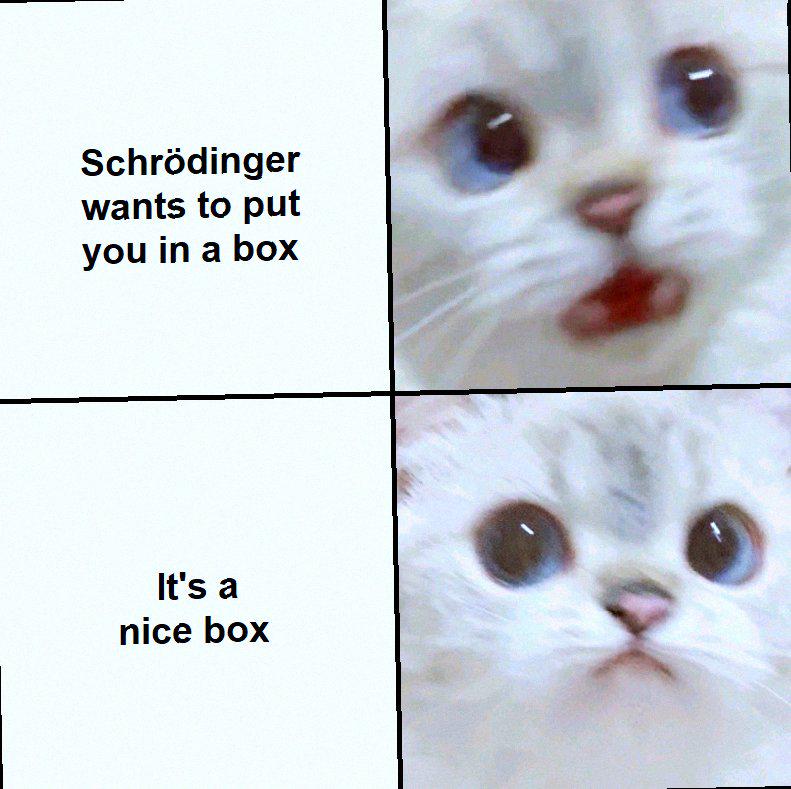
The expanding brain meme reaches peak scientific enlightenment! Starting with Newton's first law (objects at rest stay at rest), we progress to Darwin's survival of the fittest, then quantum-leap to Schrödinger's famous thought experiment (where that poor cat exists in quantum superposition until observed), and finally ascend to Einstein's theory that nothing can exceed light speed. Each level gets increasingly more mind-bending! The title "Might Be Slightly Simplified" is the scientific understatement of the century—like saying the sun is "somewhat warm" or black holes are "a bit dense." These complex theories reduced to one-liners would make these brilliant scientists either burst into laughter or quietly weep into their notebooks!

The Microbial Commuter

The Microbial Commuter
The economic paradox of microbiology! When staying home sick costs money, suddenly we're all walking petri dishes spreading pathogens with reckless abandon. That cloud of bacteria and viruses represents the perfect visualization of disease transmission dynamics - except instead of being contained in a lab, it's freely dispersing throughout the workplace ecosystem. Scientists call this phenomenon "presenteeism" - the productivity-killing practice of showing up while ill that costs the economy billions annually. Nature's way of reminding us that healthcare systems and workplace policies are just as important to public health as hand sanitizer!

Ideal Gas Law In The Epstein Files

Ideal Gas Law In The Epstein Files
The only thing more questionable than this email thread is the application of the Ideal Gas Law! Someone's trying to explain why exhaust pressure doesn't change despite compression (PV=nRT), while completely ignoring that exhaust systems aren't closed systems. The real conspiracy here isn't on that island—it's against thermodynamics! Nothing says "I definitely understand science" like confidently discussing gas laws in suspicious emails with redacted recipients. Next up in the files: why perpetual motion machines are "totally possible" and "the government is hiding it."

The Precision Spectrum: 3 Centimeters Of Scientific Panic

The Precision Spectrum: 3 Centimeters Of Scientific Panic
The precision hierarchy in science is too real! Biologists freak out over 3cm errors because that could mean mistaking a mouse for an elephant (kidding). Physicists just nod stoically—they've seen worse in quantum measurements. Civil engineers? "It's alright" because bridges need wiggle room anyway! But astronomers? They're cackling because 3cm is basically NOTHING when you're measuring objects billions of light-years away. For them, being off by 3cm is like missing a galaxy by the width of an atom. The measurement tolerance spectrum across scientific disciplines is basically a meme unto itself!

When God Speaks In Differential Equations

When God Speaks In Differential Equations
The divine origin of electromagnetism revealed! Nothing says "I'm paying attention in class" like scribbling biblical fanfiction in your physics notes. Maxwell's equations are already intimidating enough with all those fancy d'Alembertian operators and four-vectors, but this student decided what they really needed was a theological twist. "Let there be light" suddenly makes perfect mathematical sense when you realize God was just solving differential equations this whole time. Next semester's exam question: "Derive the universe in 10 minutes, show all work."

Noble Gases Just Can't Be Bothered

Noble Gases Just Can't Be Bothered
The ultimate chemical cold shoulder! Chlorine (Cl) is desperately trying to convince Argon (Ar) to share an electron, but Argon's face says it all: "Not happening, buddy." Noble gases have their electron shells completely filled—they're the trust fund babies of the periodic table who never need to work for more. Meanwhile, halogens like Chlorine are just one electron short of stability, making them the chemistry equivalent of that friend who's always asking to "borrow" something. The side-eye from Argon is chemistry's version of "new electron, who dis?"