
Math Memes

Mathematics: where 2 + 2 = 4 is just a boring special case and the answer is always "it depends on your choice of field." These memes celebrate the only science where proofs begin with alcohol and end with tears. If you've ever found yourself explaining why 0.999... really equals 1 to skeptical friends, spent hours solving a problem only to realize there's a one-line solution, or felt the special thrill of understanding a concept that has zero practical applications, you'll find your numerical tribe here. From the existential crisis of dividing by zero to the satisfaction of perfectly aligned LaTeX equations, ScienceHumor.io's math collection honors the discipline that somehow manages to be both the language of the universe and completely divorced from reality.
That's When You Know You're Done For

That's When You Know You're Done For
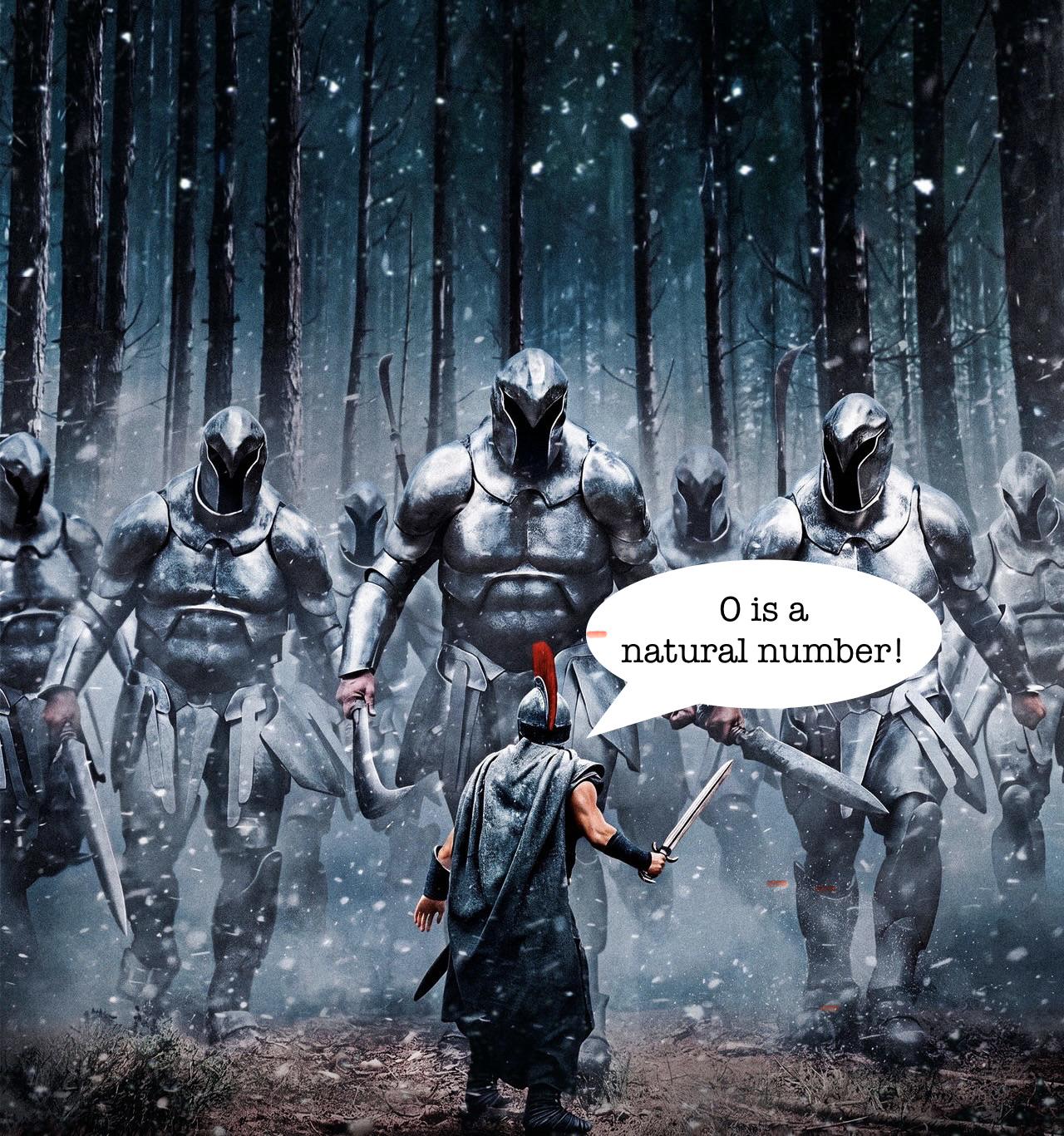
The universal language of panic! This meme perfectly captures that moment of existential dread when your field of expertise suddenly betrays you. For math students, it's that horrifying transition from nice, friendly numbers to the Greek alphabet invasion - suddenly your homework looks like it's summoning ancient deities rather than solving equations. The progression is brilliant - from military history (Vietnamese-speaking trees referencing jungle warfare) to geopolitical humor (Finnish-speaking snow during the Winter War) to the mathematical nightmare we've all experienced. That moment when α, β, γ, δ show up and your calculator can't save you anymore! Next panel: Physics students when the air starts speaking calculus.

Rejection Sure Feels Hard

Rejection Sure Feels Hard
That moment when your null hypothesis (H₀) relationship gets rejected because you found something statistically significant with your alternative hypothesis (H₁). In statistics, this is the dream scenario—your data actually showed something meaningful! Yet here you are, looking back longingly at your comfortable, safe null hypothesis that claimed "nothing interesting is happening here." Sorry buddy, p < 0.05 means you've got to break up with H₀ and publish your findings. No going back to statistical insignificance now.

The Knockout Punch Of Measure Theory

The Knockout Punch Of Measure Theory
Trying to do probability without measure theory is like stepping into a boxing ring with your hands tied behind your back. Sure, you might land a few lucky punches with basic combinatorics and conditional probability, but eventually the Lebesgue integral shows up and knocks you flat on the canvas. That smug smile you see? That's advanced mathematics watching you realize that your undergraduate stats course wasn't the complete picture after all. The probability of surviving graduate-level math without proper measure-theoretic foundations? Approximately zero.

When You Ask Dad About AI Slope

When You Ask Dad About AI Slope
The ultimate dad joke about AI! Kid asks an innocent question about AI slope, and dad unleashes a mathematical tsunami that would make even neural network researchers sweat. First, he drops the attention mechanism formula (that's the fancy e^(stuff)/sum(e^(stuff)) equation), then proceeds to bombard the poor child with feed-forward neural networks, encoder-decoder architecture, and what looks like enough Greek symbols to make Pythagoras cry. The kid's response is priceless - the universal "I should've known better than to ask" realization that hits when you accidentally trigger a nerd's special interest. That's not just math, that's weaponized mathematics!

When The Formula Breaks Your Brain (And Your Paper Supply)

When The Formula Breaks Your Brain (And Your Paper Supply)
That moment when your calculus problem transforms from "this looks manageable" to "I need to deforest an entire ecosystem for paper." The derivative of x^x starts innocently enough with the product rule, but then spirals into logarithmic differentiation hell faster than you can say "chain rule." Your tears aren't just emotional—they're a desperate attempt to create more writing space when you run out of paper. Mathematicians don't fear monsters under the bed; they fear functions that require multiple pages of work only to end with "...and thus, we've shown that the answer is 42."

I Think I Like The First One Better

I Think I Like The First One Better
This meme perfectly captures the eternal mathematical debate: summation vs. integration! On the left, we have Sigma (Σ), represented by a stepped escalator with distinct, countable steps—just like how summation adds discrete values. On the right, the integral symbol (∫) is represented by a smooth escalator, showing the continuous nature of integration where we're calculating area under a curve. Every mathematician has a preference, but we all know which one is easier on exam day. Discrete steps or smooth sailing? Your calculus professor is judging your choice right now.

I'm Still Rooting For The Riemann's Zeta Function Album!

I'm Still Rooting For The Riemann's Zeta Function Album!
This mathematical masterpiece shows Ed Sheeran's album progression (+, ×, ÷, =) followed by what could only be his most ambitious work yet: finding the zeros of the Riemann Zeta function! For the uninitiated, this infamous mathematical problem has stumped brilliant minds for over 160 years. The function ζ(s) = Σ(1/n^s) looks innocent enough, but proving all non-trivial zeros lie on a specific line (the Riemann Hypothesis) would literally earn you $1 million from the Clay Mathematics Institute. Imagine Ed dropping an album that casually solves one of the greatest unsolved problems in mathematics! His streaming numbers would be prime... I mean, prime-time amazing!

Which Weighs More: Mass Confusion

Which Weighs More: Mass Confusion
The beautiful collision of mass vs weight confusion and statistical ignorance! The meme presents the classic trick question: which weighs more, 500 lbs of pillows or 500 lbs of bricks? The punchline is that they weigh exactly the same (duh, it's 500 lbs either way), but what makes this hilarious is the bell curve showing how people respond. The normal distribution shows 34% of people choosing each wrong answer (bricks or pillows), while only 14% of people correctly identify that they weigh the same. It's basically capturing that moment when your brain short-circuits between intuition (bricks feel heavier!) and basic arithmetic (500 = 500). The facial expressions are priceless - the smug confidence of those picking sides versus the frustrated intelligence of the person who knows the correct answer but is surrounded by wrongness. Pure statistical despair!

The Stats Speak For Themselves!

The Stats Speak For Themselves!
Calculus nerds have found their ultimate crossover episode! The meme brilliantly pits pop star Taylor Swift against the mathematical Taylor Series, and the results are *infinitely* clear. While Swift might dominate the charts, she can't help you approximate sine functions or reduce those pesky nonlinear equations. Meanwhile, the Taylor Series is out here expanding functions around points like it's no big deal, showing up on your calculus exam, and training your analytical reasoning skills. The Taylor Series (that beautiful summation formula) lets mathematicians approximate complex functions using polynomials - basically the mathematical equivalent of having backup dancers make you look good. Just remember its effectiveness depends on the convergence range, unlike Swift's range which consistently hits those high notes. Next album idea: "Taylor's Version (Expanded Around a Point)"

Which Words Come To Mind?

Which Words Come To Mind?
Your brain literally short-circuits when "normal" suddenly means perpendicular to a tangent line, or "real" refers to numbers that aren't imaginary, or "complex" isn't complicated but has an imaginary component! Math vocabulary hijacks everyday language and leaves you floating in existential confusion like this bizarre propeller-hat-eye-balloon thing. The mathematical dictionary living rent-free in your head makes casual conversation a minefield. "Let me integrate that into my schedule" suddenly has you calculating area under curves!

Mathematical Christmas Derivation

Mathematical Christmas Derivation
What happens when mathematicians get festive? They derive Christmas from equations. Starting with a complex logarithmic function, our Santa-hatted professor manipulates the math step by step, canceling terms and rearranging variables until "x-mas" emerges at the bottom. The mathematical sleight of hand transforms serious calculus into holiday cheer. Nothing says "I'm tenured and I know it" like spending hours planning a mathematical Christmas joke instead of grading finals.

From Zero To Trigonometric Nightmare

From Zero To Trigonometric Nightmare
Started with basic steps, ended up summoning a demon from the math dimension. That's calculus for you—one minute you're counting, the next you're solving for variables that shouldn't legally exist in our reality. The progression from "0 MOVE" to "DO cos⁻¹(tan⁻¹θ+C)" is basically the academic equivalent of going from "let's make dinner" to "let's synthesize a new element in the kitchen."