
Engineering Memes

Engineering: where theoretical physics goes to get its hands dirty and actually accomplish something useful. These memes celebrate the field where "close enough" can be mathematically quantified and duct tape is a legitimate solution in a pinch. If you've ever made something wonderfully elegant that looks like a complete mess, explained to non-engineers why their perpetual motion machine won't work, or felt the special satisfaction of a prototype that functions on the first try, you'll find your fellow problem solvers here. From the existential dread of error propagation to the joy of an elegant design, ScienceHumor.io's engineering collection honors the discipline that turns coffee into bridges, buildings, circuits, and software through the mysterious process of staying up all night with a calculator.
Integration By Parts Be Like

Integration By Parts Be Like
This is peak calculus humor right here! The integration by parts formula (∫udv = uv - ∫vdu) brilliantly represented with a UV light minus a voodoo doll. That moment when mathematical wordplay transcends into visual punnery is just *chef's kiss*. Anyone who's survived Calculus II knows the existential dread of applying this formula only to end up with an integral more complicated than what you started with. It's like the mathematical equivalent of trying to escape a labyrinth but digging yourself deeper with each turn. Pure mathematical masochism!

Fancy Energy Units

Fancy Energy Units
Look at Pooh transforming from regular to fancy when switching from joules to kilowatt-hours! It's the SAME ENERGY just dressed differently! 🔋✨ One kilowatt-hour equals 3.6 million joules - but putting on a tuxedo doesn't change who you are inside. This is basically physics showing off at parties by using fancier units when the simple ones would work just fine. Energy unit snobbery at its finest!

Fancy Energy Units

Fancy Energy Units
The elegant transformation of Winnie the Pooh from casual to sophisticated mirrors how energy units evolve in the wild. Regular Pooh represents the humble joule—the standard SI unit measuring a single newton-meter of work. Tuxedo Pooh, clearly with a physics PhD, prefers the kilowatt-hour—essentially 3.6 million joules in a fancy suit. Same energy, different social circles.

When You Can'T Solve For The Temperature, So You Decide To Just Use A Thermometer.

When You Can'T Solve For The Temperature, So You Decide To Just Use A Thermometer.
Content Me panic-reviewing gas law calculations at 2 AM for my 7 AM exam. Because n is constant, we can use Equation 10.8. Solve: Rearranging Equation 10.8 to solve for V2 gives ½ = 4 x - (6.0 L) 1.0 atm /252 K 295 K, = 11L 0.45 atm/ check: The result appears reasonable. Notice that the felt temperatures moles, fits the initial voltaebya ratio of pressures endle volume connect sim, the expect that alecreasing pressure will cause the yetuense. increase Sintany, we expect that decre sion id cause the volume to decrease afore st at the dister. in pressures is raote aramatic than the difference in temperateres Thus, we shag expect the effect of the pressure change to predominate in determining the final yo. ume, as it does. PRACTICE EXERCISE A 0.50-mol sample of oxygen gas is confined at 0 °C in a cylinder with a morade piston, such as that shown in Figure 10.12. The gas has an initial pressure of 10 at. The piston then compresses the gas so that its final volume is halt the initial volume The final pressure of the gas is 2.2 atm. What is the final temperature of the gas in degrees Celsius? 10.5 FURTHER APPLICI OF THE IDEAL-GAS EQUATION The ideal-gas equation can be used to determine many relationships involving the physical properties of gases. In this section we use it first to define the rela tionship between the density of a gas and its molar mass, and then to calculate the volumes of gases formed or consumed in chemical reactions Gas Densities and Molar Mass The ideal-gas equation allows us to calculate gas density from the molar mas pressure, and temperature of the gas. Recall that density has the units of me per unit volume (d = m/V). a (Section 1.4) We can arrange the gas equat to obtain similar units, moles per unit volume, n/V: P V RT If we multiply both sides of this equation//// @ sergM,

Measurement Error: When Unit Conversions Cost $125 Million

Measurement Error: When Unit Conversions Cost $125 Million
Remember that $125 million Mars Climate Orbiter that crashed in 1999? Yeah, that's what happens when one team uses metric and the other uses imperial. The cosmic equivalent of trying to fit a USB plug in the wrong way—except instead of flipping it three times, you lose a spacecraft. NASA engineers were probably like "Houston, we have a... unit conversion problem." Next time someone tells you unit conversions don't matter, just point to the $125 million space debris circling Mars that proves otherwise.

The Electric Rivalry: Pixelated Edition

The Electric Rivalry: Pixelated Edition
The ultimate scientific rivalry, pixelated! Tesla's all about creating revolutionary wireless electricity and free energy (CRAFT), while Edison's just thinking "how can I monetize and claim this as MINE?" Classic case of innovation vs. capitalism in blocky form. History's greatest electrical feud immortalized in Minecraft font is honestly *chef's kiss* perfect. Edison would totally charge you $9.99 for a texture pack Tesla wanted to give away for free.

I Bought One Already!

I Bought One Already!
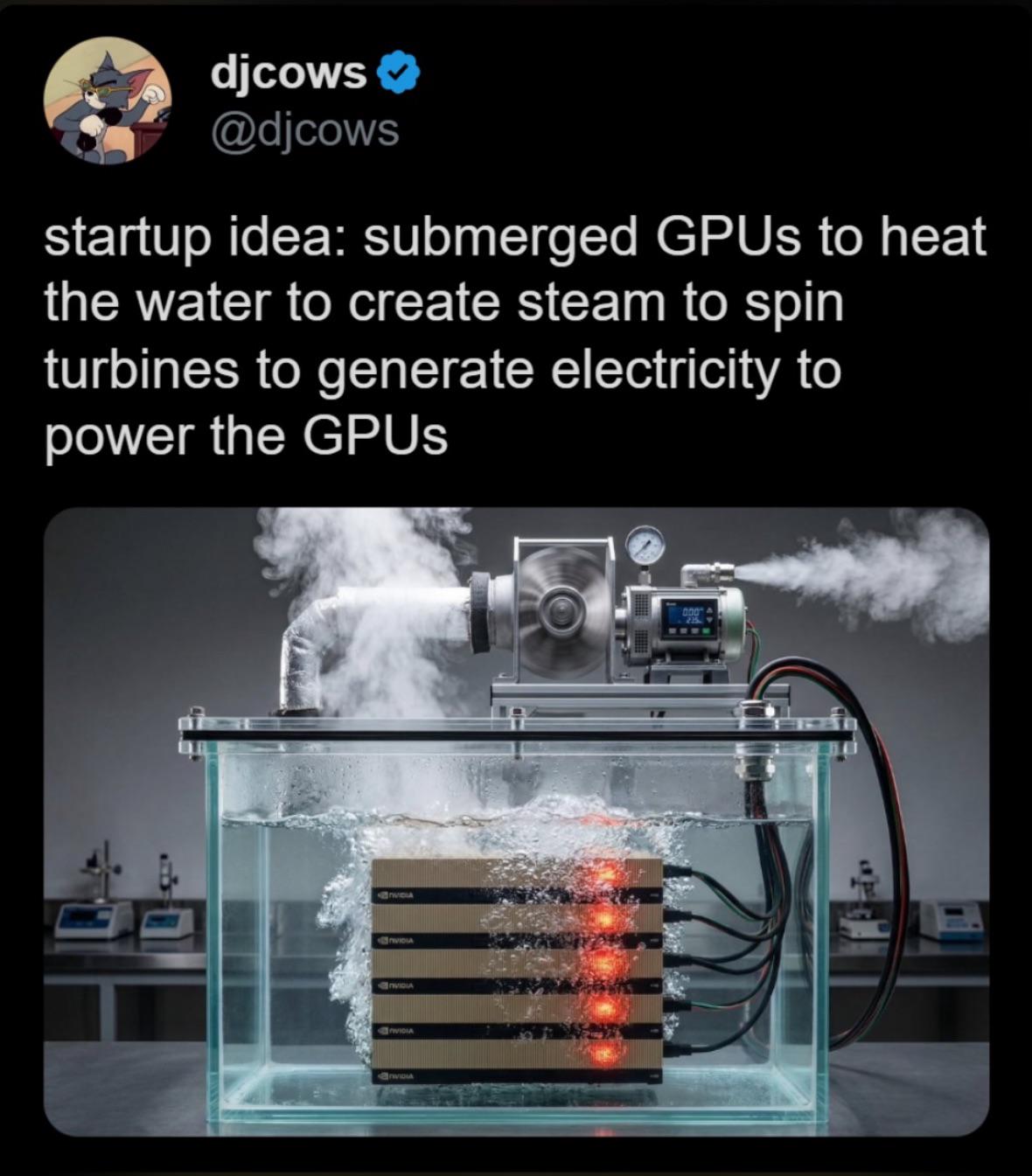
Welcome to "Reinventing Physics 101!" This brilliant startup idea is basically what happens when someone skips thermodynamics class but still thinks they're ready for Shark Tank. Using a fridge's waste heat to warm your house isn't revolutionary—it's literally how refrigerators work already! The cooling process generates heat as a byproduct (that's why the back of your fridge feels warm). Modern heat pumps actually do this intentionally, extracting heat from outside and pumping it indoors. The creator's mind-blowing "innovation" is just... basic physics in a trench coat pretending to be novel. Next groundbreaking idea: using gravity to make things fall!

Scooby-Dooby-Differential Equations

Scooby-Dooby-Differential Equations
The classic Scooby-Doo unmasking scene perfectly captures that moment when complex fluid dynamics (Navier-Stokes equations) turns out to be just Newton's Second Law (F=ma) in disguise! It's the mathematical equivalent of finding out the terrifying ghost was just Old Man Jenkins all along. Those intimidating partial derivatives and vector calculus in the Navier-Stokes equation? Just fancy mathematical clothing covering up our old reliable F=ma! Engineers everywhere are nodding knowingly while muttering "would've gotten away with it too, if it weren't for those meddling physicists."

Thermal Conductivity: The Playground Edition

Thermal Conductivity: The Playground Edition
Metal slides: the original thermal conductivity experiment disguised as playground equipment. Nothing teaches physics faster than scorching your thighs at 120°F on a sunny day. That engineer didn't hate children—he just wanted to introduce them to the concept of heat transfer in the most memorable way possible. The real genius? No lab report required, just screams of discovery echoing across the park.

Mathematical Terrorism At Its Finest

Mathematical Terrorism At Its Finest
Increasing π by just 0.1% would shatter mathematics as we know it! Engineers using 3.14 would get wildly incorrect calculations, circles would no longer be circles, and every textbook would need rewriting. The beauty of π is its mathematical constancy—it's the ratio of a circle's circumference to its diameter, approximately 3.14159... Changing this fundamental constant would be like telling gravity to take a day off. Pure mathematical terrorism!

Bird Or Plane? The Coordinate Conundrum

Bird Or Plane? The Coordinate Conundrum
No need for Superman's vision—it's a bird-plane in its natural habitat: the 3D modeling software! That silhouette is trapped in the coordinate system like a specimen in a digital petri dish. The X, Y, Z axes have decided to claim this creature as their own. Next time you hear "Is it a bird? Is it a plane?"—just check if it has RGB arrows sticking out of it!

Not How Acceleration Works

Not How Acceleration Works
The physics police would like a word with this headline! Reaching 700 km/h in two seconds is indeed impressive, but claiming Delhi to Mumbai (1,398 km) in 4 seconds? That's approximately 350 km/s or about 1/857th the speed of light! Even if this maglev train maintained its top speed without acceleration time, the journey would still take 2 hours. This headline confuses acceleration (reaching a speed) with maintaining that speed over distance. It's like saying "I can run 100 meters in 10 seconds, therefore I can run a marathon in 70 seconds." The laws of physics demand satisfaction... and possibly a correction notice.