
Physics Memes

Physics: where falling apples lead to revolutionary theories and cats can be simultaneously dead and alive. These memes celebrate the science of making simple things complicated and complicated things incomprehensible. If you've ever tried explaining quantum mechanics at a party (and watched everyone suddenly need a drink refill), calculated how long it would take to fall through the Earth just for fun, or felt unreasonably angry when someone confuses velocity with acceleration, you'll find your fellow physics enthusiasts here. From the special horror of realizing you forgot to convert to SI units to the pure joy of an elegant derivation, ScienceHumor.io's physics collection captures the beautiful absurdity of trying to describe the universe with math while your experimental values refuse to match the theoretical predictions.

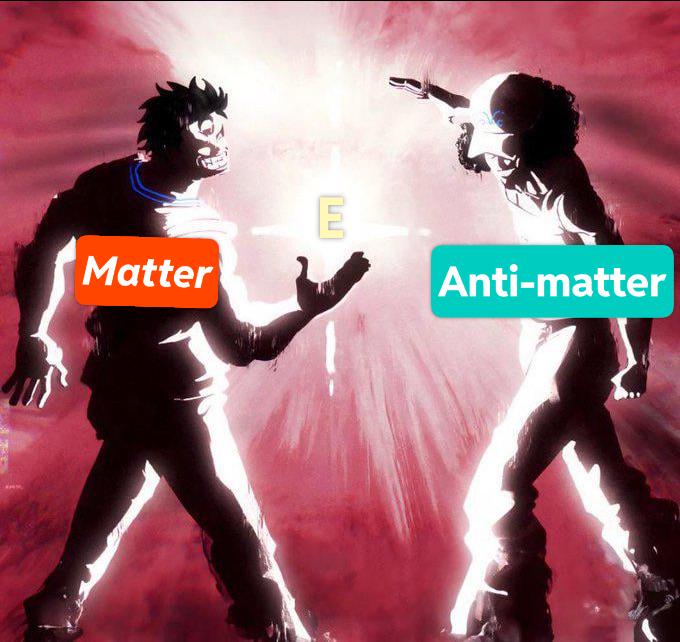
E= M

E=M
When you're trying to have a deep philosophical conversation about why the universe chose c = 299,792,458 m/s specifically, but God's just like "because I said so, that's why." The speed of light isn't some carefully calculated number—it's literally just the fundamental constant that makes E=mc² work. It's the universe's conversion factor between mass and energy, and asking "why that number?" is like asking why a meter is a meter long. The units we use are arbitrary, but c being the cosmic speed limit? That's just how spacetime decided to roll. God really said "I'm setting this dial to 1 in natural units and you mortals can figure out your own measurement systems."

Happy Life

Happy Life
You've got two types of people on this bus ride called life. On the left, someone's contemplating the Schrödinger equation—that gnarly partial differential equation describing how quantum states evolve over time. Just casually pondering wave functions and Hamiltonians, you know, light commute reading. Meanwhile, on the right, someone's vibing with Newton's second law (F=ma), probably the most chill equation in physics. "Force equals mass times acceleration"—simple, elegant, gets the job done. The contrast is *chef's kiss*. One person chose quantum mechanics as their life philosophy and looks absolutely miserable, while the other stuck with classical mechanics and is having a grand old time. Moral of the story? Sometimes overthinking the universe at the subatomic level isn't the path to inner peace. Maybe just calculate some forces and call it a day. Your mental health will thank you.

Duality Of Light

Duality Of Light
Wave-particle duality is giving these little physics characters a full identity crisis. Top left is smug about understanding both natures simultaneously, top right is confidently team particle with those cool shades, bottom right has committed to team wave, and bottom left is just... existentially confused by the whole situation, sarcastically noting "SO CLEVER..." The double-slit experiment in the middle really ties it together—literally the experiment that broke everyone's brain in the early 1900s. Light goes through two slits and creates an interference pattern (wave behavior), but when you try to observe which slit it goes through, it suddenly acts like a particle. It's like light knows you're watching and changes its behavior accordingly, which is both fascinating and deeply annoying if you're trying to understand reality. Fun fact: This quantum weirdness isn't just for light—electrons, atoms, and even molecules do this too. The universe really said "why pick one when you can be both?" and left physicists to deal with the philosophical fallout.

Who Else Loves Minesweeper?

Who Else Loves Minesweeper?
You know that famous thought experiment where Schrödinger's cat is simultaneously alive and dead until you open the box? Well, someone decided to turn it into a game of Minesweeper, and honestly, it's perfect. Each square you click is basically quantum superposition in action—the mine both exists and doesn't exist until you commit to clicking it. The real genius here is that Minesweeper captures the essence of quantum mechanics better than most textbooks: you're making educated guesses based on probability, and sometimes you just have to click and pray. The numbers tell you how many mines are nearby, but they don't tell you WHERE, just like how quantum mechanics gives us probabilities, not certainties. And just like opening Schrödinger's box collapses the wave function, clicking that suspicious square collapses your hope of winning. The difference? The cat gets to be famous for its theoretical suffering, while you just rage-quit and start a new game.

Iron Beam Laser Defense System Meme

Iron Beam Laser Defense System Meme
So you've got billions of dollars worth of cutting-edge military laser technology designed to vaporize incoming missiles at the speed of light... and then there's a compact mirror. Just a regular ol' reflective surface doing what it does best: bouncing photons like it's playing ping-pong with physics. The joke here is that lasers—no matter how sophisticated—are still just concentrated light beams. And what do mirrors do? They reflect light. So theoretically, a simple mirror could deflect a laser attack by sending all that concentrated energy right back where it came from. It's like bringing a $2 pocket mirror to a billion-dollar laser fight and actually having a chance! Of course, in reality, military-grade lasers would probably melt most mirrors before you could say "angle of incidence equals angle of reflection," but the absurdity of a tiny compact mirror being the theoretical nemesis of advanced weaponry is *chef's kiss* comedy gold.

Waaahncertainty Principle

Waaahncertainty Principle
Luigi gets the famous Heisenberg Uncertainty Principle—you know, the one where you can't simultaneously know both position and momentum with perfect precision. Cool, calm, collected. But Waluigi? He gets the ENERGY-TIME uncertainty relation, which is basically quantum mechanics saying "you can borrow energy from the universe as long as you pay it back really fast." And naturally, Waluigi is LOSING IT because that's peak chaotic energy right there. The energy-time uncertainty principle (ΔEΔt ≳ ℏ/2) is like nature's sketchy payday loan system—particles can violate energy conservation temporarily, creating virtual particles out of nowhere, as long as they vanish before the universe's accountant notices. It's the reason quantum field theory is absolutely bonkers and why vacuum isn't really empty. Perfect representation of Waluigi's unhinged vibe versus Luigi's "I'm just here for a good time" energy.

The History Of Magnetism From Thales Of Miletus And Then Suddenly Jumps To Gilbert Of England

The History Of Magnetism From Thales Of Miletus And Then Suddenly Jumps To Gilbert Of England
Every physics professor ever: "So Thales discovered lodestone in 600 BC, noticed it attracted iron, and then... *flips through 2000 years of slides* ...William Gilbert published De Magnete in 1600!" Like, excuse me, did humanity just collectively forget about magnets for two millennia? Spoiler: they didn't. Chinese scholars were using magnetic compasses for navigation by the 11th century, and medieval scholars were absolutely tinkering with magnetic properties. But textbooks love this dramatic leap from Ancient Greece straight to Renaissance England like nothing interesting happened in between. It's the educational equivalent of a movie montage that skips all the character development. Those 2000 years weren't a scientific dark age—they just don't fit neatly into a 50-minute lecture, so they get yeeted into the void. RIP to all the Persian, Chinese, and Islamic scholars who contributed but got edited out for time.

Carnot Who?

Carnot Who?
Congratulations, you've just reinvented the steam engine with extra steps and a power bill that would make Nikola Tesla weep. This beautiful circular logic is basically: use electricity to make heat to make electricity to use electricity. It's like eating a sandwich to gain the energy to make a sandwich to eat a sandwich. The Carnot cycle is rolling in its theoretical grave right now. You know, that pesky thermodynamic principle that says you can't get more energy out than you put in? Yeah, turns out the universe has rules about perpetual motion machines, and "but it looks cool underwater" isn't a valid exemption. Fun fact: Data centers already dump so much waste heat that some actually DO use it for district heating. But they're smart enough to skip the "convert back to electricity" step because, you know, physics.

It's So Over

It's So Over
You know that sinking feeling when someone casually drops that they've invented something that violates the laws of thermodynamics? Yeah, you're now trapped at 30,000 feet with either a genius who's about to revolutionize physics or someone who's about to explain their perpetual motion machine for the next 4 hours. For context: a "functional vacuum energy generator" would be extracting usable energy from the quantum vacuum—basically getting free energy from empty space. While quantum fluctuations are real, harvesting them for power violates pretty much every conservation law we hold dear. It's the sophisticated cousin of "I invented a perpetual motion machine in my garage." The worst part? You can't escape. Can't pretend you're asleep. Can't fake a phone call. You're locked in a metal tube with someone who's either about to win a Nobel Prize or explain why Big Physics is suppressing their revolutionary discovery. Either way, buckle up—it's gonna be a long flight.

Imagine Getting Magneto-Mogged By A Mars-Sized Exoplanet

Imagine Getting Magneto-Mogged By A Mars-Sized Exoplanet
Proxima-d is out here absolutely flexing on its host star Proxima Centauri by deflecting stellar flares like some kind of planetary superhero. For context, stellar flares are massive bursts of radiation that stars yeet at their planets—usually bad news for atmospheres and any potential life. But Proxima-d? Nah. It's got a magnetic field so strong it just... bounces them back. A Mars-sized exoplanet with better magnetic game than Earth's larger cousins is genuinely embarrassing for the rest of the solar system. The "magneto-mogged" terminology is chef's kiss because it combines magnetic field dominance with internet slang for being utterly outclassed. Proxima-d is basically the gym bro of exoplanets, casually deflecting cosmic radiation while Mars sits there with its dead magnetosphere wondering where it all went wrong. Nature really said "size doesn't matter" and gave a tiny planet the magnetic drip.

The Reasons Why People Get Into Physics

The Reasons Why People Get Into Physics
You walk into physics thinking you'll be the next Feynman, elegantly deriving equations on a chalkboard while students gaze in awe. Then reality hits: you're actually here because Carl Sagan made space sound cool, you binged Interstellar three times, and you spent way too many hours playing Half-Life and Portal. The "expectation" shows the romanticized academic life with a textbook on electrodynamics that you'll definitely read cover-to-cover (narrator: you won't). Meanwhile, "reality" is a beautiful collage of pop science books, Discovery Channel documentaries, Wikipedia rabbit holes at 3 AM, Cosmos reruns, and video games with crowbars and portals. That's Carl Sagan there, by the way—the man who made billions and billions of people fall in love with physics without ever solving a differential equation. Turns out most physicists weren't inspired by rigorous mathematical formalism but by sci-fi, popular science media, and the vague desire to understand why the universe is so weird. And honestly? That's perfectly valid. We all started somewhere between "space is pretty" and "I want to build a gravity gun."

Not A Real Science

Not A Real Science
Nothing brings out the academic elitism quite like scientists arguing about what counts as "real" science. Political science? Soft. Social science? Barely quantitative. Computer science? Just fancy typing. But then someone comes for string theory—one of physics' most beloved yet completely untestable theoretical frameworks—and suddenly the kitten stops laughing. Because when your entire field rests on 11-dimensional math that can't be experimentally verified, maybe throwing stones from your glass house isn't the best move. Karl Popper's falsifiability criterion basically says if you can't prove something wrong, it's not science—which technically puts string theory in the same "not hehe" category. The irony is *chef's kiss*. Physics folks love gatekeeping what's "real science" until you point out their favorite theories are essentially very elegant mathematical fan fiction.