

Taylor series Memes

Posts tagged with Taylor series
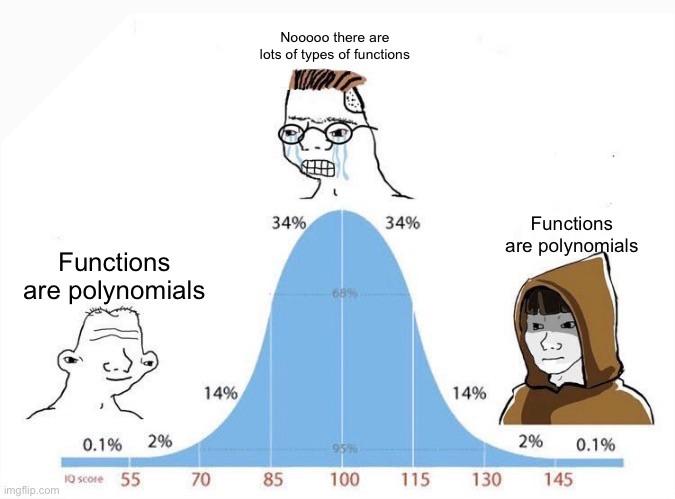
Spent Like 2 Hours Working On Taylor's Theorem Proofs For Homework Tonight

Spent Like 2 Hours Working On Taylor's Theorem Proofs For Homework Tonight
Taylor series approximates functions using infinite polynomials, so technically you're not wrong when you say "functions are polynomials." You're just... aggressively oversimplifying to the point where your calculus professor would need a stiff drink. After grinding through Taylor's theorem for two hours, your brain apparently decided that all functions can be represented as polynomials and called it a night. Sure, analytic functions can be locally approximated by their Taylor series, but that doesn't make trigonometric, exponential, or logarithmic functions actual polynomials. That's like saying "all food is pizza" because you can technically put anything on dough. The bell curve accurately captures the journey: most people understand there are many types of functions (normal distribution), while the sleep-deprived math student and the enlightened mathematician both arrive at "functions are polynomials"—one through exhaustion-induced delusion, the other through the profound realization that polynomial approximations are everywhere in analysis.

Peak Calculus

Peak Calculus
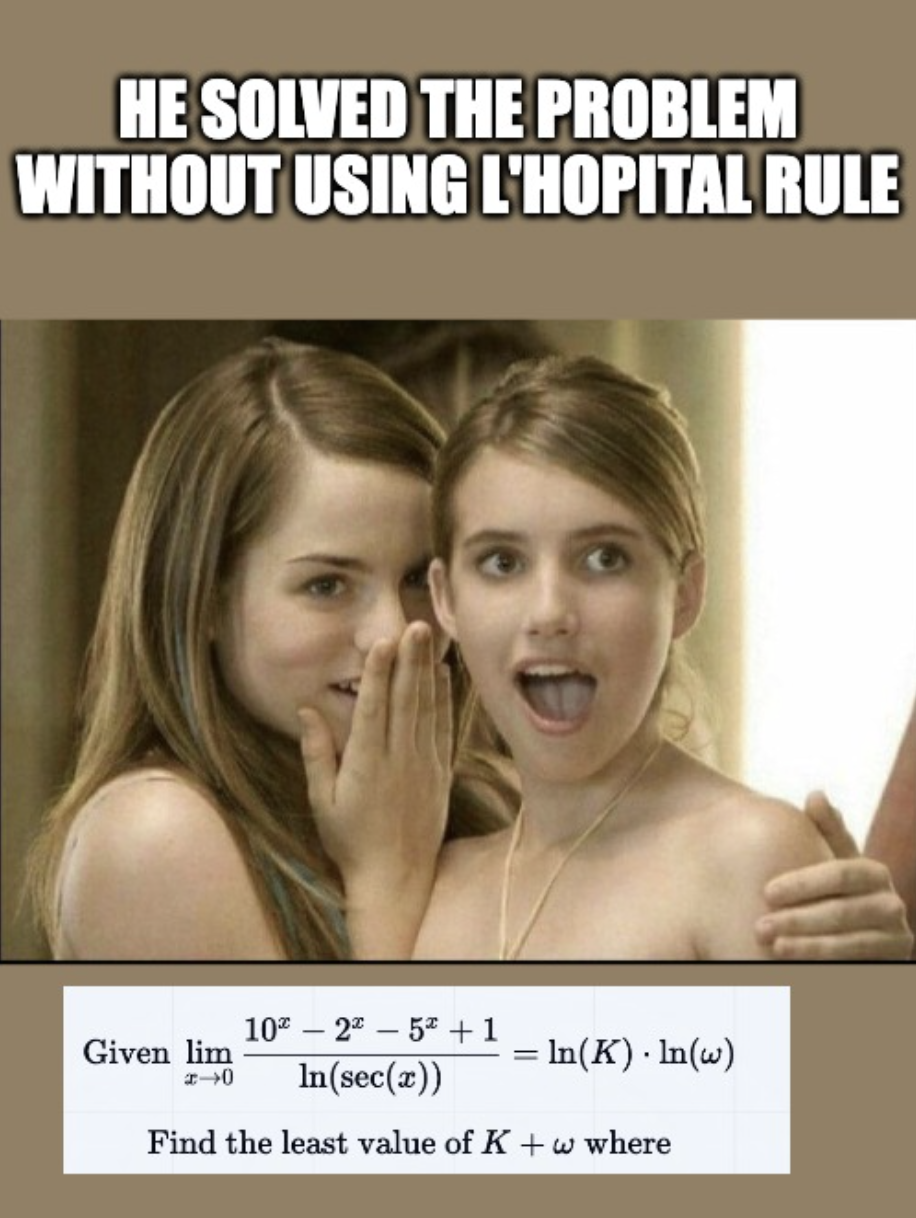
You know you've witnessed mathematical sorcery when someone evaluates a limit with ln(sec(x)) in the denominator as x approaches 0 without immediately reaching for L'Hôpital's Rule. That's the calculus equivalent of performing open-heart surgery with a butter knife and somehow the patient survives. For context: L'Hôpital's Rule is basically the "get out of jail free" card for indeterminate forms like 0/0 or ∞/∞. It lets you take derivatives of the numerator and denominator separately until you get something that actually makes sense. Most mortals would see this monstrosity and reflexively start differentiating. But solving it without L'Hôpital's? That requires either galaxy brain energy or a masochistic love of Taylor series expansions. The whispered gossip reaction is spot-on because this is the kind of flex that makes everyone else in the class simultaneously impressed and mildly concerned about your mental health.

The Answer Is 1

The Answer Is 1
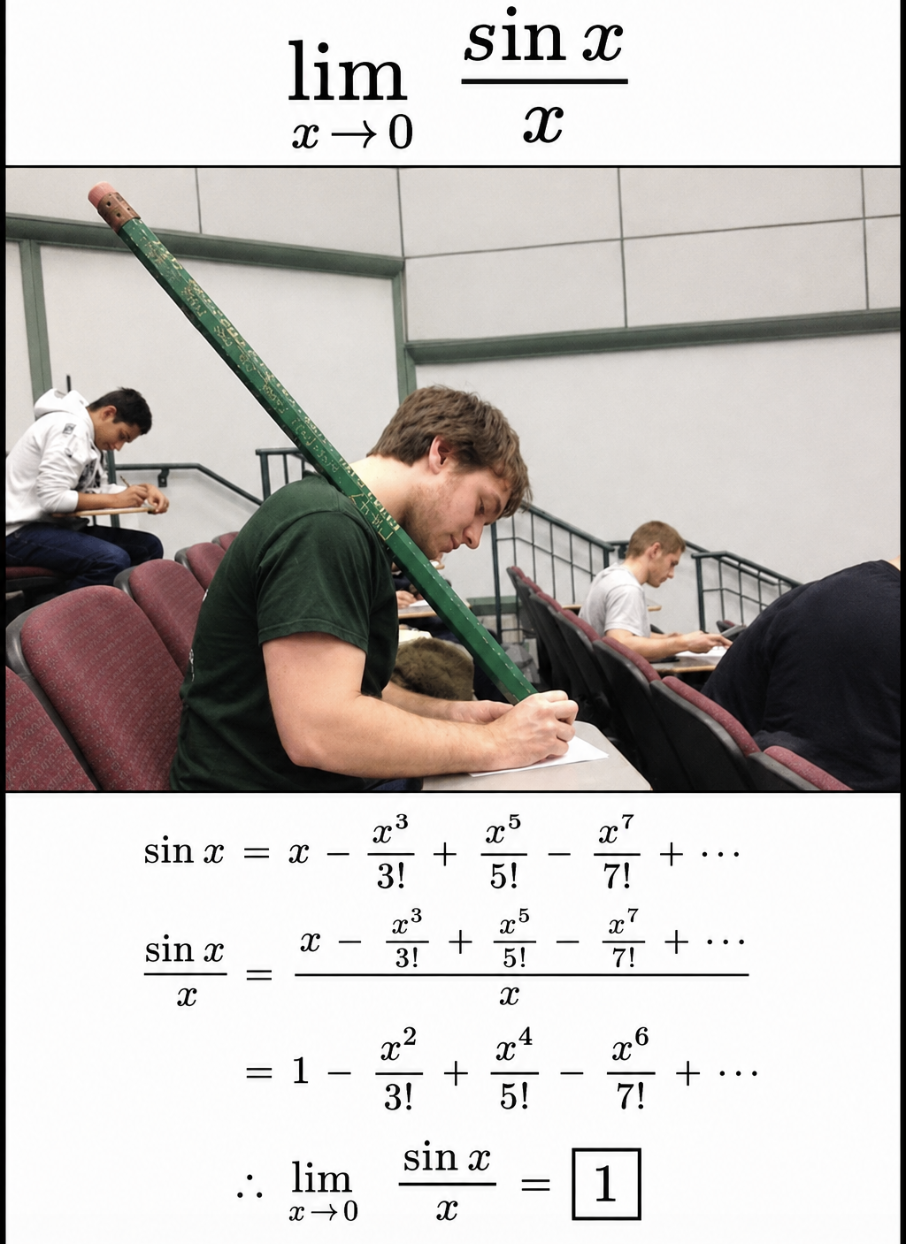
You know that limit that shows up in literally every calculus course? The one where sin(x)/x approaches 1 as x goes to 0? Yeah, it's elegant and beautiful on paper. But getting there requires busting out the Taylor series expansion like you're defusing a bomb—carefully dividing terms, canceling x's, and praying you don't mess up the factorials. Meanwhile, that giant pencil hovering menacingly over the student perfectly captures the existential weight of proving something so "simple." The proof involves expanding sin(x) into an infinite series, dividing everything by x, then watching as x approaches 0 and all those higher-order terms vanish into mathematical oblivion. What remains? Just 1. Clean, pure, inevitable. The pencil represents every professor who's ever said "this is trivial" before writing three blackboards worth of algebra. Fun fact: this limit is actually the foundation for deriving the derivative of sine, so if you ever wondered why d/dx(sin x) = cos x, blame this bad boy right here.

Superiority Complex

Superiority Complex
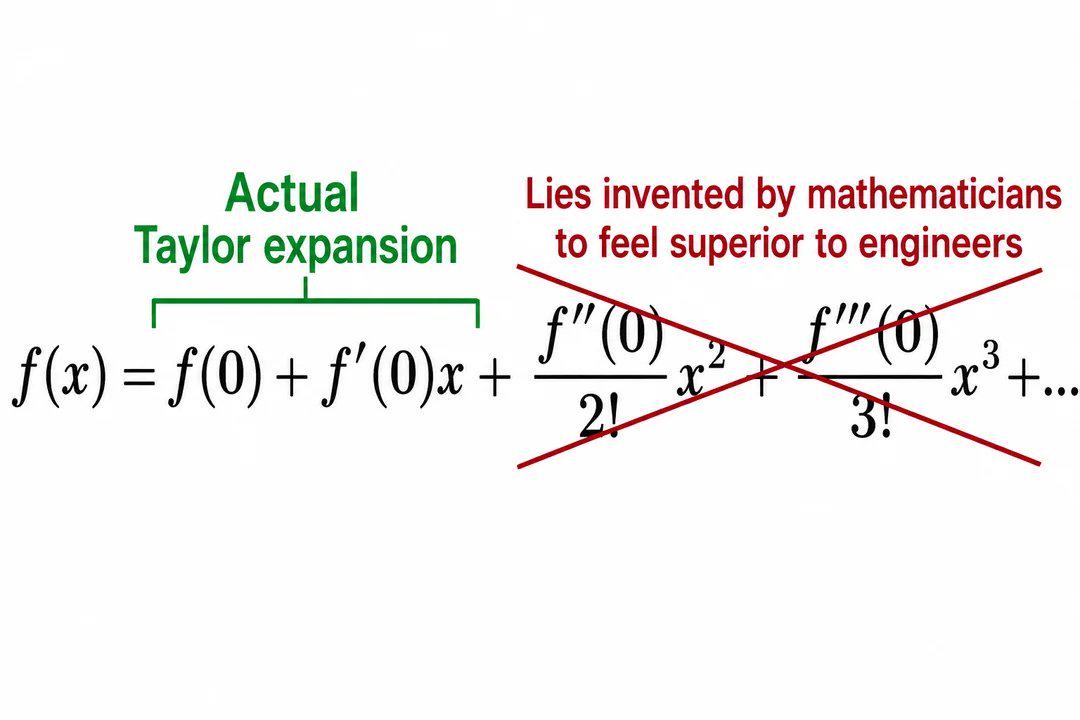
Engineers think they're hot stuff until mathematicians remind them that Taylor series actually has infinite terms. But here's the dirty little secret: engineers just use the first couple terms and call it a day because, honestly, who needs accuracy beyond the second derivative when you're building bridges that only need to stand for 100 years? The Taylor expansion is basically a way to approximate complicated functions using polynomials—you keep adding more derivative terms to get closer to the real thing. Mathematicians worship the full infinite series in all its glory. Engineers? They'll truncate it faster than you can say "margin of error" and still sleep soundly at night. This is the eternal math vs. engineering rivalry in one equation. Mathematicians get to feel intellectually superior while engineers actually get things done with "good enough" approximations. Both think they're better than the other, and honestly? They're both right.

Taylor Series Takes Flight

Taylor Series Takes Flight
The mathematical mind works in mysterious ways. While calculating a Taylor series approximation for sine, my brain inexplicably replaces the infinite sum with Taylor Swift flying through the sine curve on a toy airplane. Clearly, my subconscious believes "expanding functions around a point" means Swift taking a joyride through a waveform. Next semester I'll request accommodations for my condition: "Mathematical-Celebrity Substitution Syndrome."

The Stats Speak For Themselves!

The Stats Speak For Themselves!
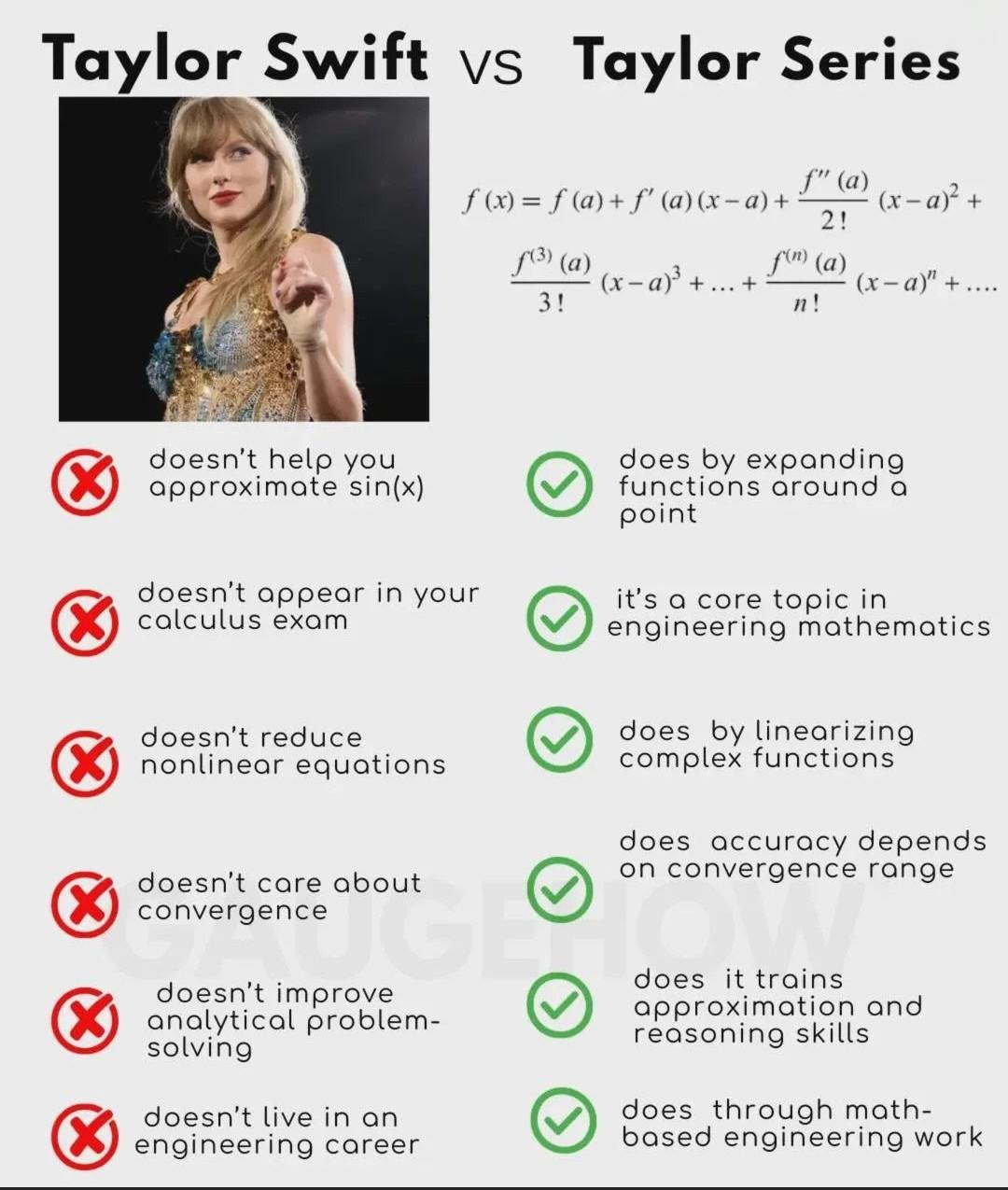
Calculus nerds have found their ultimate crossover episode! The meme brilliantly pits pop star Taylor Swift against the mathematical Taylor Series, and the results are *infinitely* clear. While Swift might dominate the charts, she can't help you approximate sine functions or reduce those pesky nonlinear equations. Meanwhile, the Taylor Series is out here expanding functions around points like it's no big deal, showing up on your calculus exam, and training your analytical reasoning skills. The Taylor Series (that beautiful summation formula) lets mathematicians approximate complex functions using polynomials - basically the mathematical equivalent of having backup dancers make you look good. Just remember its effectiveness depends on the convergence range, unlike Swift's range which consistently hits those high notes. Next album idea: "Taylor's Version (Expanded Around a Point)"

Maclaurin Swift Is My Favorite Singer

Maclaurin Swift Is My Favorite Singer
The ultimate showdown for calculus nerds! While Taylor Swift dominates the music charts, the Taylor Series dominates engineering math by expanding functions around a point. Unlike the pop star, this mathematical powerhouse actually helps you approximate sin(x), reduces nonlinear equations, and is guaranteed to appear on your calculus exam. Math professors everywhere are nodding in approval while engineering students are frantically writing this formula on their cheat sheets. The convergence range might be limited, but hey, at least the Taylor Series trains your approximation skills—something no amount of Swiftie merchandise can do!

The Unforgivable Mathematical Sin

The Unforgivable Mathematical Sin
Engineers committing mathematical heresy by approximating sin(x) with just x - x³/6 is the kind of violence that keeps mathematicians up at night. The full Taylor series for sine contains infinite terms, but engineers just shrug and say "good enough for government work." Pure mathematicians witnessing this crime against calculus is like watching someone eat a five-course meal with their hands. The approximation works surprisingly well for small angles, which is exactly the kind of pragmatic shortcut that makes theoretical mathematicians clutch their chalk in horror.

Taylor Expansion: The Academic Cold War

Taylor Expansion: The Academic Cold War
The eternal rivalry between physicists and mathematicians captured in one equation! Physicists are notorious for approximating complex functions with just the first couple of terms of a Taylor series, treating those higher-order derivatives as unnecessary complications. Meanwhile, mathematicians clutch their pearls at such blasphemy. The truth? Most physical problems work perfectly fine with the simplified version because those tiny higher-order terms contribute about as much as my motivation on Monday mornings—effectively zero. Engineers are somewhere in the background, already using just f(0) and calling it "close enough for government work."

All My Homies Reduce To Maclaurin

All My Homies Reduce To Maclaurin
The mathematical gangsters have spoken! The Taylor series might look fancy with its arbitrary center point c , but real ones know the Maclaurin series is just Taylor centered at zero. It's like showing up to a party with your complicated friend who insists on giving directions from some random landmark instead of just saying "start from downtown." Pure mathematicians spend hours proving they're different, while applied mathematicians just substitute c =0 and get on with their lives. Next time someone tries to impress you with Taylor series, just hit 'em with "cool story, but my homies reduce to Maclaurin."

The Disappearing Taylor Series

The Disappearing Taylor Series
The mathematical walk of shame! This meme shows what happens when you're too lazy to write out the full Taylor series for sine. With each panel, Homer disappears further into the bushes as more terms get dropped from the expansion. For small angles, sin(x) ≈ x is actually a decent approximation, which is why engineers can get away with it. But mathematicians? They'd rather die than commit such blasphemy. The more terms you drop, the more your professor's respect for you vanishes—just like Homer into those bushes.

Neglecting The Higher Terms

Neglecting The Higher Terms
Behold the mathematical horror story in four panels! This is what happens when you get too aggressive with Taylor series approximations. With each term Homer drops from the sine function's infinite series, he slowly disappears into the hedge of mathematical inaccuracy! By the time he's reduced the glorious sine function to just "sin(x) = x", he's practically vanished into the mathematical void! It's the calculus equivalent of saying "eh, close enough" and then watching reality collapse around you. Every math professor just felt a disturbance in the force.