
Science communication Memes

Posts tagged with Science communication
The Evolution Of Scientific Discourse

The Evolution Of Scientific Discourse
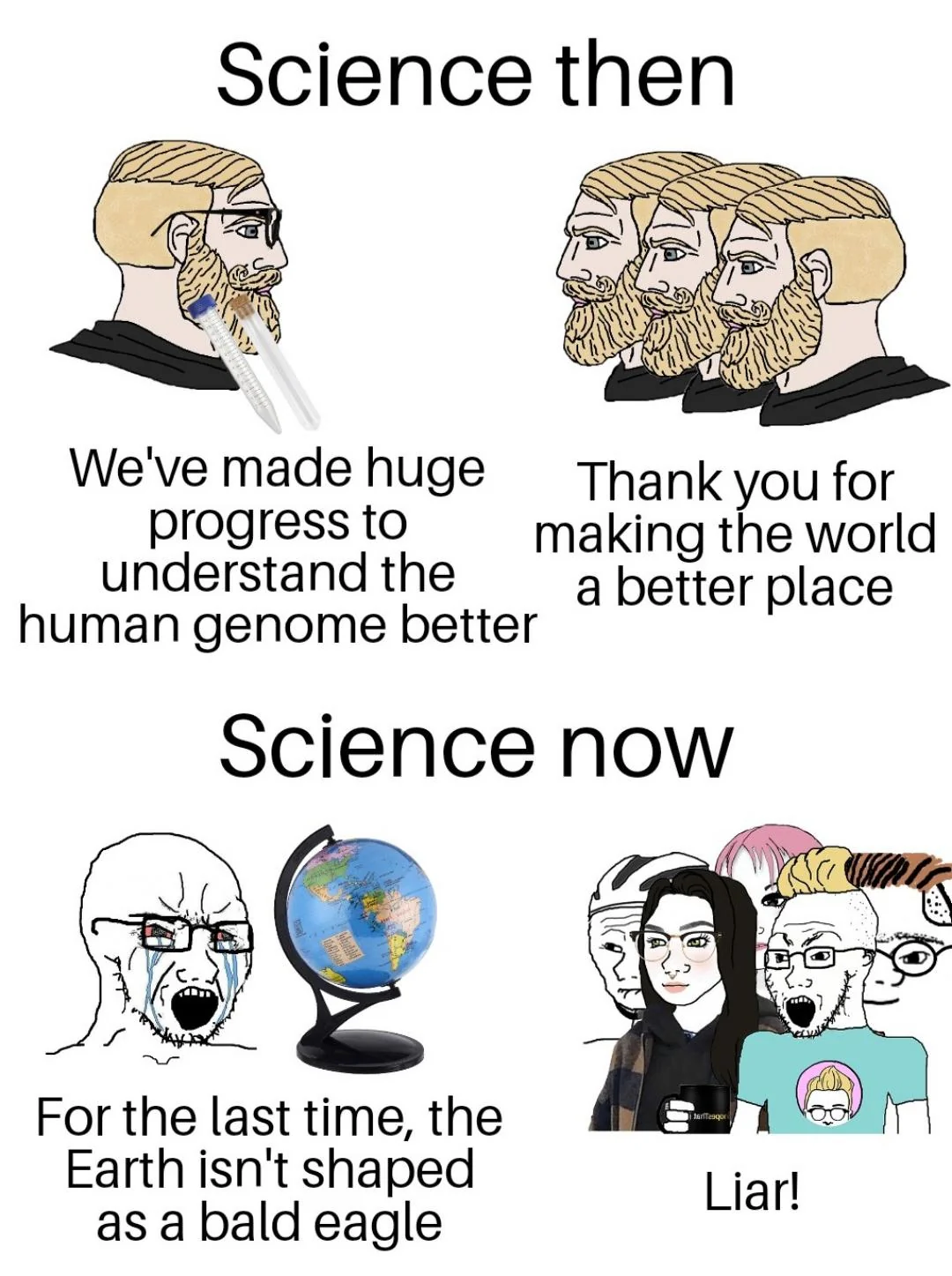
The scientific community's existential crisis in four panels! Historical scientists (sporting magnificent beards, naturally) focused on groundbreaking genome research and were thanked for their contributions. Meanwhile, modern scientists are stuck explaining that the Earth isn't, in fact, shaped like America's national bird while being called liars by people whose research consists of watching YouTube at 2 AM. The scientific method hasn't changed, but apparently the battle against misinformation has become the new peer review. Newton and Darwin never had to defend basic facts against someone who "did their own research" on TikTok!

When Scientific Acronyms Meet Game Show Panic

When Scientific Acronyms Meet Game Show Panic
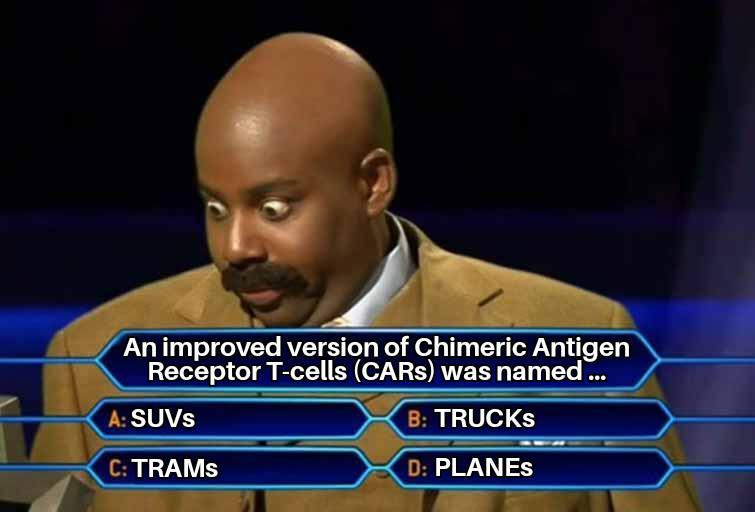
The perfect representation of that moment in scientific conferences when someone drops an incredibly complex immunology term and follows it with vehicle acronyms. The poor guy's face says it all—desperately trying to figure out if TRAMs are some revolutionary cancer treatment or just public transportation. Spoiler: in immunotherapy, they actually named the improved CAR T-cells "TRUCKs" (T cells Redirected for Universal Cytokine-mediated Killing). Scientists really will spend 80 hours a week in lab and then use their remaining brain cells to create the world's most forced acronyms.

When Quantum Physicists Enter The Gaming Realm

When Quantum Physicists Enter The Gaming Realm
When your brain is so deep in physics that you mistake gaming YouTubers for theoretical physicists! The multiverse of mix-ups continues as someone thought this Skyrim video creator was actually Sabine Hossenfelder (renowned physicist known for her no-nonsense takes on quantum mechanics) branching into video game analysis. Imagine Schrödinger's cat but it's actually just someone analyzing digital tombstones! The parallel universe where physicists explain why dragon shouts violate conservation of energy would be AMAZING though. Maybe in another timeline, Hossenfelder is indeed explaining why Skyrim's magic system breaks the laws of thermodynamics!

Need Moar Steeem

Need Moar Steeem
Scientists spend decades solving one of humanity's greatest energy challenges—achieving nuclear fusion that could provide virtually limitless clean energy. And the president's first thought? "Can we use it to heat water?" The scientific equivalent of using a supercomputer to check email. That facial expression perfectly captures the internal screaming of every researcher who's had their groundbreaking work reduced to the most mundane application imaginable.

RIP Educational Content: Gone But Not Forgotten

RIP Educational Content: Gone But Not Forgotten
Remember when we'd spend hours watching Vsauce, Veritasium, and Crash Course instead of 10-second dance videos? Squidward's mourning the digital extinction of quality science content that once thrived on YouTube. Now we're all laying flowers at the grave of intellectual curiosity while algorithms force-feed us cat videos and drama channels. The internet didn't die - its brain cells did. Pour one out for the days when "going viral" meant your quantum physics explanation got 2 million views instead of someone licking a toilet seat.

Chemistry: The Crocodile-Dependent Science

Chemistry: The Crocodile-Dependent Science
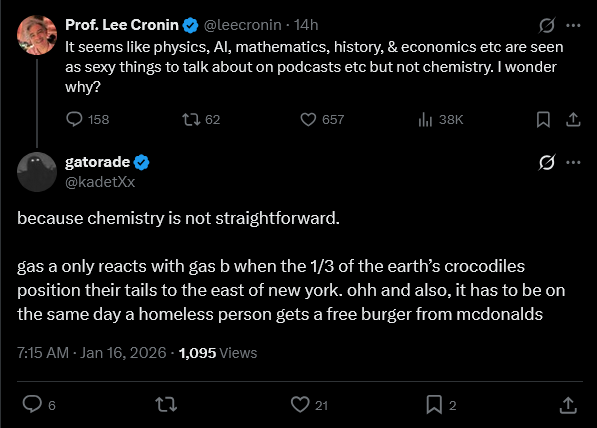
Chemistry gets no love in the podcast world, and this reply absolutely nails why. While other sciences get to sound cool with their black holes and quantum computing, chemistry is over here with reaction conditions that read like a fever dream. "Mix these two substances, but only on a Tuesday during a waxing gibbous moon while standing on one foot." The absurdist crocodile example perfectly captures how chemistry feels like learning an alien language with arbitrary rules that make thermodynamics look straightforward. No wonder we chemists just silently mix our colorful liquids in the corner while physics gets all the Neil deGrasse Tyson love.

You Can't Just Post A Revolutionary Exoplanet System And Expect People To Get It

You Can't Just Post A Revolutionary Exoplanet System And Expect People To Get It
The irony of posting the TRAPPIST-1 exoplanetary system with the caption "You can't just post a random picture and expect people to get it" is chef's kiss perfect. Every astronomy nerd is sitting there thinking "that's literally not random at all - it's one of the most significant exoplanet discoveries of the decade." It's like showing a periodic table to chemists and claiming it's obscure. The TRAPPIST-1 system, with its seven Earth-sized planets, three potentially in the habitable zone, is basically the celebrity solar system of modern astronomy. But sure, "random picture." Scientists have only been obsessing over it since 2017.

The Ultimate Scientific Allegiance

The Ultimate Scientific Allegiance
The eternal struggle between Hank Green and John Green has finally escalated into a full-blown scientific gang war! On the red side, we have Hank - the chemistry-loving, TikTok-explaining science communicator extraordinaire. On the blue side, there's John - the literary mastermind who makes teenagers cry with his novels. It's like watching two branches of academia fight for dominance! Choose your scientific allegiance carefully - do you pledge loyalty to empirical data and lab experiments, or to the philosophical musings about the universe's meaning? The Green brothers: dividing the scientific community one bandana at a time!

Everything Is Chemicals, Karen

Everything Is Chemicals, Karen
The chemistry student's existential crisis! That moment when someone smugly informs you your snack is "full of chemicals" and you're just sitting there like SpongeBob, completely done with humanity. NEWS FLASH: EVERYTHING is chemicals! That apple? Chemicals. That water? H 2 O, baby - that's a chemical! Your body? One big walking chemical reaction! The look of pure exhaustion on SpongeBob's face is every science person who's had to explain that the word "chemical" doesn't automatically mean "toxic death poison." Might as well head out before launching into your TED talk on how even organic, all-natural, farm-fresh air is just nitrogen, oxygen, and other chemical compounds hanging out together!

Which One Sounds More Threatening?

Which One Sounds More Threatening?
The scientific jargon paradox strikes again! While "asteroid near Earth" sends Mr. Krabs into panic mode, the far more scientifically complex "unusual geomagnetic storm of sunspots" barely registers on Squidward's concern meter. Truth bomb: geomagnetic storms can actually cause massive electrical grid failures, satellite disruptions, and communication blackouts that would make our tech-dependent society absolutely crumble. Meanwhile, most near-Earth asteroids are just cosmic pebbles that burn up in our atmosphere. It's the perfect illustration of how scientific terminology can either trigger mass hysteria or fly completely under the radar depending on how accessible the language is to non-specialists. The more syllables, the less we panic!

Which One Sounds More Threatening?

Which One Sounds More Threatening?
Nothing strikes fear into the hearts of humanity quite like fancy science words! The media knows exactly what they're doing here. "An asteroid came near Earth" sounds like a casual cosmic drive-by, but throw in "unusual geomagnetic storm of sunspots" and suddenly everyone's building bunkers. The irony? That "terrifying" solar activity happens constantly and rarely affects us beyond pretty auroras and occasional GPS hiccups. Meanwhile, an asteroid near-miss could actually be the opening scene of humanity's series finale. It's like being more scared of the word "rhinovirus" than someone saying "there's a tiger in your kitchen."

Pop Quantum Mechanics Moment

Pop Quantum Mechanics Moment
The internal screaming of every physicist watching someone confidently explain that the observer effect means "quantum particles know when you're looking at them." No, Karen, it's not about consciousness collapsing wave functions! The observer effect actually refers to how measuring a system inevitably disturbs it. It's like trying to check your tire pressure—the act of measuring releases some air. The quantum world doesn't care about your meditation practice or third eye. Next they'll tell you Schrödinger actually wanted to put cats in boxes. Physicists everywhere just hovering awkwardly like the person in this image, desperately trying not to flip a table.