

Lab-life Memes

Posts tagged with Lab-life

When You Finally Have Some Good Data To Show Your Supervisor

When You Finally Have Some Good Data To Show Your Supervisor
After months of failed experiments, contaminated samples, and error bars the size of Texas, you FINALLY get those beautiful, statistically significant bands on your Western blot. You practically sprint to your supervisor's office like you're presenting an ancient artifact to a deity. "Blot for the Blot God" captures that intense ritualistic energy of molecular biology perfectly—because let's be real, getting clean, reproducible blots feels like divine intervention after your 47th attempt. The multi-armed scientist here is channeling some serious Warhammer 40K "Blood for the Blood God" vibes, except instead of skulls, we're offering up perfectly transferred proteins on PVDF membranes. Your supervisor becomes this all-powerful being who judges whether your bands are worthy of publication or if you need to go back to the bench for another three weeks of optimization. The desperation is real, the relief is real, and the need for validation from your PI is VERY real.

Me And The Girls After Taking Chemistry Advice From Google AI Search Mode

Me And The Girls After Taking Chemistry Advice From Google AI Search Mode
Google's AI search has a well-documented track record of suggesting you add glue to pizza and eat rocks for minerals. Apparently someone asked it for chemistry lab protocols and now everyone's just... vibing on the couch in various states of consciousness. The lab safety officer would like a word, but they're also passed out in the corner. This is what happens when you trust an LLM that was trained on Reddit posts to guide your experimental procedures. Somewhere, a chemistry professor is having stress-induced heart palpitations without knowing why.

The Fun Fact At The Bottom Is An Incredibly Accurate Attack On My Lifestyle

The Fun Fact At The Bottom Is An Incredibly Accurate Attack On My Lifestyle
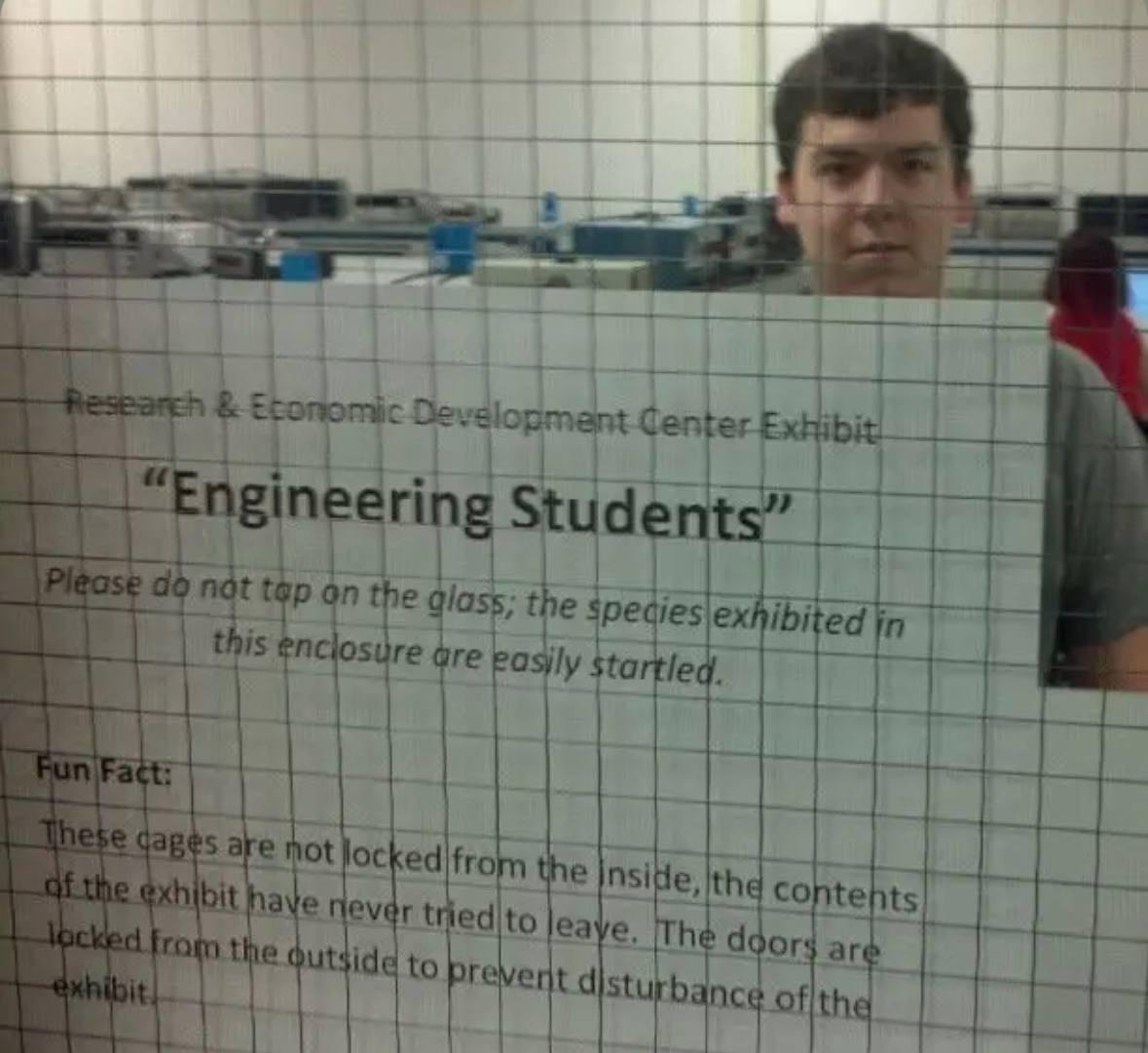
This exhibit sign treats engineering students like zoo animals, complete with behavioral warnings about being "easily startled" by glass tapping. But the real roast comes in the fun fact: the cages aren't locked from the inside because the contents have never tried to escape. The doors are locked from the outside to prevent disturbance. It's a brutal but accurate commentary on engineering student life—voluntarily trapped in labs, workshops, and study rooms, so absorbed in problem sets and projects that escape doesn't even occur to them. The doors are locked not to keep them in, but to keep the outside world from interrupting their natural habitat of CAD software, circuit boards, and caffeine-fueled all-nighters. The self-aware pain in that title really seals the deal.

How Do You Draw Your Five Membered Rings?

How Do You Draw Your Five Membered Rings?
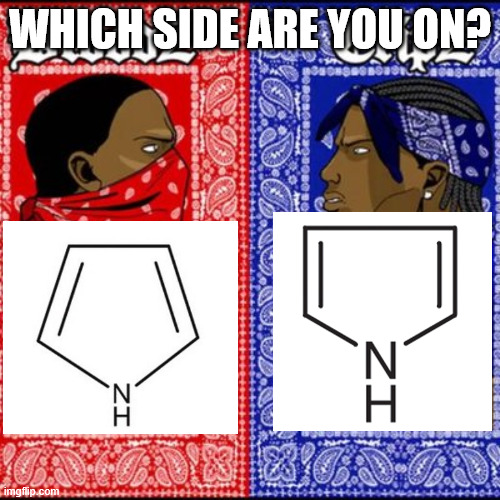
Organic chemistry has its own version of Crips vs Bloods, and it's all about how you draw pyrrole! On the left, we've got the "nitrogen at the bottom" gang – clean, symmetric, aesthetically pleasing. On the right, there's the "nitrogen on the side" crew – practical, ready for mechanism arrows, probably thinks they're being more "realistic" about the structure. Here's the thing: both are technically correct representations of the same five-membered heterocyclic ring. The nitrogen placement is arbitrary since the molecule is planar and symmetric. But somehow this tiny stylistic choice becomes a hill people are willing to die on in chemistry class. Your professor draws it one way, your textbook shows it another, and suddenly you're questioning everything. Fun fact: the side-nitrogen folks often argue it's better for showing reaction mechanisms because the lone pair on nitrogen is more visible. The bottom-nitrogen people counter that it looks cleaner and matches how we draw cyclopentane. The debate rages on in every organic chemistry lab worldwide!

Thank You Overlapping Multiplet Signals

Thank You Overlapping Multiplet Signals
Running the NMR spectrometer? Sure, everyone's eager! Push a button, get pretty peaks, feel like a wizard. But then comes the soul-crushing part: assigning those protons when your multiplets decided to have a family reunion and all overlap into one chaotic blob. Suddenly, you're playing "guess which hydrogen is which" in a spectrum that looks like abstract art. NMR spectroscopy uses magnetic fields to identify hydrogen atoms (protons) in molecules. When neighboring protons interact, they create splitting patterns called multiplets. But when your molecule is complex enough, these signals overlap into an uninterpretable mess—turning what should be straightforward structural analysis into a cryptographic nightmare that makes you question your career choices. Every organic chemist has spent hours staring at overlapping multiplets at 3.5 ppm, wondering if they should just switch to computational chemistry where molecules stay in their lane.

Scientists Tracking The Microplastic Pollution Just Realized They Were Measuring Their Own Lab Gloves

Scientists Tracking The Microplastic Pollution Just Realized They Were Measuring Their Own Lab Gloves
Nothing screams "scientific rigor" quite like accidentally contaminating your own samples with the very thing you're trying to measure. These researchers spent who knows how long tracking microplastic pollution in the environment, only to discover they were basically just documenting their own latex gloves shedding particles everywhere. It's like trying to measure air pollution while chain-smoking in the lab. The gallows humor here is perfect—because what else can you do when you realize months or years of data might be compromised by the most obvious contamination source imaginable? Just smile awkwardly while the noose of peer review tightens around your neck. At least they caught it before publication... hopefully. Fun fact: Contamination from lab equipment is such a notorious problem in microplastics research that some scientists now work in special clean rooms and use metal tools instead of plastic ones. Turns out studying something that's literally everywhere—including on your hands—is harder than it sounds.

5 Centimeters Per Second Meme

5 Centimeters Per Second Meme
Every lab instructor has lived this nightmare. You've explained significant figures until you're blue in the face, written it on the board, sent reminder emails, probably tattooed it on your forehead, and yet somehow students still submit "34.64 cm" when measuring something with a ruler that has centimeter markings. Buddy, your ruler can't measure to the hundredth of a centimeter—you're not wielding some NASA-grade precision instrument here, it's a plastic stick from the supply closet. The rule is simple: report what you can actually measure plus one estimated digit. If your ruler shows centimeters, you write "34.6 cm" or maybe "35 cm" depending on the markings. That extra ".04" is pure fiction, a number pulled from the void of academic optimism. It's like claiming you can taste individual molecules in your coffee—technically impressive, completely impossible. The frustration is real because this isn't advanced quantum mechanics—it's basic measurement literacy that somehow evaporates the moment students touch a lab report. Five times. FIVE. TIMES.

Biology Is Scary

Biology Is Scary
Chemistry discoveries: "Ooh, shiny new compound! Let's celebrate with a trophy!" 🏆 Biology discoveries: *puts on hazmat suit* *grabs flamethrower* "NOPE NOPE NOPE" 😱 Chemistry gives you pretty crystals and Nobel prizes. Biology gives you antibiotic-resistant superbugs, brain-eating amoebas, and parasites that make you want to gouge your eyes out. Every time biologists discover something new, it's either horrifying, disgusting, or both. Like that fungus that turns ants into zombies, or the fact that there are microscopic mites having wild parties in your eyelash follicles RIGHT NOW. Chemistry: "We made a new polymer!" Biology: "We found a worm that lives in eyeballs and—" Everyone: "STOP. Just... stop."

When The Signal Is Saturated

When The Signal Is Saturated
Every researcher running fluorescence assays, Western blots, or qPCR knows this pain intimately. You've got your sample loaded, you hit "run," and then you see it—that beautiful signal is so strong it's completely maxed out your detector's dynamic range. Your protein expression is off the charts! Your fluorophore is screaming! But instead of celebrating, you're now stuck doing serial dilutions like some kind of molecular bartender. Signal saturation happens when your detector gets overwhelmed—think of it like trying to measure the brightness of the sun with a light meter designed for candles. The pixels or sensors literally can't register any higher values, so you get a flat-topped peak instead of useful quantitative data. Sure, you know there's a lot of your target molecule there, but "a lot" isn't exactly publication-worthy data. Now you're pipetting out 1:10, 1:100, maybe even 1:1000 dilutions, praying you hit that sweet spot in the linear range. And of course, you're using up precious sample that took three weeks to prepare. The real kicker? You probably could've avoided this if you'd just run a quick test dilution first, but hindsight is 20/20 and your grant deadline is tomorrow.

I Really Should Clean My Bathroom

I Really Should Clean My Bathroom
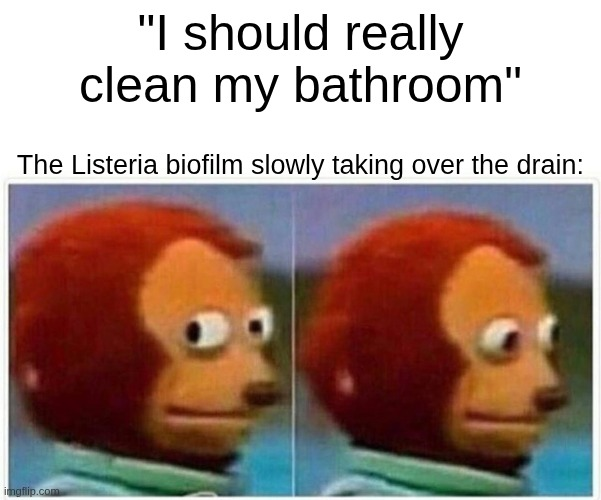
Nothing says "I'm a functioning adult" quite like watching a Listeria biofilm establish its own civilization in your shower drain. That slimy, stubborn layer of bacteria isn't just chilling—it's forming a complex community with its own architecture, communication systems, and probably a tiny municipal government at this point. Biofilms are basically bacterial cities where microbes stick together in a self-produced matrix of slime (technically extracellular polymeric substances, but "slime" sounds way more honest). They're notoriously difficult to remove because they're up to 1,000 times more resistant to antimicrobials than their free-floating cousins. So yeah, that side-eye you're giving your drain? Totally justified. It's judging you right back. Pro tip: Listeria can survive in some seriously harsh conditions, including your fridge. So maybe clean that bathroom before it starts charging you rent.

Finally, The Solution To Everything. 😂

Finally, The Solution To Everything. 😂
Every lab scientist knows the eternal struggle: that one stain on your glassware that survived the autoclave, the dishwasher, and your dignity. You've tried soap, you've tried acid, you've tried pretending it doesn't exist. But then you remember acetone exists, and suddenly you're a superhero. But wait—what if acetone didn't work? Simple. More acetone. It's basically the lab equivalent of "have you tried turning it off and on again?" except it actually works. That stubborn organic residue doesn't stand a chance against the nuclear option of solvents. Pro tip: If even more acetone doesn't work, you've either discovered a new form of matter or it's time to just buy new glassware and never speak of this again.

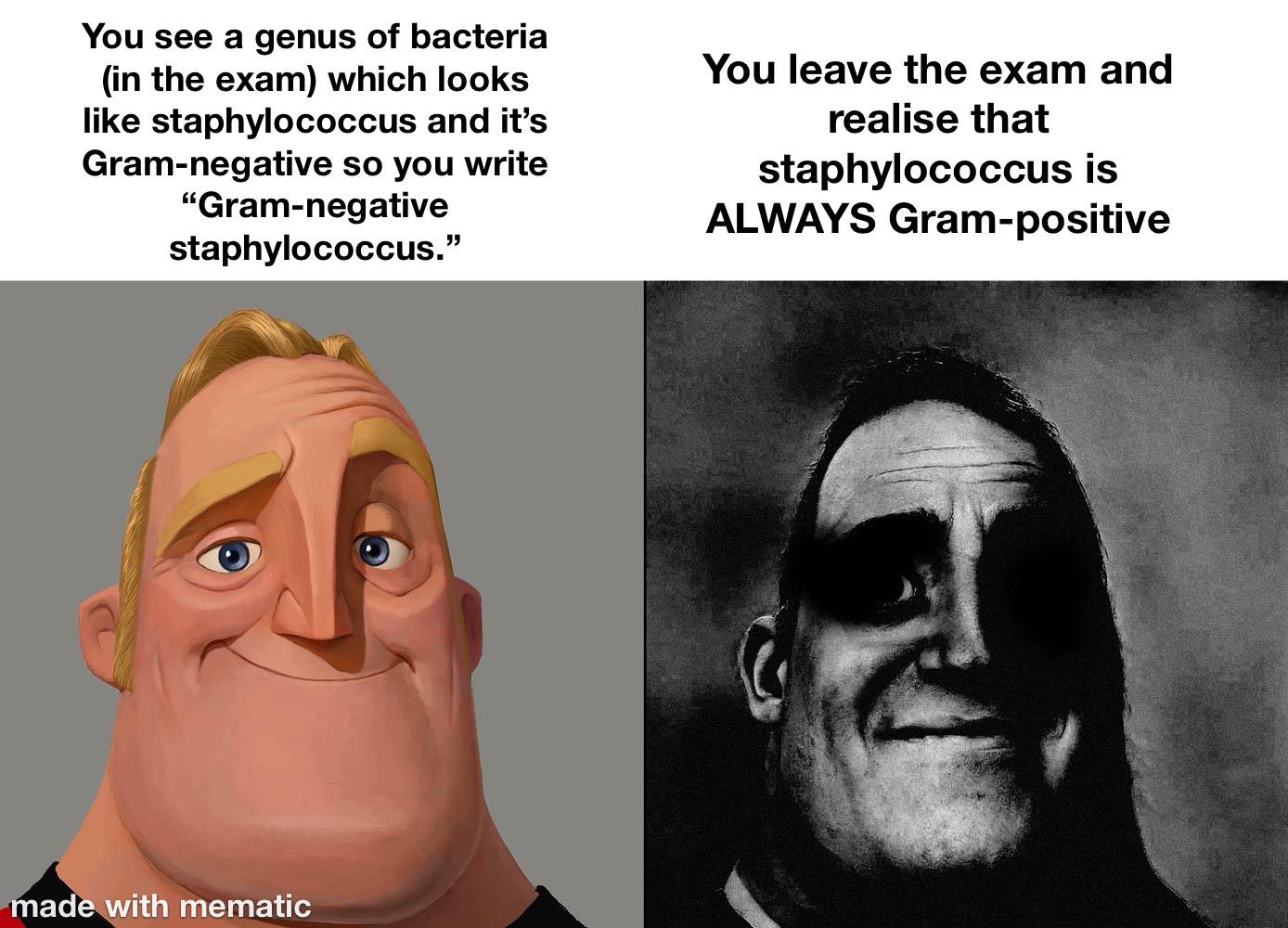
Not My Brightest Moment

Not My Brightest Moment
Nothing quite matches the sinking feeling of confidently writing down an answer in a microbiology exam, only to realize post-exam that you've just committed one of the cardinal sins of bacteriology. Staphylococcus is always Gram-positive—it's literally one of the most basic facts you learn in micro. The thick peptidoglycan layer in their cell wall retains that crystal violet dye like it's holding on for dear life. But hey, exam brain does weird things. You see those grape-like clusters under the microscope, panic sets in, and suddenly you're second-guessing everything you've ever learned. Maybe you confused it with some other bacteria for a hot second, or maybe the test anxiety just decided to delete your entire microbiology folder from your brain's hard drive. Either way, that walk out of the exam hall hits different when you realize you just told your professor that one of the most famous Gram-positive bacteria is actually Gram-negative. RIP to that grade.