
Budget Memes

Posts tagged with Budget

Is This A Good Telescope For Beginners?

Is This A Good Telescope For Beginners?
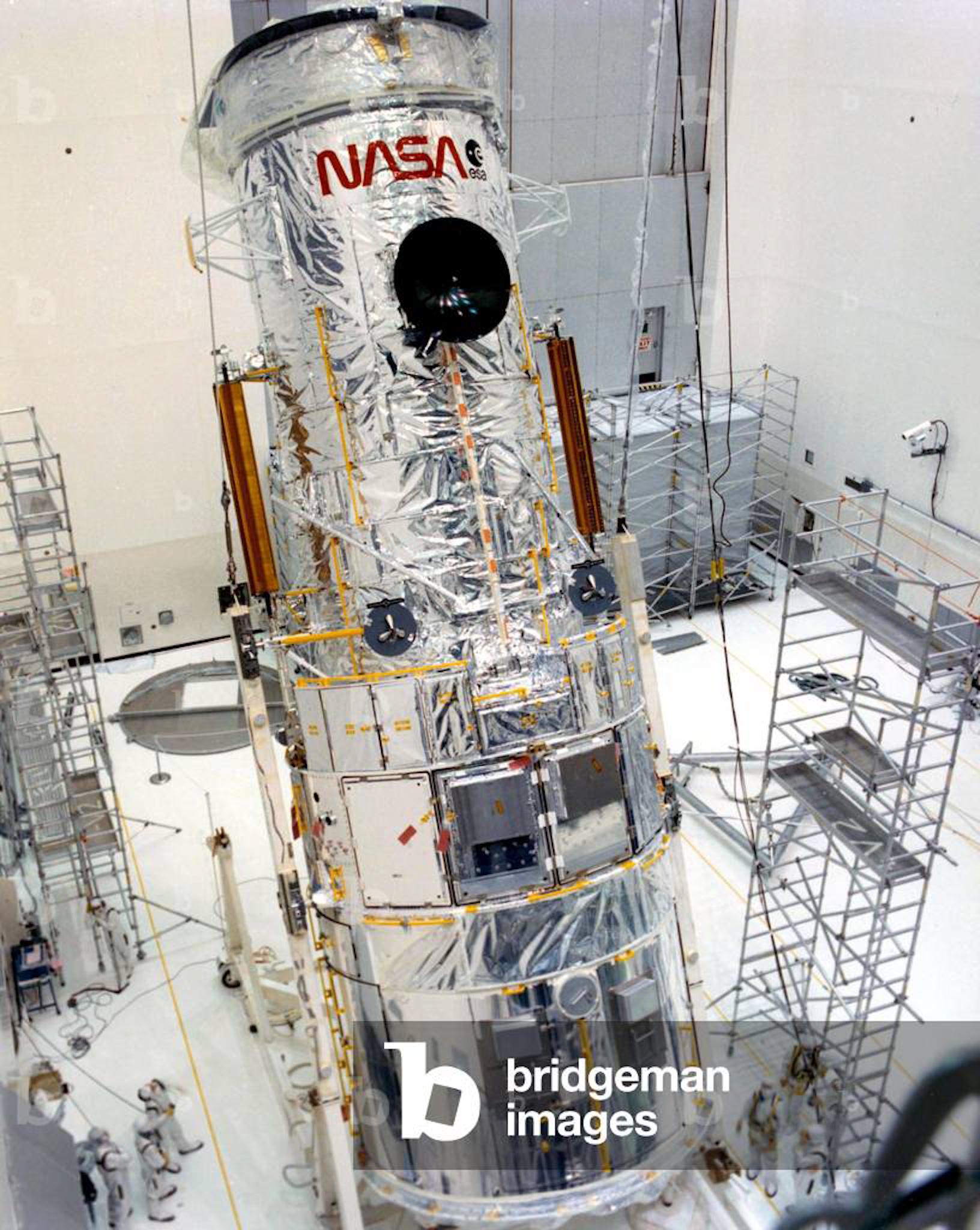
Sure, if your budget is $4.75 billion and you have NASA on speed dial! What we're looking at is the Hubble Space Telescope - basically the Ferrari of stargazing equipment. Built to orbit Earth at 340 miles up, this bad boy can see galaxies billions of light-years away while your "beginner telescope" from Amazon struggles to spot the moon on a cloudy night. The irony of asking if one of humanity's most sophisticated scientific instruments is "good for beginners" is just *chef's kiss*. Like asking if a nuclear submarine is good for your kid's first swimming lesson.

Convex Lens From Temu

Convex Lens From Temu
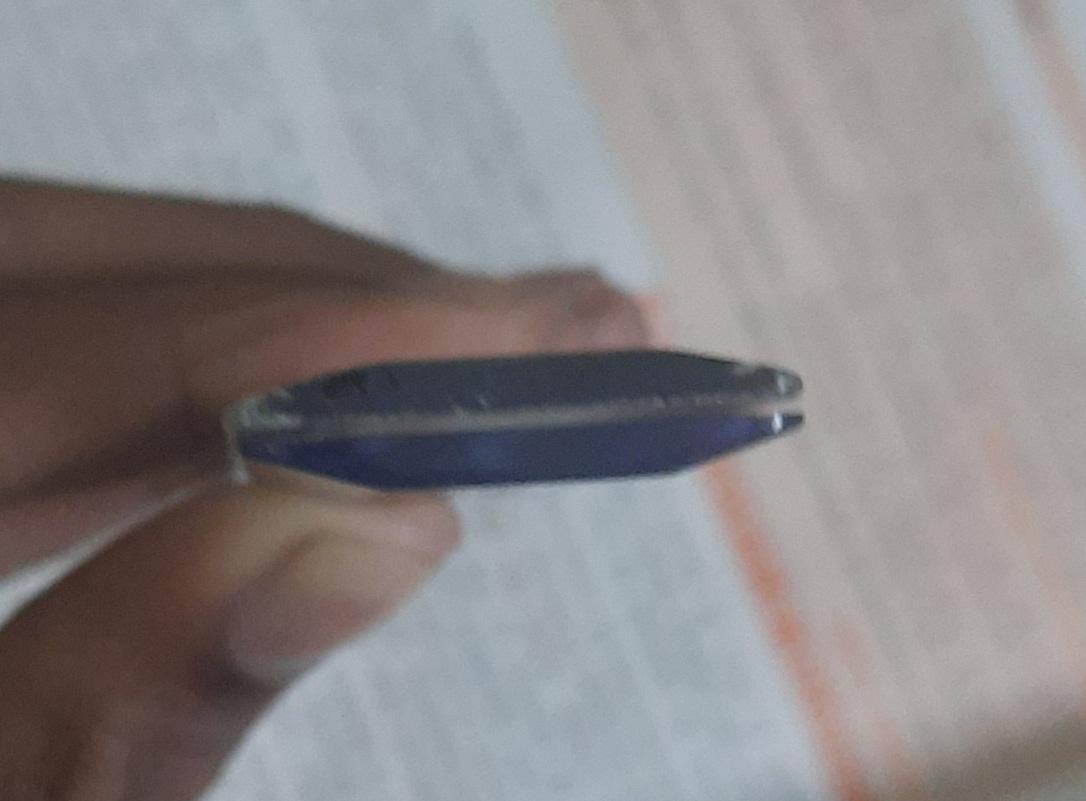
That's not a convex lens—that's a concave one! Ordering optical equipment from Temu is like asking a flat-earther to explain gravity. The whole point of a convex lens is to bulge outward in the middle, not collapse inward like your research funding after budget cuts. Physics students everywhere just collectively gasped at this optical abomination. Next time, maybe spend the extra $5 for equipment that actually obeys the laws of physics instead of creating its own alternative reality.

The Mathematician's Contraband

The Mathematician's Contraband
Nothing says "dedicated mathematician" quite like sneaking textbooks past your spouse's budget embargo. The checkbox offering a fake "congratulations on winning" receipt is basically the academic equivalent of smuggling contraband. Every math professor has that secret stash of "totally necessary reference materials" hidden between couch cushions. Because let's be honest—nothing says marital bliss like explaining why you absolutely needed that $53.94 treatise on non-Euclidean geometry when you already own seventeen books on the same topic.

Amateur Astronomers Be Like

Amateur Astronomers Be Like
Going from two lenses to three lenses in your DIY telescope setup is like upgrading from standard definition to 4K Ultra HD for backyard astronomers! The pure, unbridled excitement when that third lens reveals Jupiter's bands or Saturn's rings in slightly better detail is astronomical (literally). Professional astronomers spend millions on equipment while these heroes are out here having religious experiences with craft store components and super glue. The face of pure joy in the bottom panel is universal to anyone who's ever whispered "holy crap" while looking at a slightly less blurry moon crater.

The Hidden Cost Of Academic Entertainment

The Hidden Cost Of Academic Entertainment
The table claims studying Classical Electrodynamics costs just $0.12/hour because the textbook lasts 1,000 hours. That's like saying banging your head against Maxwell's equations is "entertainment." Sure, and lab explosions are "planned demonstrations." The real cost should include therapy sessions and the coffee required to comprehend why a moving charge creates a magnetic field at 3 AM. Whoever made this clearly never had to derive the wave equation in spherical coordinates while questioning their life choices.

Chemistry On Budget

Chemistry On Budget
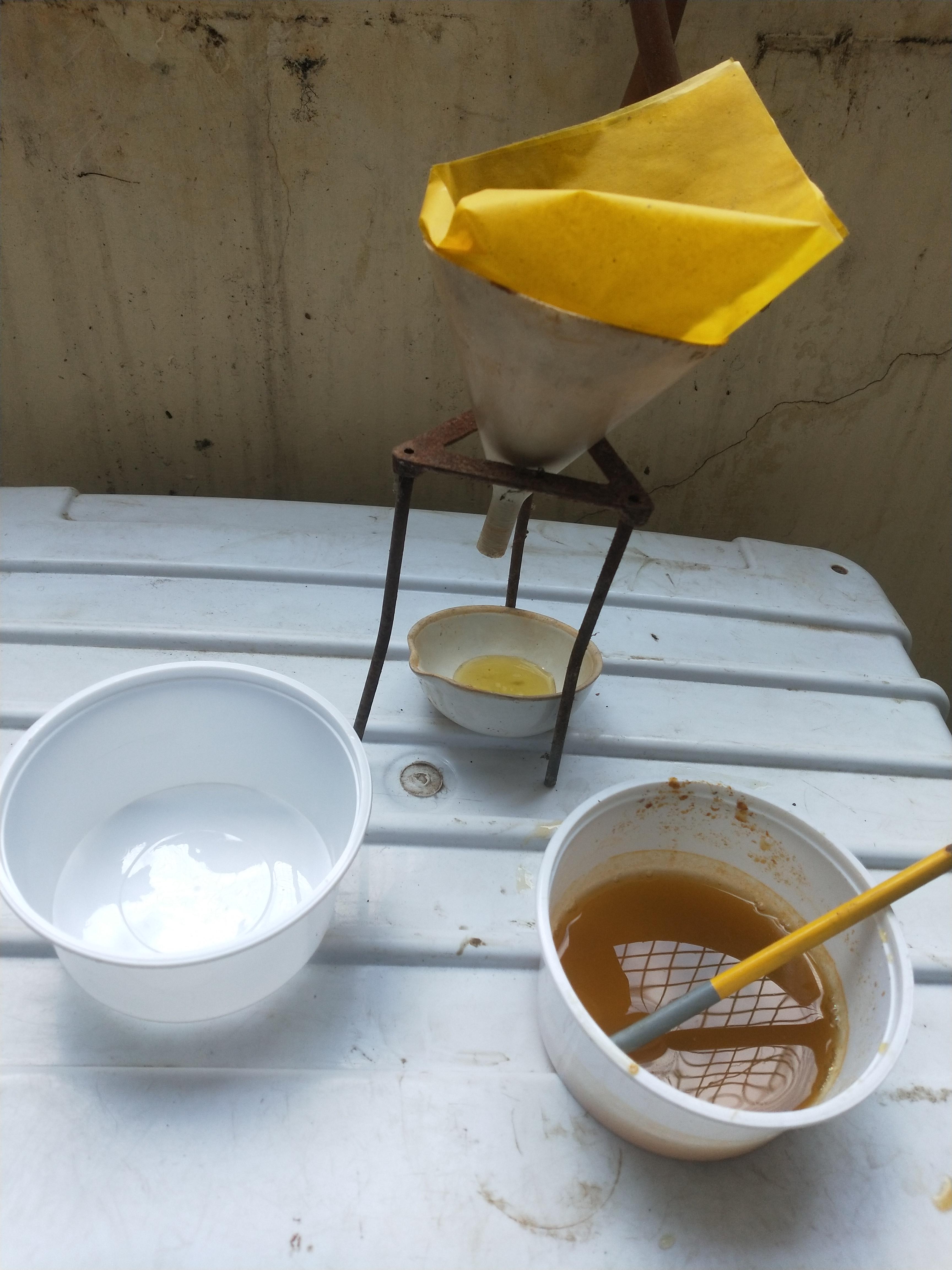
When your research grant gets cut but the experiment must go on. That's a paper funnel held by a ring stand over what appears to be a makeshift filtration setup. Somewhere, a lab safety officer just felt a disturbance in the force. The best discoveries were always made with equipment held together by determination and whatever was in the kitchen drawer. Nobel Prize committees don't ask how you filtered your precipitate.

Trump Cuts Funding To Ice Core Storage Facility...

Trump Cuts Funding To Ice Core Storage Facility...
The ultimate climate scientist nightmare - thousands of years of irreplaceable ice core data melting away because some politician decided it wasn't worth the electricity bill. Those cores contain our planet's climate history like tree rings on steroids! Once they're gone, that's it. No do-overs. No "let me just grab another 800,000-year-old ice sample real quick." The perfect metaphor for how science funding works - decades of meticulous research can vanish faster than free donuts in a faculty meeting.

The False Economy Principle

The False Economy Principle
The classic corporate cost-cutting paradox in its natural habitat! First comes the triumphant "we saved money by doing engineering in-house" declaration, followed by the soul-crushing reality: "we can almost afford to start implementation once they're prepared." It's the corporate equivalent of buying cheap shoes that fall apart after a week—sure, you saved $20, but now you're barefoot and your feet hurt. The Einstein disguise is just *chef's kiss* perfect for delivering bad financial news with scientific authority. Next up: discovering that the money saved was actually just moved to the "future problems" spreadsheet!

Funding Gap: Math Blocks Vs. Particle Smashers

Funding Gap: Math Blocks Vs. Particle Smashers
Behold the perfect illustration of research funding disparities! On the left, mathematicians pushing boundaries with $20 worth of building blocks. On the right, physicists casually smashing particles with their $9 billion Large Hadron Collider. The mathematician's like "I've constructed a revolutionary proof using these plastic toys" while physicists are like "Sorry, can't hear you over the sound of our superconducting magnets rearranging subatomic particles." Pure math: solving millennium problems with chalk and imagination. Experimental physics: "We need another billion to upgrade the antimatter containment field." The eternal academic flex battle continues!

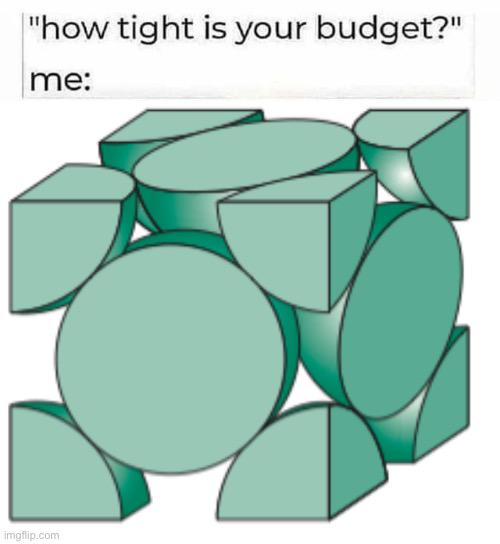
Atomic Packing Factor: The Budget Edition

Atomic Packing Factor: The Budget Edition
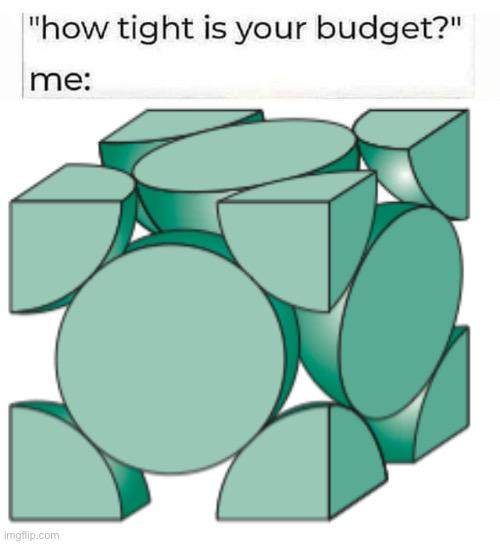
When someone asks about your budget constraints and you're living like atoms in a crystal lattice! The image shows a perfect example of inefficient atomic packing—spheres surrounded by cubes with tons of wasted space. In crystallography, this would be a materials scientist's nightmare with a pathetically low packing factor. For the uninitiated, efficient crystal structures like face-centered cubic have atoms packed so tightly they reach 74% space utilization. This budget, however, is operating at maybe 30% efficiency—basically the crystallographic equivalent of paying Manhattan rent for a closet-sized apartment while your neighbor's cat has the penthouse.

Maximum Density, Minimum Funds

Maximum Density, Minimum Funds
Financial efficiency maximized to 74% - just like face-centered cubic crystal structures. Those empty spaces between atoms? That's where my hopes of affording concert tickets used to live. Materials scientists know the pain of trying to fill space optimally while maintaining structural integrity. My bank account follows similar principles, except with less mathematical elegance and more instant ramen.

The Duality Of Engineer Brain

The Duality Of Engineer Brain
The duality of the engineer brain in its natural habitat. On one side, the rational voice saying "we should stop wasting money on this" while wearing a "thinking cap" - and on the other, the primal lizard brain whispering "literal coolest thing ever" at the sight of an F-22 Raptor. Military budgets might be questionable, but supersonic stealth aircraft with thrust vectoring capabilities trigger the same neuron activation as shiny objects to magpies. Defense contractors know exactly which buttons to push in the engineer psyche.