

Academia Memes

Posts tagged with Academia
Guys I Just Realized What To Do When You Run Out Of English, Greek, Hebrew And Cyrillic Alphabets: The Armenian Alphabet (Ignore Existing Symbols). Can Also Use Each Letter With Certain Transformations Applied Such As Rotation Or Reflection.

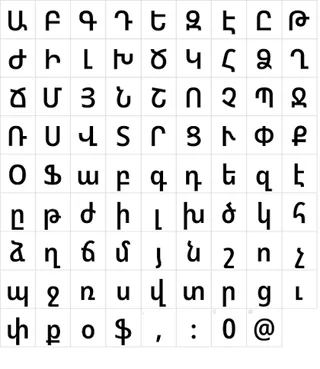
Guys I Just Realized What To Do When You Run Out Of English, Greek, Hebrew And Cyrillic Alphabets: The Armenian Alphabet (Ignore Existing Symbols). Can Also Use Each Letter With Certain Transformations Applied Such As Rotation Or Reflection.
You know you've been doing math too long when you've exhausted the entire Latin alphabet, burned through Greek, raided Hebrew for good measure, borrowed from Cyrillic, and now you're eyeing Armenian characters like they're the last lifeboat on the Titanic. This is what happens when you need to define 47 different variables in a single equation and you're too stubborn to use subscripts properly. The real galaxy brain move here is suggesting rotations and reflections. Nothing says "I've lost control of my notation system" quite like using ∃ and Ǝ as two completely different variables in the same proof. Your thesis committee will love it. Or report you to the authorities. Fun fact: Mathematicians have actually done this. They've used Fraktur, blackboard bold, script fonts, and even Hebrew letters like ℵ (aleph) for cardinalities. At this point we're just collecting alphabets like Pokémon cards. Gotta notate 'em all.

Years Of Academy Training Wasted!

Years Of Academy Training Wasted!
Imagine spending decades mastering quantum mechanics, particle physics, and sophisticated mathematical models, only to find out that J.J. Thomson's 1904 "plum pudding" model—where electrons are just scattered through a blob of positive charge like raisins in a dessert—was somehow the accurate one all along. You know, the model we literally teach in intro physics as "here's what people thought before they knew better." The existential horror of realizing your entire career of increasingly complex atomic models (Rutherford, Bohr, quantum mechanical) was just humanity overcomplicating a Victorian-era pudding analogy. All those particle accelerators? Unnecessary. That PhD thesis on electron orbitals? Worthless. Should've just stuck with dessert-based physics. Plot twist: this will never happen because Rutherford's gold foil experiment definitively yeeted the plum pudding model into the scientific graveyard in 1909, but the fantasy of all that education being pointless? That's the real nightmare fuel for any physicist.

Something We Can Learn From Him

Something We Can Learn From Him
When a Fields medalist casually drops his mental health coping strategy and it's just... reading manga. Yu Deng, who won mathematics' most prestigious award in 2026, apparently handles depression by diving into yuri manga—a genre focused on romantic relationships between women. The juxtaposition is chef's kiss: you'd expect some profound mathematical meditation or complex problem-solving ritual, but nope. Just wholesome anime romance. Honestly? Relatable king. Sometimes the solution to existential dread isn't found in differential equations but in the pure escapism of illustrated storytelling. The man solved problems that would make most people's brains melt, but his therapy is the same as half the internet's. Respect.

Comment On Sheafification Of G's Latest Video

Comment On Sheafification Of G's Latest Video
Someone just dropped "sheafification" and "morphism" in casual YouTube conversation like they're ordering coffee. Sheafification is this wild algebraic topology thing where you take presheaves and turn them into sheaves—basically upgrading your mathematical structure to behave better with local data. And morphisms? Those are just fancy math-speak for structure-preserving maps between objects. But the real comedy gold here is the "composing it" innuendo followed by that suspiciously coy "let's just say." My dude really said "let me flex my category theory vocabulary while making it sound vaguely suggestive" and got 352 likes for it. The internet truly rewards mathematical chaos.

Proof By "Go Take Another Math Class For The Proof"

Proof By "Go Take Another Math Class For The Proof"
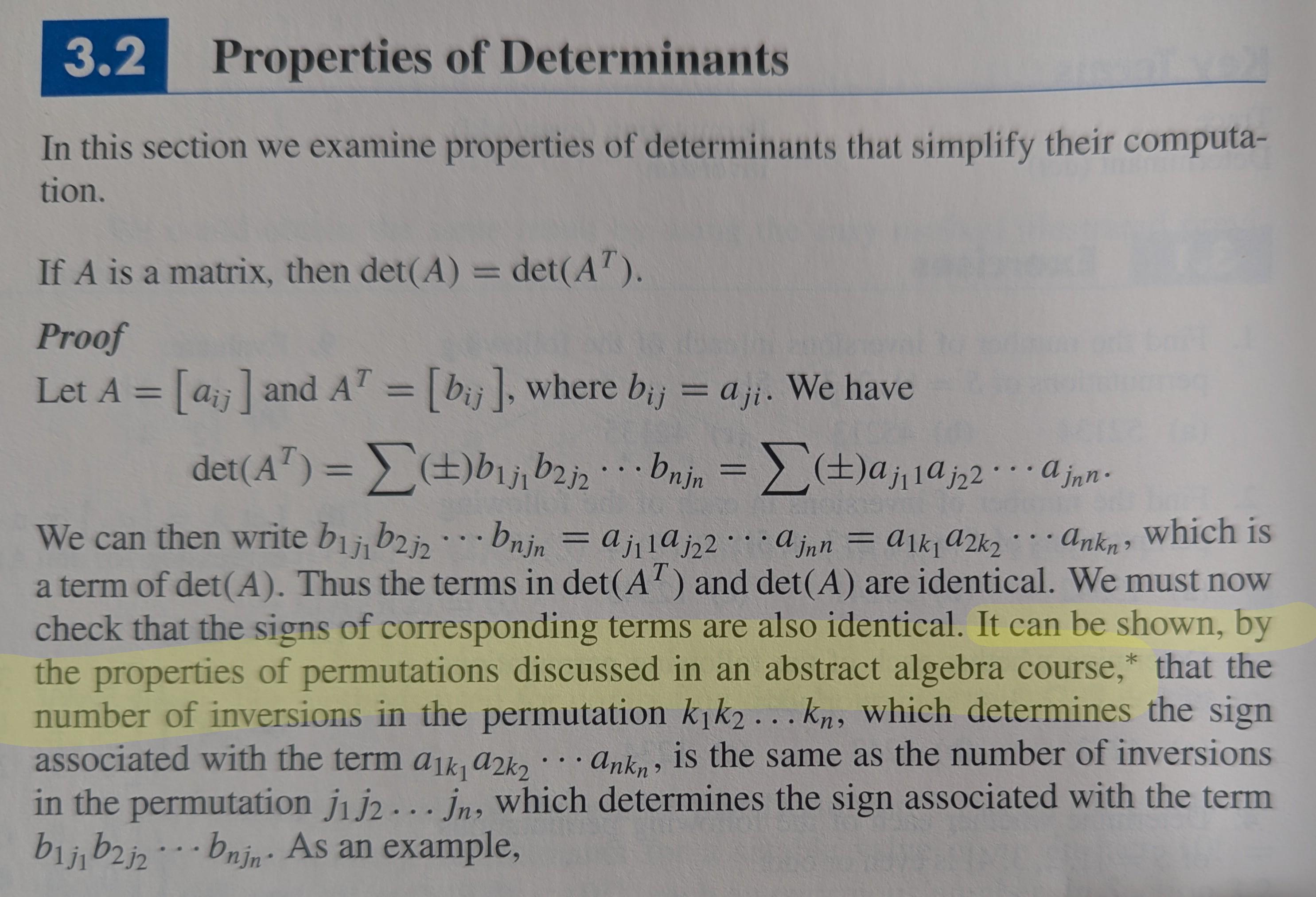
You know that feeling when your linear algebra textbook is almost done proving something, and then suddenly drops "It can be shown, by the properties of permutations discussed in an abstract algebra course,*" with a little asterisk like it's no big deal? That's basically the mathematical equivalent of "trust me bro" but with extra steps and a reading list. The textbook is literally saying "yeah we COULD prove this determinant property right here, but nah—go take an entirely different upper-level math course first." It's the academic version of gatekeeping, except instead of a bouncer at a club, it's your textbook casually suggesting you need another semester of coursework to understand one sentence. Nothing says "simplifying computation" quite like requiring knowledge from a completely different branch of mathematics! The highlighted section is basically math's way of saying "the proof is left as an exercise for the reader" but with more passive-aggressive energy. Classic textbook move.

"Fail To Reject The Null" Are You Kidding Me

"Fail To Reject The Null" Are You Kidding Me
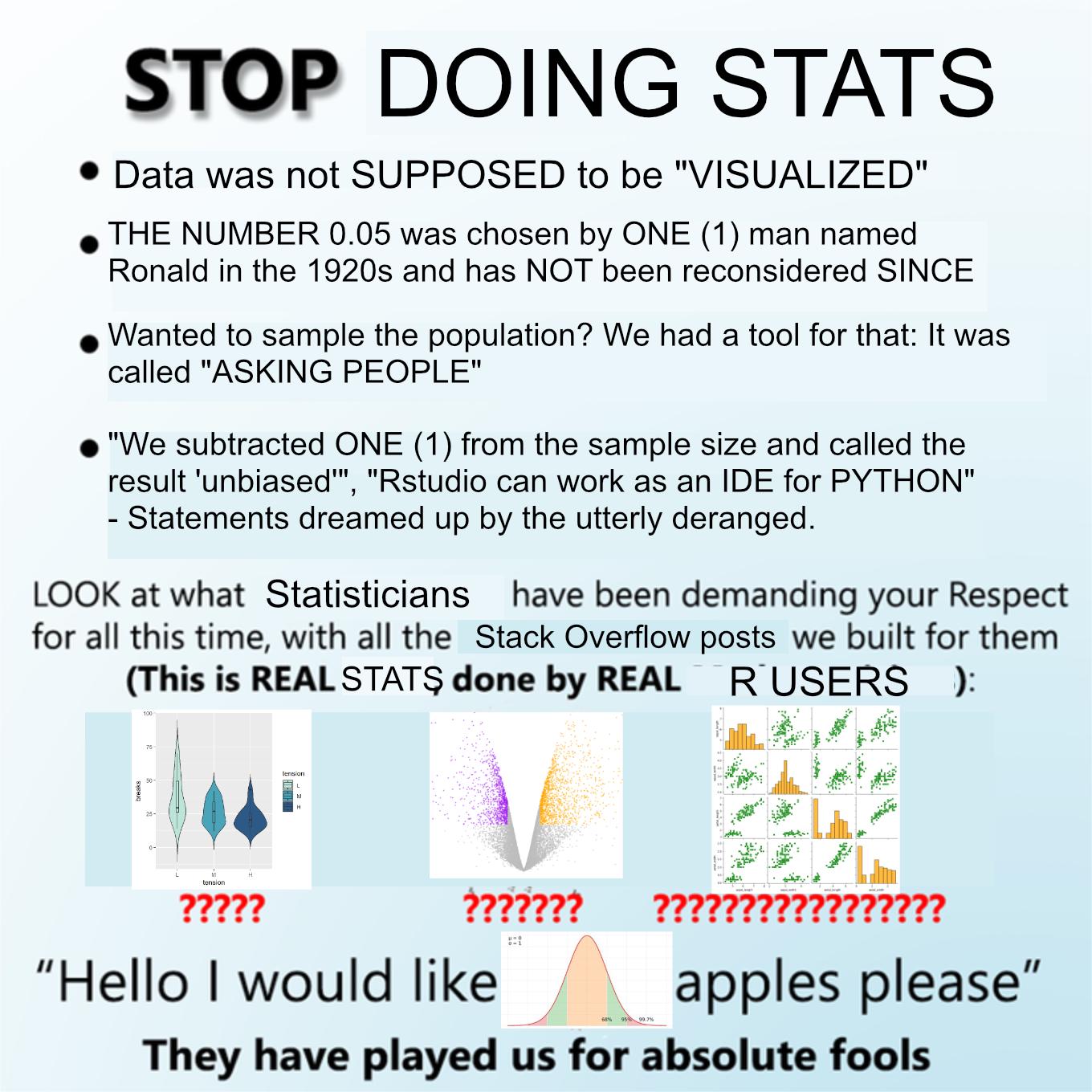
This is the statistician's version of a public roast, and honestly, they deserve it. The meme calls out every frustration non-statisticians have with stats culture: the arbitrary p=0.05 threshold (thanks Ronald Fisher from the 1920s for that legacy), the overcomplicated jargon like "fail to reject the null hypothesis" instead of just saying "no significant difference found," and the obsession with making beautiful visualizations that confuse more than clarify. The real kicker is the bottom section showing what "real R users" actually create—violin plots that look like abstract art, scatter plots that resemble butterfly wings, and correlation matrices so dense they need their own ZIP code. The confused question marks underneath each graph perfectly capture everyone's reaction when statisticians present their "findings." And that final punchline? "Hello I would like apples please" with a simple normal distribution curve. Translation: sometimes people just want straightforward answers, not a PhD thesis on why your methodology is theoretically sound but practically incomprehensible. The statisticians have indeed played us for absolute fools with their fancy graphs and arcane terminology.

Union Of A Family

Union Of A Family
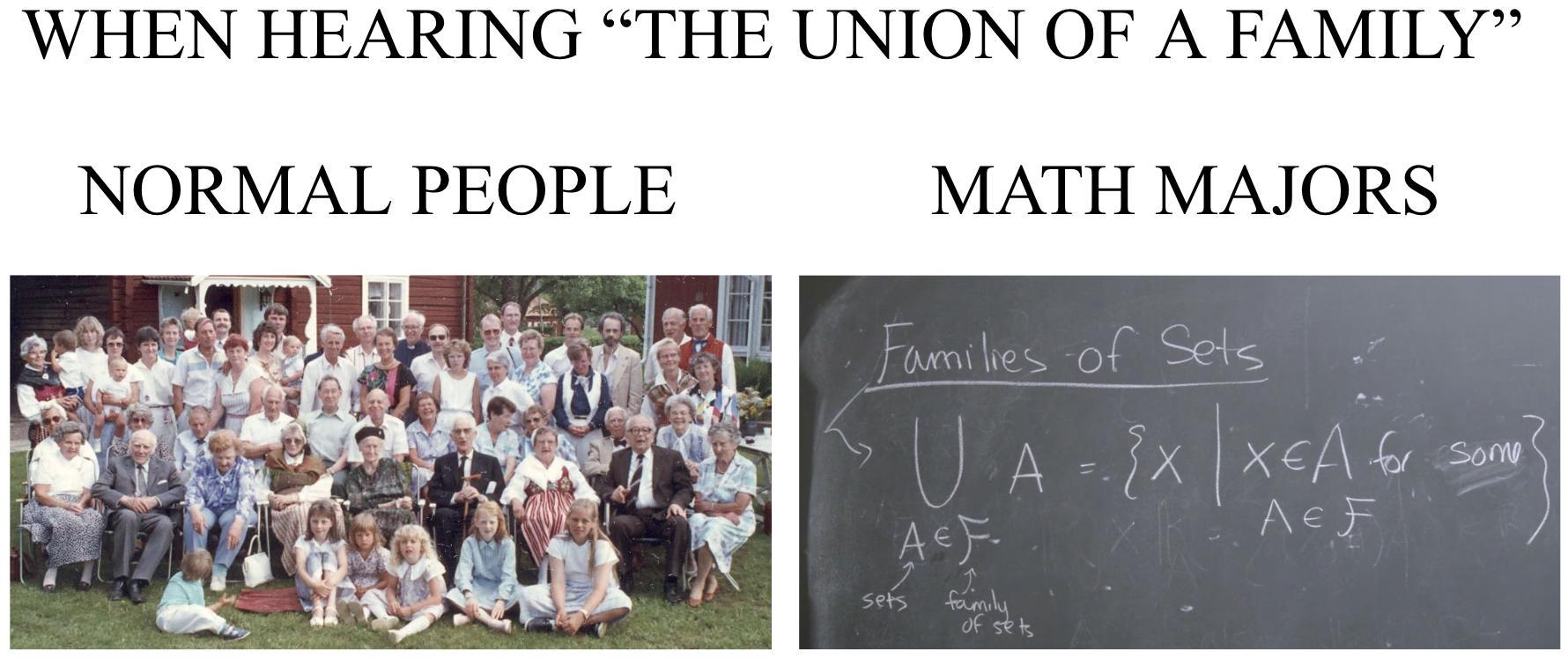
Normal people hear "union of a family" and picture a wholesome gathering with grandma's casserole and awkward small talk. Math majors? They immediately start scribbling set theory notation on the nearest chalkboard. Because why think about actual humans when you can represent them as elements in a mathematical structure? In set theory, a union (∪) combines all elements from different sets into one big happy mathematical family. So while everyone else is passing the mashed potatoes, math students are calculating whether cousin Jimmy belongs to set A or if he's part of the intersection with set B. The "family of sets" notation is just *chef's kiss* perfect—because apparently even families need to be organized into hierarchical mathematical structures. The real tragedy? They're not wrong. A family reunion IS technically a union of sets. But maybe save that observation for after dessert, or you'll be eating alone at the kids' table.

Mathematicians When They Find A Way Around The Rules They Made Up

Mathematicians When They Find A Way Around The Rules They Made Up
Mathematicians really be out here creating entire axiom systems, defining what's "allowed" and what's "forbidden," then spending the next 200 years finding loopholes like they're tax attorneys. "You can't divide by zero? Cool, cool... but what if we just *approach* zero? Checkmate, logic!" They literally invented imaginary numbers because regular numbers weren't cutting it anymore. The self-congratulation energy is off the charts—like awarding yourself a medal for solving a puzzle you created while locked in your own basement. And honestly? Respect. That's some next-level mental gymnastics right there.

The Fun Fact At The Bottom Is An Incredibly Accurate Attack On My Lifestyle

The Fun Fact At The Bottom Is An Incredibly Accurate Attack On My Lifestyle
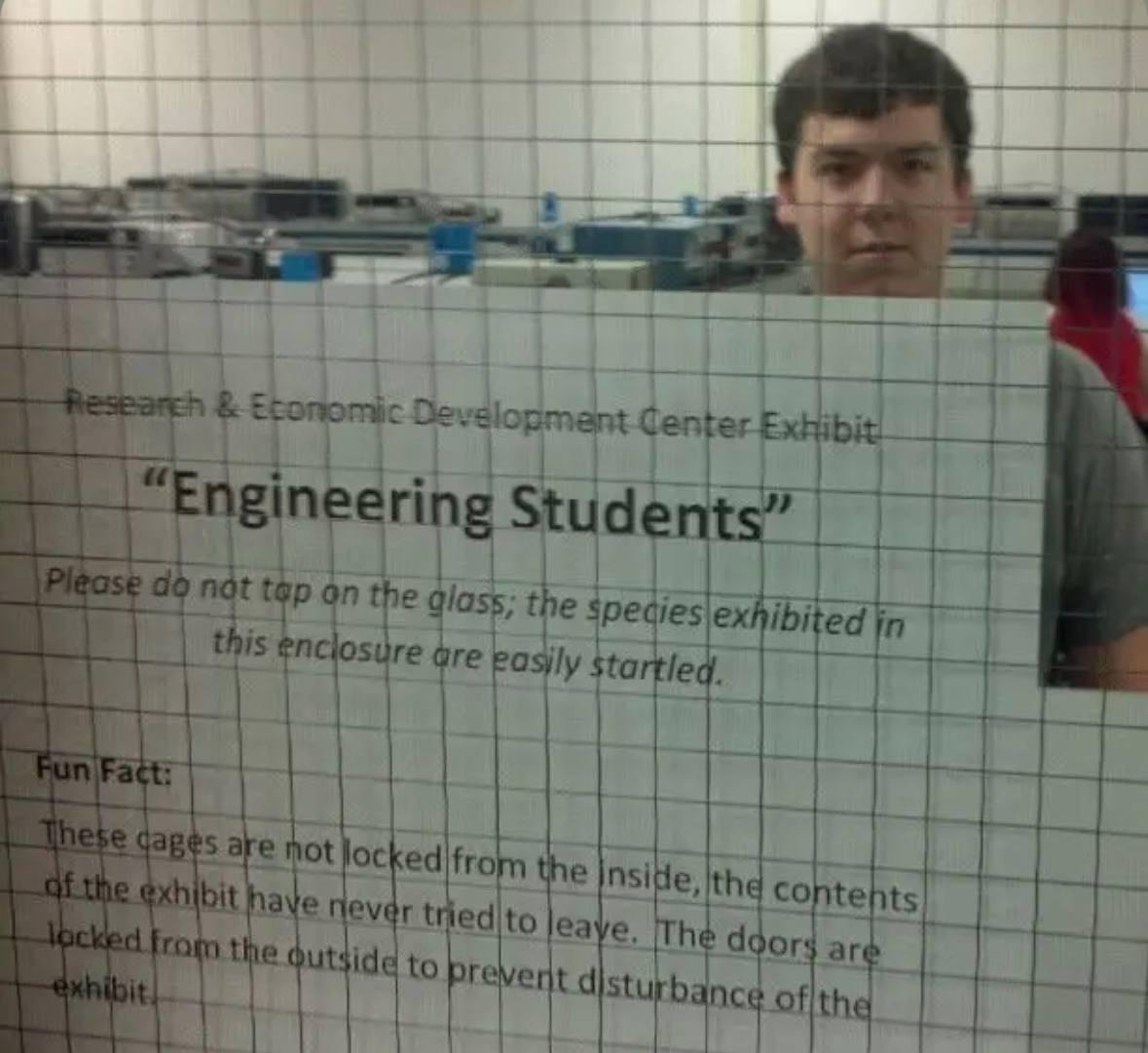
This exhibit sign treats engineering students like zoo animals, complete with behavioral warnings about being "easily startled" by glass tapping. But the real roast comes in the fun fact: the cages aren't locked from the inside because the contents have never tried to escape. The doors are locked from the outside to prevent disturbance. It's a brutal but accurate commentary on engineering student life—voluntarily trapped in labs, workshops, and study rooms, so absorbed in problem sets and projects that escape doesn't even occur to them. The doors are locked not to keep them in, but to keep the outside world from interrupting their natural habitat of CAD software, circuit boards, and caffeine-fueled all-nighters. The self-aware pain in that title really seals the deal.

Wait Till You Learn About Trivial Algepanties

Wait Till You Learn About Trivial Algepanties
Real Analysis mathematicians have spent years mastering epsilon-delta proofs and Lebesgue integration, only to have someone waltz in talking about "Fake Vaginalybro" like it's a legitimate mathematical concept. The sheer audacity of making up nonsense math terms that sound vaguely legitimate is sending them into existential crisis mode. For context: Real Analysis is one of the most rigorous and notoriously difficult branches of mathematics, dealing with limits, continuity, and the foundations of calculus. It's where math students go to question their life choices. So when someone comes in with completely fabricated terminology that sounds like it could be real (because let's be honest, math already has absurd-sounding names like "hairy ball theorem" and "cox ring"), it's both hilarious and mildly offensive to those who've suffered through it. The title reference to "Trivial Algepanties" is chef's kiss—another fake math term playing on "trivial" (math-speak for "obviously easy") and "algebraic topology." It's like watching someone's brain short-circuit in real time.

When You Realize Physics And Math Taught You The Greek Alphabet

When You Realize Physics And Math Taught You The Greek Alphabet
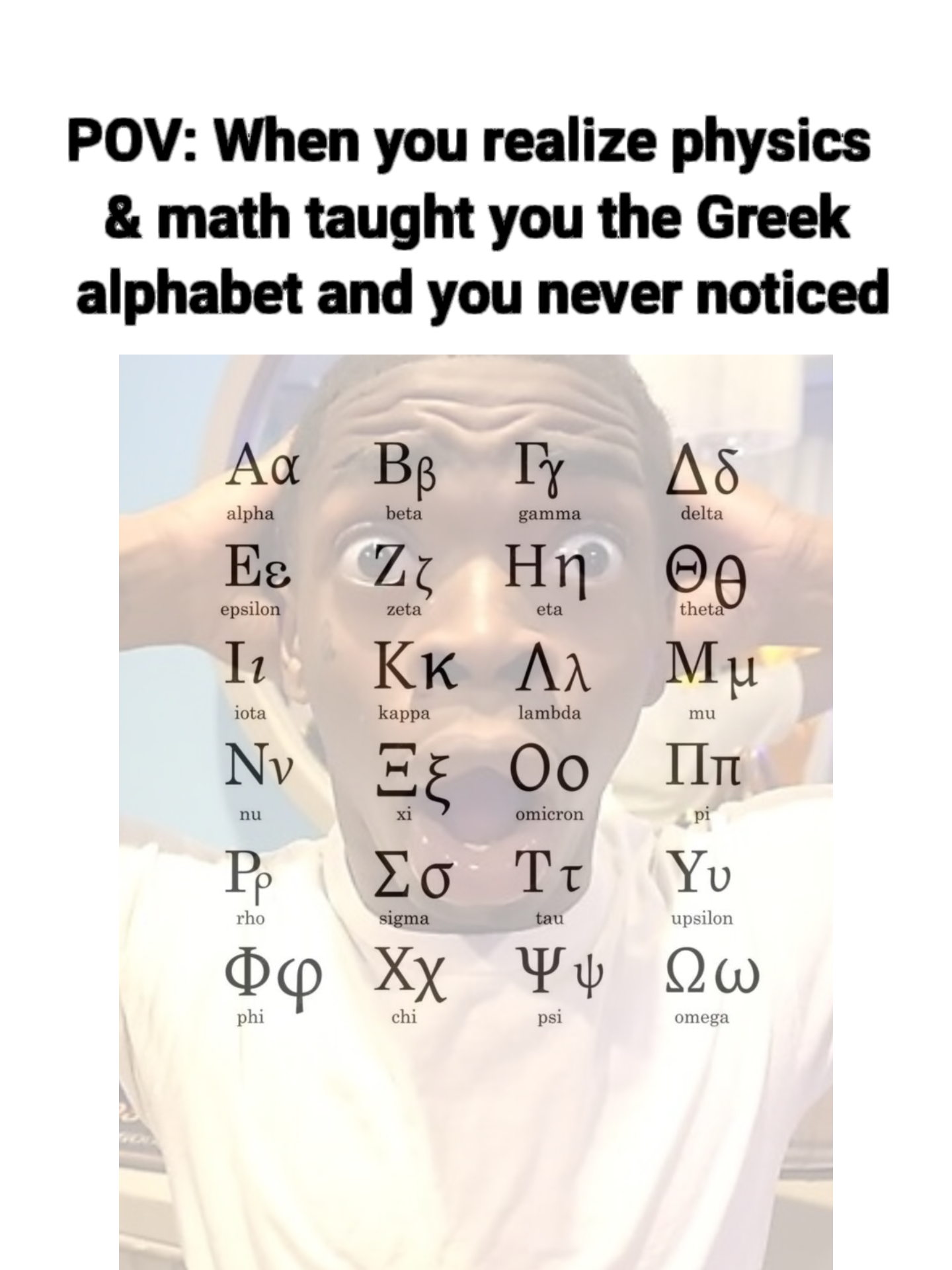
Nobody sits down and actually learns the Greek alphabet in STEM. You just osmose it through years of equations where α is your angle, β is your velocity coefficient, γ is your Lorentz factor, δ is your change in literally anything, and somehow you can recite the whole thing faster than the actual Greek students in your class. You didn't choose to memorize it—physics just kept throwing symbols at you until theta became more familiar than half the Latin alphabet. Now you're out here casually writing ω for angular frequency while still not knowing what xi is supposed to represent because nobody uses that cursed letter anyway.

Organic Chem Exam Scores: You Vs. Linda Walker Be Like...

Organic Chem Exam Scores: You Vs. Linda Walker Be Like...
There's always that one person in organic chemistry who somehow aces the exam while everyone else is barely scraping by. You got 67 out of 800 points and you're crying into your molecular model kit. Meanwhile Linda Walker over here casually pulls a 719 like she's been synthesizing complex molecules since kindergarten. The crying cat perfectly captures that moment when you realize you studied the wrong chapters, mixed up SN1 and SN2 reactions for the fifteenth time, and somehow drew benzene as a hexagon with feelings. Linda probably has a color-coded reaction mechanism notebook and dreams in stereochemistry. The rest of us are just trying to remember which way the arrows go.