
Tier list Memes

Posts tagged with Tier list
Analytical Techniques Tier List

Analytical Techniques Tier List
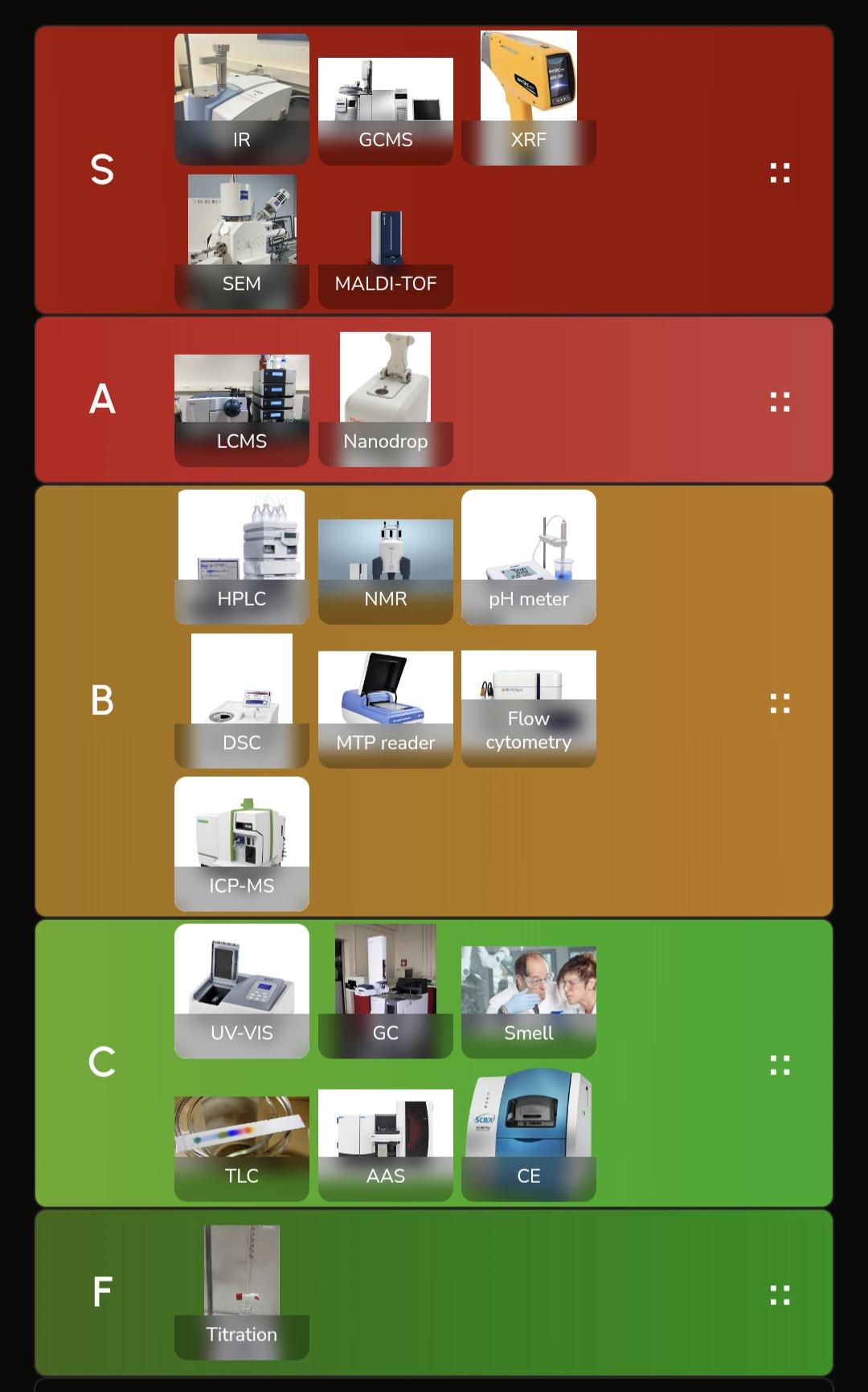
S-tier is reserved for the absolute workhorses of analytical chemistry—IR, GCMS, XRF, SEM, and MALDI-TOF. These are the instruments that make you look like a genius when they actually work, and cost more than a small house when they break. Then we've got A-tier with LCMS and Nanodrop, which are still incredibly powerful but somehow slightly less glamorous. B-tier features the reliable middle children: HPLC, NMR (which honestly deserves higher but probably got downgraded for making chemists wait 3 hours for a spectrum), pH meter, DSC, MTP reader, flow cytometry, and ICP-MS. C-tier is where things get spicy—UV-VIS, GC, and literally just "Smell" as an analytical technique (which, let's be real, organic chemists rely on way too much). Also TLC, AAS, and CE are here, probably because they're effective but nobody's writing home about them. F-tier? Just titration. Sitting alone in analytical chemistry jail. The disrespect is palpable, considering titration is what got most of us through freshman chemistry. But compared to shooting lasers at samples or ionizing molecules, yeah, manually dripping liquid from a burette does feel a bit medieval.

Multiples Of 3

Multiples Of 3
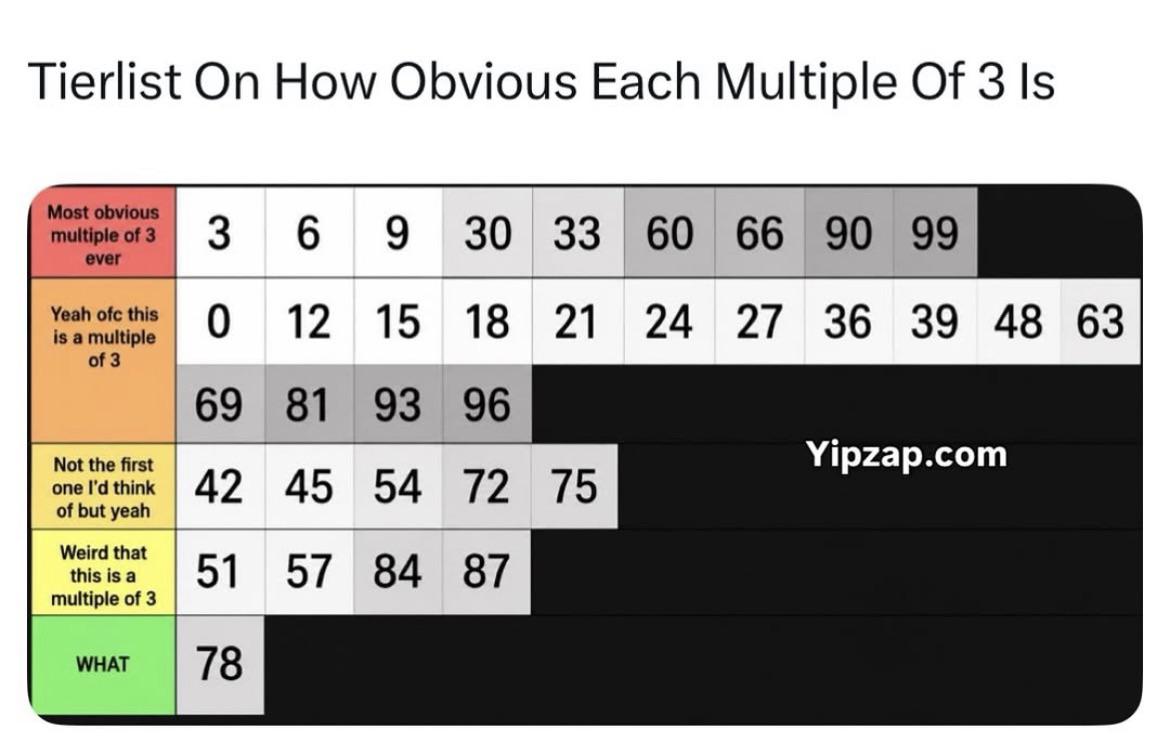
This tier list ranks multiples of 3 by how immediately recognizable they are as divisible by 3. At the top, we've got the heavy hitters like 3, 6, and 9—numbers so obviously divisible by 3 that even your sleep-deprived brain at 3 AM could confirm it. Then there's the "yeah okay" tier with numbers like 12, 15, and 21 where you nod along confidently. But then things get spicy. Numbers like 42 and 54 make you pause for a second—you know they're multiples of 3, but you need that mental confirmation. The "weird that this is a multiple of 3" tier features rebels like 51 and 87, which just feel wrong somehow, like they snuck into the club with a fake ID. And finally, there's 78 in the "WHAT" category. Mathematically, 78 = 26 × 3, but emotionally? It refuses to cooperate with our pattern-seeking brains. The number just radiates chaotic energy, like it's divisible by 3 purely out of spite. Pro tip: A number is divisible by 3 if the sum of its digits is divisible by 3. For 78: 7 + 8 = 15, and 15 ÷ 3 = 5. Science (well, math) doesn't lie, even when your intuition screams otherwise.

Ranking Every Digit In Graham's Number

Ranking Every Digit In Graham's Number
The joke is that Graham's number is so incomprehensibly, mind-bendingly MASSIVE that the tier list for ranking its digits is completely empty! It's like trying to count the number of times your professor says "um" during a lecture—except Graham's number has more digits than there are particles in the observable universe. SQUARED. THEN RAISED TO THAT POWER AGAIN. Even if you spent your entire life writing down just ONE digit per second, you wouldn't even make a microscopic dent in it. The universe would experience heat death, be reborn, and die again approximately 10^100 times before you finished. The tier list is empty because ranking every digit would be like trying to name every grain of sand on every beach... on every planet... in every galaxy... in every universe in the multiverse!

How Tf Did This Dude Get 4 Atoms Of Oganesson

How Tf Did This Dude Get 4 Atoms Of Oganesson
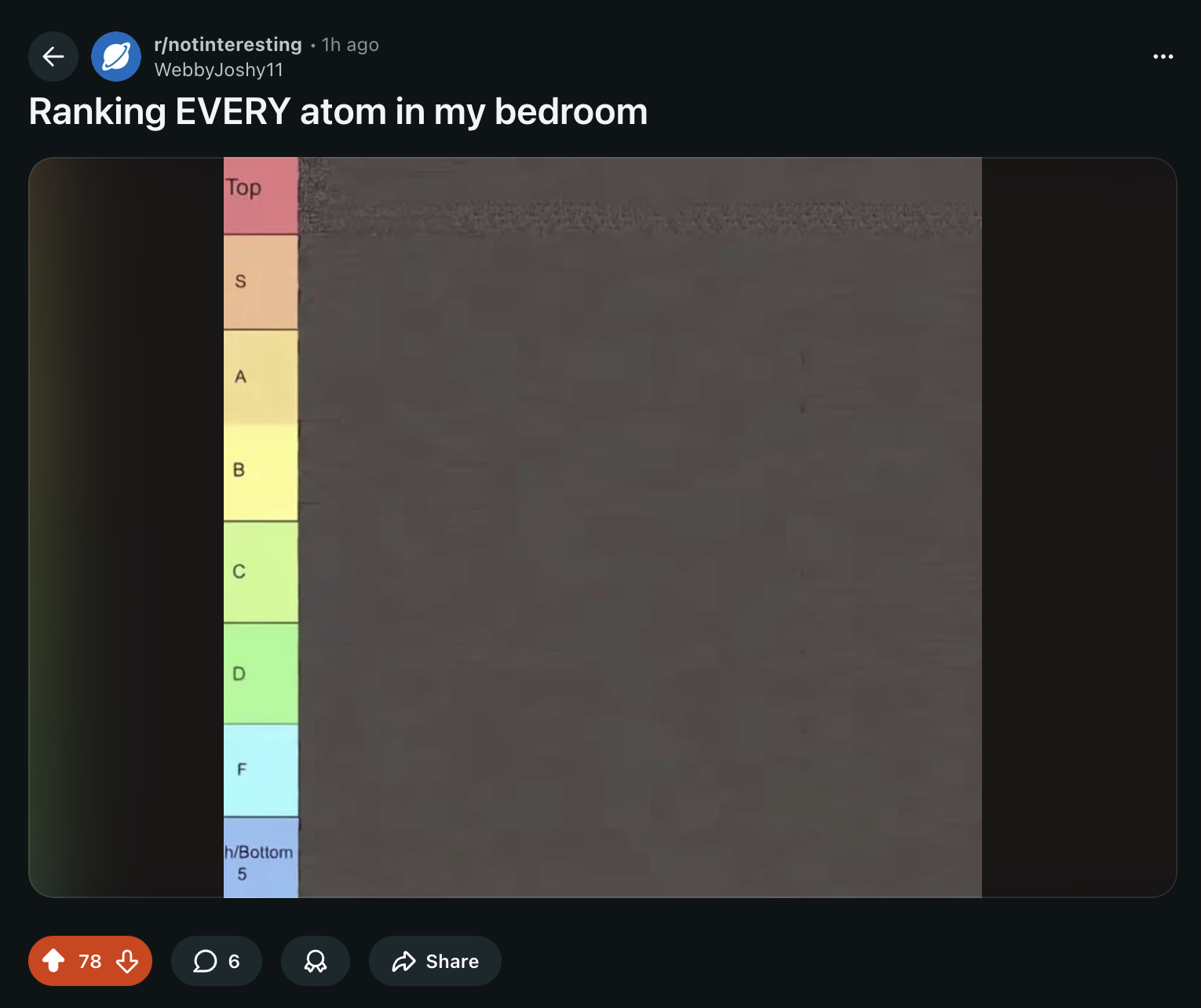
The absurdity of finding Oganesson in a bedroom is what makes this hilarious! Oganesson (Og) is element 118 - the heaviest known element on the periodic table with a half-life of less than a millisecond. Scientists have only ever created a few atoms of it using particle accelerators and specialized equipment costing millions of dollars. Meanwhile, this person casually ranks it in their bedroom tier list like it's just hanging out between their PlayStation and laundry hamper. That would be like saying "yeah, I keep my pet black hole in the sock drawer" - physically impossible and utterly ridiculous for anyone with even basic chemistry knowledge!

Mathematical Constants Tier List

Mathematical Constants Tier List
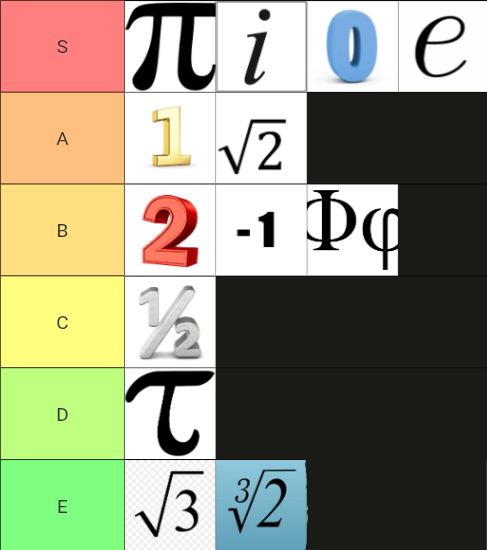
Mathematical elitism at its finest! Someone created a tier list ranking mathematical constants from S-tier (godlike) to E-tier (barely making the cut). π, i , 0, and e get the royal treatment in S-tier, while poor √3 and ∛2 are relegated to the basement of mathematics. The creator clearly has strong opinions about which numbers deserve respect in the mathematical universe. Imagine being the number 1/2 and seeing yourself in C-tier while π gets another moment in the spotlight. Talk about numerical discrimination! I bet √2 is filing a formal complaint about being stuck in A-tier despite being irrational royalty.

Periodic Table Taste Test

Periodic Table Taste Test
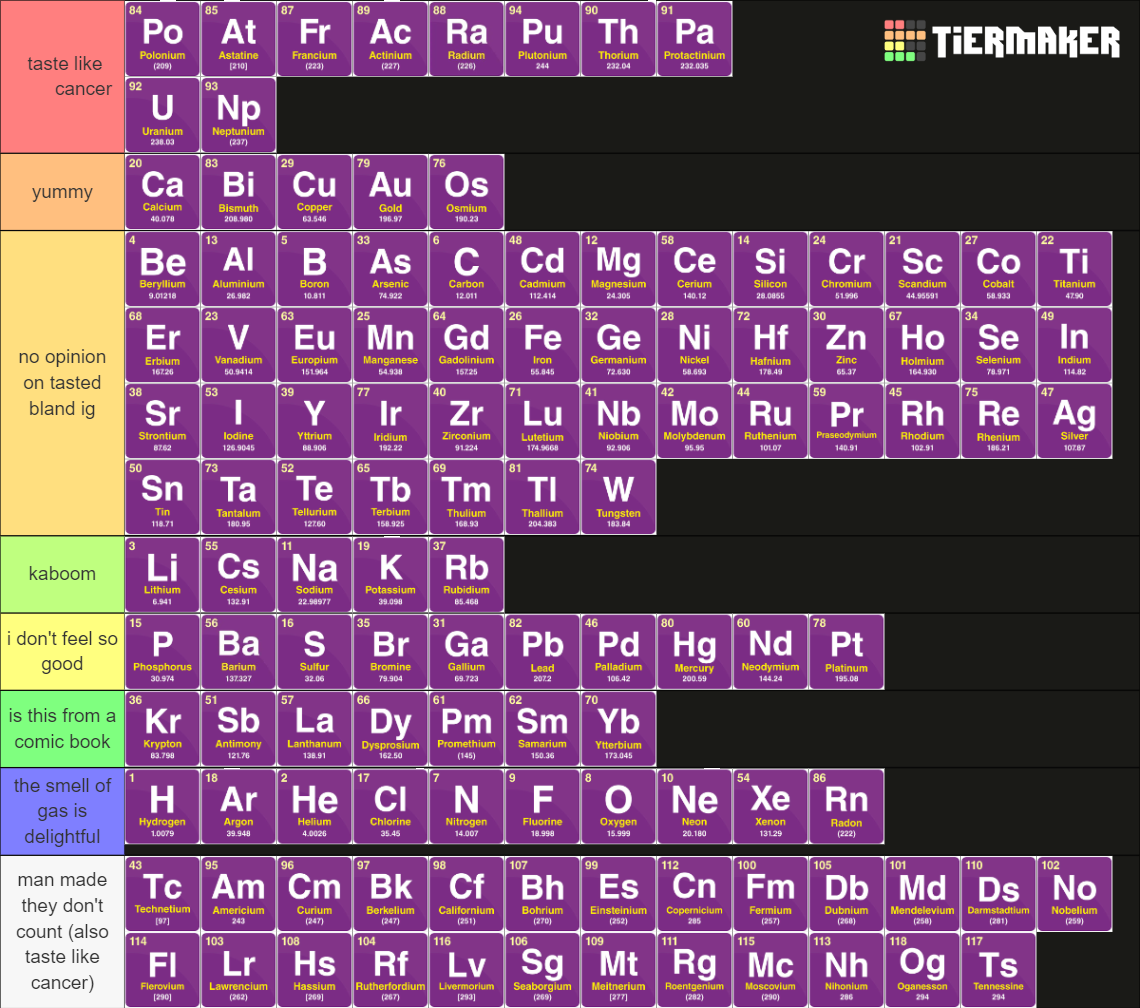
Someone's been licking the periodic table again. Apparently polonium has that distinctive "tastes like cancer" bouquet, while alkali metals go "kaboom" on the tongue. The noble gases? "Delightful" aroma, naturally. This is what happens when chemists work through lunch. For the record, calcium and gold being categorized as "yummy" explains why your expensive supplements and fancy desserts both leave that metallic aftertaste. And those synthetic elements at the bottom? They don't count because they're man-made, but they'd give you cancer anyway. Science is just spicy cooking with extra steps.

Periodic Table Taste Test: The Forbidden Snack Guide

Periodic Table Taste Test: The Forbidden Snack Guide
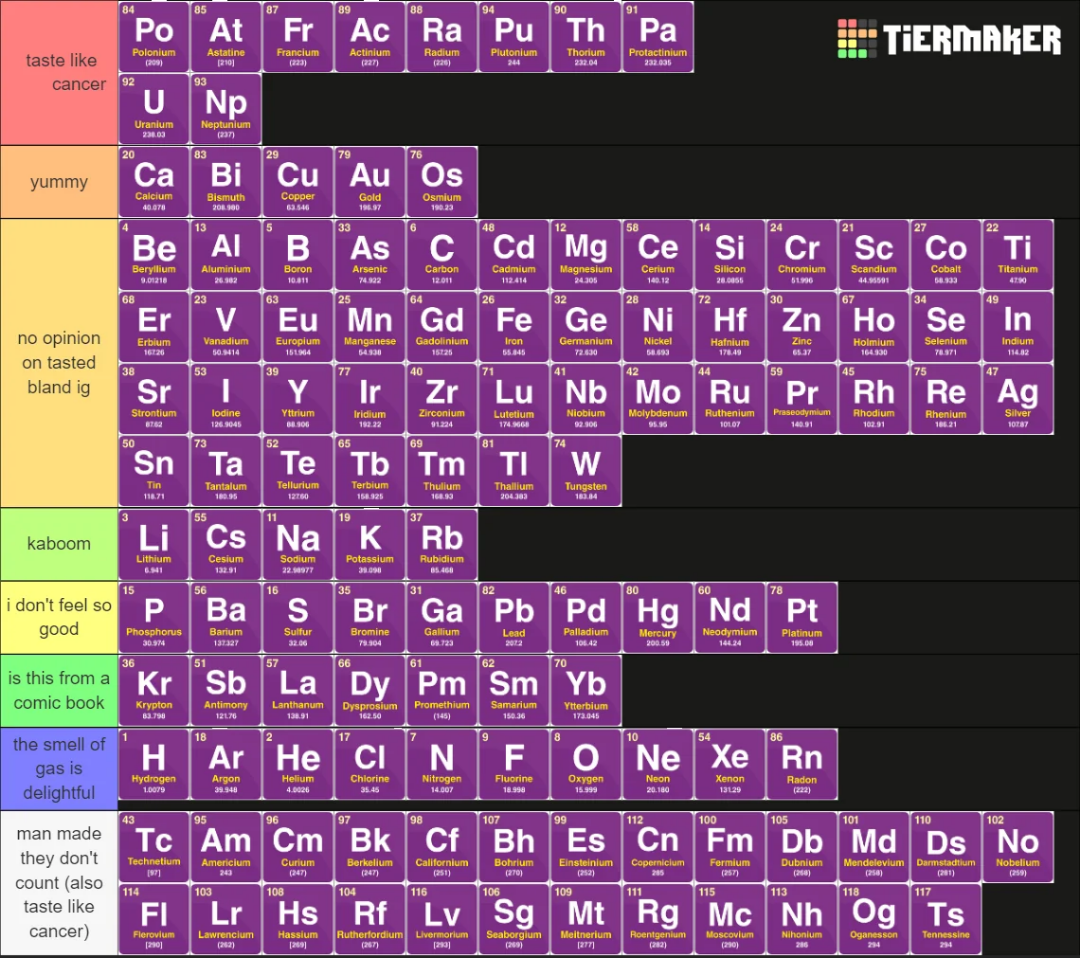
The only tier list that comes with a side of radiation poisoning and a hospital stay. Top tier has all the radioactive elements because apparently cancer has a distinctive flavor profile. Meanwhile, calcium and gold are "yummy" - which explains why medieval alchemists kept trying to eat their experiments. The alkali metals are labeled "kaboom" because nothing says delicious like a violent reaction with your saliva. And let's appreciate the honesty of "I don't feel so good" tier - mercury and lead are indeed mood killers. Pro tip: if you're wondering whether something from the periodic table is edible, the answer is almost always "please don't." This is basically the chemistry version of those "forbidden snack" memes, except following this guide would actually end your subscription to living.

Ranking Every Planet I Visited

Ranking Every Planet I Visited
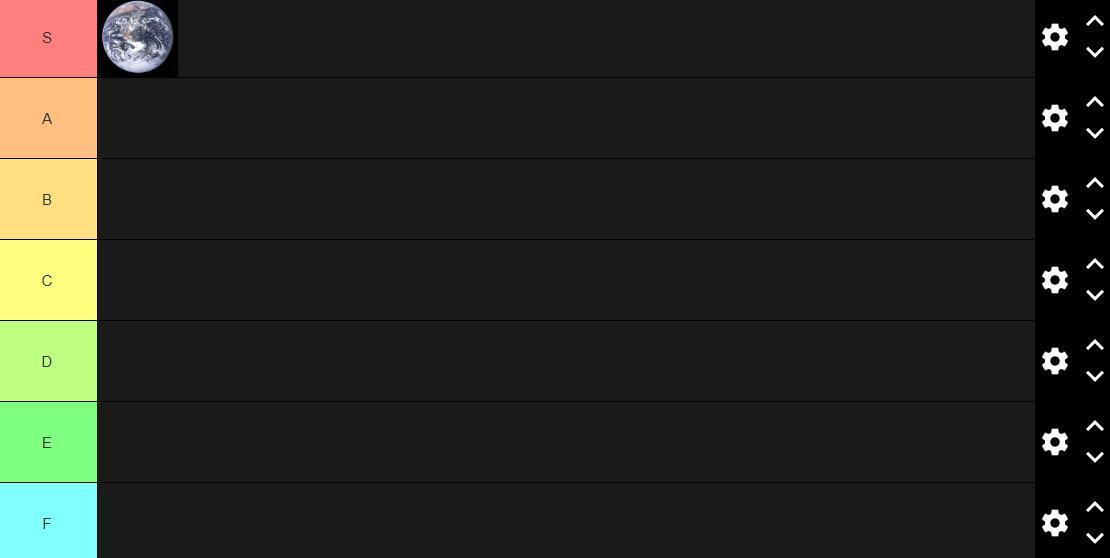
The ultimate travel review that nobody asked for! This meme shows Earth getting an "S-tier" ranking in a list that's suspiciously empty of other planets. Talk about a biased reviewer! 😂 It's the cosmic equivalent of rating restaurants when you've only ever eaten at one place. "5 stars for Earth - great atmosphere, decent water supply, and the only planet where my species evolved to survive!" The empty slots for other planets are sending me! Like we're all just waiting for that Mars vacation to finally post our review. "B-tier: Dusty. No oxygen. Robot roommates kept beeping at me."

My Tier List Of Derivative Rules

My Tier List Of Derivative Rules
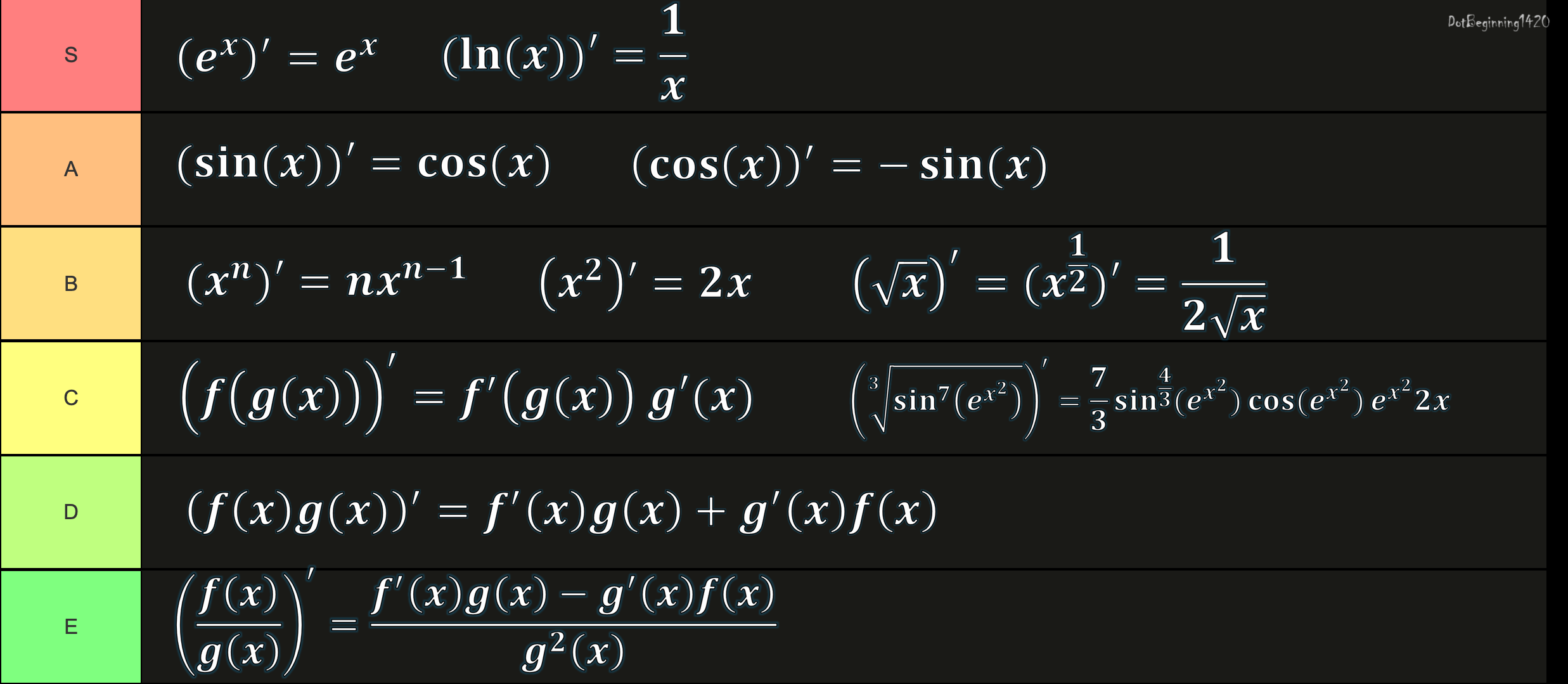
Behold! The sacred hierarchy of calculus suffering! 🧪 The exponential and logarithm rules sitting pretty in S-tier because they're basically showing off—differentiating themselves! Meanwhile, that chain rule in C-tier with its nested functions is the mathematical equivalent of Russian nesting dolls designed by a sadist. And don't get me started on the quotient rule in E-tier... it's the calculus version of "I heard you like fractions so I put fractions in your fractions." Every math student knows the true tier list is based on how many tears were shed per formula!

My Tier List Of Trigonometric Identities

My Tier List Of Trigonometric Identities
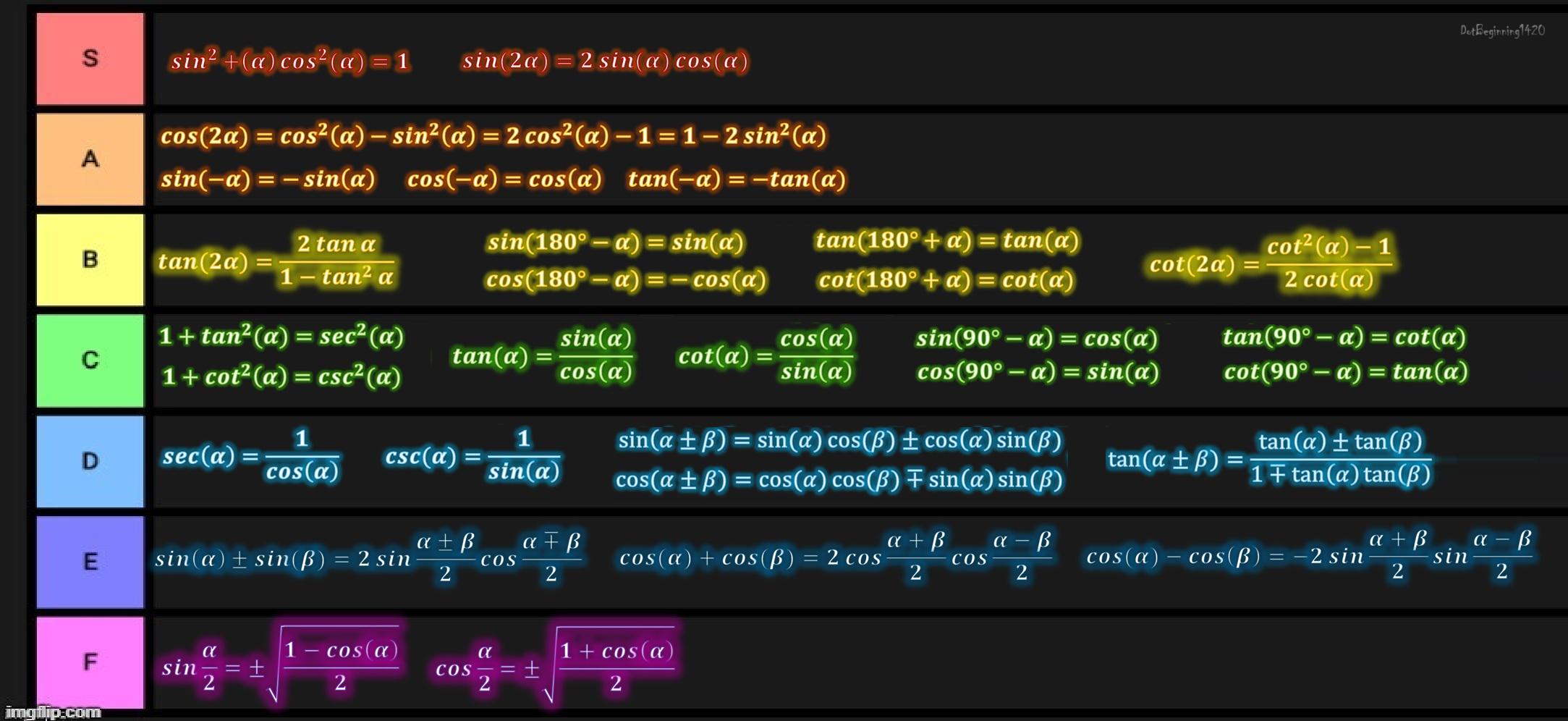
Every math student's secret obsession: ranking trigonometric formulas like they're characters in a fighting game! The Pythagorean identity (sin²α + cos²α = 1) sitting at S-tier is just *chef's kiss* - the formula that saves your homework when all else fails. Meanwhile, those half-angle formulas at F-tier are like the math equivalent of that one friend who shows up to the party with complicated board games nobody wants to play. The true hierarchy of mathematical suffering, beautifully organized by trauma level!

I Have Ranked The Optimal Packings

I Have Ranked The Optimal Packings
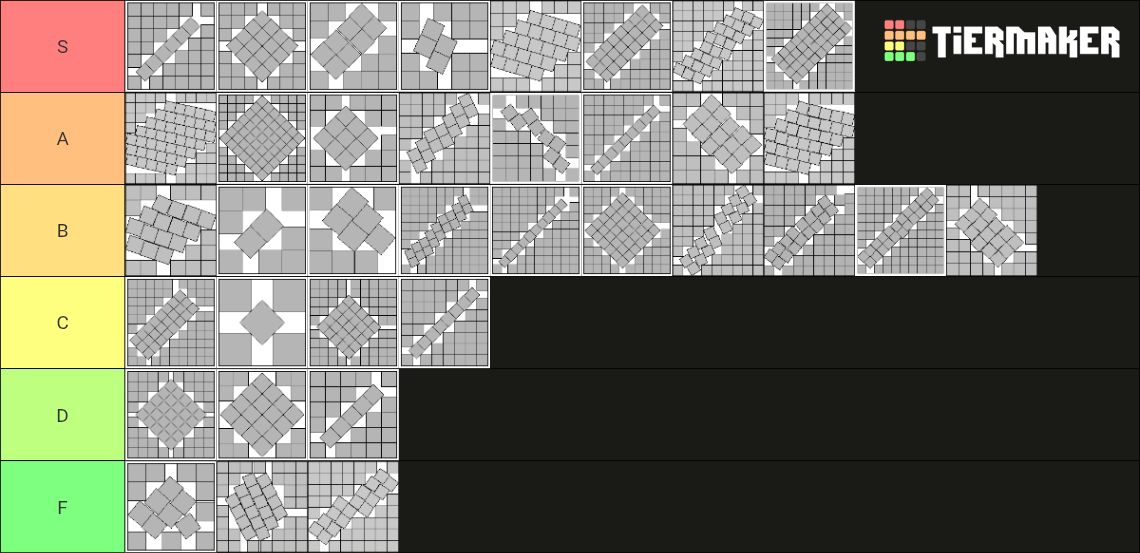
Someone finally did the hard science we've all been waiting for. This tier list ranks various square/diamond packing arrangements by efficiency, and frankly, I'm relieved we can finally settle the age-old debate of optimal tessellation patterns. The S-tier arrangements clearly maximize space utilization while the F-tier patterns would make any mathematician physically ill. This is the kind of research that keeps crystallographers up at night and makes materials scientists feel things. Next up: ranking hexagonal close-packing vs. cubic close-packing, but that might be too controversial for the internet.

Trig Functions Tier List: The Math Hierarchy

Trig Functions Tier List: The Math Hierarchy
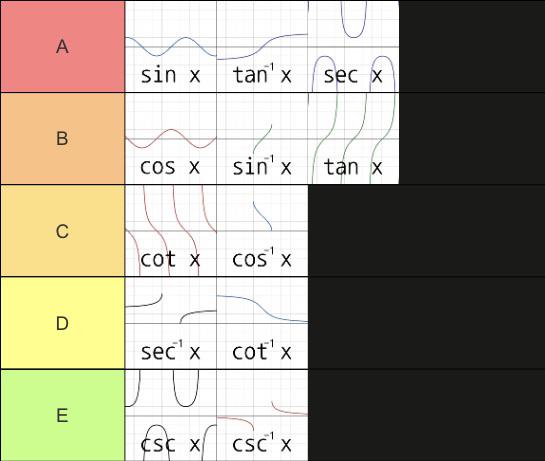
The mathematical elitism is strong with this one! Someone ranked trigonometric functions like video game characters, and the hierarchy is brutal. Sine gets S-tier treatment while cosecant is banished to E-tier purgatory. Let's be honest - nobody has voluntarily calculated a cosecant since high school. The creator clearly has favorites, and the smooth, well-behaved sine wave gets all the love while the functions with asymptotes and discontinuities get tossed into the mathematical basement. This is what happens when mathematicians have too much free time between proofs.