
Sun Memes

Posts tagged with Sun
But At Least I'm Vibing, I Guess

But At Least I'm Vibing, I Guess
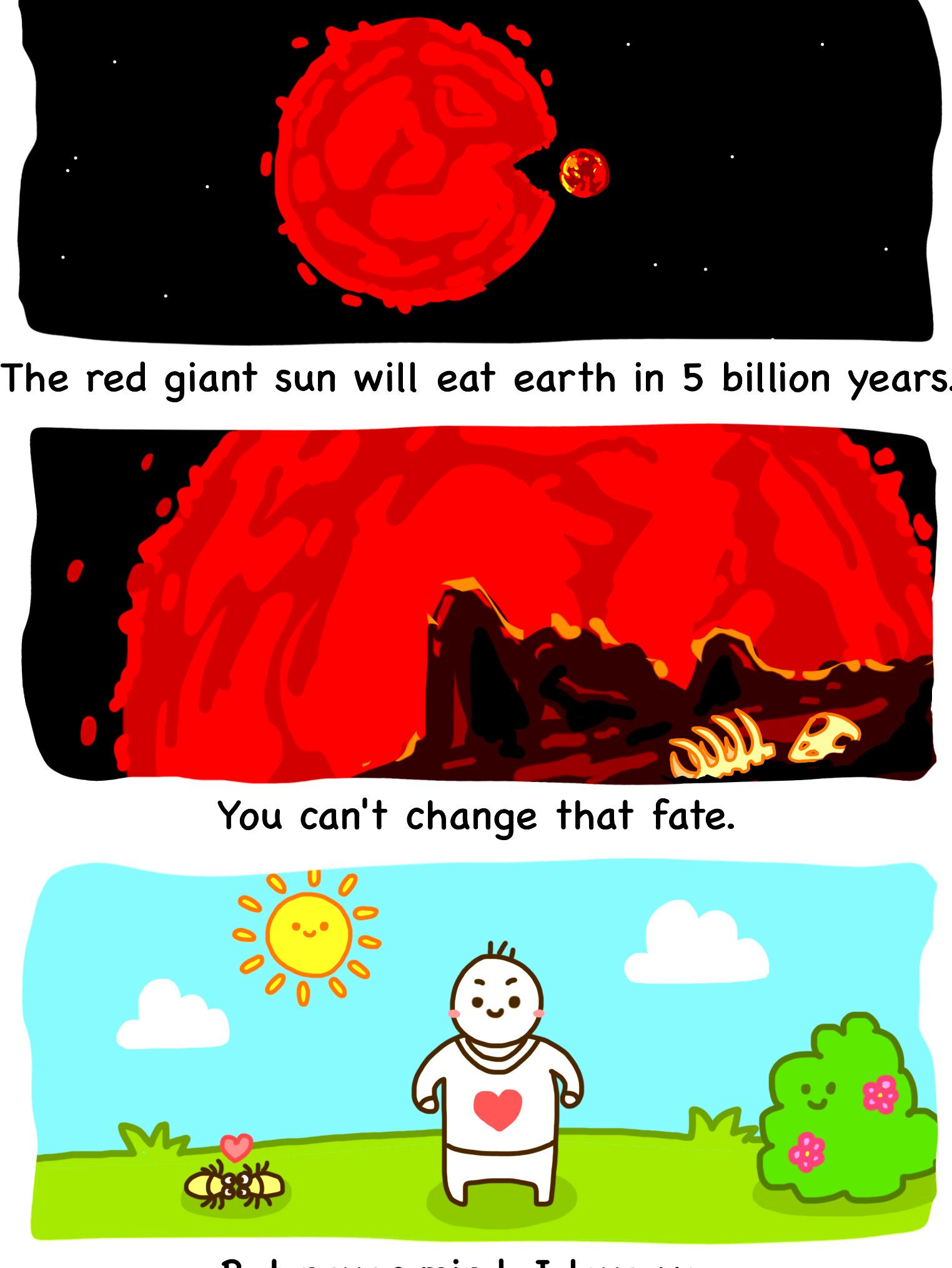
This meme captures the beautiful absurdity of human existence in the face of cosmic inevitability. In about 5 billion years, our Sun will expand into a red giant and engulf Earth, turning everything into vaporized particles. That's a scientific certainty. Can't negotiate with stellar evolution, can't file a complaint with physics. But here's the thing: instead of spiraling into existential dread, the meme pivots to a wholesome little dude just... existing. Enjoying the sunshine. Appreciating the flowers. Living his best life despite the universe's long-term plans for planetary annihilation. It's the ultimate "live in the moment" philosophy backed by astrophysics. Sure, the Sun will eventually betray us in the most dramatic way possible, but that's billions of years away. Right now? Touch grass. Smell flowers. The heat death of our planet can wait.

Just Look Up At The Sun For Some Tips & Tricks

Just Look Up At The Sun For Some Tips & Tricks
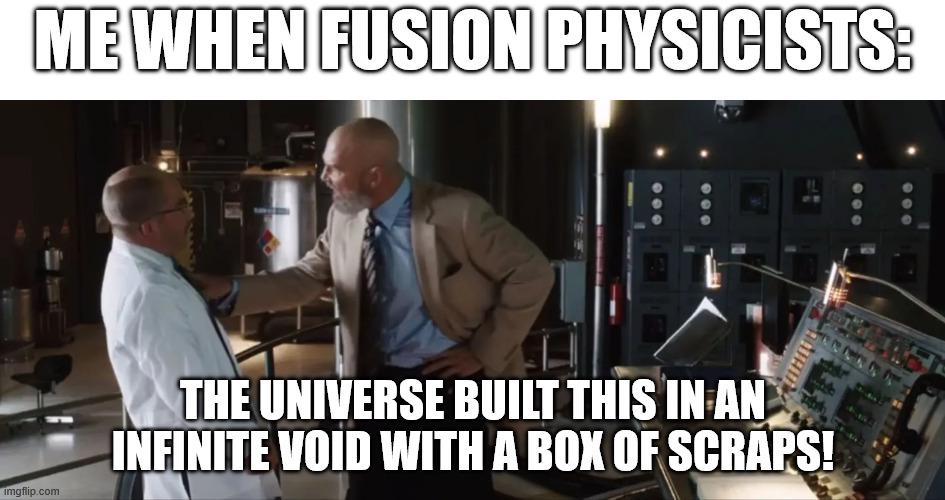
So fusion physicists are out here trying to recreate what the Sun does effortlessly every nanosecond—smashing hydrogen atoms together at 15 million degrees to release clean energy. Meanwhile, they're working with billion-dollar tokamaks, superconducting magnets, and plasma containment systems that look like they were designed by aliens on a budget. The Sun? Just vibing in space with gravity doing all the heavy lifting. No fancy equipment, no grant proposals, no peer review. Just raw gravitational pressure and 4.6 billion years of experience. It's like watching someone solve a Rubik's cube in 3 seconds while you're still peeling off the stickers. The real kicker? We're literally trying to bottle a star with duct tape and dreams while the universe already has 100 billion of them running perfectly fine. Nature's ultimate flex.

My Favorite Temperature Is The Highest One

My Favorite Temperature Is The Highest One
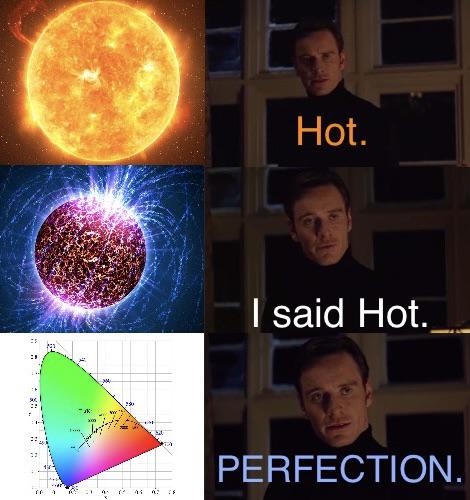
The escalating standards of a physicist who won't settle for anything less than chromatic perfection! First panel shows our Sun (a mere 5,778 K) labeled "Hot." Not impressed enough, the second panel shows a neutron star (potentially billions of degrees) and he's still demanding "I said Hot." Only when presented with the complete chromaticity diagram—the mathematical representation of all perceivable colors—does he finally reach satisfaction. Classic physicist behavior: regular thermodynamic heat isn't enough, theoretical color temperature is the real flex. This is what happens when you let someone with a PhD control the office thermostat.

It Has Just A Little More Hydrogen Than Us...

It Has Just A Little More Hydrogen Than Us...
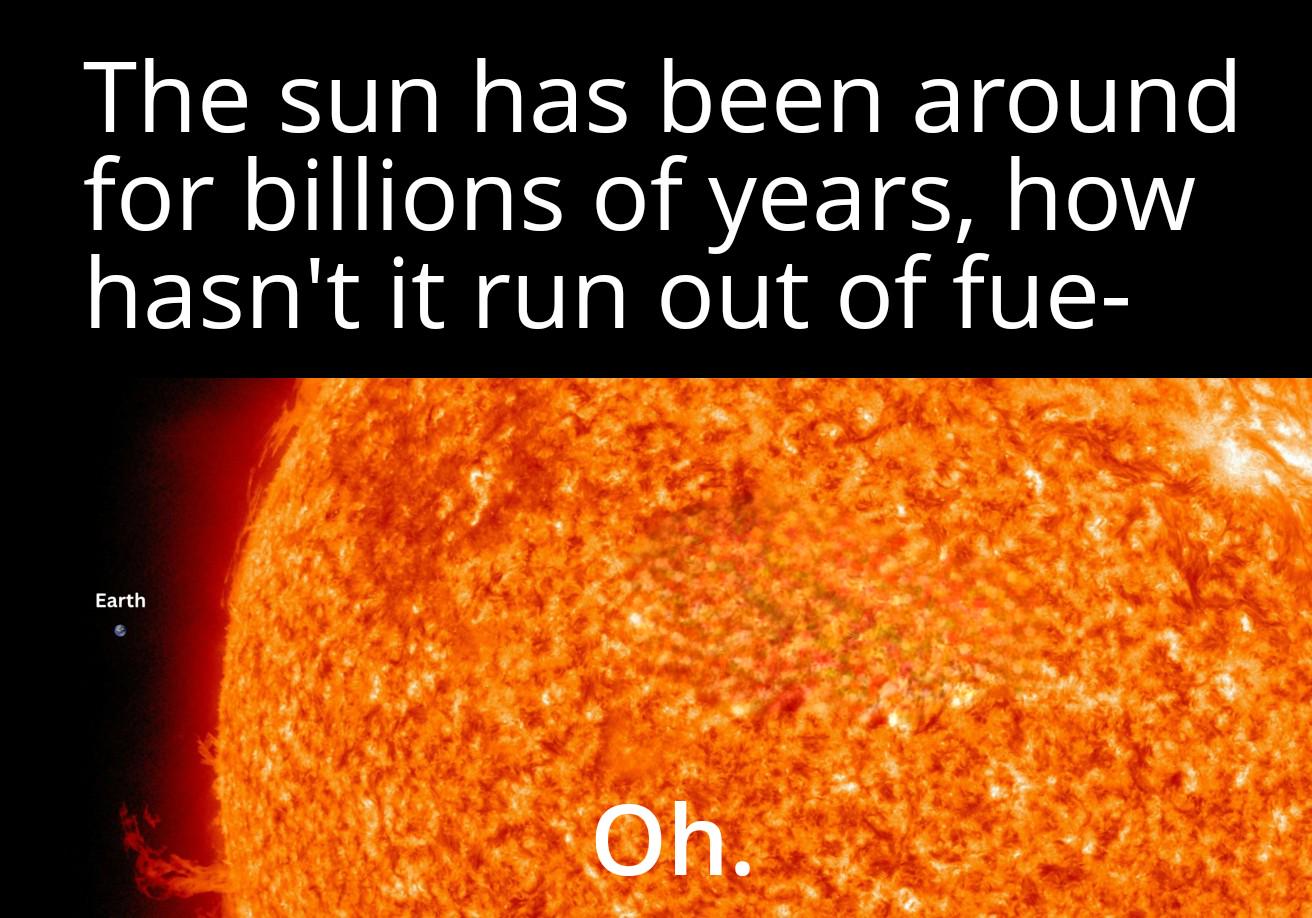
The classic "Oh" moment when you realize the sun isn't burning like your campfire, but rather fusing hydrogen into helium in a massive thermonuclear reactor. That awkward silence when someone discovers nuclear fusion doesn't "use up fuel" the same way their car does. The sun just casually converts 600 million tons of hydrogen into energy every second and has enough to last another 5 billion years. Meanwhile, I'm rationing coffee beans until payday.

When Celestial Bodies Break The Rules

When Celestial Bodies Break The Rules
Hold onto your telescopes, space cadets! This cosmic comedy gets the celestial positioning hilariously wrong! In a lunar eclipse, the Earth blocks sunlight from reaching the Moon. In a solar eclipse, the Moon blocks sunlight from reaching Earth. But that third scenario? If the Moon somehow ended up BETWEEN the Sun and Earth while still visible from Earth? That's not astronomy—that's the laws of physics having an existential crisis! The universe would be playing celestial billiards with our solar system! No wonder they labeled it "apocalypse"—it's literally impossible unless someone's been messing with the cosmic remote control!

The Sun's Unsolicited Fusion Flex

The Sun's Unsolicited Fusion Flex
The Sun, just sitting there in space, casually turning 600 million tons of hydrogen into helium every second without anyone asking. Nuclear fusion so intense it's literally visible from 93 million miles away. Meanwhile, humans struggle to keep fusion reactors running for more than a few seconds without them exploding. The Sun's been flexing on us for 4.6 billion years and plans to continue this unnecessary power move for another 5 billion. Such a show-off.

Happy Cosmic Treadmill Day!

Happy Cosmic Treadmill Day!
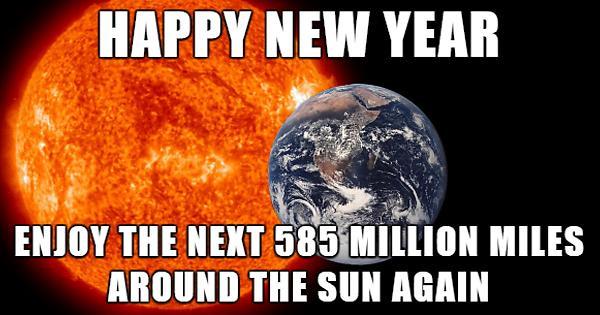
Nothing says "cosmic perspective check" quite like remembering our New Year celebrations are just marking another arbitrary point in Earth's 585-million-mile cosmic treadmill routine. The universe doesn't care about your resolutions—we're all just passengers on a rock hurling through space at 67,000 mph while circling a giant nuclear fusion reactor. So pop that champagne! You've completed another meaningless orbit that we've collectively decided to celebrate because humans need to feel special in an indifferent cosmos. Cheers to astronomical insignificance!

Eight Minutes Of Blissful Ignorance

Eight Minutes Of Blissful Ignorance
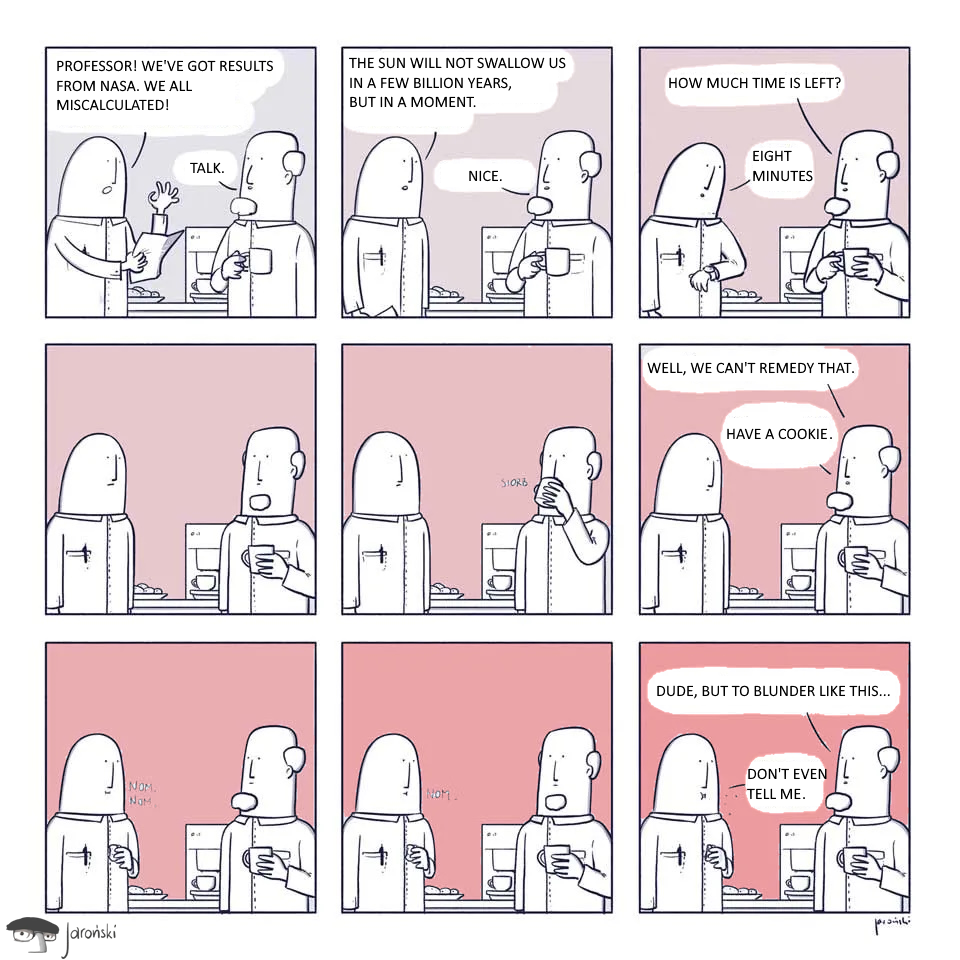
The existential comedy here is peak astrophysics humor! Light from the Sun takes approximately 8 minutes to reach Earth, so if the Sun suddenly disappeared or went supernova, we'd continue existing in blissful ignorance for those 8 minutes before the catastrophic effects hit us. These scientists just realized they miscalculated something major about the Sun's stability, but there's literally nothing they can do except... offer a cookie? The perfect representation of scientific fatalism - when you discover an extinction-level event and all that's left is gallows humor and snacks. At least they'll get to finish their coffee before the solar radiation hits!

If The Sun Is Bigger Than Pluto, Why Isn't Sun A Planet?

If The Sun Is Bigger Than Pluto, Why Isn't Sun A Planet?
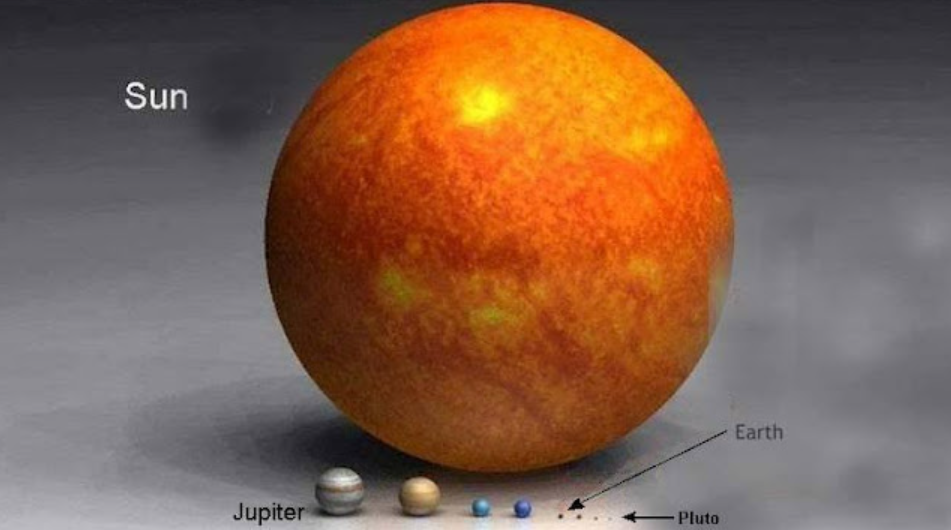
Someone's been skipping their astronomy lectures. The image shows an orange (labeled "Sun") next to some smaller fruits/objects (planets), with Pluto being practically microscopic. Size isn't the determining factor for planethood—otherwise my department head's ego would qualify as a celestial body. Stars are massive balls of plasma undergoing nuclear fusion, while planets are just rocky/gaseous objects orbiting stars. By this logic, I should ask why my coffee mug isn't classified as a teacup despite being larger than my colleague's teacup. The astronomy department would have a collective aneurysm reading this.

The Sun's Existential Crisis

The Sun's Existential Crisis
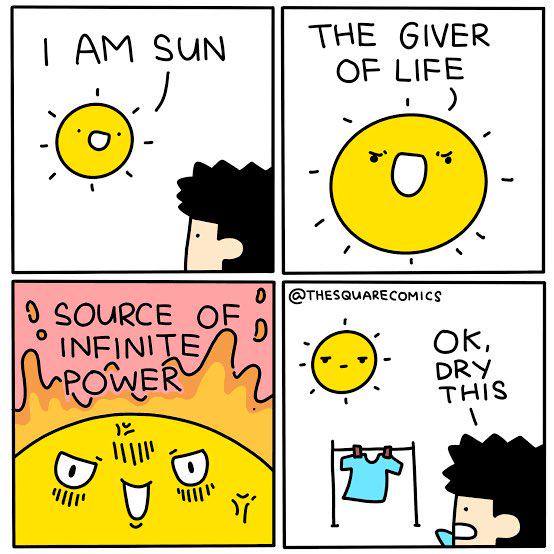
The cosmic irony of human-sun interactions! While the sun's over there having an identity crisis - "I'm the giver of life! Source of infinite power!" - humans just want to dry their laundry. Talk about putting a nuclear fusion reactor in its place! The sun provides 173,000 terawatts of energy to Earth continuously, powers photosynthesis, drives our climate... and we're like "thanks for drying my t-shirt, bro." Sometimes even celestial bodies need a reality check!

Rated M For Melanoma

Rated M For Melanoma
The meme juxtaposes anime character preferences (1-3) with option 4: literally just the sun. Dermatologists everywhere are nodding grimly. While you're busy selecting your preferred anime personality type, the sun is silently plotting your skin's demise with UV radiation. That fiery ball of plasma doesn't need to dominate you or ask permission—it's already bombarding your epidermis with enough radiation to alter your DNA. Melanoma doesn't care about your waifu preferences. Pro tip from someone who's spent too many hours under lab fluorescents: SPF 30+ is the only relationship with the sun worth having.

K-Stars Are The Best Stars

K-Stars Are The Best Stars
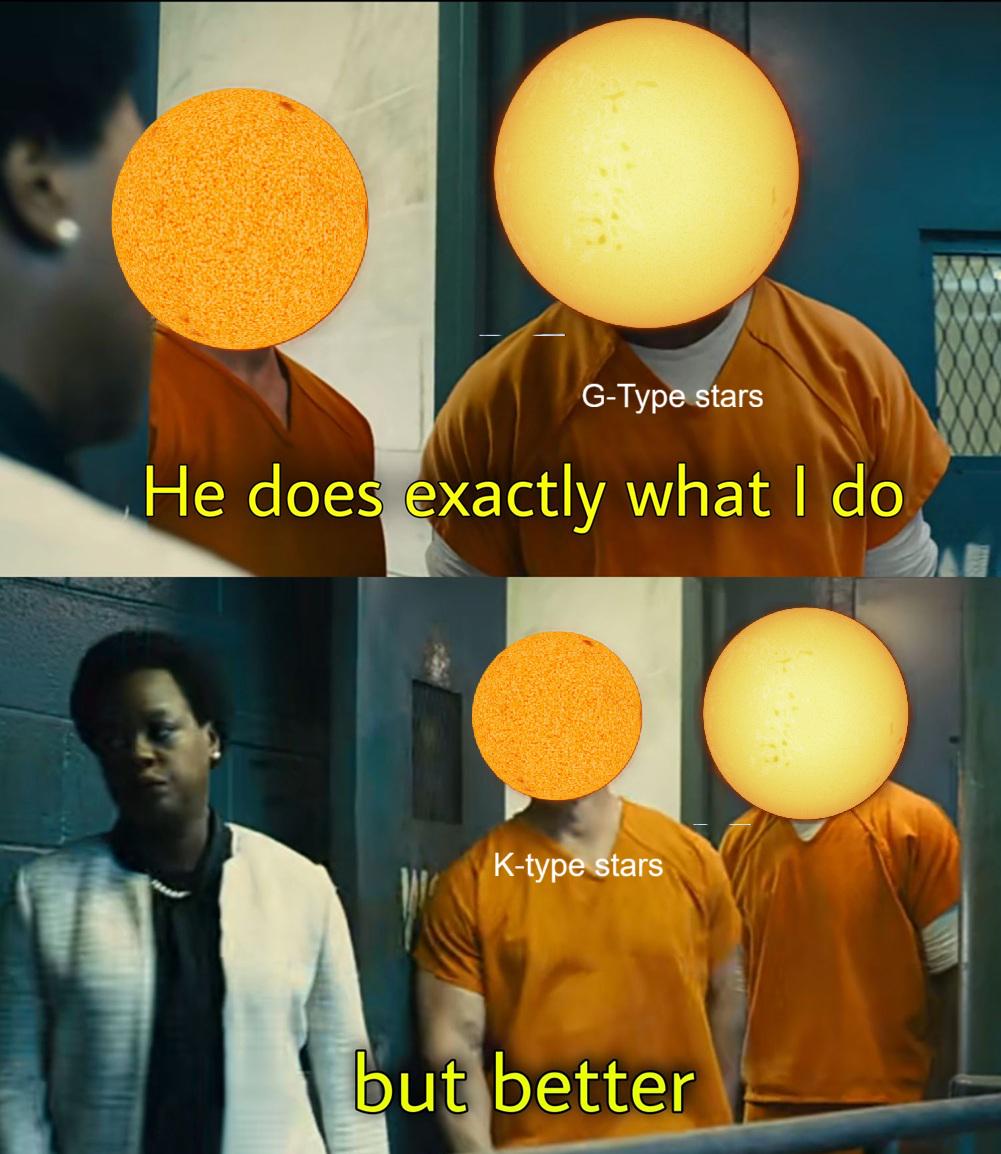
Stellar classification humor at its finest! G-type stars (like our sun) think they're hot stuff, but K-type stars are basically saying "hold my beer." While G-types get all the fame for hosting Earth, K-types are actually more stable, live longer, emit less harmful UV radiation, and might be better candidates for habitable planets. It's like comparing that flashy professor who publishes in Nature once and never shuts up about it versus the quiet workhorse who actually gets meaningful research done. The astronomical equivalent of "same job description, superior performance review."