

Stability Memes

Posts tagged with Stability
They Be Feeling Tuff

They Be Feeling Tuff
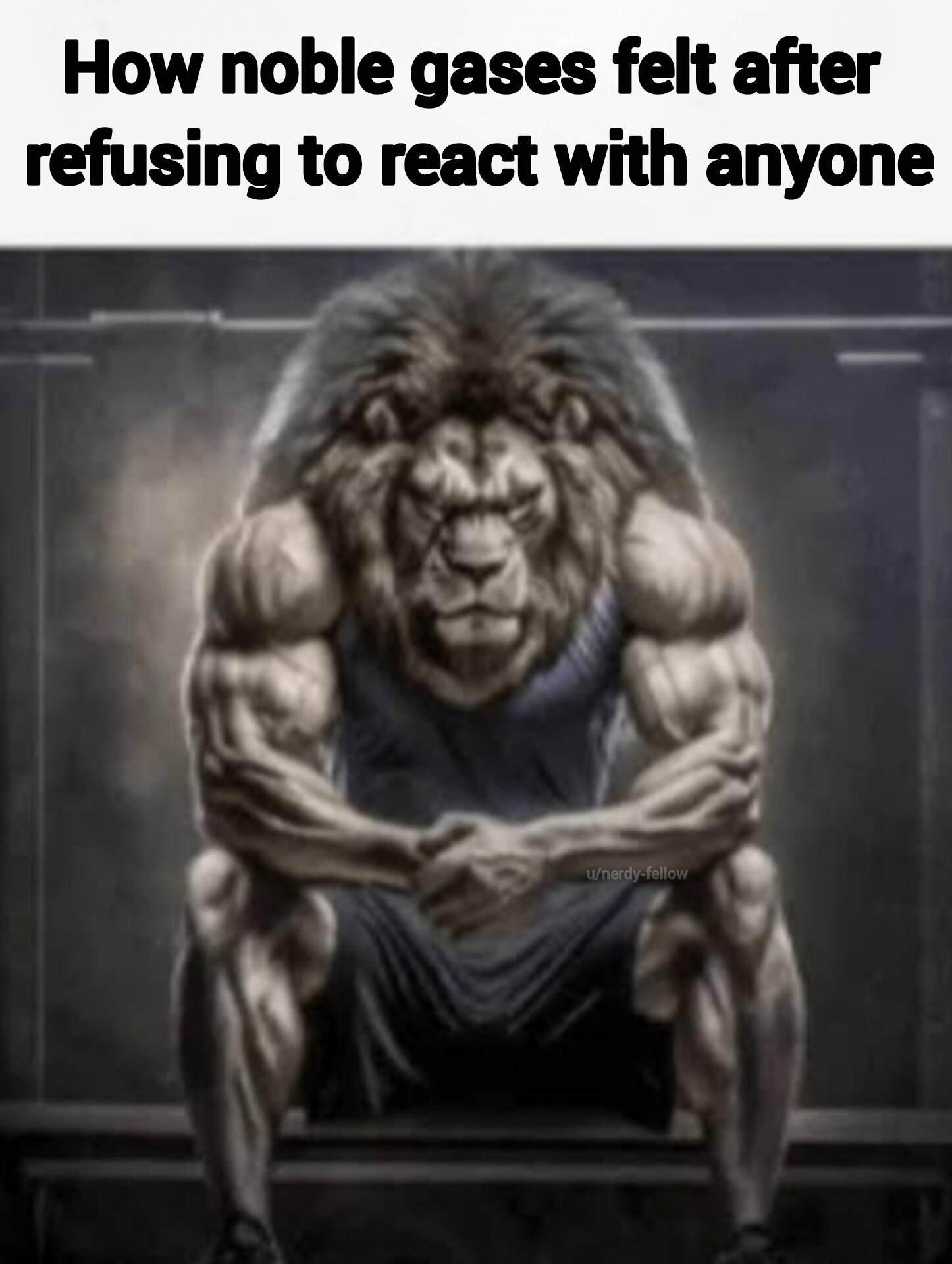
Noble gases really out here acting like they're too cool for school. These elements—helium, neon, argon, krypton, xenon, and radon—have completely filled outer electron shells, which makes them chemically stable and almost completely unreactive. They're literally sitting there with their perfect electron configuration like "nah, we're good" while every other element is desperately trying to bond and share electrons. The buff lion perfectly captures their energy. They've achieved what every element dreams of: complete stability without needing anyone else. While oxygen is out here ripping electrons from everything in sight and sodium is exploding at the mere sight of water, noble gases are just vibing in their lane, completely unbothered. They're the introverts of the periodic table who already have everything they need and aren't interested in your chemical reactions, thank you very much. Fun fact: it took scientists forever to even get noble gases to react with anything because they're THAT stubborn. When xenon compounds were first synthesized in 1962, it was considered groundbreaking because everyone thought it was impossible!

Ma Taught Me Nobility!

Ma Taught Me Nobility!
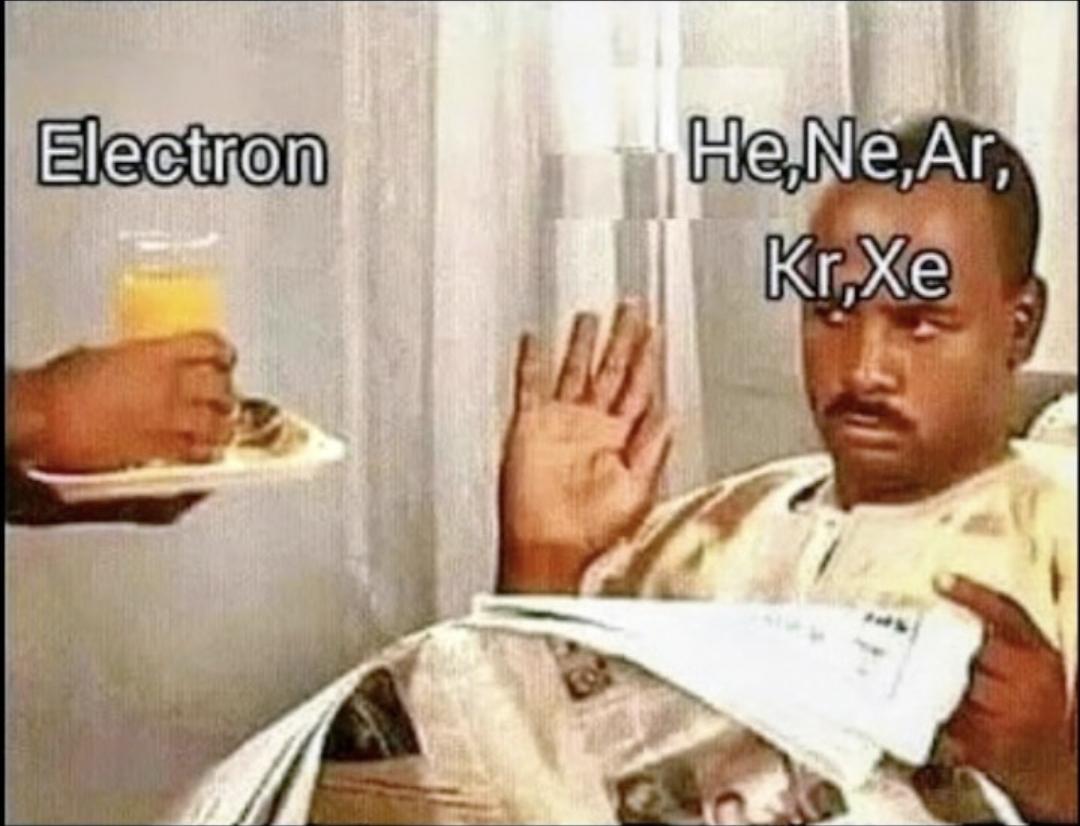
When your electron friend tries to introduce you to their sketchy reactive buddies but you're just sitting there with your full outer shell like "nah, I'm good." The noble gases (He, Ne, Ar, Kr, Xe) are basically the introverts of the periodic table—completely stable, unreactive, and perfectly content being alone because they've already got that complete octet life figured out. Meanwhile, that electron is out here desperately trying to bond with literally anyone who'll share or steal it. Noble gases are the ultimate "thanks but no thanks" energy in chemistry form. They literally won't react with anything under normal conditions because they're already living their best life. It's giving "I don't need drama, I'm already complete" vibes.

Or Electrons

Or Electrons
You'll be waiting a while . Protons are ridiculously stable—so stable that if they do decay, their half-life is estimated to be at least 10³⁴ years. That's about a trillion trillion trillion times longer than the current age of the universe. Scientists have literally built massive underground detectors filled with thousands of tons of water just to catch a single proton potentially decaying, and so far? Nothing. Zero. Nada. Meanwhile, electrons are theoretically stable forever according to charge conservation laws, so good luck with those too. This skeleton's got more patience than every grad student waiting for their PI's email combined.

The Struggle For Stability Is Real

The Struggle For Stability Is Real
Two electron orbitals walk into a bar... The 3d 4 orbital is having an existential crisis while the 4s 2 orbital is just trying to be helpful. What we're witnessing is basically electron donation in its natural habitat. Transition metals are notorious for this drama - shuffling electrons between orbitals like some atomic soap opera. The 3d orbital needs one more electron to reach that sweet half-filled stability, and 4s is like "fine, take one of mine." Chemistry doesn't get more passive-aggressive than this. Nobel committee, I'll be waiting for my call.

Benzene's Existential Crisis

Benzene's Existential Crisis
Benzene's got that "dead inside" look because it's too stable for its own good. Despite its reputation as a reactive bad boy, those six carbon atoms are locked in a perfect resonance ring—basically chemistry's version of existential ennui. It's like the tenured professor who's seen it all: "Sure, I could burst into flames, but what's the point when I've achieved aromatic stability?" That's the irony—the compound that should be wild is actually just sitting there, resonating with disappointment.

Neutrons For The Win

Neutrons For The Win
Nuclear redemption arc in progress. Highly radioactive isotopes start as unstable troublemakers, emitting radiation all over the place. But after sufficient decay, they often end up as stable lead—the nuclear equivalent of retiring from a life of crime. The half-life transformation from dangerous to inert is basically the atomic version of a reformed bad boy. Just don't mention their wild uranium days.

Are You Sure You Can Convince A Noble Gas To Give Up Its Electrons?

Are You Sure You Can Convince A Noble Gas To Give Up Its Electrons?
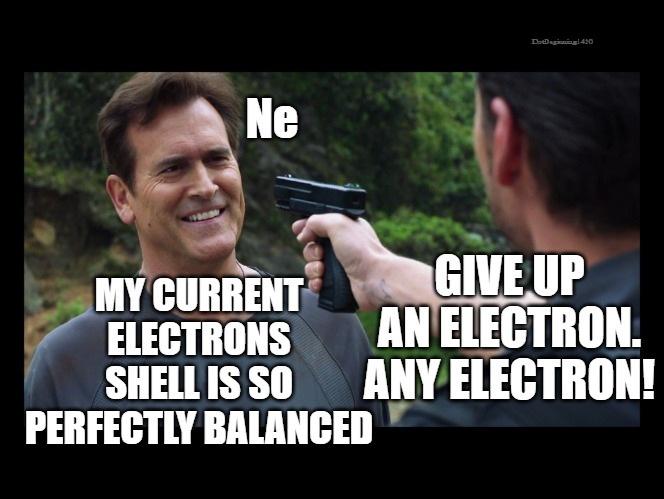
Noble gases are the chemical equivalent of that one friend who refuses to share their snacks. Neon (Ne) with its full valence shell is basically saying "I'd rather die than bond with you." Even at gunpoint, its electron configuration (2-8) remains more stable than my career prospects. That's why chemists need extreme conditions like ionization energy of 2080 kJ/mol just to pry one electron loose. Talk about commitment issues.

The Noble Gas Life Goals

The Noble Gas Life Goals
The unstable electron configuration vs. the sweet relief of noble gas stability! That school bus is living the chemistry dream - going from a chaotic electron arrangement (1s² 2s² 2p⁶ 3s² 3p⁶) to the blissful 4s² 3d¹⁰ configuration. Just like how we all dream of going from "frantically juggling 17 responsibilities" to "Netflix and snacks on the couch." Chemistry doesn't just happen in beakers, folks—it's literally driving down the street screaming "I JUST WANT TO BE INERT!"

Unstable Bois

Unstable Bois
Chemistry students know the struggle! That panicked Plankton is exactly how reaction intermediates exist in the chemical world - frantically zigzagging, desperate to bond with literally anything because they're so electronically unstable. Meanwhile, the final product (Squidward) is just chilling with a smug face because he's achieved electronic stability and doesn't need to react anymore. Those reaction intermediates are the true chemical drama queens - existing for microseconds before transforming or decomposing. Next time your synthesis fails, just remember: your intermediates were probably having an existential crisis!

Wasted Tuition Fee

Wasted Tuition Fee
That moment when years of mechanical engineering education crashes into a 9-year-old's flawless logic. The kid's argument about three-legged chairs having "one less direction to fall in" is both hilariously wrong and yet has that weird ring of confidence that makes you question your entire degree. Meanwhile, your brain is frantically calculating stability moments, center of gravity, and static equilibrium just to prove a child wrong. Four years and $100,000 in student loans, and you're being intellectually challenged by someone whose biggest achievement this week was beating level 7 in Minecraft. The equations floating around your head won't save you from this existential crisis.

Avg Ionic Bond Enjoyer

Avg Ionic Bond Enjoyer
It's electron donation time! Sodium's out here looking for that sweet stability with its lonely outer electron, while chlorine's desperate for just one more to complete its shell. Then BAM! They hook up and form the ultimate power couple - table salt! 💪 What makes this relationship work? Pure electrostatic attraction, baby! Sodium goes positive (Na+), chlorine goes negative (Cl-), and they're drawn together like teenagers to TikTok. The result? NaCl crystals forming a perfect lattice structure that's literally the foundation of your french fries' flavor. Chemistry pickup line of the day: "Are you made of sodium and chlorine? Because you're clearly a salt-y match!"

Ain't Gonna Split That One Anytime Soon

Ain't Gonna Split That One Anytime Soon
Checking on your proton after 10 35 years is the ultimate long-term relationship status. The meme brilliantly plays on the mind-boggling stability of protons, which have a theoretical half-life exceeding 10 33 years according to some Grand Unified Theories. That's roughly a trillion trillion trillion times the current age of the universe! Talk about commitment issues—even subatomic particles outperform us. The disappointment in finding zero evolution after waiting longer than the universe has existed is nuclear physics humor at its finest. Next time someone calls you impatient, just remind them you're not waiting around for proton decay.