
Planets Memes

Posts tagged with Planets

Planetary Proportions And Potty Humor

Planetary Proportions And Potty Humor
The astronomical fact about Uranus's massive size (63 Earths can fit inside it) gets completely derailed by the juvenile wordplay. The original post presents legitimate planetary science—Uranus is indeed the third-largest planet by diameter in our solar system—but the "64 if you relax" addition transforms it into a classic anatomy joke. The commenter's self-awareness about eventually outgrowing this humor is the cherry on top of this cosmic comedy. Fun fact: Uranus actually rotates on its side with an axial tilt of 98 degrees, making it even more unique among planets... but that's probably not why people keep giggling about it.

Gamma Ray Bursts: The Universe's Death Stare

Gamma Ray Bursts: The Universe's Death Stare
Gamma Ray Bursts staring intensely at planets with life is cosmic-level stalking! These massive energy explosions are like the universe's most dramatic photobombers—releasing more energy in seconds than our sun will in its entire lifetime. They're basically the universe's way of saying "I see you developing complex life forms over there... would be a shame if something... happened to it." Talk about an existential threat with attitude! Thankfully, Earth hasn't been in the crosshairs of these celestial snipers yet, or we wouldn't be here making memes about them!

The Moon Flex: Jupiter vs Earth

The Moon Flex: Jupiter vs Earth
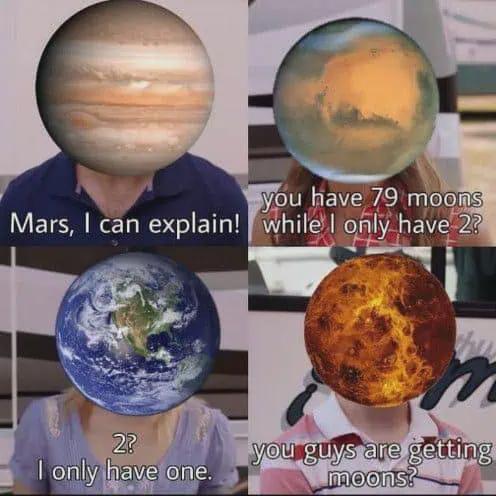
Jupiter's sitting there flexing with its 95 moons stacked in a massive pyramid while Earth is awkwardly holding its singular moon like "this is fine." Talk about cosmic inequality! Jupiter's basically the kid who brings the 64-pack of crayons with built-in sharpener to school while Earth's still coloring with the broken stub it found under the couch. The gas giant's moon collection is so extra that astronomers keep discovering new ones like they're dropping out of Jupiter's pockets. Meanwhile, Earth treasures its one moon that controls our tides and inspires countless bad werewolf movies. Planetary flex gone astronomical!

The Orbital Expansion Of Holiday Waistlines

The Orbital Expansion Of Holiday Waistlines
When your holiday eating habits perfectly mirror Saturn's orbital perspective! The top image shows Saturn with its magnificent rings visible from the side - your pre-holiday waistline looking all majestic and defined. But by December 25th? We're looking at Saturn from above where the rings appear as a thin line across the middle - exactly what happens when your belt becomes a theoretical concept after consuming your body weight in cookies and eggnog. The universe really does provide the perfect metaphors for our expanding holiday circumferences. Even gas giants have better excuses for their size than "I was just taste-testing the gravy."

The Lunar Popularity Contest

The Lunar Popularity Contest
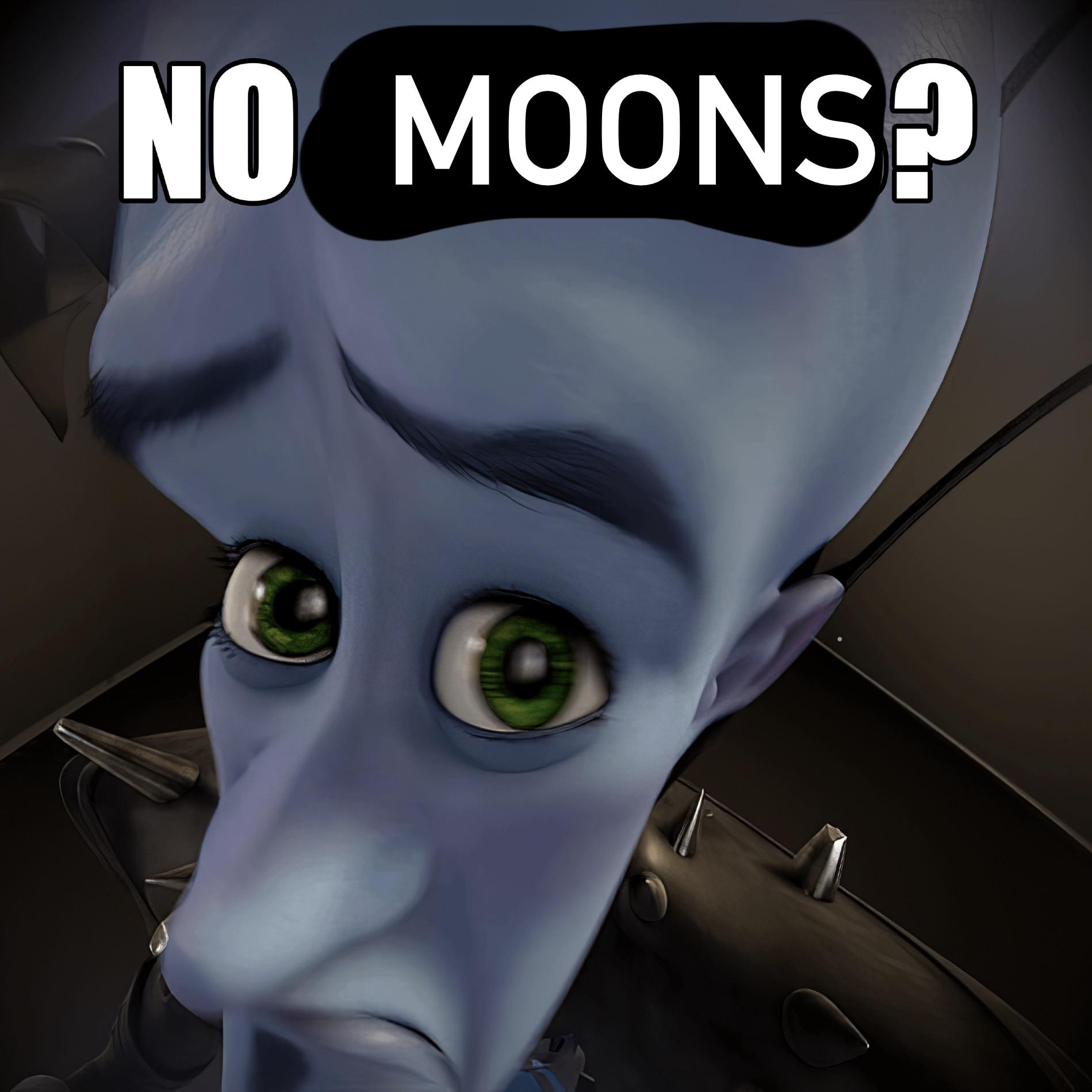
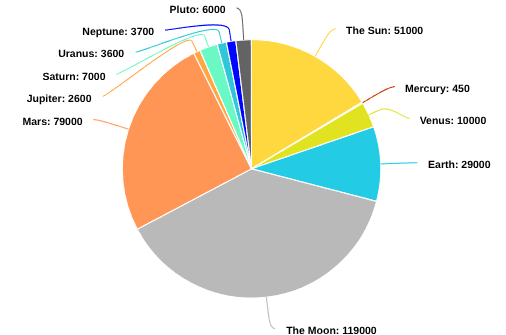
Saturn showing off with 274 moons like that one colleague who keeps adding authors to their paper. Meanwhile, Mercury and Venus sitting there with zero moons, the academic equivalent of "my dog ate my research." Jupiter's 97 is respectable but still looks like amateur hour next to Saturn's moon-hoarding tendencies. The gas giants are basically running a celestial moon pyramid scheme at this point.

If The Sun Is Bigger Than Pluto, Why Isn't Sun A Planet?

If The Sun Is Bigger Than Pluto, Why Isn't Sun A Planet?
Someone's been skipping their astronomy lectures. The image shows an orange (labeled "Sun") next to some smaller fruits/objects (planets), with Pluto being practically microscopic. Size isn't the determining factor for planethood—otherwise my department head's ego would qualify as a celestial body. Stars are massive balls of plasma undergoing nuclear fusion, while planets are just rocky/gaseous objects orbiting stars. By this logic, I should ask why my coffee mug isn't classified as a teacup despite being larger than my colleague's teacup. The astronomy department would have a collective aneurysm reading this.

Size Doesn't Matter (In Planetary Classification)

Size Doesn't Matter (In Planetary Classification)
Size isn't everything in the cosmic popularity contest! Our Moon (left) is actually bigger than Pluto (right), but doesn't get the planet status because astronomy is basically celestial high school politics. 🌑 > 🪐 The truth? Planets need to "clear their neighborhood" of other objects in their orbit. The Moon is Earth's clingy sidekick that never bothered to dominate its own orbital path. Meanwhile, poor Pluto got kicked out of the planet club in 2006 for the same reason - it's like getting rejected from a party because your gravitational influence isn't cool enough. So next time someone asks why the Moon isn't a planet despite its size advantage over Pluto, just tell them: "It's not about the size of your celestial body, it's about how you use your gravitational influence!"

Ancient Vs. Modern Planet Naming Crisis

Ancient Vs. Modern Planet Naming Crisis
The stark contrast between modern exoplanet naming conventions and ancient Roman astronomy is just *chef's kiss*. Modern astronomers are out here with alphanumeric soup like "Gliese 581c" and "J1407b" - basically giving planets serial numbers like they're IKEA furniture. Meanwhile, ancient Romans took one look at a giant red spot in the sky and went: "That big red boi? That's Jupiter because he's an absolute unit like our strongest god." Honestly, the straightforward logic is refreshing. No PhD required to understand "THIS THING IS RED AND ENORMOUS." Modern astronomy: technically precise. Roman astronomy: vibes-based classification system that somehow still works 2000 years later.

The Great Planetary Identity Crisis

The Great Planetary Identity Crisis
The planetary classification wars continue! This chart brilliantly satirizes how the definition of "planet" is surprisingly subjective. From the 2006 demotion of poor Pluto to the philosophical "what if space itself is a planet, duuude?" existentialist take. The "Spiteful" category is peak astronomy pettiness—counting only Pluto as revenge for its demotion. Meanwhile, the "Regolithic" definition would make practically everything a planet, because who doesn't have a little dirt and ice? My favorite has to be the "Empiricist" who only counts planets they've personally observed. Classic scientist move: "If I haven't seen it with my own eyes and equipment, does it really exist?"

In Response To Mercury's Planetary Identity Crisis

In Response To Mercury's Planetary Identity Crisis
Mercury's out here with the celestial equivalent of a PowerPoint presentation defending its planetary status. "I'm round! I orbit the Sun! I'm in that mnemonic device about planets!" Meanwhile, it's conveniently glossing over the fact that it can't even organize its day-night schedule properly and needs its orbital mommy for cleanup. The comparison to Ganymede is particularly brutal - like showing up to a job interview and finding out the other candidate has the same qualifications but also speaks five languages and volunteers at animal shelters. The "give me liberty or give me core" bit is just *chef's kiss* - planetary existential crisis in four lines. Next thing you know, Mercury will be posting inspirational quotes about "living your best orbit" while blocking all the dwarf planets on social media.

Make These Planets Blue Again

Make These Planets Blue Again
Look what they did to our majestic ice giants! The original Voyager 2 images showed Uranus as a bland cyan ball while Neptune flaunted that gorgeous deep blue. Then some scientists decided to "reprocess" the images and—BAM—now both planets look like they've been through the cosmic washing machine with too much bleach! Neptune's signature blue? GONE. The astronomical equivalent of taking the blueberry out of blueberry pie! No wonder our stick figure friend is having an existential crisis. This is what happens when you let photo editors loose on planetary data—suddenly the solar system looks like it's suffering from color blindness!

Make Neptune/Uranus Blue Again

Make Neptune/Uranus Blue Again
Hold onto your telescopes! Someone just reprocessed the Voyager 2 images and turned our beloved blue ice giants into boring mint-colored orbs! The outrage is astronomical! 😱 For decades, we've known Neptune as the stunning deep blue planet and Uranus as its lighter cyan cousin. But apparently some image processing wizardry has stripped them of their iconic colors! The stick figure's reaction perfectly captures every space enthusiast having an existential crisis. Fun fact: Neptune's rich blue comes from methane gas absorbing red light, while Uranus has more atmospheric haze giving it that distinct cyan look. Now someone's gone and made them practically twins! The planetary identity theft is real!