

Philosophy Memes

Posts tagged with Philosophy
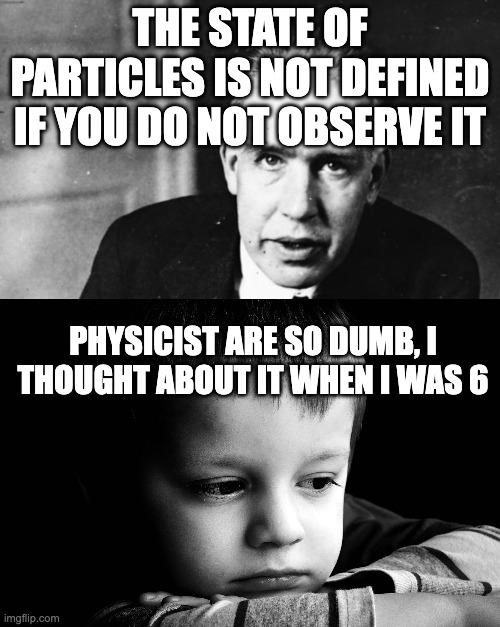
Real Reason People Hate Copenhagen Interpretation

Real Reason People Hate Copenhagen Interpretation
The Copenhagen interpretation basically says that quantum particles exist in superposition until you measure them—which sounds profound until you realize it's just fancy physics speak for "we don't know what's happening when we're not looking." The meme nails why this bothers people: it genuinely does sound like something a six-year-old would come up with. "If a tree falls in the forest and no one's around, does it make a sound?" meets particle physics, and physicists have been arguing about it for a century. The interpretation works mathematically, sure, but philosophically? It's giving "I didn't do my homework because my dog ate my wave function." Most physicists just shut up and calculate at this point.

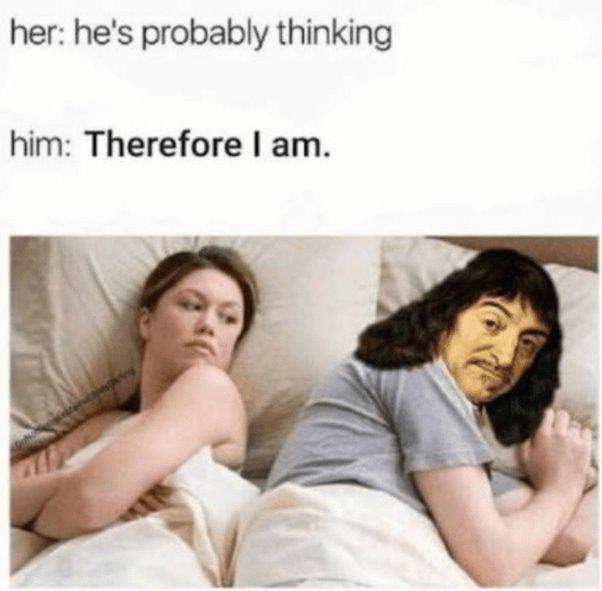
If She Thinks He Is Thinking About Others, Is He?

If She Thinks He Is Thinking About Others, Is He?
Descartes just rolled over in his grave... and then questioned whether he actually did. This brilliant philosophical mashup takes the classic "boyfriend thinking about other girls" meme format and slaps Descartes' famous "Cogito, ergo sum" right in the middle of relationship anxiety. She's worried he's contemplating other romantic interests, but plot twist—he's actually having an existential crisis about the nature of consciousness itself. Because nothing says "romance" quite like pondering whether your existence is validated through the act of thinking. The observer effect meets bedroom dynamics: does her thinking about his thinking make his thinking real? Or is he only thinking because she thinks he's thinking? Fun fact: Descartes developed his philosophy while lying in bed late into the mornings (he was famously lazy about getting up), so this meme is historically accurate in the weirdest way possible. The man literally philosophized his way through bed rest.

Problem Of Induction Meme

Problem Of Induction Meme
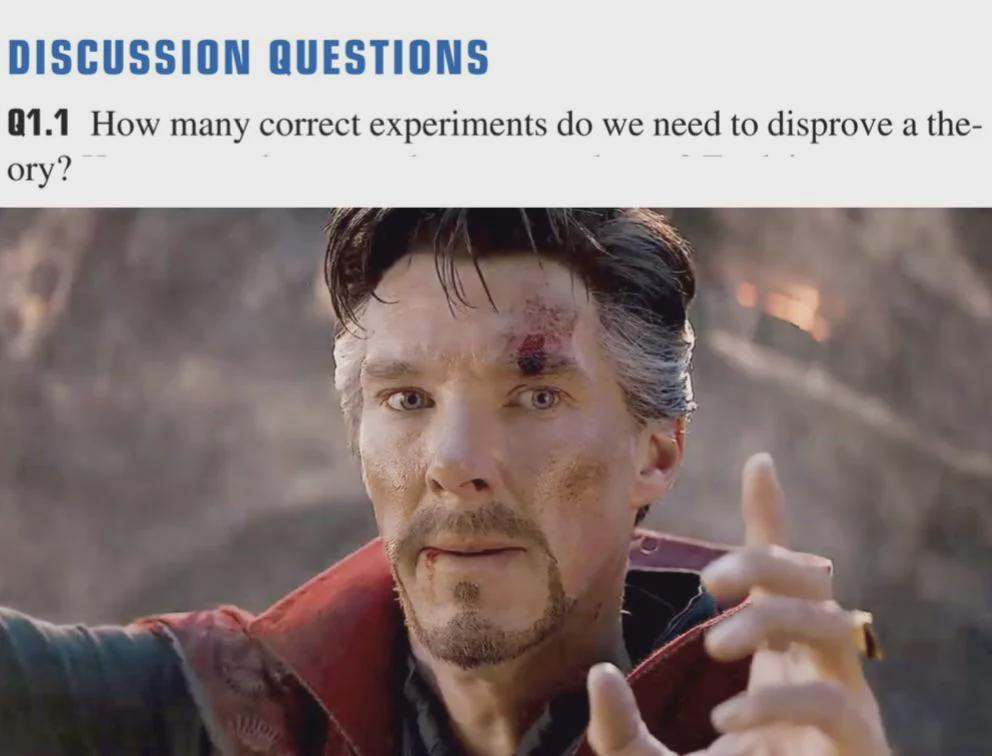
The beautiful irony here is that the question itself reveals a fundamental misunderstanding of how science works. You don't need multiple experiments to disprove a theory—you need exactly one that contradicts it. Meanwhile, you could run a million confirming experiments and still not "prove" the theory true, because that's the problem of induction David Hume warned us about centuries ago. The problem of induction is basically this: just because something has happened repeatedly in the past doesn't logically guarantee it'll happen in the future. The sun rose yesterday, today, and a billion times before, but that doesn't prove it'll rise tomorrow—we just have really strong inductive reasoning to believe it will. So the answer to Q1.1? One. Just one contradictory experiment can shatter a theory. But the student asking probably expects some large number, which is why Doctor Strange here is holding up that iconic finger like "buddy, we need to talk about falsification."

I Love Proving Numbers Exist

I Love Proving Numbers Exist
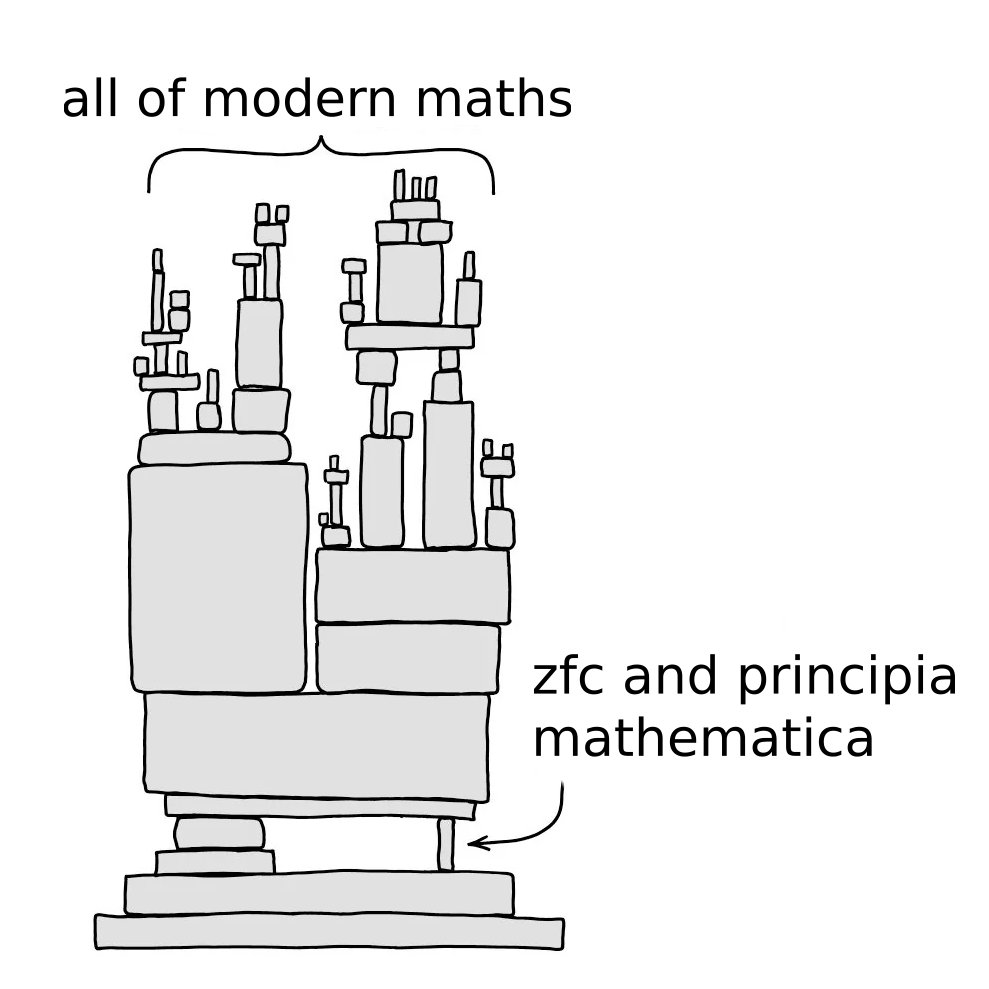
You know you're deep in the mathematical weeds when your entire field rests on two tiny axioms at the bottom. ZFC (Zermelo-Fraenkel set theory with the Axiom of Choice) and Principia Mathematica are basically the "trust me bro" foundation that holds up literally everything else in modern mathematics. It's like building a skyscraper on a couple of pebbles and hoping nobody asks too many questions about whether those pebbles are actually real. Mathematicians spent centuries just trying to prove that numbers exist and that 1+1=2 without creating logical paradoxes. Bertrand Russell and Alfred North Whitehead needed over 300 pages in Principia Mathematica to rigorously prove that 2+2=4. Meanwhile, the rest of us are up there doing calculus, topology, and abstract algebra, blissfully unaware that the entire enterprise could theoretically collapse if someone finds a contradiction in the axioms. The best part? We can't even prove these foundational systems are consistent from within themselves (thanks, Gödel). So yeah, modern math is just vibes built on unproven assumptions. Sleep tight!

Our Understanding Of The Physical World Is So Fragile. Thanks Hume. Now I Have Anxiety

Our Understanding Of The Physical World Is So Fragile. Thanks Hume. Now I Have Anxiety
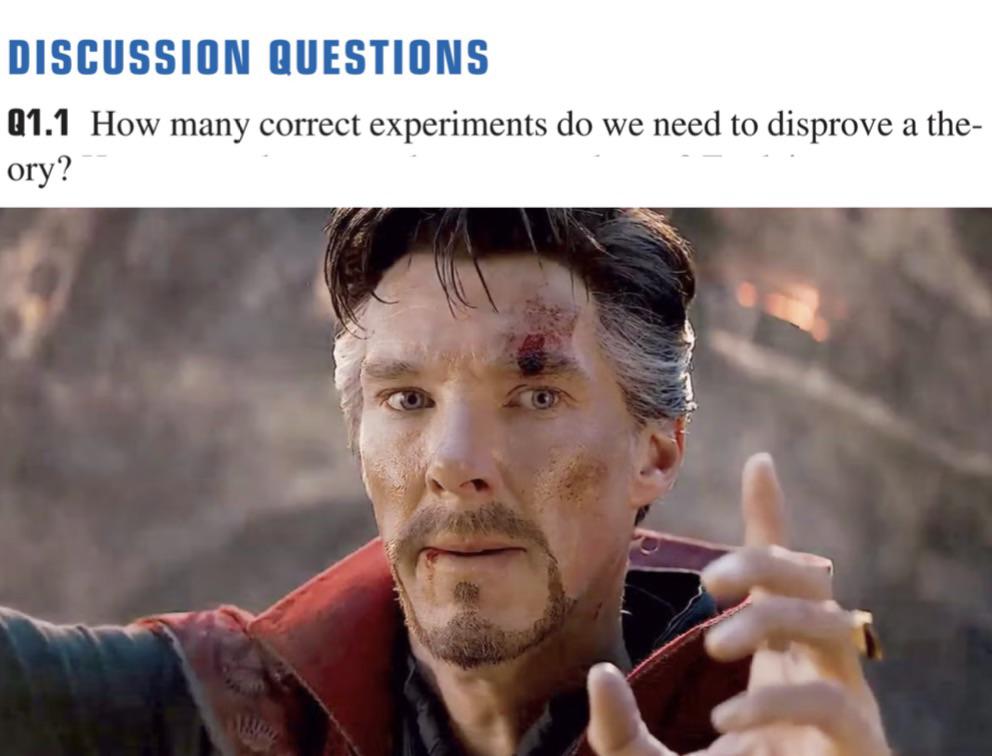
David Hume really woke up one day and said "hey, you know how you think the sun will rise tomorrow because it always has? Yeah, you can't actually prove that." And scientists have been having existential crises ever since. The brutal truth is that it only takes ONE experiment to completely demolish a theory, but you could run a million successful experiments and still not prove it's universally true. You're just building confidence on a foundation of "well, it hasn't failed YET." This is the problem of induction that keeps philosophers of science up at night. We assume nature follows consistent patterns, but that assumption itself can't be proven—it's just something we kinda have to accept to do science at all. Doctor Strange here holding up one finger perfectly captures that sinking feeling when you realize your entire understanding of reality is built on observations that could theoretically be wrong tomorrow. Sleep tight!

Math And Physics Meme

Math And Physics Meme
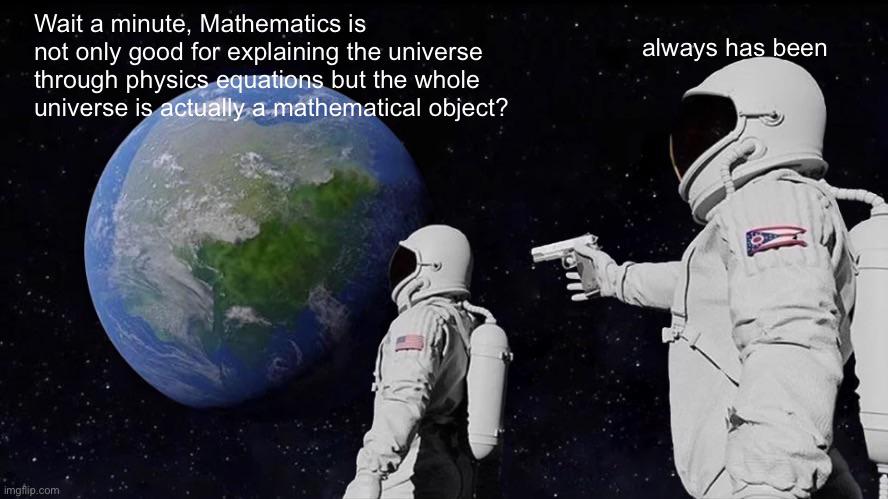
So you're telling me we've been using math as a tool to describe reality, but plot twist—reality itself might just be math wearing a fancy costume? That's the kind of existential crisis that makes you want to point a gun at someone in space. This is basically every physicist's journey: first you learn equations to model the universe, then you start wondering if the universe IS the equation. It's like discovering your map is actually the territory. Eugene Wigner called it "the unreasonable effectiveness of mathematics" because somehow our abstract number games perfectly predict how atoms behave and galaxies spin. Suspicious, right? The astronaut on the right represents that moment when you realize Max Tegmark might be onto something with his Mathematical Universe Hypothesis—that physical reality doesn't just follow mathematical laws, it literally IS a mathematical structure. Your coffee cup? Just a solution to some differential equations having a really good day.

(P ∨ ~P)

(P ∨ ~P)
The title is the law of excluded middle from logic: either proposition P is true, or its negation (~P) is true. There's no third option. So the commenter brilliantly applies this to relationship status: "he either has a girlfriend, or no girlfriend" – which is just... stating that all possible outcomes exist. Revolutionary insight there, buddy. What makes this comedy gold is Alexander's response: "its usually like that for everyone." He's absolutely right – this is a tautology, a statement that's always true by definition. You've just described reality using formal logic to sound profound while saying absolutely nothing of substance. It's like announcing "either it will rain tomorrow or it won't" and expecting applause. The crying emoji really sells the false profundity of it all. Welcome to philosophy 101, where you can make obvious statements sound intellectual by adding symbolic notation.

Engineering Vs Philosophy

Engineering Vs Philosophy
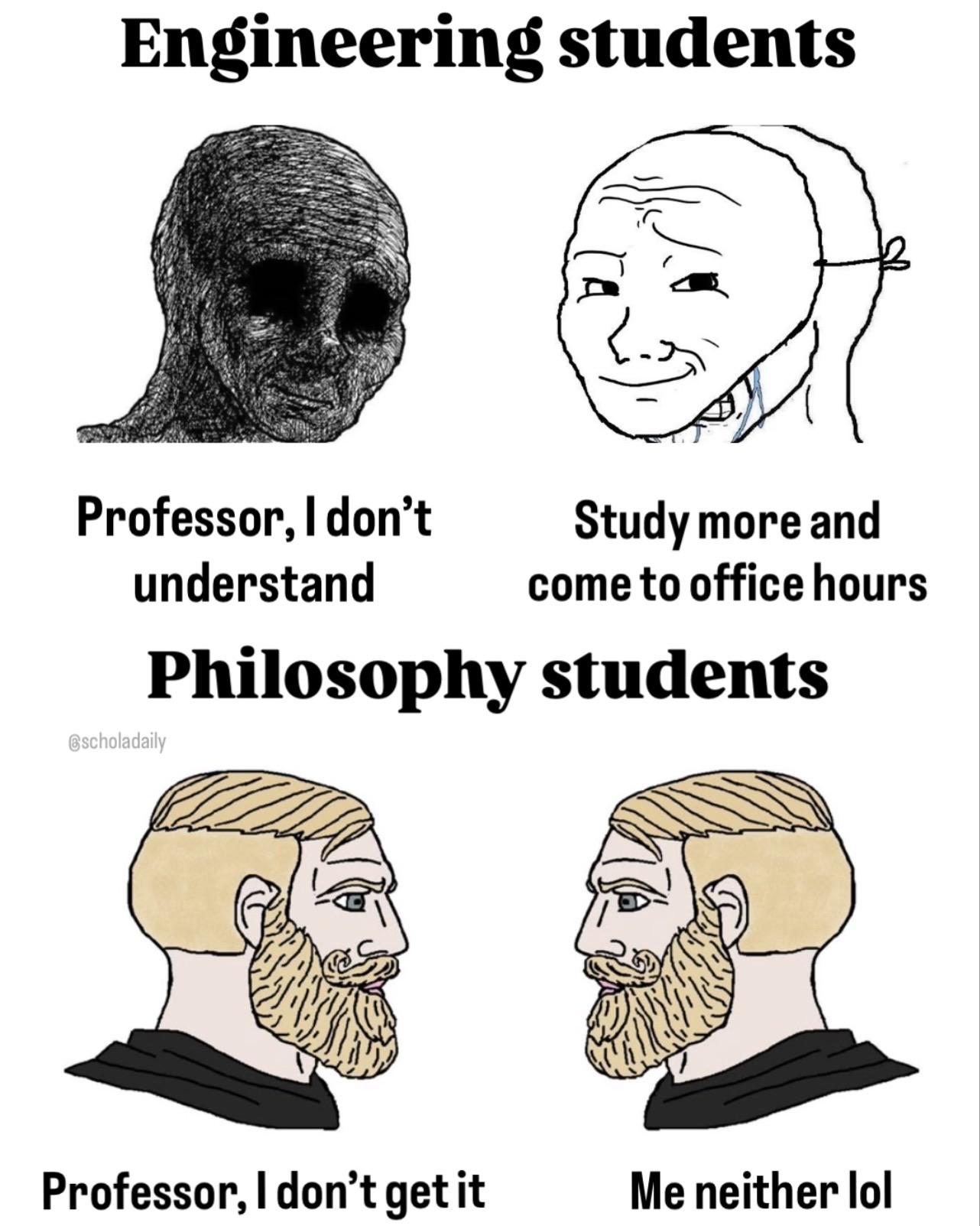
Engineering students panic when they don't understand something. They'll show up to office hours with color-coded spreadsheets and three energy drinks. Philosophy students, on the other hand, have achieved enlightenment: they don't understand anything, you don't understand anything, the professor doesn't understand anything, and that's literally the entire point of the discipline. One group thinks confusion is a bug. The other thinks it's a feature. Both are sleep-deprived, but only one has accepted their fate with a knowing smile.

Technically Philosophy Of Math But Close Enough

Technically Philosophy Of Math But Close Enough
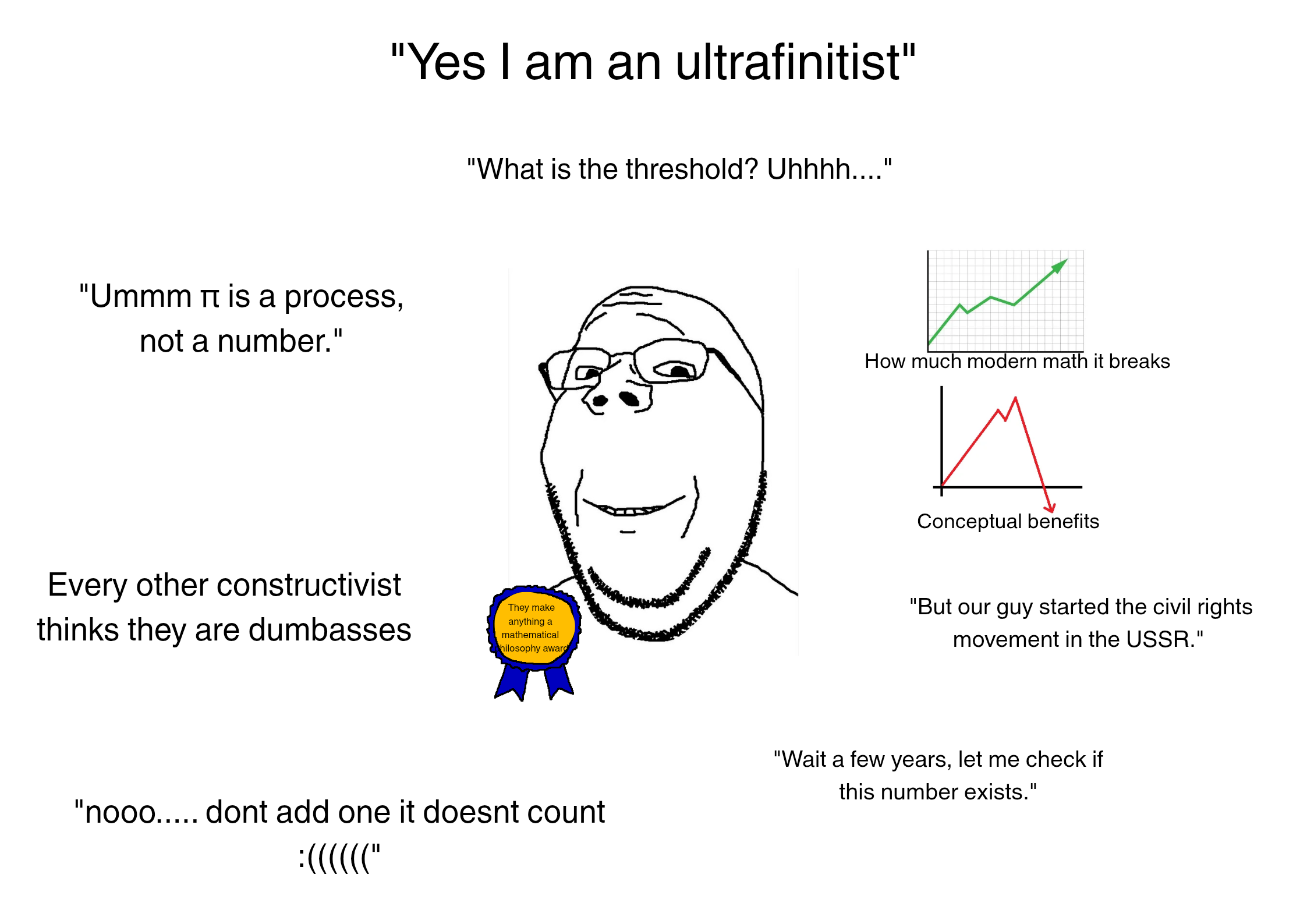
Mathematical ultrafinitists walk into a bar and immediately start questioning whether the bar even has enough atoms to exist. These folks believe only a finite number of mathematical objects are real—basically, if you can't physically count it before the heat death of the universe, it doesn't exist. The meme nails their greatest hits: claiming π is a process rather than a number (because infinite decimals are too spicy), insisting there's some mysterious threshold where numbers just... stop being real, and my personal favorite—waiting a few years to verify if a number exists. Like numbers are on some kind of probationary period. The graphs showing "how much modern math it breaks" versus "conceptual benefits" is chef's kiss accurate. Ultrafinitism basically nukes calculus, analysis, and most of number theory while offering the philosophical equivalent of "but have you considered... what if no?" Meanwhile, other constructivists—who already reject certain mathematical concepts unless they can be explicitly constructed—look at ultrafinitists like they're the weird cousins at the family reunion. The civil rights movement joke is a deep cut referencing how ultrafinitism was notably developed by Soviet mathematician Alexander Esenin-Volpin, who was also a prominent human rights activist. Imagine fighting for human rights while simultaneously denying the existence of large numbers. The duality of man.

Coaxed Into More Fol (Goomba Funnel Edition)

Coaxed Into More Fol (Goomba Funnel Edition)
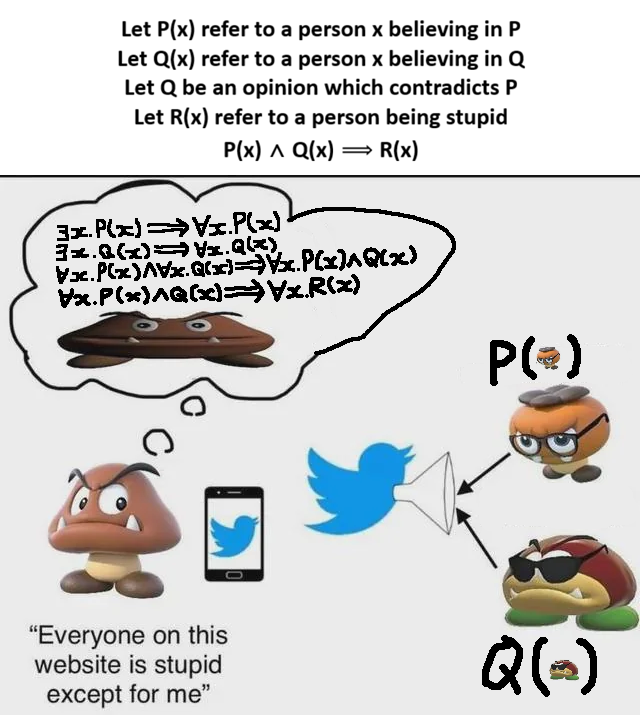
So we've got a formal logical proof that if you simultaneously believe two contradictory things, you're stupid. Then someone goes on Twitter and declares "everyone on this website is stupid except for me." The beautiful irony here is that P(🍄) believes everyone else is stupid while Q(🐢) believes everyone else is stupid, which means they both believe contradictory things about who's stupid. By their own logical framework, they've just proven themselves stupid. It's like watching someone carefully construct a bear trap and then immediately step in it. The existential quantifiers in the thought bubble are doing some heavy lifting here—basically saying "there exists someone who believes P" and "there exists someone who believes Q" while simultaneously claiming everyone who believes both is an idiot. The self-own is so elegant it could be published in a logic textbook under "How to Refute Yourself in 280 Characters."

Am I Just A Fluctuation?

Am I Just A Fluctuation?
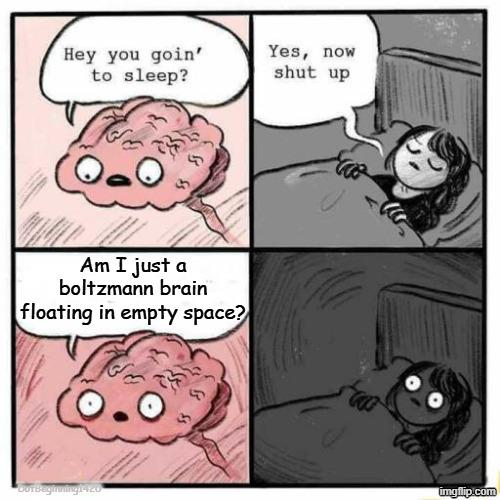
Your brain at 3 AM asking the real questions. The Boltzmann brain is this delightful thought experiment where, given infinite time and random quantum fluctuations, it's statistically more likely that a single conscious brain would spontaneously assemble in the void of space than an entire universe would form naturally. So technically, you could just be a disembodied brain floating in space with false memories of everything you've ever experienced. Sleep tight. The real kicker? You can't prove you're NOT a Boltzmann brain. Philosophy majors and physicists have been losing sleep over this for decades, so your brain is just keeping up with tradition by bringing it up at bedtime.

When Mathematical Paradoxes Meet Medieval Hot Tubs

When Mathematical Paradoxes Meet Medieval Hot Tubs
This brilliant mashup takes Gödel's incompleteness theorem from the abstract realm of mathematics and drops it into medieval class warfare. Just like Gödel proved you can't use a mathematical system to prove its own consistency, you can't expect someone to critique a system they're deeply embedded in (especially when they're sitting pretty in a castle hot tub). The peasant wants logical proof the system works, while Mr. "Very Intelligent" Gödel basically says, "You can't prove the system is consistent from within the system, but look at me enjoying my noble privileges!" It's mathematical paradox meets feudal hypocrisy - chef's kiss for anyone who's ever tried explaining structural problems to someone benefiting from those very structures.