

Measurement Memes

Posts tagged with Measurement

Candela Is Not A Fundamental Unit

Candela Is Not A Fundamental Unit
Okay so someone's out here fighting the good fight and I'm here for it. The candela (cd) is one of the seven SI base units, measuring luminous intensity, but here's the kicker: it's literally defined using other fundamental units. It's basically kg⋅m²⋅s⁻³⋅sr⁻¹, which makes it about as "fundamental" as calling a sandwich a basic food group just because you eat it every day. The candela is defined as the luminous intensity of a light source emitting monochromatic radiation at 540 THz (green light, where human eyes are most sensitive) with a radiant intensity of 1/683 watt per steradian. So yeah, it's derived from watts (power) and steradians (solid angles), which themselves come from more fundamental units. It's basically a unit that exists because humans decided "we need to measure light the way our eyeballs perceive it" rather than any actual fundamental physical property. This person is absolutely right to be upset, and frankly, we should all be joining them at this table. The candela is the imposter among the SI units, and it's time we had this conversation.

Both Are Correct

Both Are Correct
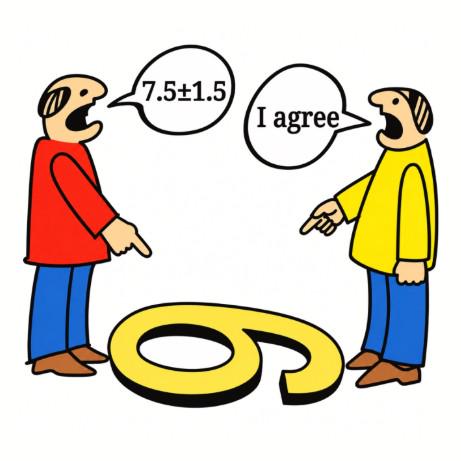
When one scientist says "7.5±1.5" and the other says "I agree," they're both technically staring at the same ambiguous shape on the ground that could be either a 6 or a 9, depending on your perspective. The beauty here? Guy in red is covering his bases with uncertainty intervals (anywhere from 6 to 9 works!), while guy in yellow is just vibing with the confidence of someone who didn't actually check the math but trusts the error bars to do the heavy lifting. It's the perfect representation of scientific collaboration: one person does the calculation, the other nods enthusiastically, and somehow they're both right because perspective matters and error propagation is a beautiful thing.

Technically Correct

Technically Correct
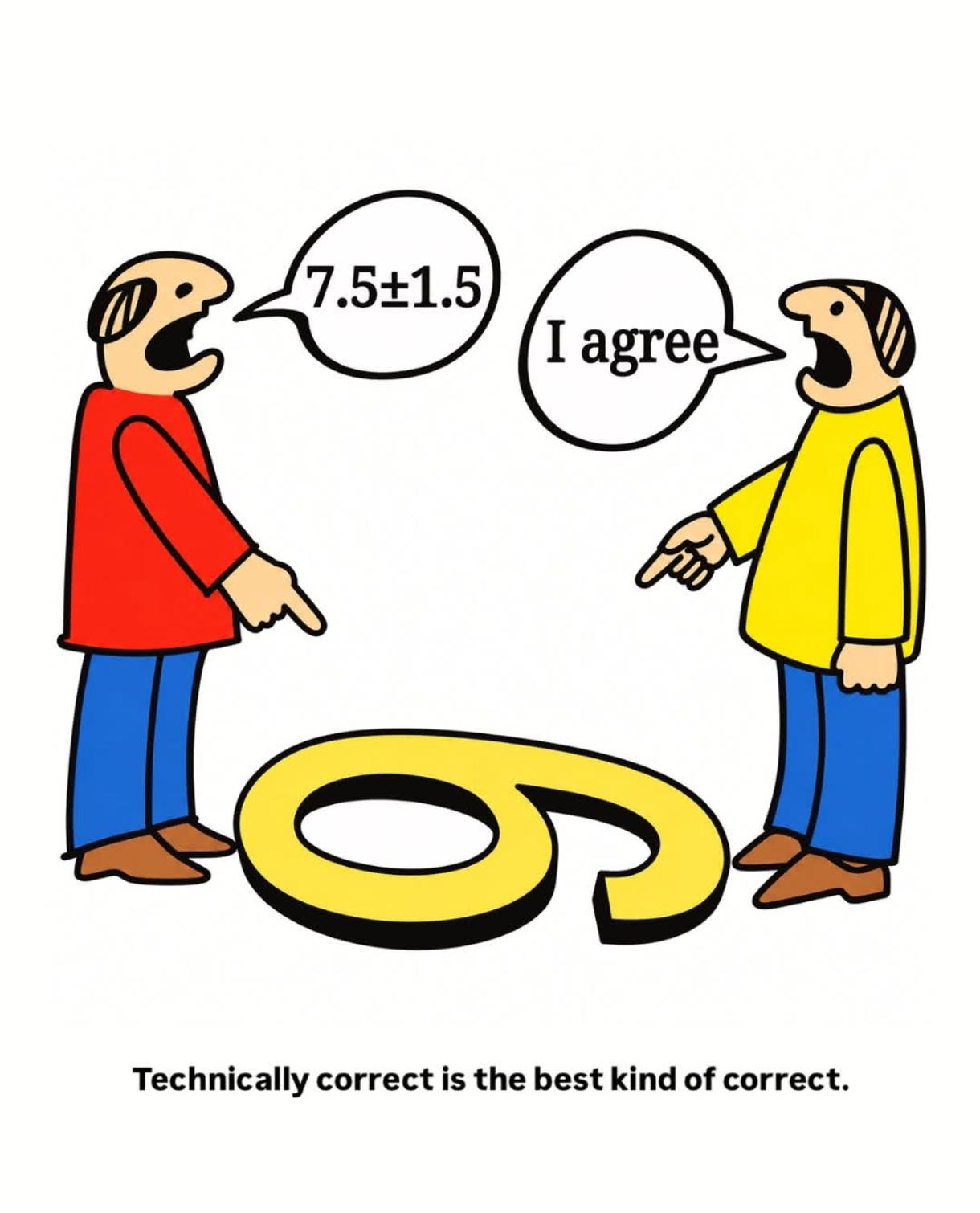
When someone says "7.5±1.5" and you respond "I agree" while standing next to what could be either a 6 or a 9 depending on your perspective. Both people are technically correct because the range covers 6 through 9, and the object on the ground is simultaneously validating both viewpoints. This is what happens when you let statisticians and philosophers collaborate on optical illusions. The beauty here is that the uncertainty interval ±1.5 creates a range from 6 to 9, which means both observers are within acceptable error margins. It's the scientific equivalent of "we're both right, just from different reference frames." Peak conflict resolution through statistics.

5 Centimeters Per Second Meme

5 Centimeters Per Second Meme
Every lab instructor has lived this nightmare. You've explained significant figures until you're blue in the face, written it on the board, sent reminder emails, probably tattooed it on your forehead, and yet somehow students still submit "34.64 cm" when measuring something with a ruler that has centimeter markings. Buddy, your ruler can't measure to the hundredth of a centimeter—you're not wielding some NASA-grade precision instrument here, it's a plastic stick from the supply closet. The rule is simple: report what you can actually measure plus one estimated digit. If your ruler shows centimeters, you write "34.6 cm" or maybe "35 cm" depending on the markings. That extra ".04" is pure fiction, a number pulled from the void of academic optimism. It's like claiming you can taste individual molecules in your coffee—technically impressive, completely impossible. The frustration is real because this isn't advanced quantum mechanics—it's basic measurement literacy that somehow evaporates the moment students touch a lab report. Five times. FIVE. TIMES.

Why Do These Even Exist

Why Do These Even Exist
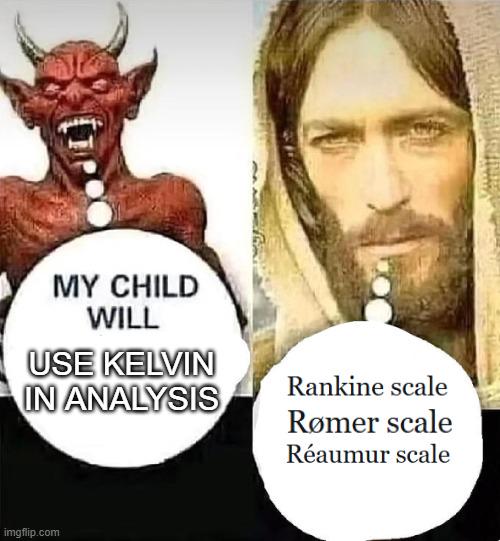
Devil: "My child will use Kelvin in analysis" versus Jesus blessing us with Rankine, Rømer, and Réaumur scales. The unholy trinity of temperature scales nobody asked for! While Kelvin actually serves a purpose in thermodynamics (absolute zero at 0 K, no negative temperatures, makes equations cleaner), these other three are like that drawer in your kitchen filled with gadgets you've never used. Rankine is basically Kelvin's American cousin—it uses Fahrenheit-sized degrees but starts at absolute zero. Rømer was an early attempt from 1701 where water freezes at 7.5° (because why not?). Réaumur sets water's boiling point at 80° instead of 100°. These scales exist purely to torture engineering students who stumble upon old European scientific papers and have to convert everything back to something remotely usable. Fun fact: There are actually even MORE obscure temperature scales like Newton, Delisle, and Wedgwood. Scientists really went wild inventing these things before everyone agreed to just stick with Celsius and Kelvin.

The Real Truth

The Real Truth
Look, both camps have their reasons, but let's be real here—one is objectively superior for science, and the other just wants to avoid typing two extra letters. Celsius gives you water freezing at 0°C and boiling at 100°C, which is beautifully logical for literally anyone doing chemistry, biology, or just existing in a lab. Meanwhile, someone out there is defending Fahrenheit because "Celsius" has more keystrokes than "Fahrenheit"... which, by the way, makes zero sense as an argument. The scientific community settled this debate decades ago, but sure, keep using a scale where water freezes at 32 and boils at 212 because some guy in the 1700s thought mercury and ice baths were a vibe. At least we can all agree that Kelvin users are the true psychopaths—nobody wants to hear that it's 298 degrees outside.

Trust The Quantum Circle

Trust The Quantum Circle
Just a regular green circle claiming to be a "quantum circle" that was apparently a yellow square before observation. Classic quantum mechanics joke playing on the observer effect—where particles exist in multiple states until measured. The difference is that real quantum particles don't lie to your face about what they were. My PhD advisor would call this "creative data interpretation."

The Different Sciences And Their Measurement Tolerance

The Different Sciences And Their Measurement Tolerance
The precision standards across scientific fields are hilariously accurate! 🔬 When told "You were off by 3 centimeters," each scientist has their own reaction: Biologist: *horrified cat face* - Because in microbiology, 3cm might as well be the Grand Canyon! Physicist: *concerned face* - That's a catastrophic error when you're measuring fundamental particles! Civil Engineer: "I MEAN IT'S ALRIGHT" - Because when you're building bridges, a few centimeters? Pfft, we've got safety factors for that! Astronomer: *laughing hysterically* - When you're measuring distances in light-years, being off by 3cm is like worrying about a grain of sand on a beach! Next time your measuring tape shows you're off by a bit, just ask yourself: "What kind of scientist am I today?" 📏✨

The Precision Spectrum: 3 Centimeters Of Scientific Panic

The Precision Spectrum: 3 Centimeters Of Scientific Panic
The precision hierarchy in science is too real! Biologists freak out over 3cm errors because that could mean mistaking a mouse for an elephant (kidding). Physicists just nod stoically—they've seen worse in quantum measurements. Civil engineers? "It's alright" because bridges need wiggle room anyway! But astronomers? They're cackling because 3cm is basically NOTHING when you're measuring objects billions of light-years away. For them, being off by 3cm is like missing a galaxy by the width of an atom. The measurement tolerance spectrum across scientific disciplines is basically a meme unto itself!

That Animal Is Off The Scale!

That Animal Is Off The Scale!
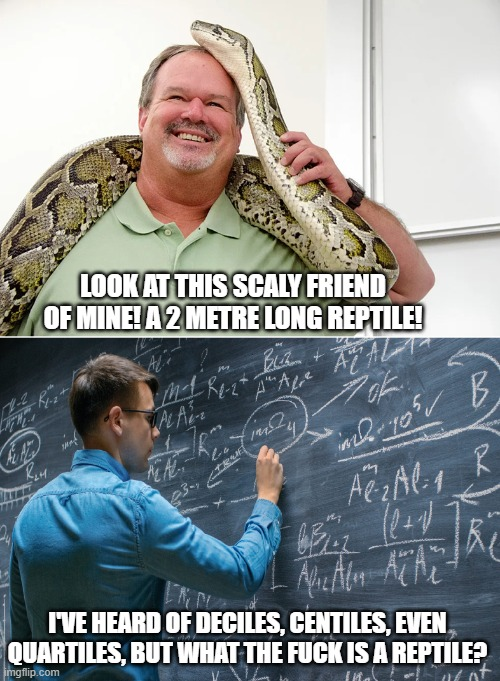
The perfect collision of herpetology and statistics! The top panel shows a proud snake handler with his 2-meter python, while the bottom panel features a mathematician completely baffled by the unit of measurement. In statistics, we have deciles (10ths), centiles (100ths), and quartiles (4ths) to divide data distributions—but "reptile" isn't exactly a mathematical term! The joke hinges on the mathematician hearing "reptile" as if it were another statistical division like "percentile," creating a beautiful scientific misunderstanding that would make even Pythagoras hiss with laughter.

Metric > Imperial: The Scientific Affair

Metric > Imperial: The Scientific Affair
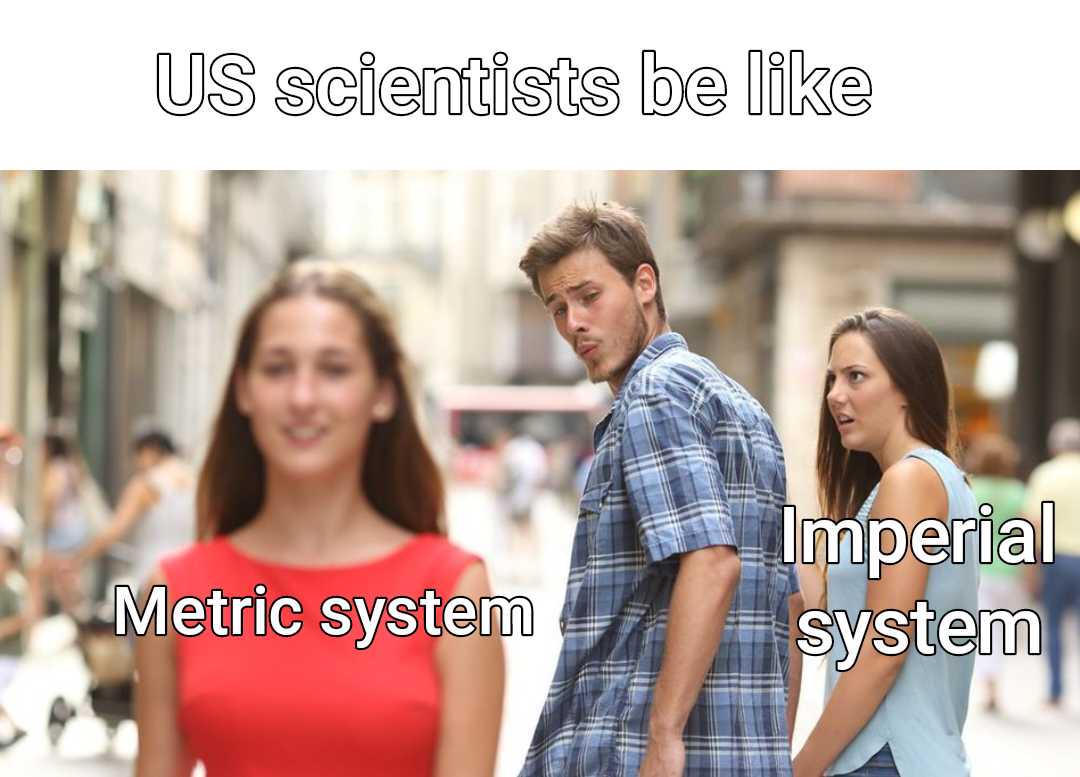
Even American scientists can't resist sneaking a peek at the metric system while being officially married to imperial units! It's the scientific equivalent of texting your ex while your current partner is watching. 🧪📏 Fun fact: NASA lost a $125 million Mars orbiter because one team used metric units while another used imperial. Talk about an expensive unit conversion error! The rest of the scientific world just watches this relationship drama unfold with popcorn in hand. 🍿

The Ultimate Units Showdown

The Ultimate Units Showdown
The eternal battle between metric and imperial units gets a hilarious upgrade! Kilogram and pound duke it out like movie monsters, but both are utterly demolished by the electron-volt—the tiny yet mighty unit that particle physicists use to measure energy at subatomic scales. It's like watching two bodybuilders flex while a quantum physicist walks in with a particle that could power a small galaxy. The scientific measurement hierarchy has spoken, and electron-volts reign supreme in the tiniest corners of reality!