
Language Memes

Posts tagged with Language
Which Words Come To Mind?

Which Words Come To Mind?
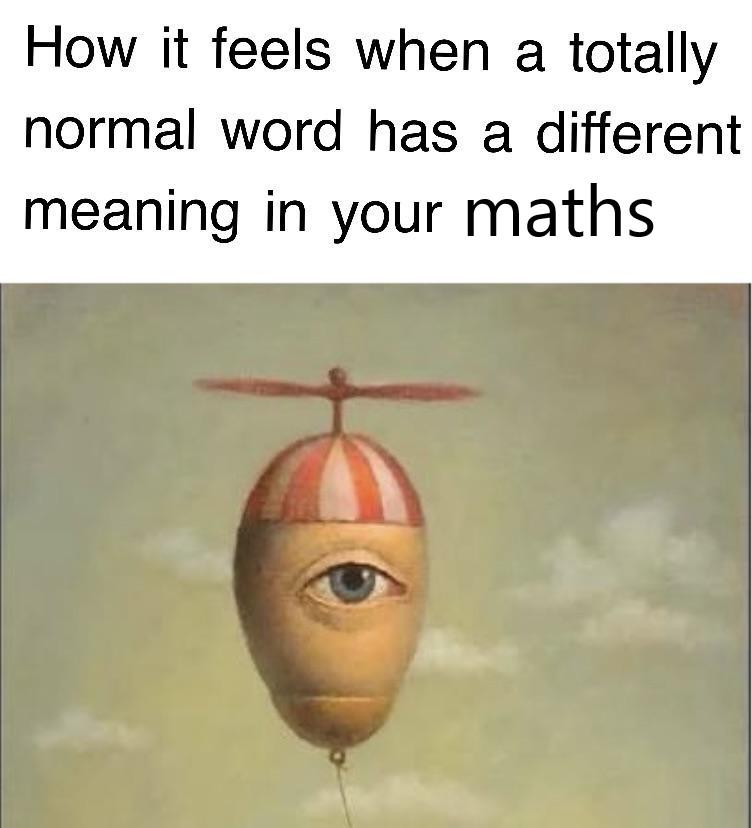
Your brain literally short-circuits when "normal" suddenly means perpendicular to a tangent line, or "real" refers to numbers that aren't imaginary, or "complex" isn't complicated but has an imaginary component! Math vocabulary hijacks everyday language and leaves you floating in existential confusion like this bizarre propeller-hat-eye-balloon thing. The mathematical dictionary living rent-free in your head makes casual conversation a minefield. "Let me integrate that into my schedule" suddenly has you calculating area under curves!

Perfect Piece Of Advice, Thanks!

Perfect Piece Of Advice, Thanks!
The ultimate linguistic paradox for coders! Taking language learning advice literally, beginner Python programmers find themselves in an Indiana Jones situation - surrounded by actual pythons instead of semicolons and brackets. The programming language named after Monty Python (not the reptile) creates this perfect double entendre. Next tutorial: learning Java by visiting Indonesia and drinking excessive amounts of coffee!

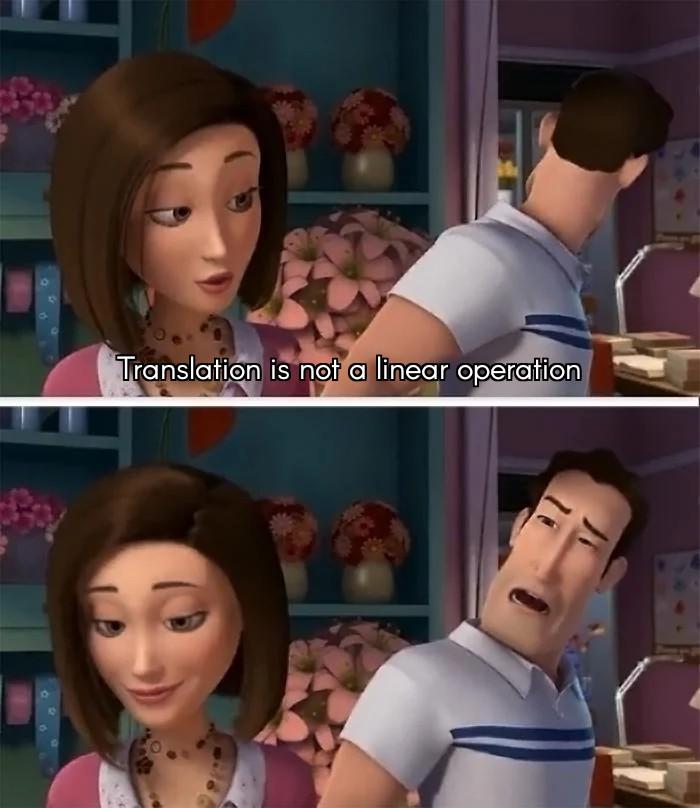
Translation Is Not A Linear Operation

Translation Is Not A Linear Operation
Mathematicians and computer scientists having existential crises when they realize language translation doesn't follow nice, clean transformation rules! The guy's horrified expression perfectly captures that moment when you discover your elegant algorithm can't handle "raining cats and dogs" in Mandarin. Translation is this beautiful chaos where context, culture, and idioms make a mockery of our beloved linear systems. Even Google Translate occasionally produces gibberish that would make Turing weep into his tea.

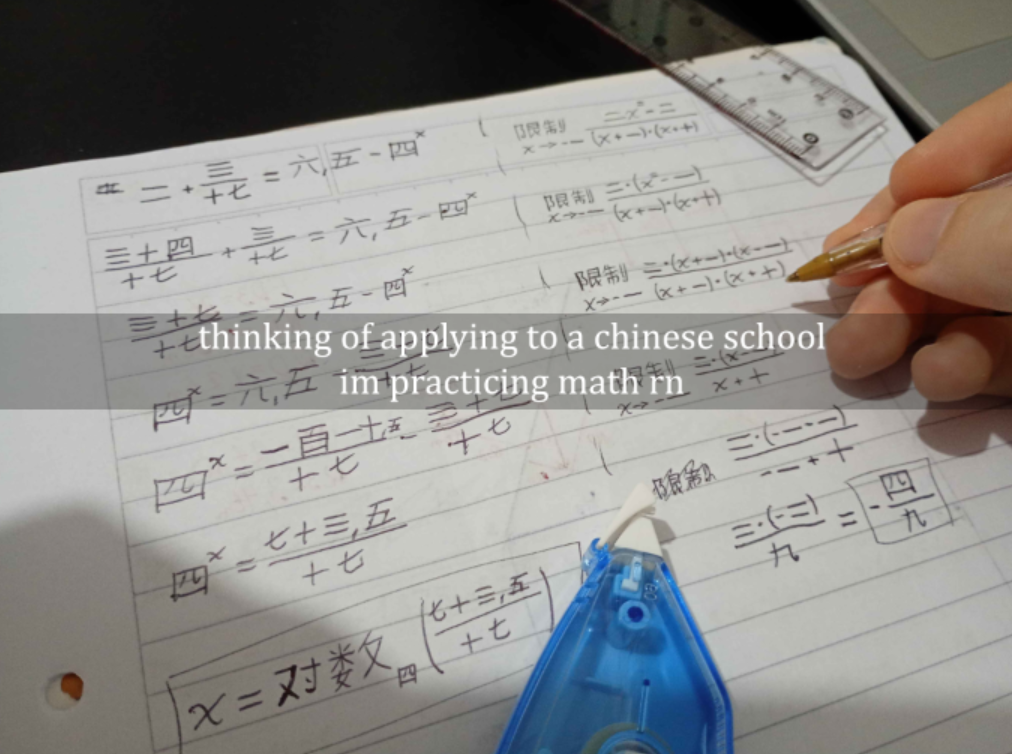
Lost In Mathematical Translation

Lost In Mathematical Translation
Writing Chinese characters and calling it "math practice" is like claiming you're fluent in quantum mechanics because you can say "Schrödinger's cat." That notebook isn't filled with equations—it's Chinese numerals and characters that would make an actual Chinese math teacher weep into their abacus. Reminds me of my freshman students who think writing gibberish in their lab reports will somehow translate to partial credit. Spoiler alert: it doesn't.

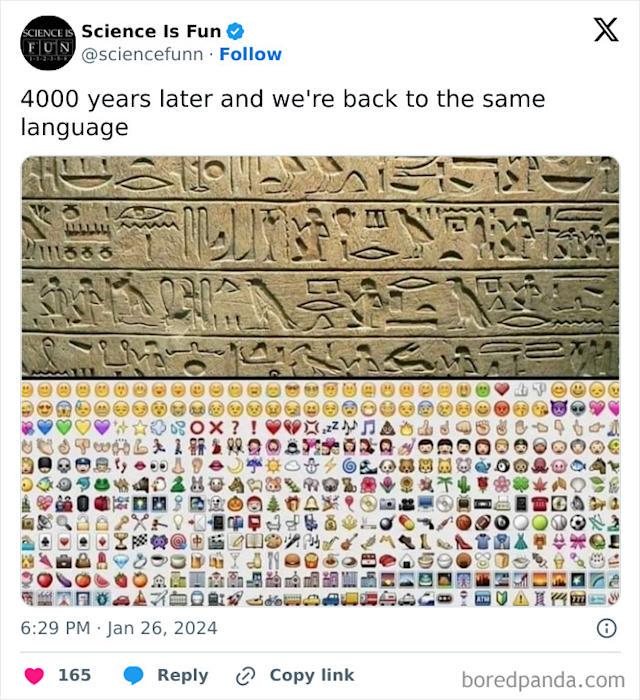
Back To The Same Language?

Back To The Same Language?
History really does repeat itself! Ancient Egyptians used hieroglyphics to communicate complex ideas through symbols, and here we are in 2024 expressing our deepest thoughts with 🔥💯😂. The circle of communication is complete! Our ancestors spent centuries developing alphabets and complex writing systems only for us to collectively decide "nah, tiny pictures are better." Next time someone complains about "kids these days and their emojis," remind them we're just honoring our ancient ancestors. Somewhere, a pharaoh is nodding in approval at your eggplant emoji. 👑

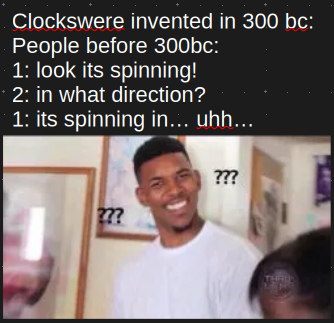
Directional Dilemma Before Clocks

Directional Dilemma Before Clocks
Ever tried describing rotation without having a standardized reference point? That's the existential crisis these pre-300 BC folks are experiencing! Without clocks to establish clockwise/counterclockwise directions, they're stuck in a linguistic paradox trying to explain which way something is spinning. It's like trying to give directions without having invented left and right yet. "It's spinning... you know... THAT way!" *gestures vaguely at the universe*

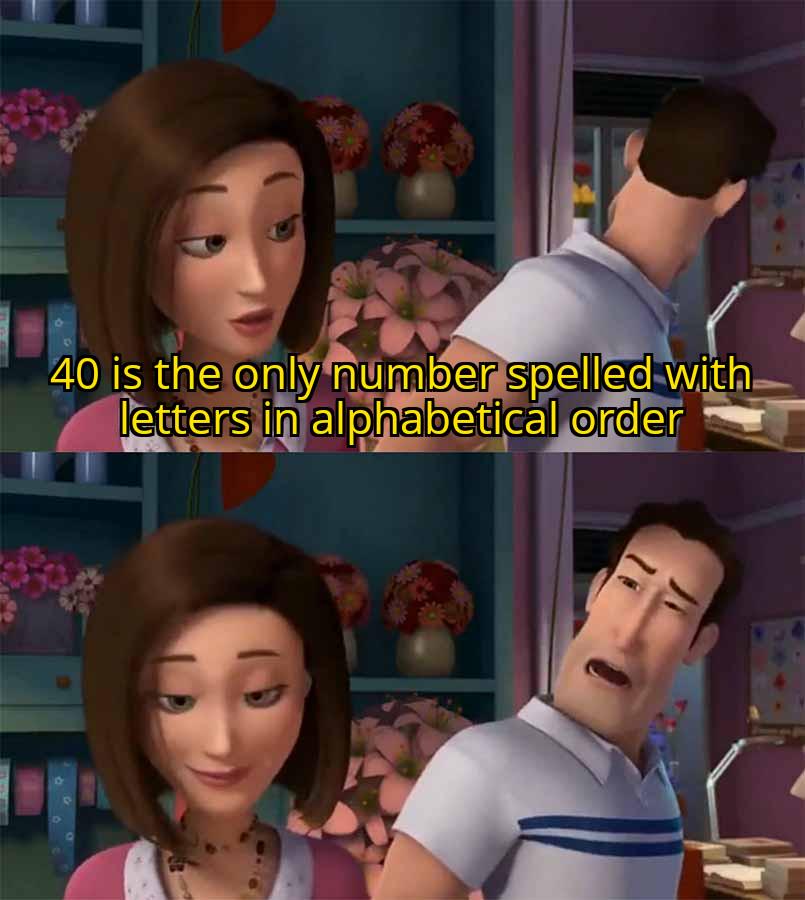
The Only Number In Alphabetical Order

The Only Number In Alphabetical Order
Think about it: f-o-r-t-y. The letters are indeed in alphabetical order. Meanwhile, the guy's brain just imploded from this utterly pointless linguistic trivia. This is exactly what happens when you're on your third consecutive all-nighter before finals and your brain starts serving up these "profound" realizations instead of actual useful knowledge. The kind of fact that will occupy valuable neural real estate forever, while you still can't remember the Krebs cycle for your biochem exam tomorrow.

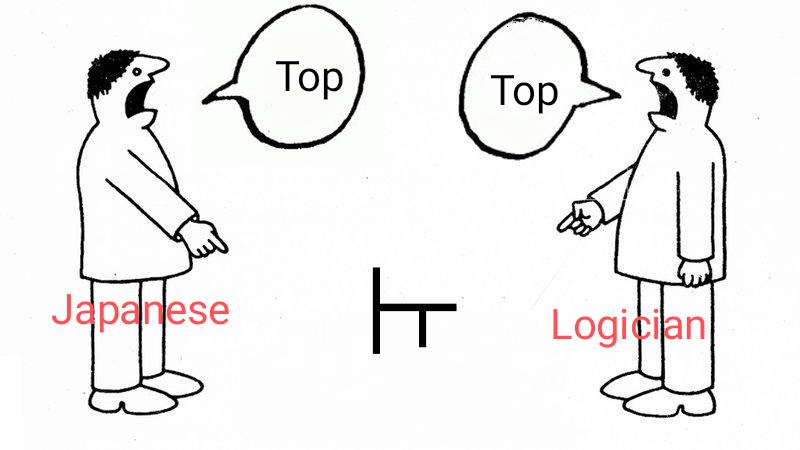
Sometimes, Right Or Wrong Does Not Depend On Perspective

Sometimes, Right Or Wrong Does Not Depend On Perspective
When a Japanese person and a logician look at the same symbol, they're both technically correct from their frame of reference! The symbol "⊥" appears as a "T" rotated 90 degrees. To the Japanese person, it's clearly "top" since in Japanese typography this character represents "top" or "above." Meanwhile, the logician sees the same symbol and also says "top" because in formal logic, "⊥" represents a contradiction or "top" in lattice theory. Two completely different knowledge domains arriving at the same verbal conclusion while meaning entirely different things! The universe really does have a sense of humor when it comes to cross-cultural symbols.

Brain Activation Levels For Language Learning Motivations

Brain Activation Levels For Language Learning Motivations
The neurological evolution of language acquisition motivation! This meme brilliantly illustrates how our brain's reward pathways intensify based on perceived utility. Learning English for global communication? Basic cognitive activation. But learning Hindi specifically to decode those lightning-fast engineering tutorials? MAXIMUM CEREBRAL ILLUMINATION! It's peak neuroplasticity when we're driven by highly specific goals rather than general communication needs. The progression of brain illumination perfectly captures how our neural networks light up when we're learning for something we're genuinely passionate about rather than just practical necessity.

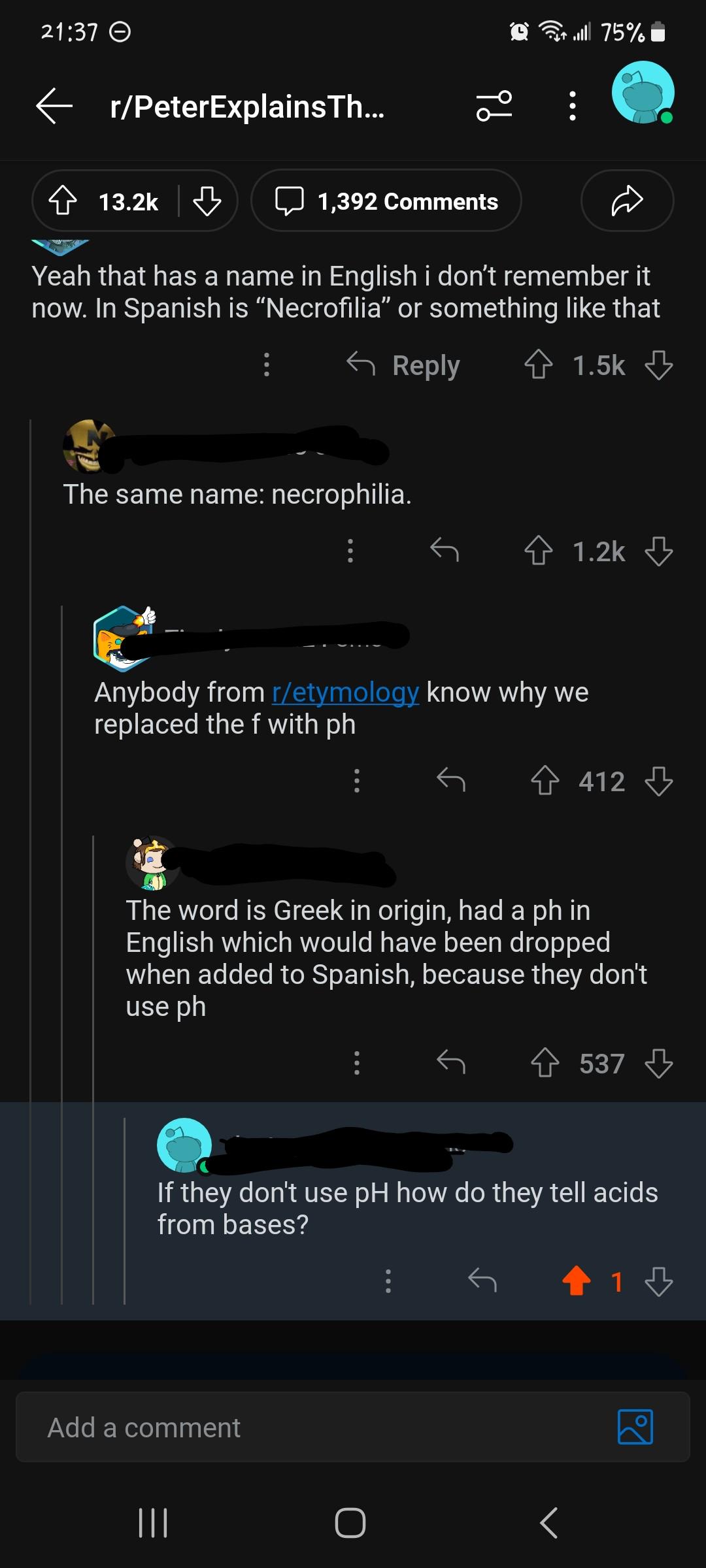
I Hope This Joke Isn't Too Basic

I Hope This Joke Isn't Too Basic
The perfect linguistic pH joke doesn't exi— Oh wait, there it is! Someone brilliantly connected Spanish phonetics with chemistry by asking "If they don't use pH how do they tell acids from bases?" Pure genius! The punchline works because Spanish doesn't use the "ph" digraph in spelling (replacing it with "f"), while in chemistry, pH is the scale that measures how acidic or basic a solution is. It's a spectacular collision of etymology and titration that would make both linguists and chemists snort their coffee through their nose filters.

The Great Mathematics Schism

The Great Mathematics Schism
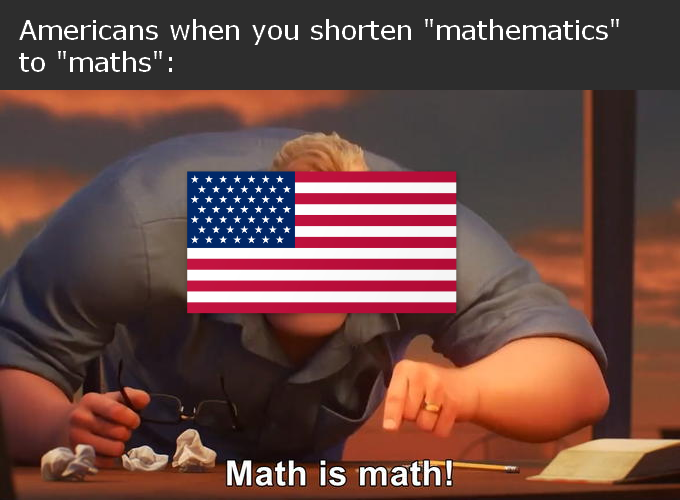
The transatlantic linguistic divide strikes again! While Brits casually refer to "maths" (because, you know, mathematics is plural), Americans clutch their calculators in horror at this abbreviation blasphemy. The "Math is math!" reaction perfectly captures that moment when Americans encounter the British version and have an existential crisis. It's like discovering someone puts pineapple on pizza – technically valid but deeply unsettling to certain populations. Next up in cultural mathematics warfare: whether "z" is pronounced "zee" or "zed" in algebraic equations!

Non-English Speaking Math Students Unite

Non-English Speaking Math Students Unite
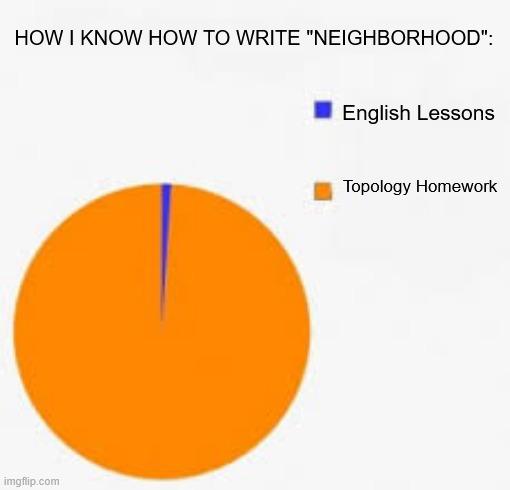
The brutal truth of math education! When you're studying topology, "neighborhood" isn't just a place where you live—it's a mathematical concept describing points near a given point in a topological space. The tiny sliver of English lessons is just decorative at this point. Who needs proper spelling when you're busy defining open sets and continuous functions? Math students worldwide collectively nod while frantically scribbling symbols that make way more sense than English orthography ever will.