
History Memes

Posts tagged with History
When Your Wife Has Better Naming Skills Than You

When Your Wife Has Better Naming Skills Than You
The ultimate scientific "why didn't I think of that" moment! Poor Max Planck excitedly shares his groundbreaking discovery of the smallest possible length in the universe with his wife, hoping for a creative naming brainstorm. Instead, Marie hits him with the most obvious solution that was literally staring him in the face the whole time. The Planck length (approximately 1.6 × 10 -35 meters) is indeed named after him and represents the scale where our current physics breaks down completely. Scientists still can't measure anything that small, but at least Max got his name on it... even if he needed a little spousal nudging to see the obvious!

The 2000-Year Fact-Checking Failure

The 2000-Year Fact-Checking Failure
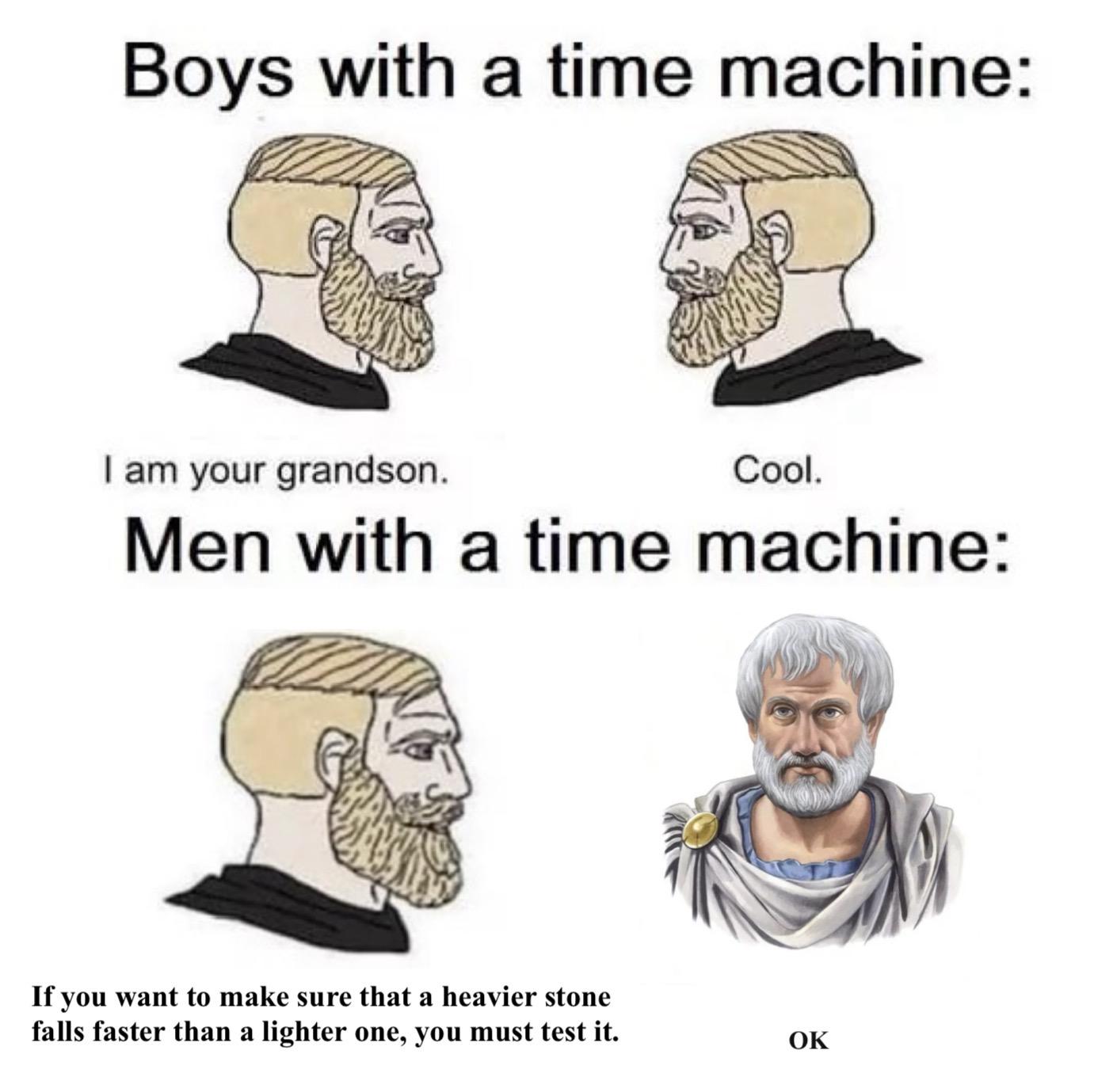
Aristotle really dropped the ball on this one! For two millennia, his unchallenged assertion that heavier objects fall faster than lighter ones was just... accepted. Nobody bothered to climb a tower and drop different weights until Galileo finally said "hold my wine" in the 1500s. Imagine the physics textbooks we could have had if someone had just taken five minutes to fact-check the guy. The scientific method was apparently on a 2000-year coffee break!

When Gaming History Rewrites Scientific History

When Gaming History Rewrites Scientific History
Gaming history trumps actual history! A poll asking who invented the light bulb shows Arthur Morgan (a fictional cowboy from Red Dead Redemption 2) winning with 92%, while Edison trails at 7%. The joke plays on "TB" - in the game, Arthur has tuberculosis, but fans are cleverly misinterpreting it as "The Bulb." Meanwhile, actual inventors like Humphry Davy and Lewis Latimer barely register at 1% each. Historical accuracy getting absolutely destroyed by 10,000 gamers who'd rather believe their favorite outlaw secretly moonlighted as an electrical engineering pioneer between robbing trains and shooting O'Driscolls.

Morgan's Uncertainty Principle

Morgan's Uncertainty Principle
The quantum theory poll results are in, and apparently Arthur Morgan from Red Dead Redemption 2 is winning by a landslide with 79% of votes! Meanwhile, actual quantum pioneers like Planck (6%) and Einstein (12%) trail far behind. Newton's sitting at 3%, which makes sense since he was busy inventing gravity while Morgan was clearly formulating wave-particle duality between robbing trains and having existential crises in the Wild West. Heisenberg's Uncertainty Principle? Please. Morgan's Uncertainty Principle states you can precisely measure either how much money is in the bank vault OR how fast your horse can escape the law—but never both simultaneously.

For The Love Of Mathematics, Wear The Vest!

For The Love Of Mathematics, Wear The Vest!
The mathematical tragedy we never got to solve! Poor Évariste Galois—brilliant mathematician who revolutionized abstract algebra at 20, then promptly got himself killed in a duel at 20. Time travelers would absolutely try to save this math prodigy who scribbled his groundbreaking theories the night before his death! His group theory work now underpins everything from cryptography to quantum physics. Imagine what else he could've discovered if someone had just convinced him to wear that bulletproof vest! The mathematical universe is still recovering from this epic facepalm moment.

Ancient Greeks: The Original Constellation Conspirators

Ancient Greeks: The Original Constellation Conspirators
Two ancient Greeks stare at a random cluster of stars and immediately decide it's a horse. Because why not? When you've got no Netflix and your entertainment options are "stare at sky" or "invent democracy," you make do with what you've got. The Greeks basically invented celestial connect-the-dots, turning perfectly innocent star arrangements into elaborate mythological creatures and heroes. "See those seven stars? That's clearly a warrior fighting a two-headed dragon while riding a dolphin." Sure, buddy. Whatever helps you get through those long Mediterranean nights.

Explosive Metal + Deadly Gas = Yummy Seasoning

Explosive Metal + Deadly Gas = Yummy Seasoning
From deadly elements to dinner table staple! Sodium (Na) is that wild party metal that literally bursts into flames when it hits water. Chlorine (Cl) was so toxic it was weaponized in World War I trenches. Yet somehow, these two dangerous substances hook up and become... the stuff you sprinkle on your fries? 🧂 Chemistry is basically just spicy matchmaking - take two substances that would kill you individually, introduce them properly, and suddenly they're making your potato soup taste better! Talk about a glow-up from "chemical weapon" to "pass the salt please"!

Time Traveling Math Terrorists

Time Traveling Math Terrorists
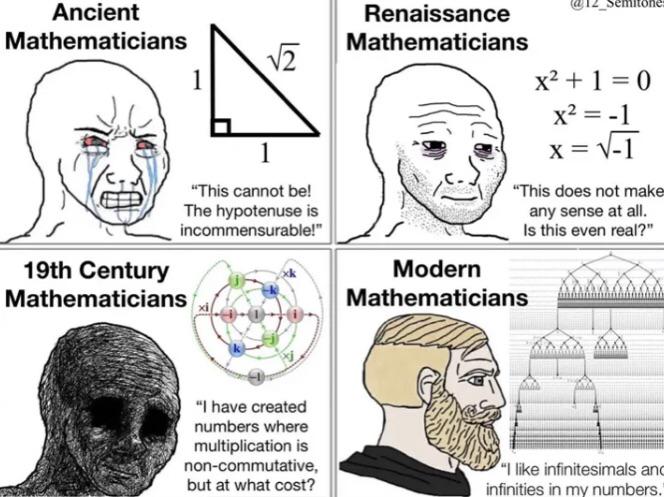
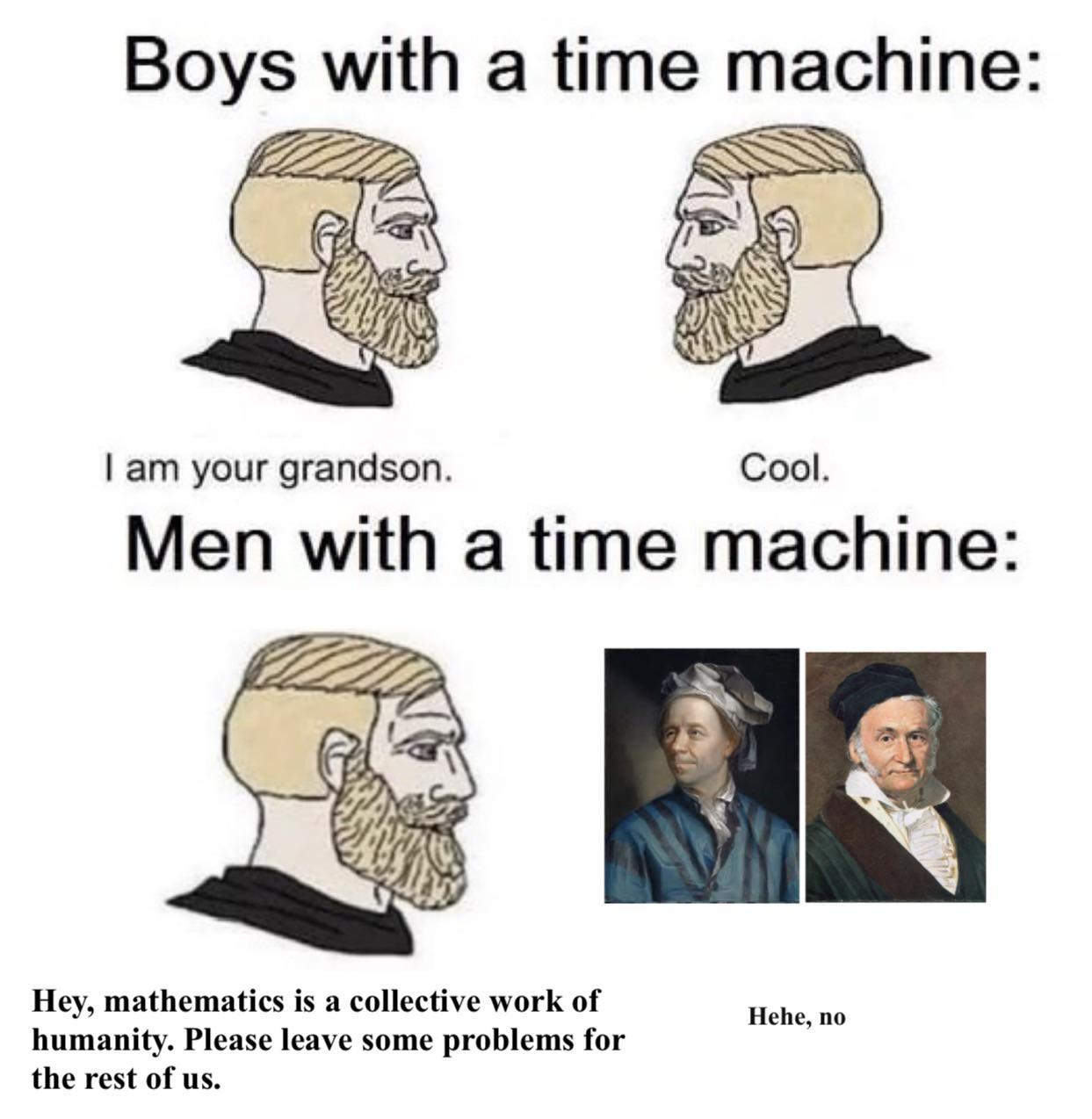
The ultimate time travel priority check! While regular folks might use a time machine to meet their descendants (boring), true intellectuals would go straight to ancient Greece to traumatize Pythagoras with irrational numbers. Pythagoras and his cult were so obsessed with whole-number ratios that they literally drowned the guy who proved √2 couldn't be expressed as a fraction. Imagine showing up in your time machine just to casually drop "Hey, so π, e, and √2 are totally valid numbers" and watching the mathematical meltdown ensue. The perfect mathematical trolling doesn't exi—

Time Traveling Electrical Engineers

Time Traveling Electrical Engineers
The meme brilliantly contrasts how different generations would use time machines. Young guys just want to meet their descendants (boring!), while true intellectuals would go straight to Benjamin Franklin to drop some electrical knowledge bombs. Imagine Franklin's face when you tell him "Electron flow is from the anode to the cathode" and he's just like "Cool." Meanwhile, he's probably thinking "What in tarnation is an electron? I'm still flying kites in thunderstorms over here!" The ultimate scientific flex would be explaining modern electrical theory to the guy who didn't even know what he was discovering. History's greatest "well, actually" moment.

I Was There 3000 Years Ago...

I Was There 3000 Years Ago...
Nothing makes you feel like a digital fossil quite like remembering the Y2K panic. That Best Buy sticker warning you to turn off your computer before midnight on 12/31/99 is a relic from when we genuinely thought computers might implode because programmers saved two digits on dates to conserve precious kilobytes. Kids today will never understand the existential dread of wondering if planes would fall from the sky because computers couldn't handle "00" as a year. Meanwhile, those of us who stockpiled canned goods and printed our bank statements are looking at Gen Z's TikTok Y2K aesthetic like battle-scarred veterans. We didn't survive the dial-up modem sounds just to become vintage meme material.

Mind-Blowing Inertia

Mind-Blowing Inertia
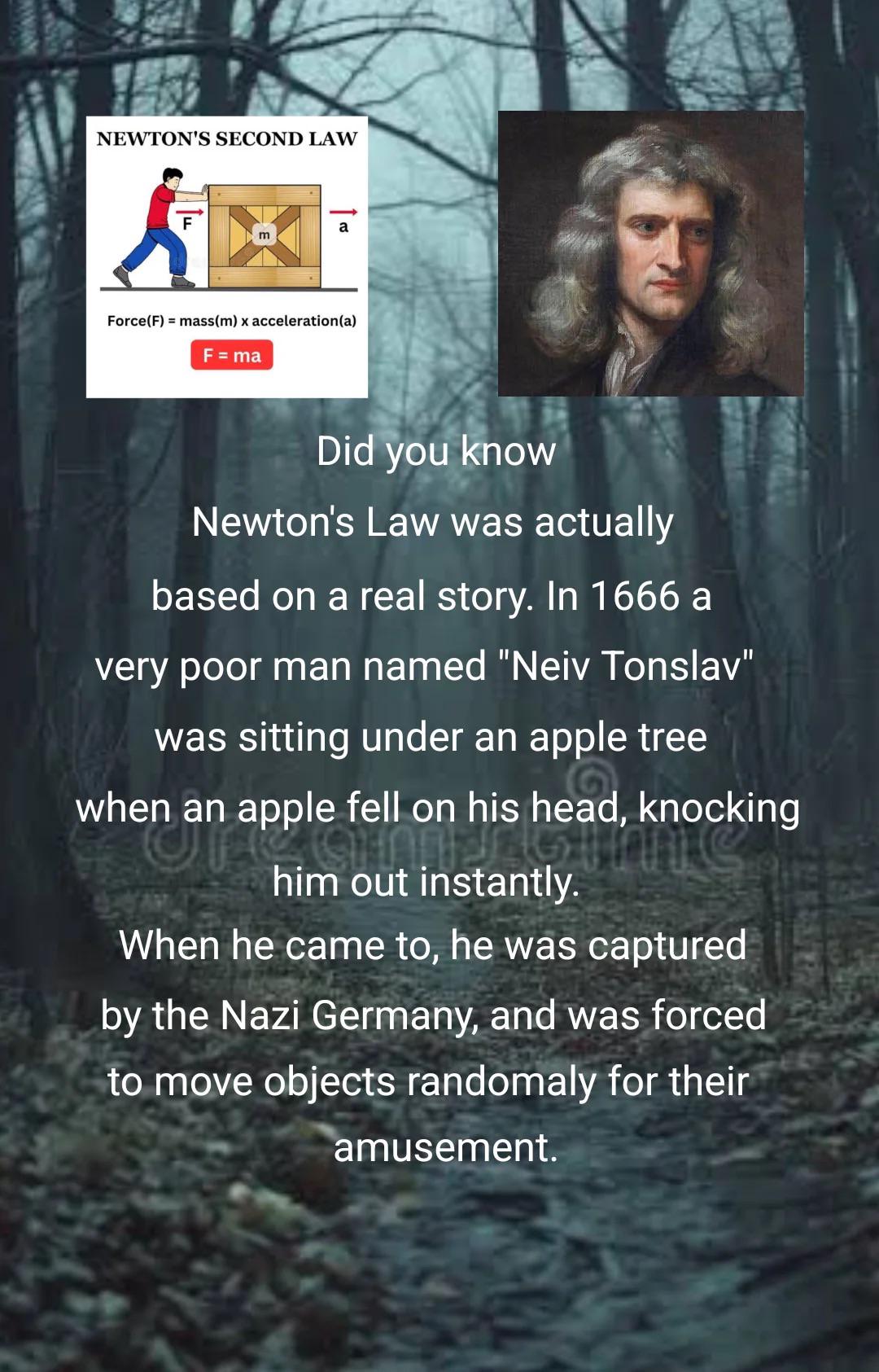
Newton's first law of motion, simplified to "things don't move unless pushed," was absolutely revolutionary in 17th century Europe. The cartoon monkey's shocked expression perfectly captures how minds were blown when Newton basically said "stationary objects stay stationary." Before this, people thought objects needed constant force to keep moving. Newton walks in and says "nope, inertia exists" and everyone loses their minds. That's the scientific equivalent of telling people water is wet and getting a Nobel Prize for it.

Move Over Robert Oppenheimer!

Move Over Robert Oppenheimer!
The classic David vs Goliath story, but with nuclear physics! On the left, we have the entire U.S. Army guarding atomic bomb secrets with mushroom clouds and military might. On the right, just one determined British mathematician (Klaus Fuchs) who casually stole those secrets using some fancy math and a camera. Fuchs was a theoretical physicist who worked on the Manhattan Project while secretly passing nuclear weapon designs to the Soviet Union. His espionage dramatically accelerated the Soviet nuclear program, proving that sometimes all you need to defeat a superpower is a good understanding of differential equations and zero moral qualms about nuclear proliferation. The intelligence community still uses this as their favorite example of why you shouldn't let brilliant mathematicians near classified information without extensive background checks!