

Chemistry Memes

Posts tagged with Chemistry
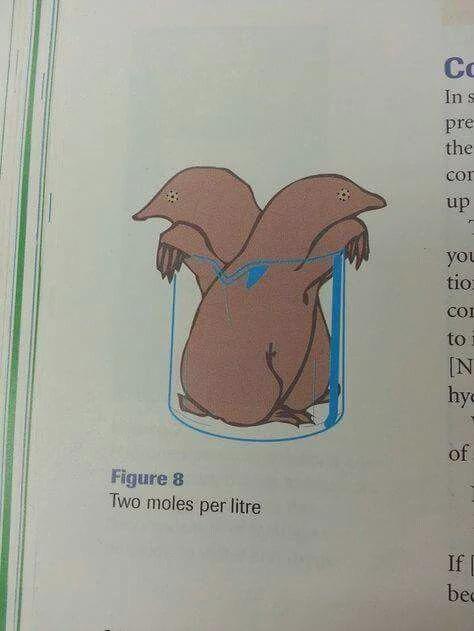
Two Moles

Two Moles
Chemistry textbooks really said "let's illustrate molarity" and just shoved two literal furry moles into a beaker. The caption reads "two moles per litre" and honestly, whoever drew this deserves a raise for their commitment to the bit. Nothing says "concentration of solute" quite like a pair of confused underground mammals drowning in what I can only assume is distilled water. Those little guys are holding onto each other for dear life while some chemistry student calculates their molecular weight. The mole (6.022 × 10²³ particles) meets mole (small blind creature that digs holes) in the most beautifully cursed crossover nobody asked for. Peak educational humor right here.

Always These Three

Always These Three
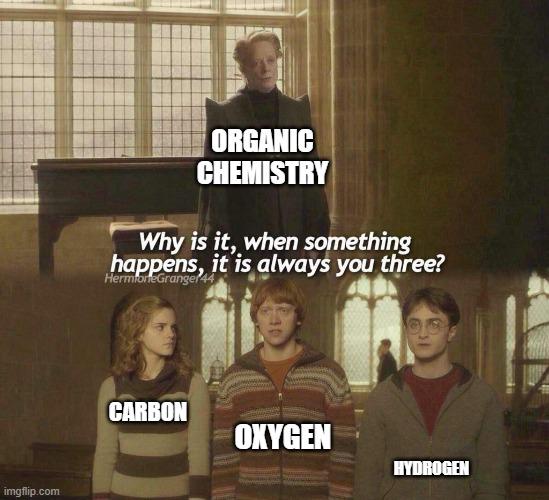
Organic chemistry calling out its favorite trio for causing all the drama. Carbon, hydrogen, and oxygen are basically the Hermione, Ron, and Harry of chemistry—wherever there's a reaction happening, you can bet these three are involved. From alcohols to carboxylic acids to sugars to literally every biomolecule, it's always the same suspects. Meanwhile, nitrogen is somewhere in the background feeling left out (but still shows up in amines and amino acids when needed). The meme perfectly captures how organic chemistry is essentially just watching these three elements rearrange themselves in increasingly creative ways while pretending each new combination is a completely different molecule. Spoiler alert: it's still just CHO doing their thing.

Is This Diagram Correct?

Is This Diagram Correct?
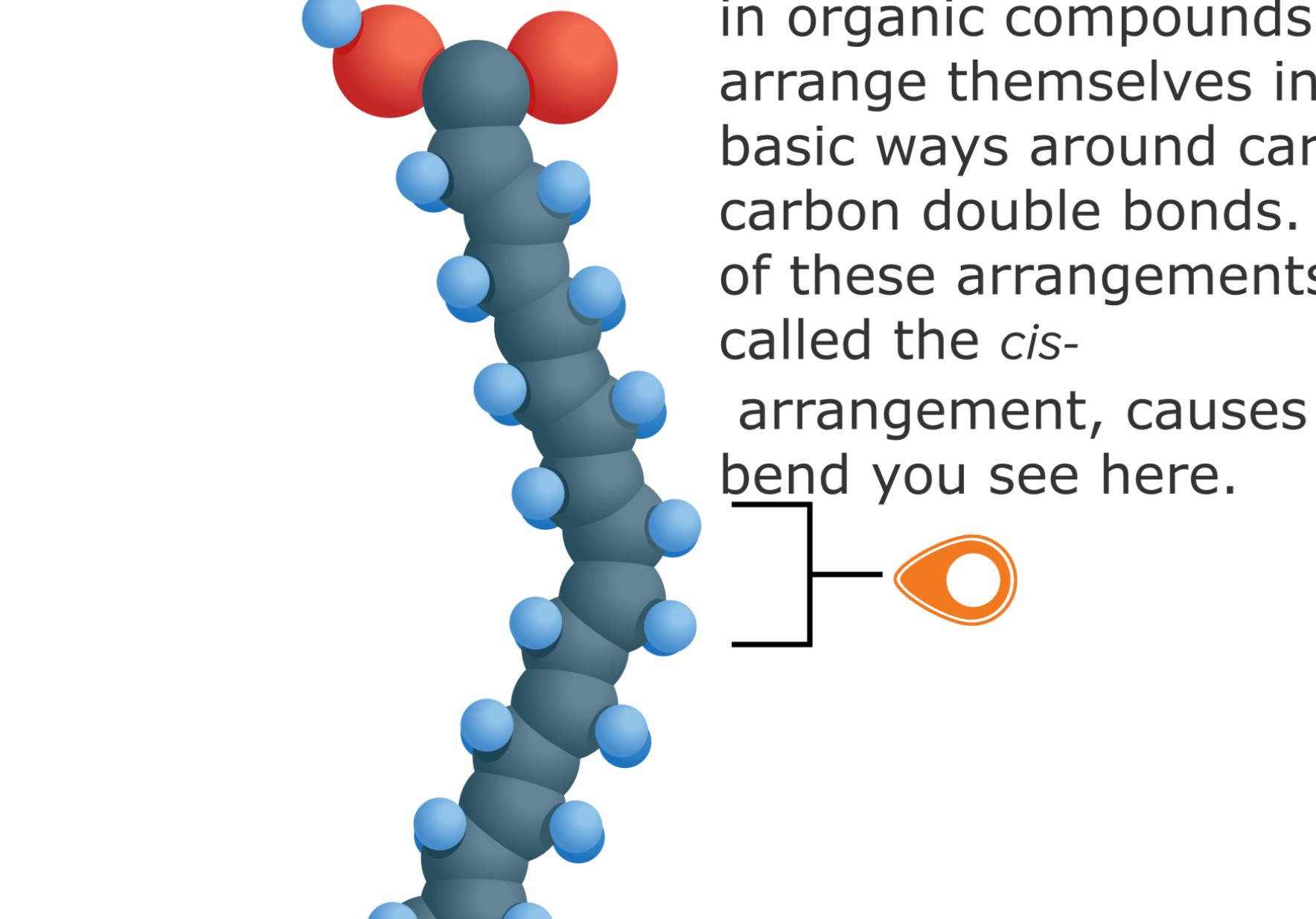
Someone's organic chemistry textbook is trying to explain cis -isomerism and molecular geometry, but instead created what looks like a carbon-based snake that's been hitting the gym. The text earnestly explains how carbon-carbon double bonds create rigid structures that can bend molecules... and then points to what appears to be the Loch Ness Monster made of hydrocarbons. For context: cis -arrangements around C=C double bonds DO cause bends in molecular structure because the double bond restricts rotation. But this diagram has taken "bend" to a whole new level—it looks less like oleic acid and more like a molecular conga line. The molecule is so dramatically curved it could qualify for a yoga instructor certification. The best part? The arrow pointing to a random spot on this carbon centipede like "yes, THIS is where the magic happens." That's not a bend, that's a full existential crisis in molecular form.

Relationship Issues

Relationship Issues
Nothing says "I love you" quite like a chemistry pun gone wrong. Someone tried to be clever by saying they're "hypochlorite" (the bleaching agent) instead of "hypocrite," but their partner clearly isn't having it after hearing this joke for the TENTH time. For context: hypochlorite is the active ingredient in bleach (NaOCl), and yes, it does technically "show its true colors" by oxidizing and breaking down colored compounds. But using it as relationship banter? That's a bond that's about to dissociate faster than HCl in water. The real tragedy here is that chemistry puns only work once, maybe twice if you're lucky. By the tenth repetition, you're not being punny anymore—you're just being a periodic annoyance. Some relationships can't survive the activation energy required to keep laughing at the same joke.

A Skeleton Is A Skeleton

A Skeleton Is A Skeleton
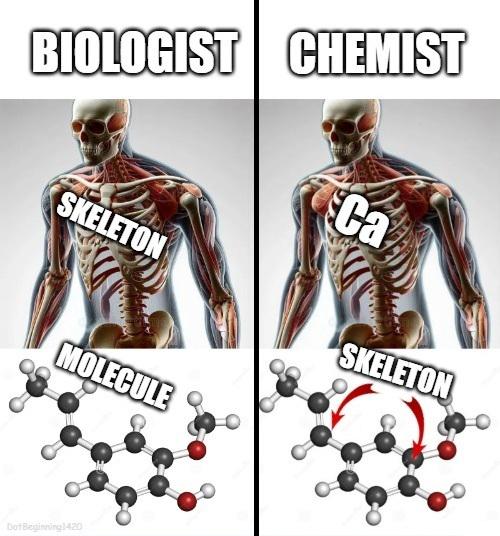
Here we have the fundamental philosophical divide between two scientific tribes. The biologist looks at a molecular structure and sees a beautiful skeleton—the carbon backbone that forms the framework of organic molecules. Meanwhile, the chemist looks at the exact same thing and just sees... Ca. Calcium. The literal skeletal element. It's like watching two people speak completely different languages while staring at the same picture. Biologists are out here getting poetic about carbon chains and molecular architecture, while chemists are like "yeah cool story bro, but that's just calcium doing calcium things in your bones." The real kicker? They're both right, which somehow makes it even funnier. One discipline named the concept after the structure, the other is just being painfully literal about what bones are actually made of. Classic interdisciplinary communication breakdown right there.

So-B Ased

So-B Ased
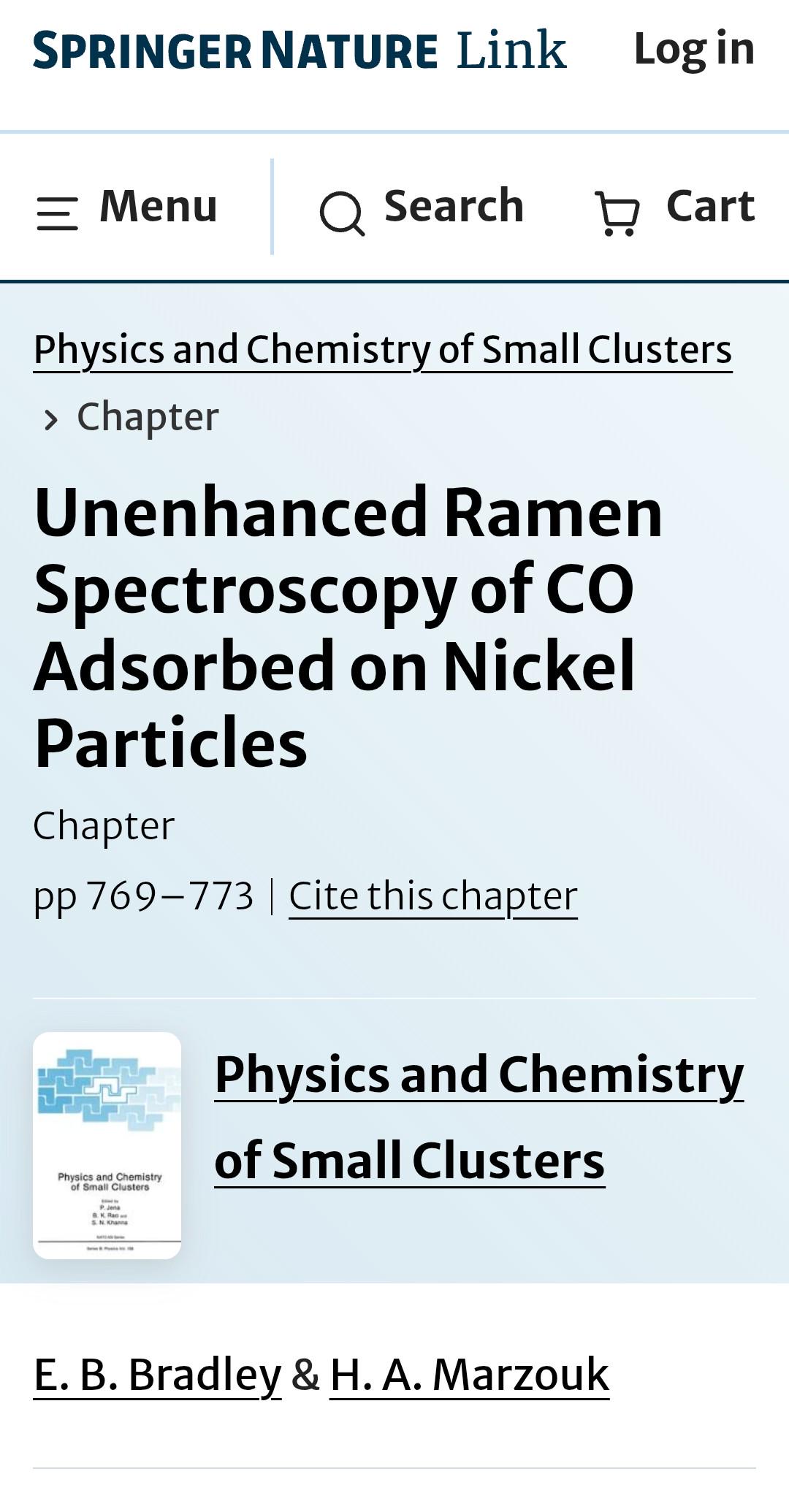
When you're studying CO (carbon monoxide) adsorbed on nickel particles and the paper title literally becomes a chemistry pun. "CO Adsorbed" = "CO-Adsorbed" which sounds exactly like "So based" in internet slang. The researchers knew EXACTLY what they were doing when they titled this chapter. Someone at Springer Nature really said "let's make surface chemistry cool" and honestly? Mission accomplished. The fact that this is real academic literature from a book called "Physics and Chemistry of Small Clusters" makes it even better. Bradley and Marzouk out here accidentally creating the most chemistry-bro title in spectroscopy history. It's giving "we're studying molecular interactions but make it Gen Z."

How Other STEM Majors Usually Use Their Hands Vs. Biology Majors 💀

How Other STEM Majors Usually Use Their Hands Vs. Biology Majors 💀
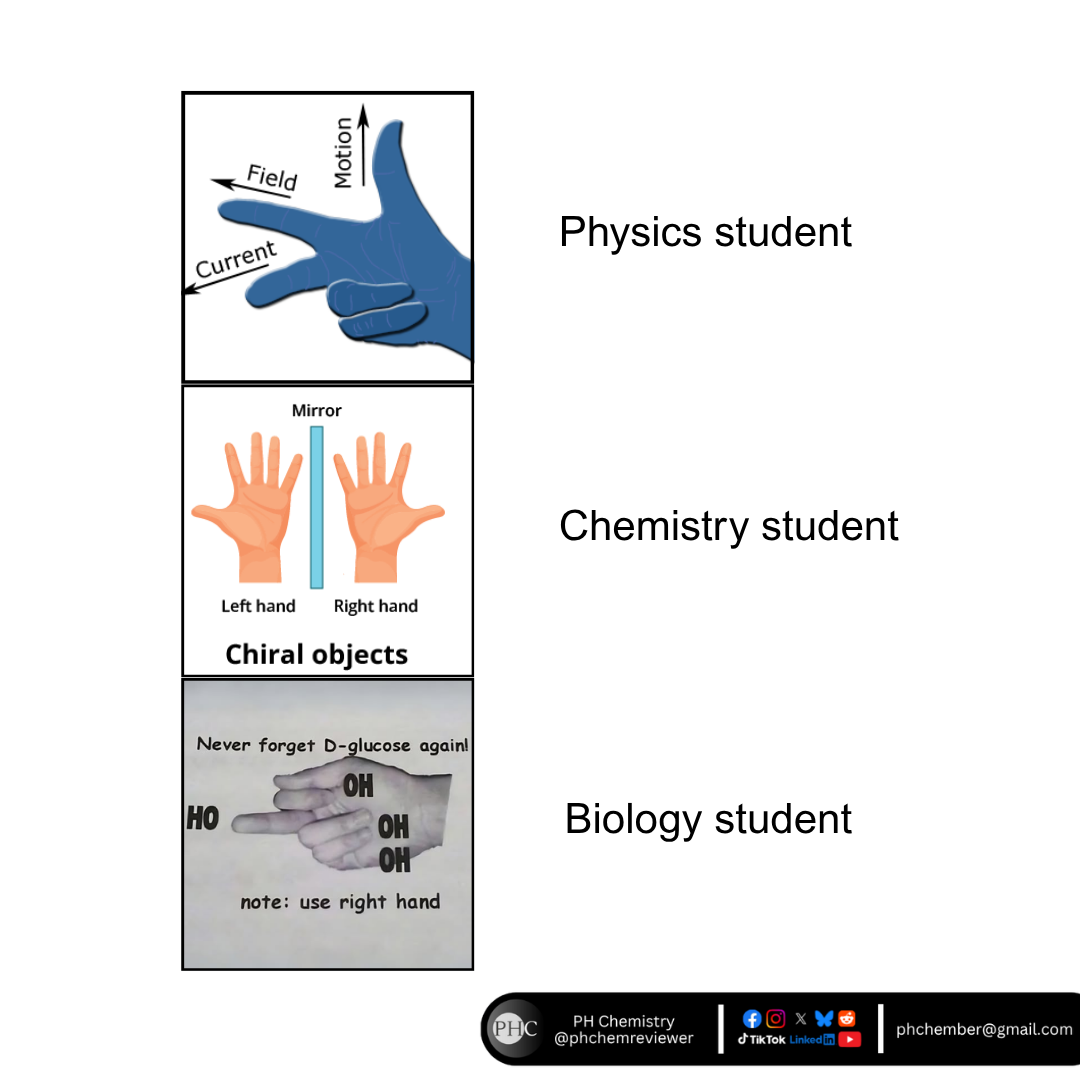
Physics students using the right-hand rule to figure out magnetic fields and current directions, chemistry students using their hands as mirror images to determine chirality... and then there's biology students literally turning their hand into a D-glucose molecule mnemonic device. The dedication to memorizing every single hydroxyl group position on that six-carbon sugar ring is REAL. While physics and chemistry students are out here doing elegant hand gestures for fundamental principles, biology majors are basically tattooing organic chemistry onto their fingers because there's no way anyone's remembering whether it's D-glucose or L-glucose without this hand trick. Fun fact: D-glucose (dextrose) is the most abundant monosaccharide in nature and the primary energy source for your cells right now. Your brain alone burns through about 120 grams of it daily. So yeah, biology students better not forget which way those OH groups point!

It's Not Only Me That Does This Right?

It's Not Only Me That Does This Right?
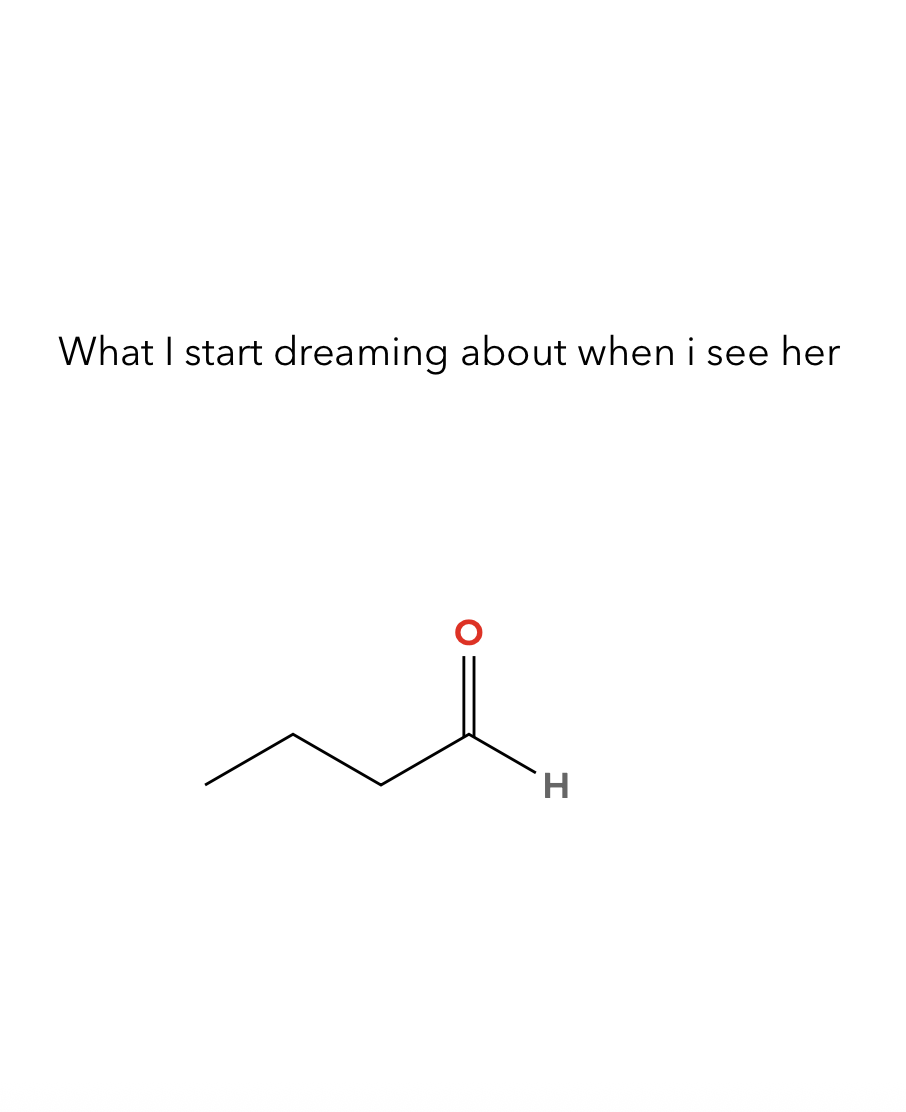
Chemistry students have a special kind of brain rot where they see butanal (C₃H₇CHO) and immediately think "beautiful." Like, you're just trying to live your life, maybe grab coffee, and suddenly you spot an aldehyde structure and your brain goes full romantic mode. Is it the perfectly symmetrical double bond? The way that oxygen just hangs there looking all electronegative? Who knows. But there's something oddly satisfying about a clean aldehyde structure that makes organic chemistry nerds weak in the knees. Normal people see their crush and think about their smile. Chemistry majors see butanal and start fantasizing about nucleophilic addition reactions. We're not okay, but at least we're not alone.

Me And The Girls After Taking Chemistry Advice From Google AI Search Mode

Me And The Girls After Taking Chemistry Advice From Google AI Search Mode
Google's AI search has a well-documented track record of suggesting you add glue to pizza and eat rocks for minerals. Apparently someone asked it for chemistry lab protocols and now everyone's just... vibing on the couch in various states of consciousness. The lab safety officer would like a word, but they're also passed out in the corner. This is what happens when you trust an LLM that was trained on Reddit posts to guide your experimental procedures. Somewhere, a chemistry professor is having stress-induced heart palpitations without knowing why.

Carbon Rules Supreme

Carbon Rules Supreme
Exobiologists (scientists who study the possibility of life beyond Earth) are basically the carbon-based life fan club, and they get VERY defensive when anyone suggests silicon could be a viable alternative. The joke here is that when someone brings up silicon-based life forms as a theoretical possibility, exobiologists immediately shut it down with the enthusiasm of someone explaining why sand is terrible. Silicon sits right below carbon on the periodic table and can form four bonds just like carbon, which is why sci-fi writers love it. But here's the thing: silicon bonds are weaker, silicon dioxide is a solid (aka sand/glass) instead of a gas like CO₂, and silicon just doesn't have carbon's chemical flexibility. So while theoretically possible under wildly different conditions, carbon remains the undisputed champion of biochemistry. The exobiologist's reaction is basically: "Sure, let me tell you exactly why your silicon dreams will crumble into... well, sand." Carbon supremacy forever! 💎

But Not Of The Elements

But Not Of The Elements
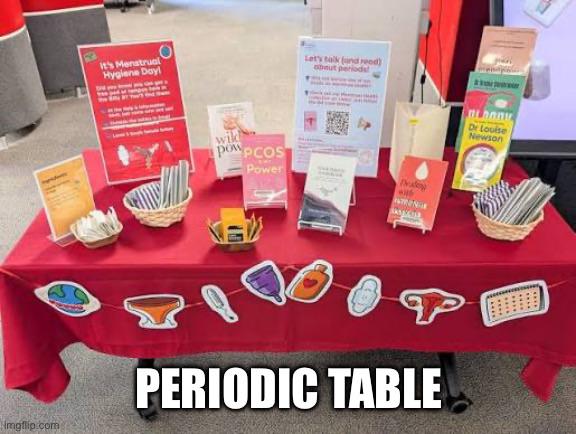
Chemistry teachers everywhere just felt a disturbance in the force. Someone set up a display table about menstrual health and period products, and naturally labeled it "PERIODIC TABLE" because wordplay is eternal. The table's got pamphlets about PCOS, menstrual cups, and educational materials—basically everything related to periods except the one Mendeleev would recognize. Props to whoever made those little uterus and pad stickers though; they're giving strong "we tried to make this approachable" energy. Dmitri Mendeleev is somewhere rolling in his grave while simultaneously appreciating the pun game.

Spectrum

Spectrum
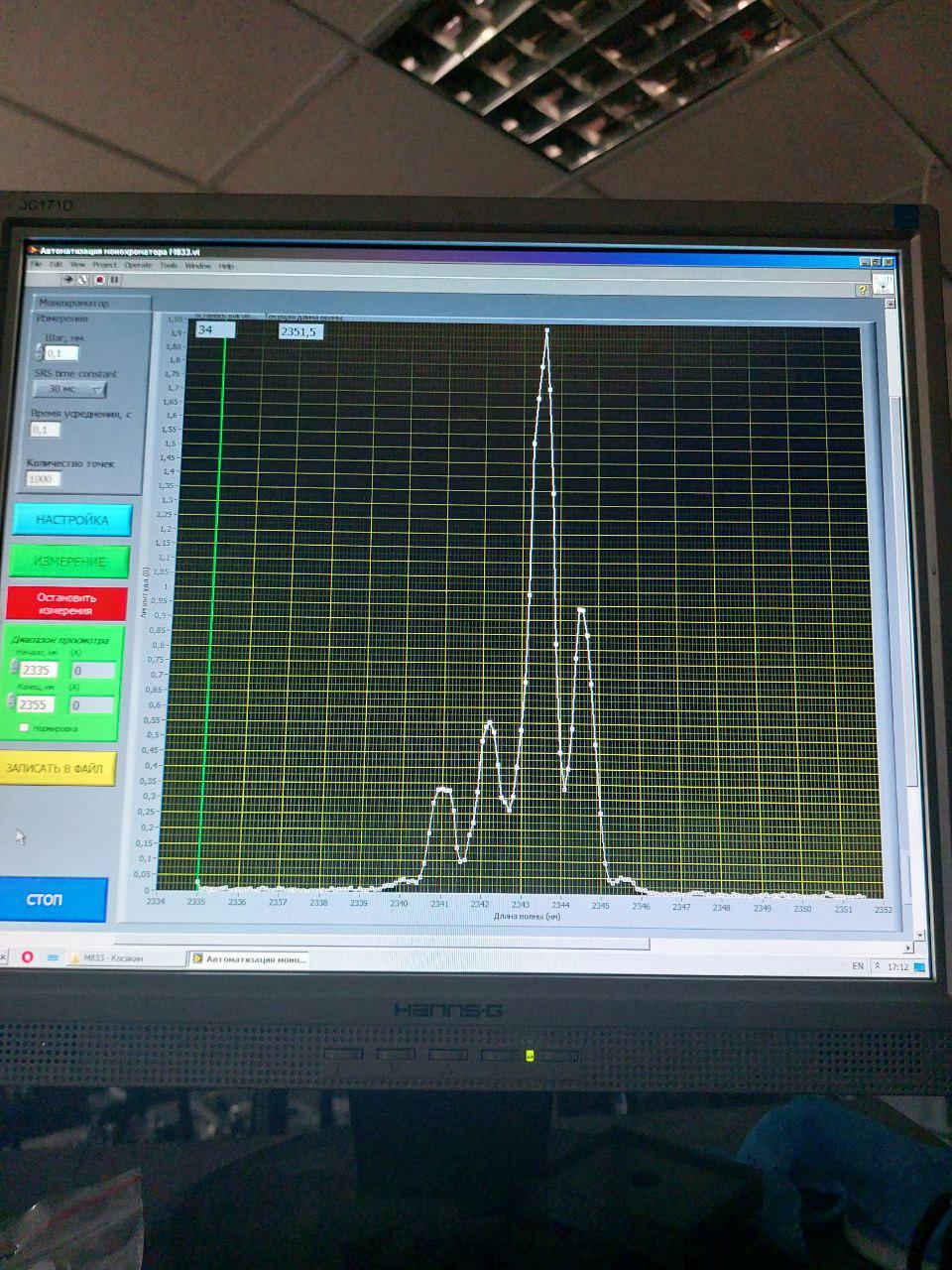
When your spectrometer data looks like a perfectly tuned middle finger pointing straight at your hypothesis, you know the universe has a sense of humor. That sharp peak around 2340 nm with those smaller satellite peaks? Nature just gave you the most eloquent "nope" in spectroscopic form. Scientists spend years perfecting their instruments, calibrating their equipment, and carefully designing experiments... only to have their data flip them off with stunning precision. The best part? You still have to write this up in your lab report with a straight face, probably calling it "an unexpected spectral feature" or "anomalous peak morphology." Meanwhile, everyone in the lab knows exactly what that spectrum is really saying about your expected results.