

Chain rule Memes

Posts tagged with Chain rule
It Don't Work That Way

It Don't Work That Way
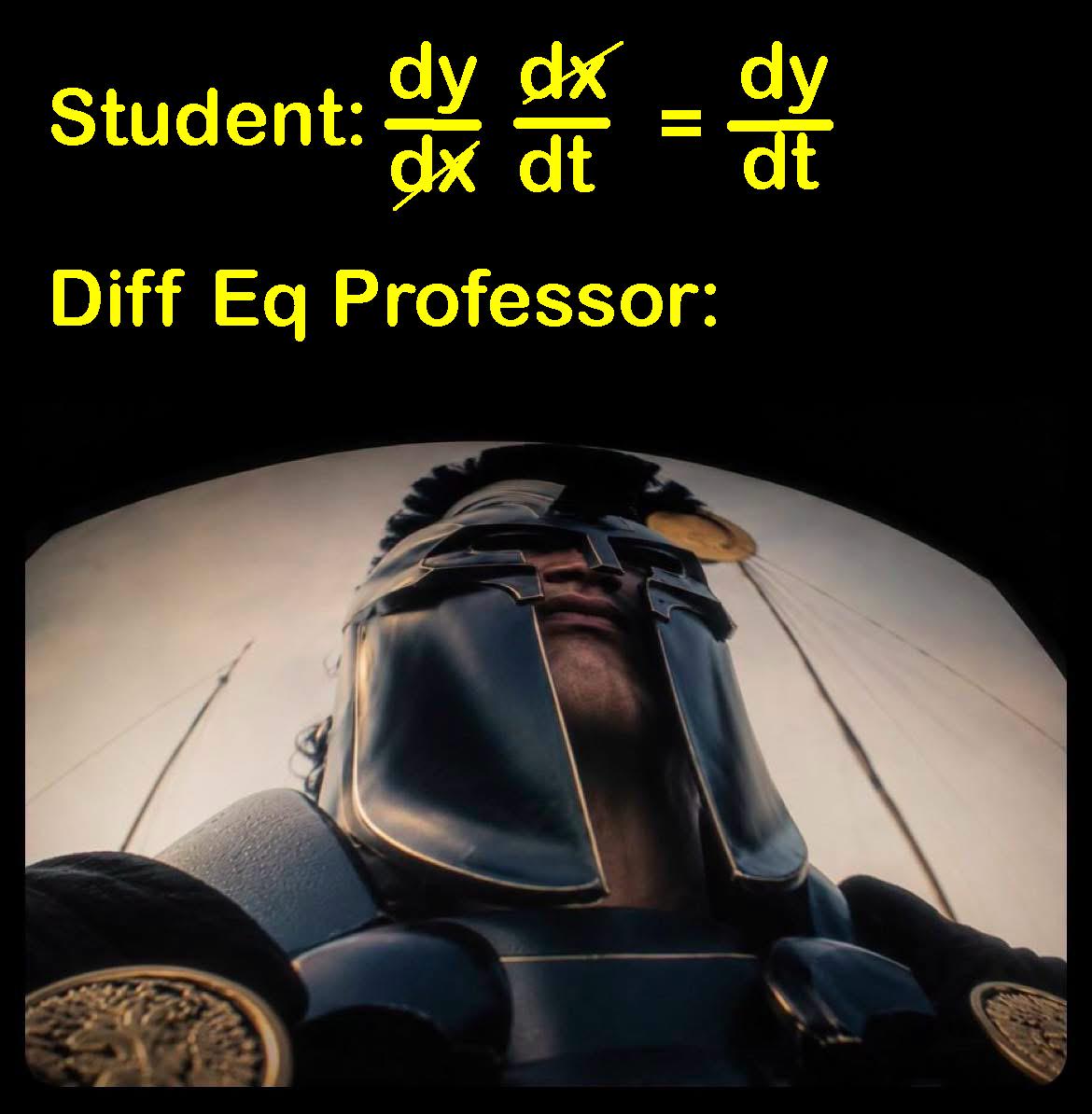
Every calculus student's favorite party trick: treating derivatives like fractions and just canceling stuff out. The student here is doing some algebraic gymnastics by "canceling" the dx terms like they're simple fractions, which... technically gives you the right answer but makes every differential equations professor age 10 years instantly. Here's the thing: the chain rule actually DOES give you dy/dt = (dy/dx)(dx/dt), so the student isn't wrong. They're just using freshman algebra logic on calculus notation, which is like using a hammer to perform surgery—it might work, but you're gonna give someone a heart attack watching you do it. The professor's horrified reaction is because while the notation looks like fractions, they're actually limits of ratios, and treating them as algebraic fractions is mathematically sketchy even if it works out. It's the mathematical equivalent of getting the right answer for the wrong reasons, and professors can smell that from a mile away.

I Challenged My Friend To Find (Xˣ)' And Got Exactly What I Deserved

I Challenged My Friend To Find (Xˣ)' And Got Exactly What I Deserved
The mathematical equivalent of a dad joke. Instead of solving for the actual value of (X X ), this person just wrote X·X X-1 , which is technically correct if you apply the chain rule for differentiation. It's like being asked to simplify a fraction and just writing "simpler fraction" underneath. The kind of solution that makes professors silently contemplate early retirement.

I Am Studying Calculus And This Is Deep

I Am Studying Calculus And This Is Deep
Behold the epic saga of trigonometric derivatives portrayed through the rise and fall of civilization! The top shows a mighty empire (like the derivative chain rule itself) where -cos(x) creates sin(x). Then we witness the mathematical circle of life continuing through each era - functions deriving functions in an eternal mathematical dance! The gradual descent into chaos perfectly mirrors how students feel when they realize these functions keep transforming into each other for eternity. It's the mathematical version of "what goes around comes around" but with more homework and existential dread!

My Tier List Of Derivative Rules

My Tier List Of Derivative Rules
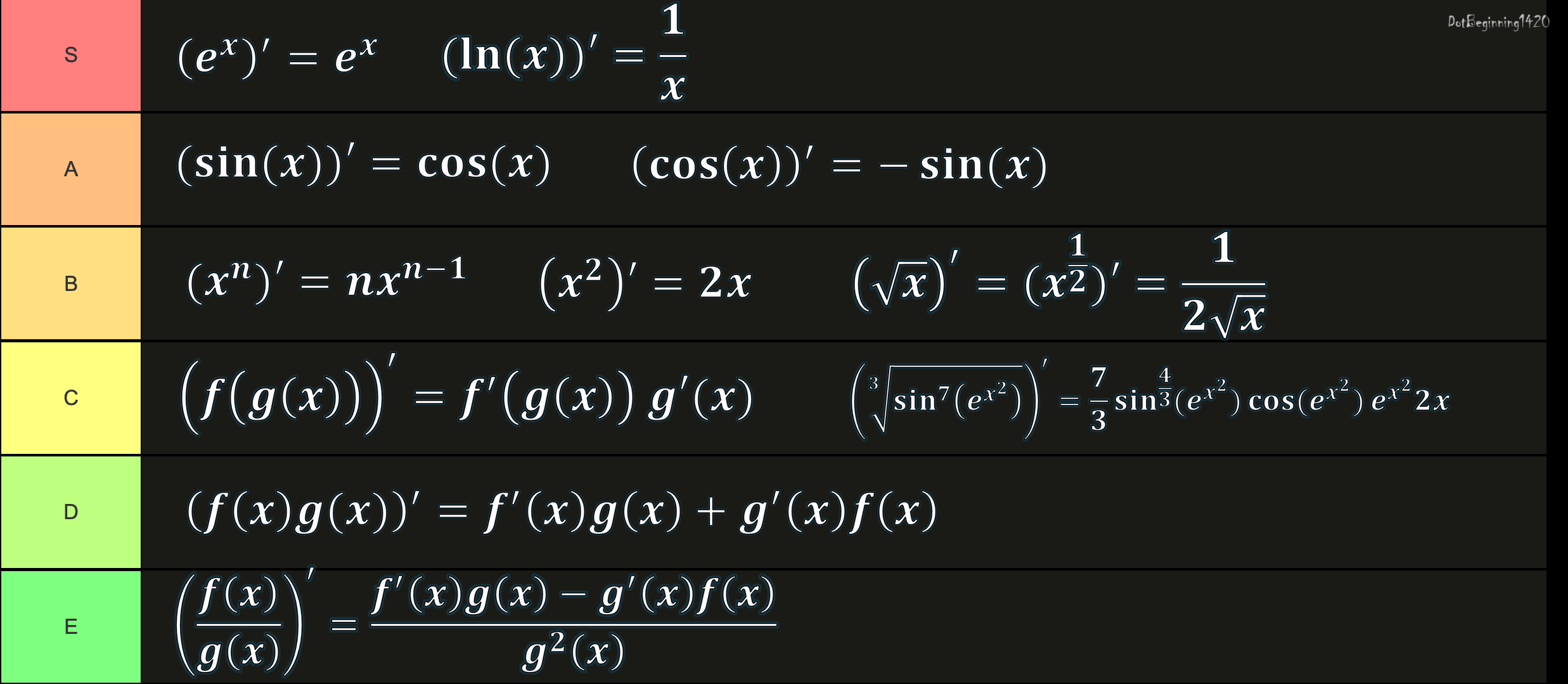
Behold! The sacred hierarchy of calculus suffering! 🧪 The exponential and logarithm rules sitting pretty in S-tier because they're basically showing off—differentiating themselves! Meanwhile, that chain rule in C-tier with its nested functions is the mathematical equivalent of Russian nesting dolls designed by a sadist. And don't get me started on the quotient rule in E-tier... it's the calculus version of "I heard you like fractions so I put fractions in your fractions." Every math student knows the true tier list is based on how many tears were shed per formula!

The Calculus Conspiracy They Don't Want You To Know

The Calculus Conspiracy They Don't Want You To Know
The calculus conspiracy has finally been exposed! What they're showing is the chain rule for derivatives being simplified by canceling out the "dx" terms like they're fractions - which is mathematically illegal but somehow gives the right answer. It's like cooking meth but for differential equations. Math professors have been screaming "YOU CAN'T CANCEL THE DIFFERENTIALS LIKE THAT!" for centuries while secretly knowing it works anyway. Big Calculus doesn't want you questioning their authority!

Calculus Amnesia Millionaire

Calculus Amnesia Millionaire
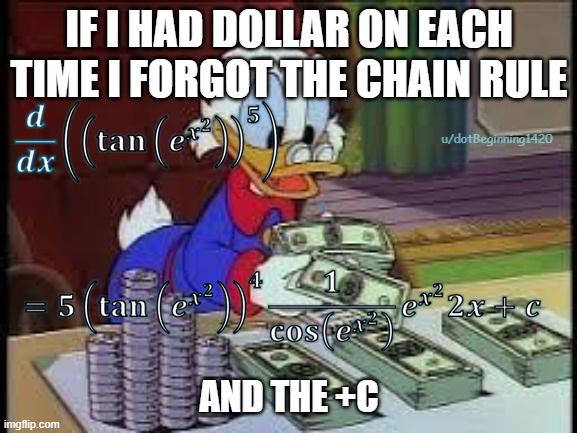
The eternal struggle of calculus students everywhere! That derivative with nested functions looks like Scrooge McDuck's worst nightmare. The chain rule (differentiating composite functions) and remembering the +C for indefinite integrals are the twin villains of every calculus exam. Students would be filthy rich if they got paid for each time they messed these up. The irony is perfect - showing the correct application of both concepts while joking about forgetting them. I've seen students write "+C" in their wedding vows just to make sure they never forget again.

The Holy Grail Of Calculus

The Holy Grail Of Calculus
Every calculus student's fever dream! The post claims to have found the mythical "chain rule for integration" - which is basically like claiming you've spotted Bigfoot riding a unicorn. Integration by parts, substitution, partial fractions... we have those. But a simple chain rule for integration? That's why the meme shows someone clutching "the sacred texts" - because such a discovery would be the mathematical equivalent of finding the Holy Grail. Mathematicians have been crying into their coffee for centuries because the reverse chain rule isn't as elegant as its differentiation counterpart. Sorry to burst your bubble, but if you're still hunting for this mathematical unicorn, you might as well search for a proof that P=NP while you're at it.

Calculus Classmates Be Like...

Calculus Classmates Be Like...
The mathematical equivalent of "well yes, but actually no." The first student confidently applies the power rule for derivatives (d/dx of x^n = nx^(n-1)) but skips the chain rule entirely. The correct approach would involve the chain rule since we're differentiating 7^2 with respect to 7. It's like watching someone get the right answer using completely wrong methods—the mathematical equivalent of failing successfully. That hesitant "you're not wrong but..." response is what every math tutor internally screams before launching into a 20-minute explanation about proper differentiation techniques.

Are They Fractions?

Are They Fractions?
The eternal confusion of calculus newcomers! The equation shows the chain rule in action, where those aren't fractions but actually derivative notation. Physics students learn this mathematical sleight-of-hand where dv/dx looks like a fraction (and sometimes behaves like one) but represents the rate of change of v with respect to x. The character's bewilderment is the universal reaction of students encountering calculus notation for the first time and thinking "wait, can I just cancel these terms like regular fractions?" Spoiler: sometimes you can, but for reasons that would make your calculus professor have an existential crisis.

Real Men Use First Principles Every Time

Real Men Use First Principles Every Time
The calculus gatekeepers have spoken! At the top, we have the elegant definition of differentiation—a beautiful limit that captures the essence of instantaneous change. Below that? The chaotic battlefield where mathematicians store their emotional trauma. Every time you memorize a derivative formula instead of deriving it from first principles, a mathematician somewhere sheds a single tear. Sure, you could painfully work through the chain rule from scratch every time... or you could just accept that these formulas are the mathematical equivalent of therapy. Remember kids, real mathematicians derive everything from scratch—and also never sleep, subsist entirely on coffee, and have "lim h→0" tattooed somewhere inappropriate.

The Schrödinger's Fraction Paradox

The Schrödinger's Fraction Paradox
The eternal calculus paradox that haunts undergrads everywhere. First, the professor confidently states that du/dt = (du/dx)(dx/dt), treating du/dx like a perfectly normal fraction. Then when a student dares to ask if du/dx is actually a fraction, suddenly it's "No." Welcome to mathematics, where we use fraction notation for things that aren't fractions, cancel terms that technically can't be canceled, and somehow still get the right answer. Schrödinger's fraction—simultaneously a fraction and not a fraction until a student asks about it.

Chain Rule Applied

Chain Rule Applied
The eternal mathematical paradox that haunts physics students everywhere! d/dt is simultaneously an operator (it tells you to take the derivative with respect to time) AND can be treated as a fraction when applying the chain rule. Physics professors love to switch between these interpretations mid-equation without warning, leaving students questioning their sanity. It's like Schrödinger's notation - both a fraction and not a fraction until a physicist needs to solve a particular problem!