
Calculus Memes

Posts tagged with Calculus

Ha Ha Ha

Ha Ha Ha
When you've been doing calculus for so long that basic arithmetic becomes a trap. Someone asks "what's 9+5?" and your brain, which has been trained to spot trick questions and complex patterns, immediately goes into overdrive. "Wait, is this a factorial problem? Is that exclamation mark part of the answer?" So you confidently answer "4!" (four factorial = 4×3×2×1 = 24) when they literally just wanted you to say 14. Classic case of being so smart you circle back to being wrong. Your math professor would be simultaneously proud and disappointed.

The Real Reason Newton Chose His Notation

The Real Reason Newton Chose His Notation
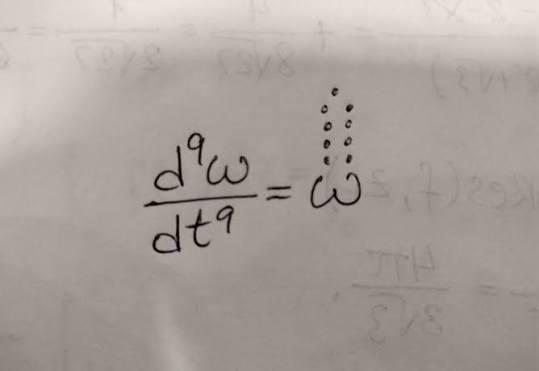
Newton's derivative notation strikes again with maximum chaos energy. The equation shows d q ω/dt q = ω̇ (omega with dots above it), and honestly, this is the most Newton thing ever. While Leibniz was out here inventing clean, logical notation that clearly shows what you're differentiating with respect to what, Newton was like "nah, I'll just slap some dots on top and call it a day." The joke here is that Newton's dot notation (those dots floating above the ω) looks suspiciously like he just... kept adding dots for higher-order derivatives. Need a second derivative? Two dots. Third? Three dots. It's the mathematical equivalent of naming your variables x, xx, xxx. The "q" superscripts on the left side suggest this is a q-th order derivative, which would require q dots stacked vertically in Newton's notation—basically turning into a dotted line ascending to the heavens. Plot twist: Newton probably chose this notation specifically because it was easier to write by hand in the 1600s. But looking at it now? It's like he designed it to confuse physics students three centuries later. Mission accomplished, Isaac.

The Answer Is 1

The Answer Is 1
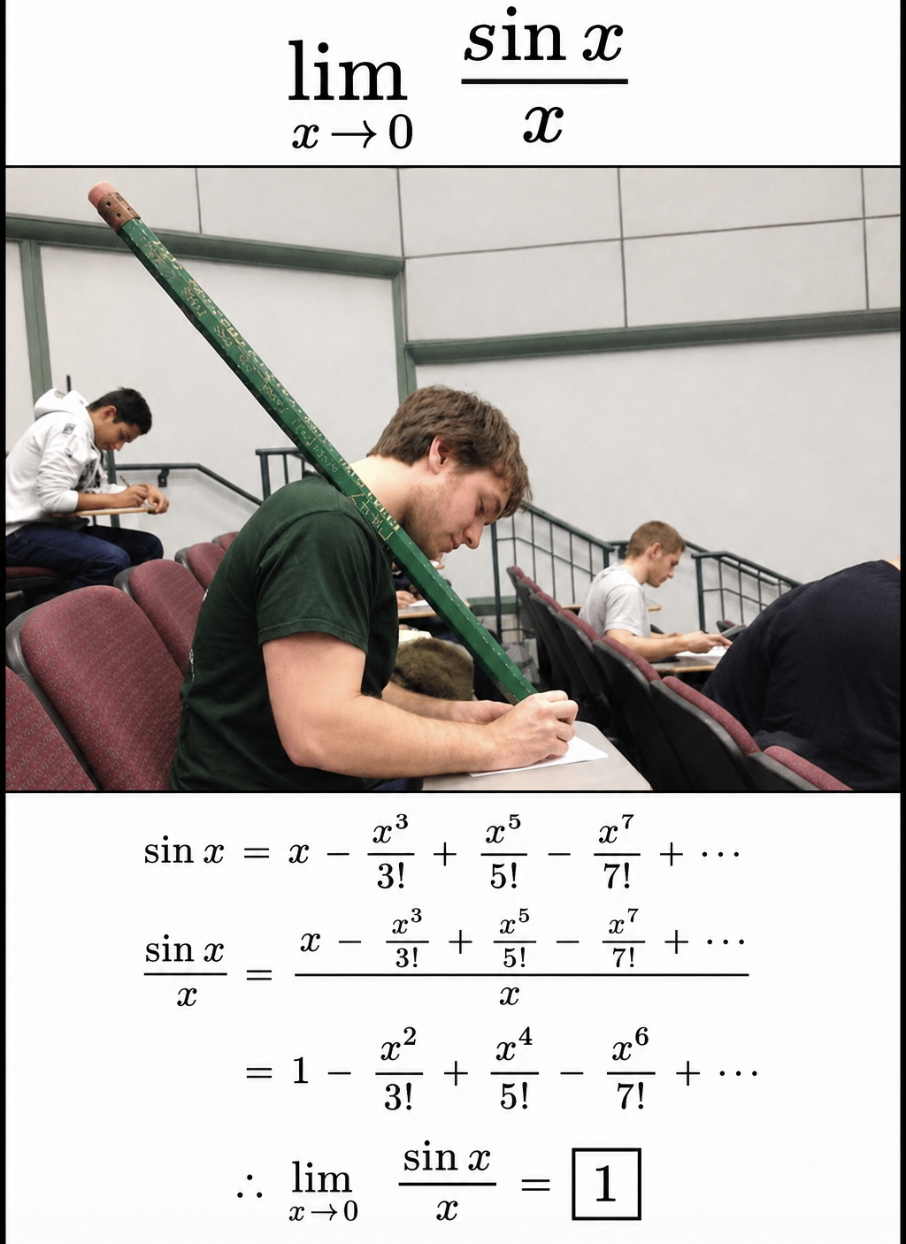
You know that limit that shows up in literally every calculus course? The one where sin(x)/x approaches 1 as x goes to 0? Yeah, it's elegant and beautiful on paper. But getting there requires busting out the Taylor series expansion like you're defusing a bomb—carefully dividing terms, canceling x's, and praying you don't mess up the factorials. Meanwhile, that giant pencil hovering menacingly over the student perfectly captures the existential weight of proving something so "simple." The proof involves expanding sin(x) into an infinite series, dividing everything by x, then watching as x approaches 0 and all those higher-order terms vanish into mathematical oblivion. What remains? Just 1. Clean, pure, inevitable. The pencil represents every professor who's ever said "this is trivial" before writing three blackboards worth of algebra. Fun fact: this limit is actually the foundation for deriving the derivative of sine, so if you ever wondered why d/dx(sin x) = cos x, blame this bad boy right here.

More Efficient Way To Count

More Efficient Way To Count
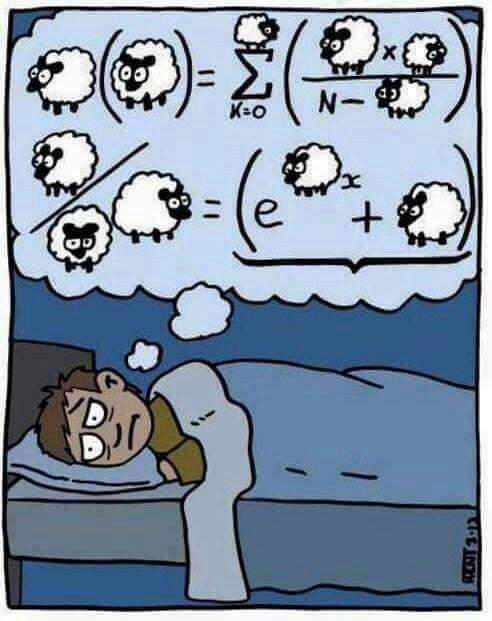
So instead of counting sheep the normal way like a peasant, this person decided to use summation notation and exponential functions to fall asleep. Because nothing says "relaxation" quite like mentally computing ∑(k=0 to N-∞) of sheep or solving e^sheep + sheep. This is peak mathematician energy—turning a simple bedtime ritual into an unnecessarily complex mathematical exercise. The best part? They're probably lying there wide awake trying to figure out what N-∞ even means (spoiler: it's mathematically cursed) instead of actually sleeping. Pro tip: If you need calculus to count sheep, you've already lost the battle against insomnia. Just accept your fate and scroll through memes like the rest of us.

Superiority Complex

Superiority Complex
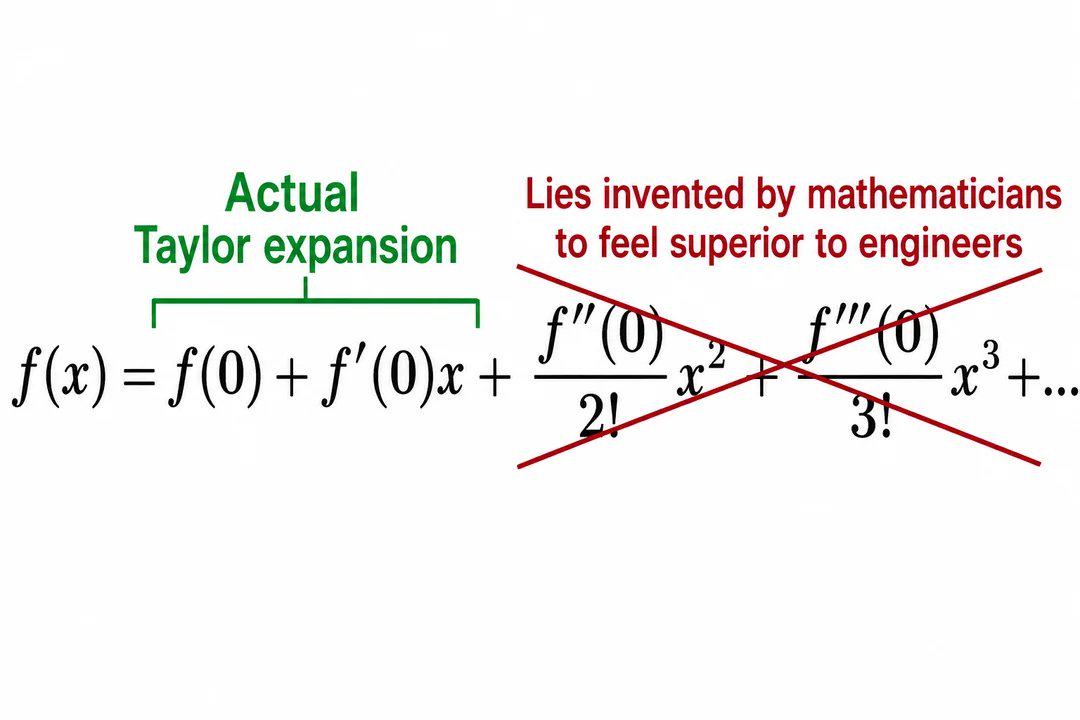
Engineers think they're hot stuff until mathematicians remind them that Taylor series actually has infinite terms. But here's the dirty little secret: engineers just use the first couple terms and call it a day because, honestly, who needs accuracy beyond the second derivative when you're building bridges that only need to stand for 100 years? The Taylor expansion is basically a way to approximate complicated functions using polynomials—you keep adding more derivative terms to get closer to the real thing. Mathematicians worship the full infinite series in all its glory. Engineers? They'll truncate it faster than you can say "margin of error" and still sleep soundly at night. This is the eternal math vs. engineering rivalry in one equation. Mathematicians get to feel intellectually superior while engineers actually get things done with "good enough" approximations. Both think they're better than the other, and honestly? They're both right.

The Escalator Of Regret

The Escalator Of Regret
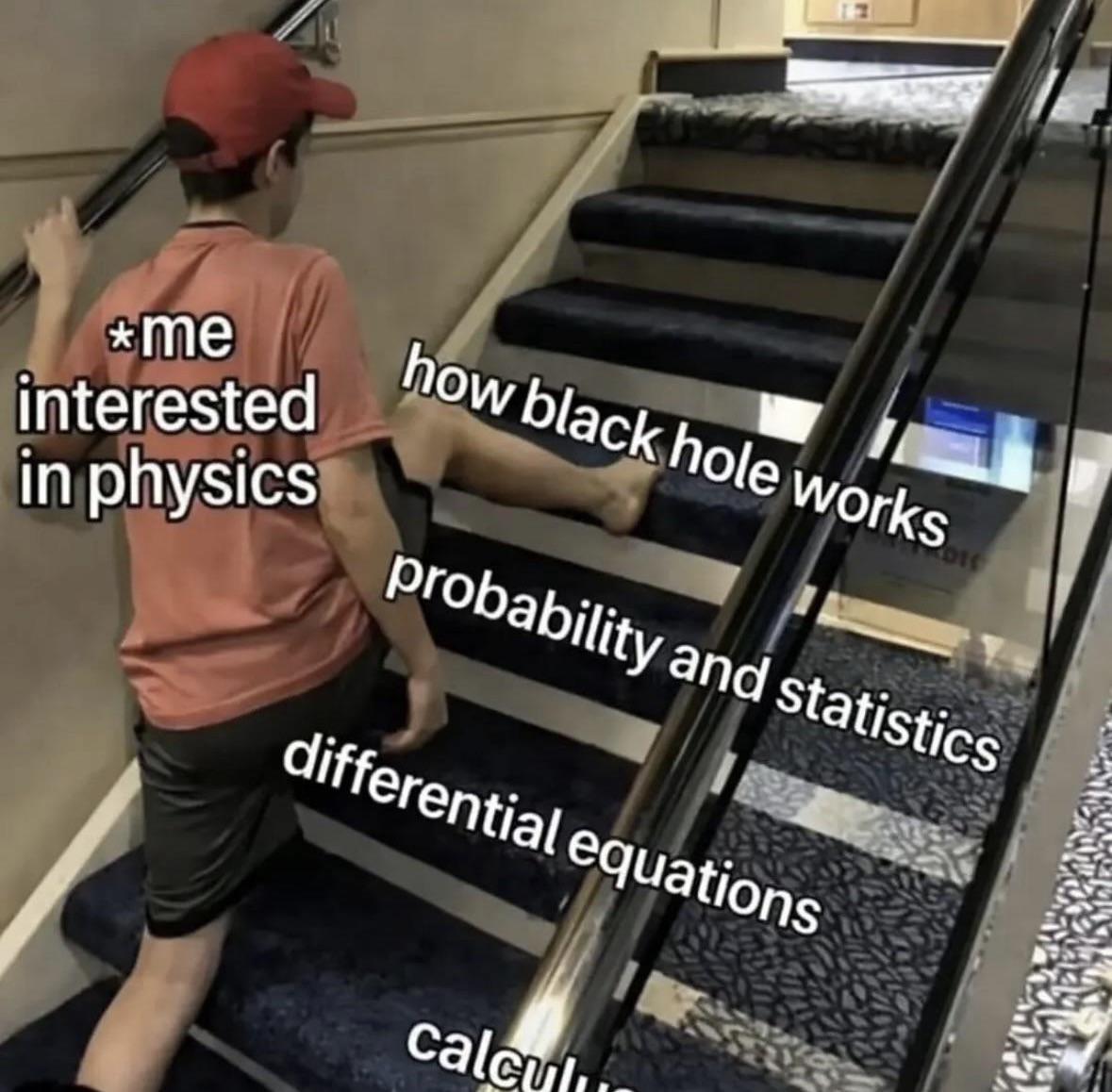
You start out thinking black holes and general relativity are cool, maybe watch a few YouTube videos about spacetime curvature. Next thing you know, you're drowning in probability distributions, wrestling with partial differential equations, and calculus has become your sleep paralysis demon. Physics has this beautiful way of luring you in with mind-bending concepts about the universe, then immediately punishing you with the mathematical machinery needed to actually understand any of it. The escalator only goes down, friend—and there's no emergency stop button.

The Only Time My Degree Makes Me Feel Like A Genius

The Only Time My Degree Makes Me Feel Like A Genius
Engineering students spend years wrestling with differential equations, thermodynamics, and complex analysis, only to realize their superpower is... basic arithmetic. Meanwhile, pre-med students are over here memorizing the entire human body, thousands of drug interactions, and obscure disease pathways, but ask them to calculate a tip at a restaurant and suddenly they're looking at you like you just asked them to solve the Riemann hypothesis. The beautiful irony here is that engineering curricula are basically four years of mathematical torture—calculus, linear algebra, differential equations, numerical methods—while medical students focus on memorization and pattern recognition. So when a med student needs help with integrals or probability, engineering students get that rare dopamine hit of feeling intellectually superior. It's like being Einstein for exactly 3 minutes before returning to your regularly scheduled existential crisis about job prospects. Fun fact: both groups will end up making more money than math PhDs, who actually understand what they're doing.

Delta Airlines vs Nabla Airlines

Delta Airlines vs Nabla Airlines
So apparently the Greek letter Delta (Δ) gets you a nice functioning airplane cruising smoothly through the clouds, while its mathematical cousin Nabla (∇) gets you... whatever that crashed disaster is sitting in the snow. For those who slept through vector calculus: Delta typically represents change or difference, while Nabla is the del operator used for gradients, divergence, and curl. Basically, Delta is straightforward—"here's the change"—while Nabla is the overachiever that has to calculate rates of change in every possible direction simultaneously. The visual metaphor writes itself: one symbol gets you reliable transportation, the other gets you a catastrophic failure frozen on a runway. Maybe Nabla tried to optimize its flight path in too many dimensions at once? Should've stuck with simple Δx and Δy instead of computing the gradient field of air resistance.

For Those Who Were Asking For Translation...

For Those Who Were Asking For Translation...
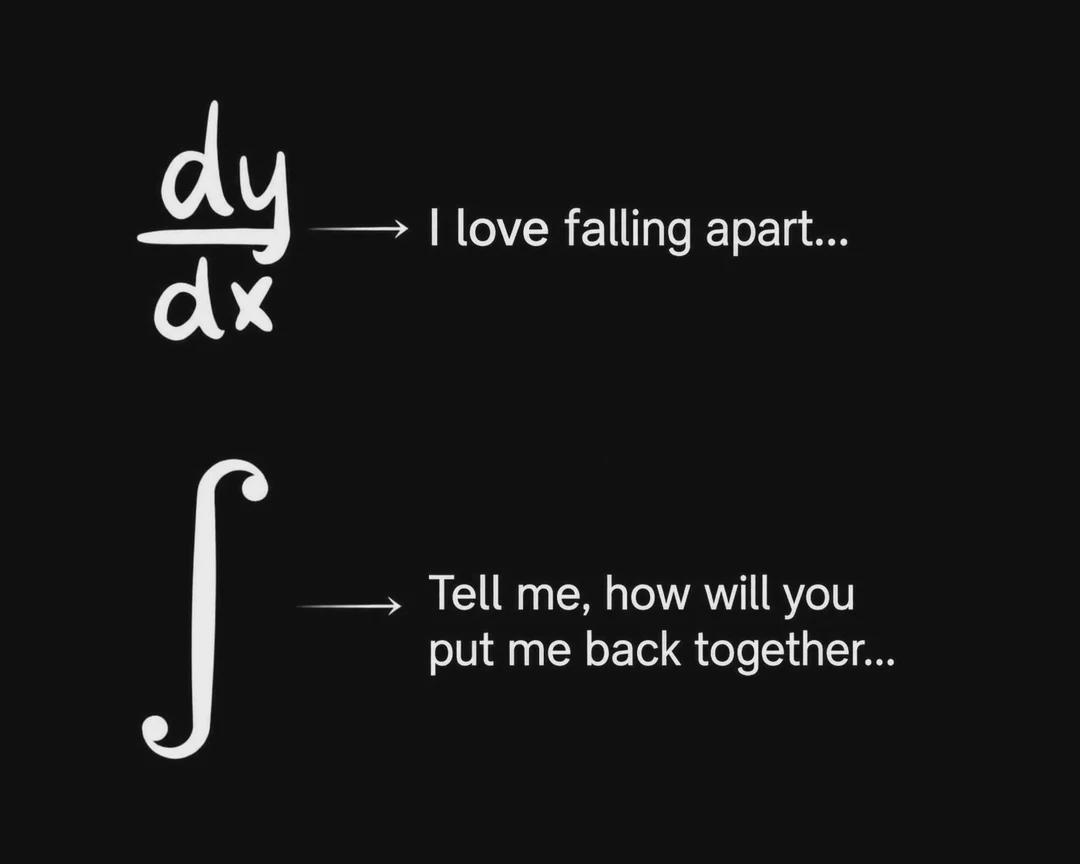
Someone just turned calculus notation into a breakup anthem and honestly, it's devastatingly accurate. The derivative dy/dx literally represents the rate of change—how fast y is changing with respect to x—so it's basically measuring how quickly things are falling apart. Very relatable for anyone who's ever watched their function (or relationship) differentiate into chaos. But then the integral ∫ swoops in with the existential question: how do we reverse this process? Integration is the inverse operation of differentiation, so if dy/dx represents things breaking down, then ∫ should theoretically piece everything back together. Except anyone who's tried to solve an integral knows it's WAY harder than taking a derivative. Sometimes there's no closed-form solution. Sometimes you need numerical methods. Sometimes you just cry and use Wolfram Alpha. The emotional weight here is chef's kiss because integration doesn't always give you back what you started with—you get that pesky constant of integration (+C) that represents all the information lost during differentiation. So even if you DO manage to integrate, you're never quite whole again. Mathematics really said "let me give you trust issues."

True, False And Can't Talk About It Bro

True, False And Can't Talk About It Bro
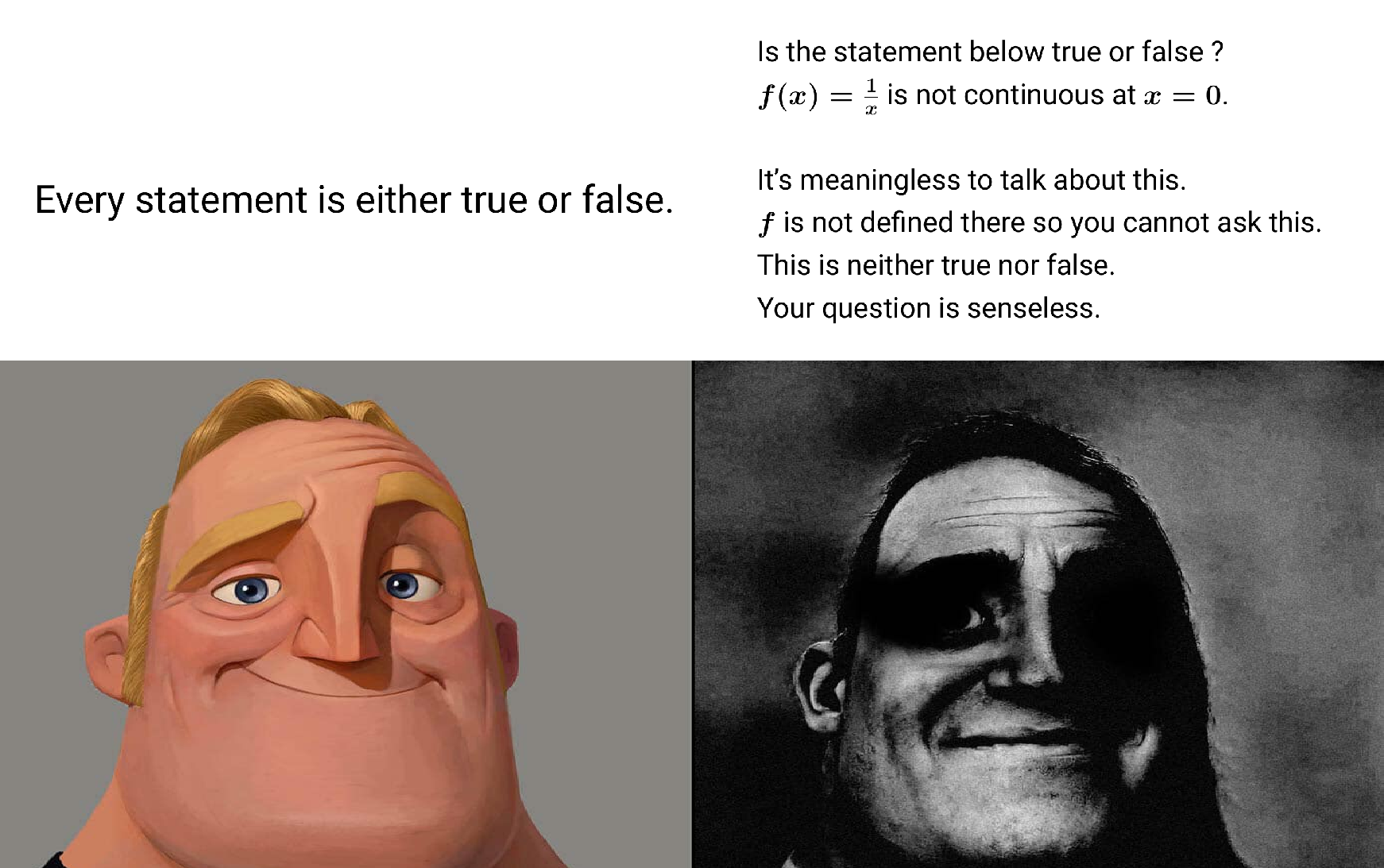
You know that smug feeling when you think you've got logic all figured out? Yeah, calculus just entered the chat to humble you. The function f(x) = 1/x literally doesn't exist at x = 0 because dividing by zero is the mathematical equivalent of asking "what color is Tuesday?" The question itself is broken! So when someone asks if the statement "f(x) is not continuous at x = 0" is true or false, mathematicians are like "bruh, the function isn't even DEFINED there, so we can't discuss its continuity." It's like asking if your imaginary friend is tall or short. The premise is flawed from the start! That's why this perfectly captures the third option beyond true/false: "this question is nonsense and we need to have a serious conversation about domain restrictions." Mathematics really said "not every question deserves an answer" and I respect that energy.

Was I Wrong Or Does That Subreddit Have Zero Tolerance For Humour?

Was I Wrong Or Does That Subreddit Have Zero Tolerance For Humour?
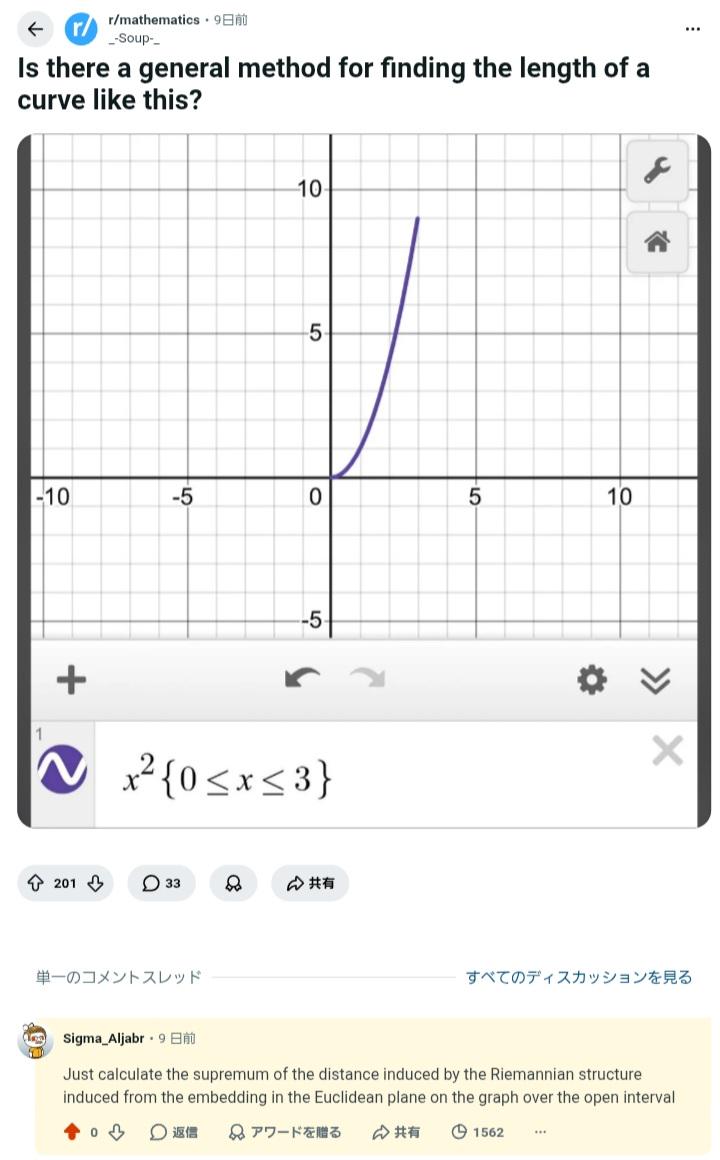
Someone innocently asked r/mathematics how to find the length of a curve, and this absolute legend responded with the most unnecessarily overcomplicated word salad possible: "Just calculate the supremum of the distance induced by the Riemannian structure induced from the embedding in the Euclidean plane on the graph over the open interval." Translation for mortals: "Use calculus to add up tiny segments along the curve." But why say that when you can sound like you're defending a PhD thesis at 2 AM while simultaneously having a stroke? The real answer is arc length integration, which for this x² curve would be ∫√(1 + (2x)²)dx from 0 to 3. Simple, elegant, teachable. But nope—someone decided to flex their entire differential geometry vocabulary instead. The mathematical equivalent of using a flamethrower to light a birthday candle. And judging by the title, r/mathematics did NOT appreciate the comedy. Mathematicians: proving once again they can solve complex integrals but can't detect sarcasm to save their lives.

Which Side Are You On?

Which Side Are You On?
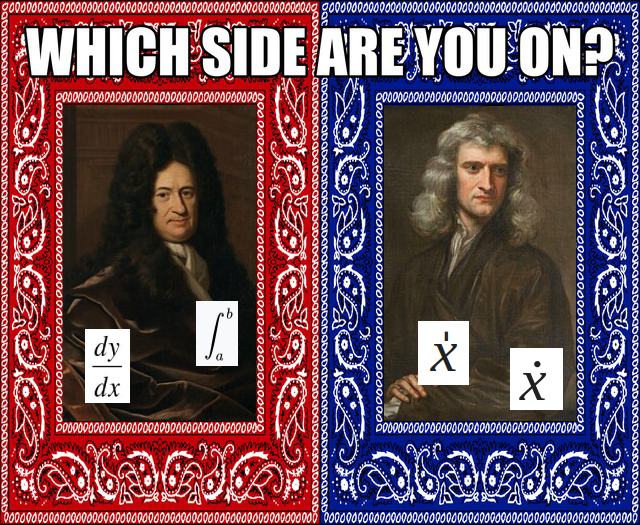
This is basically the Crips vs Bloods of mathematics. On the red side, we've got Leibniz with his dy/dx notation for derivatives—smooth, elegant, and looks like actual fractions (even though they're not, but shhhh). On the blue side, there's Newton rocking the dot notation for derivatives, keeping it simple and clean. The funny thing? These two literally invented calculus independently around the same time and got into one of history's pettiest academic beefs about who did it first. Their rivalry was so intense it split European mathematics for generations. Leibniz's notation won the popularity contest though—most of us learn dy/dx in school because it's way more intuitive for showing what's actually happening. Newton's dot notation still shows up in physics for time derivatives, so both gangs are still repping to this day. Choose your fighter wisely—your calculus professor is judging you.