
Vector calculus Memes

Posts tagged with Vector calculus

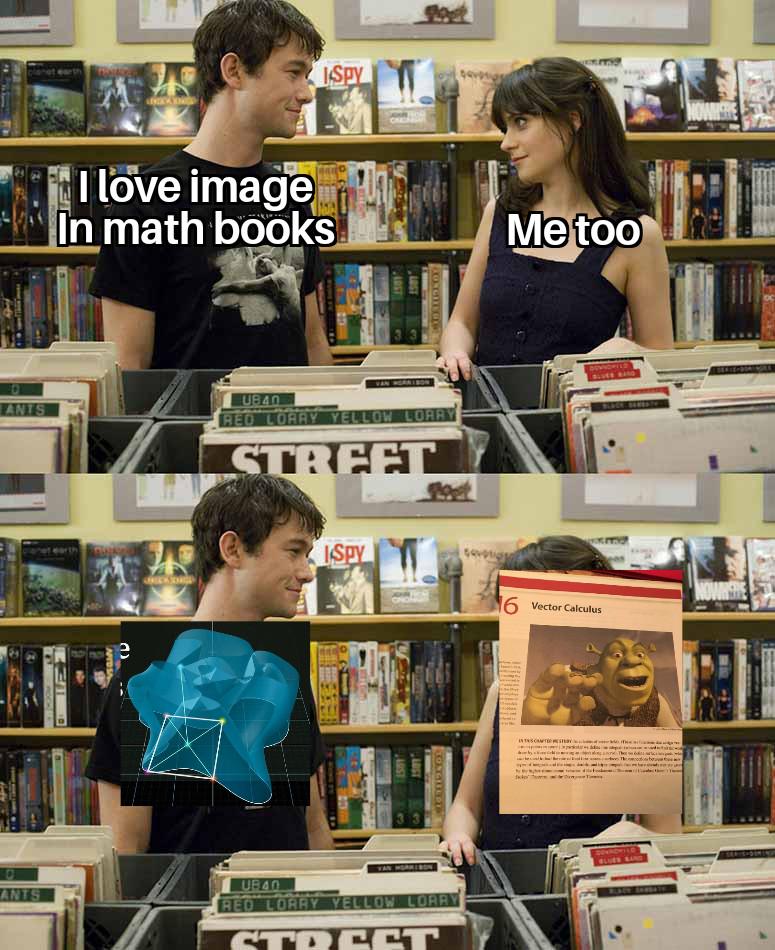
When Math Textbooks Use Shrek To Explain Vector Calculus

When Math Textbooks Use Shrek To Explain Vector Calculus
The eternal paradox of math textbooks: they either show you incomprehensible abstract geometry that looks like it was drawn by someone having a seizure with a ruler, or they throw in completely random pop culture references as if Shrek will somehow make partial derivatives click in your brain. Nothing says "I understand vector fields now" like seeing an ogre explain curl and divergence. Next semester they'll use SpongeBob to demonstrate Fourier transforms. The textbook publishers are just trolling us at this point.

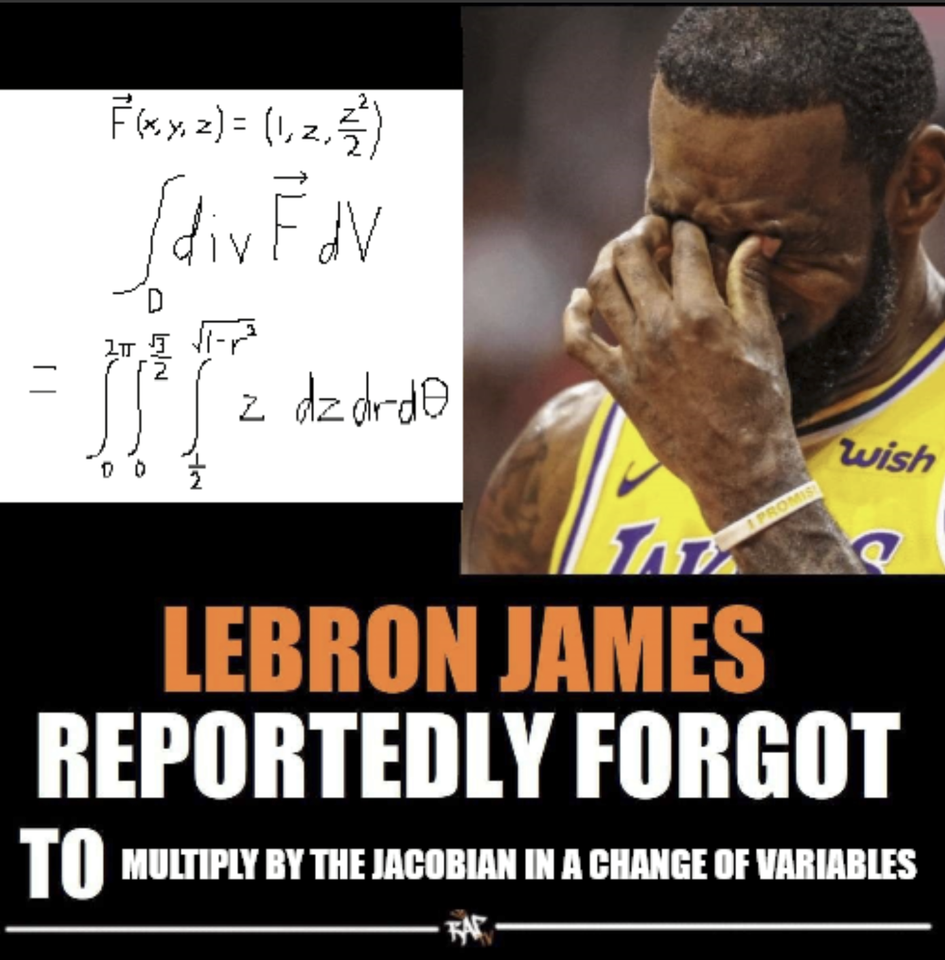
Calc 3 Final Got Me Good

Calc 3 Final Got Me Good
Even basketball royalty can't escape the wrath of vector calculus! The meme shows a complex triple integral with spherical coordinates that would make any math student weep uncontrollably. The punchline? Our basketball hero supposedly "forgot to multiply by the Jacobian" - which is basically the mathematical equivalent of showing up to the NBA Finals without shoes. For the uninitiated math mortals: when converting between coordinate systems (like Cartesian to spherical), you need this thing called a Jacobian determinant to make sure your integrals don't turn into mathematical nonsense. Forgetting it is the classic blunder that sends Calc 3 students spiraling into existential crisis mode! Next time you miss a free throw, just blame it on forgetting the Jacobian. Works every time! 🧮✨

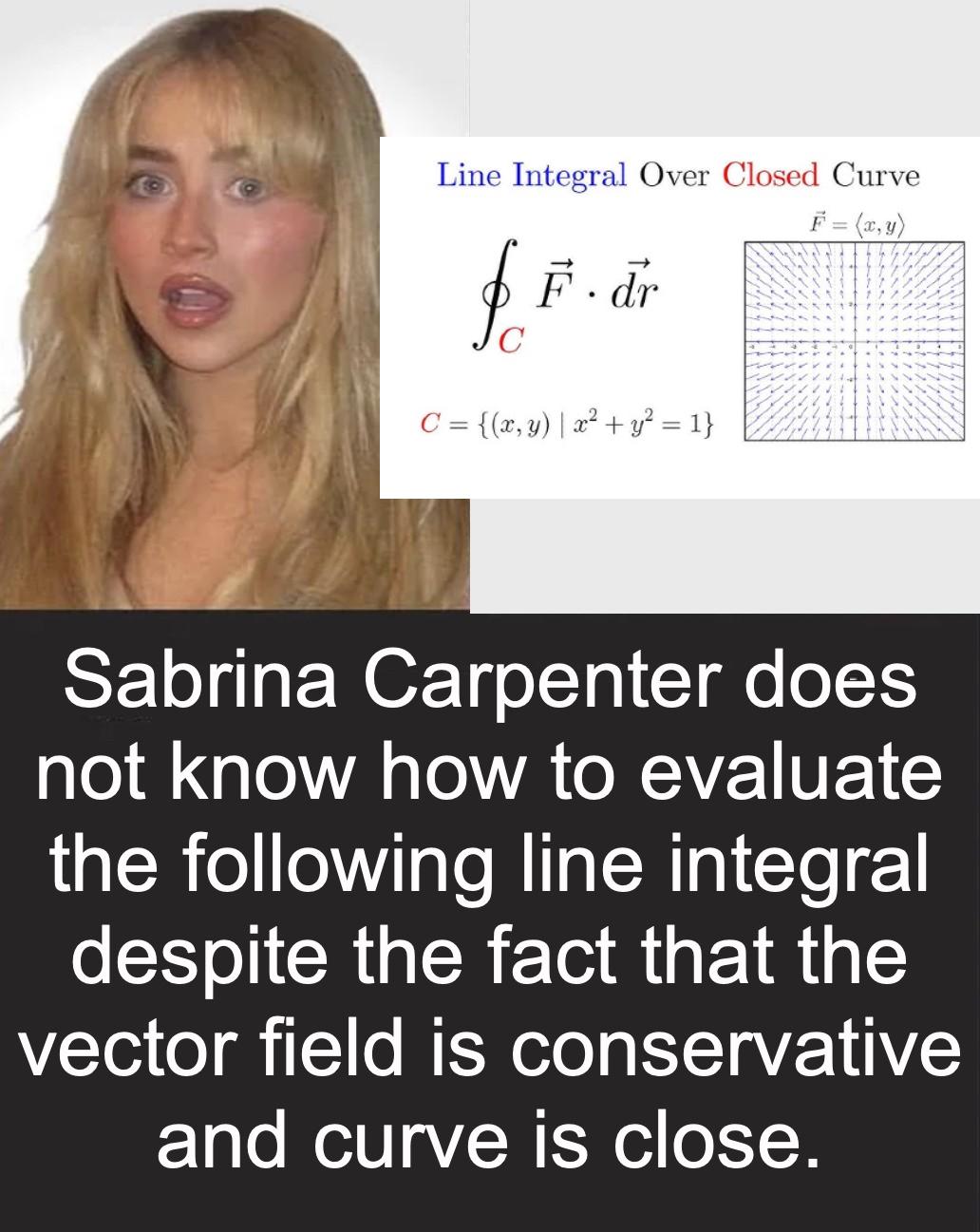
The Conservative Field Shortcut

The Conservative Field Shortcut
The shocked expression perfectly matches anyone facing a line integral that's practically begging to be solved with Stokes' theorem! That vector field F = <x,y> is clearly conservative (∇ × F = 0), and with a closed curve (literally a unit circle), the integral equals zero by fundamental theorem of calculus for line integrals. It's basically free points on a calculus exam! The look of horror is every math student realizing they spent 20 minutes computing parameterizations when they could've just written "0" and moved on. Even first-year calculus students know conservative vector fields over closed curves integrate to zero—it's practically the "free parking" space of vector calculus!

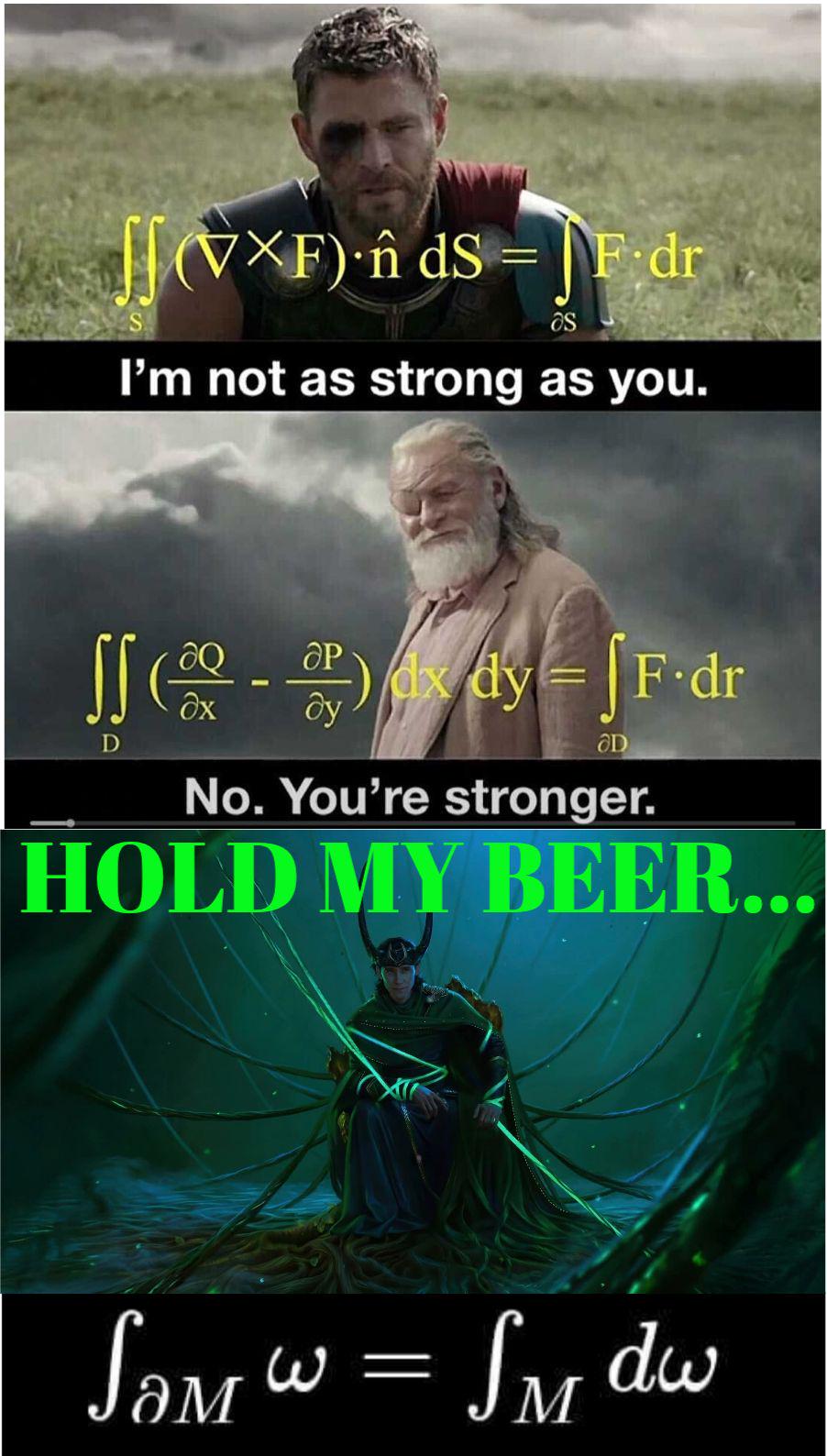
The Mathematical Flex Battle

The Mathematical Flex Battle
Ever witnessed a mathematical flex battle? First we've got Stokes' theorem trying to look tough, then Green's theorem comes in with the "actually, I'm stronger" energy, but then... BAM! The conservation of angular momentum drops the mic on both of them. It's like watching calculus nerds fight with increasingly sophisticated weapons. The progression from surface integrals to line integrals to conservation principles is basically the physics equivalent of "you call that a knife? THIS is a knife!" The beautiful irony? They're all saying the same thing in different mathematical languages. Classic physics showboating. Next time you're struggling with vector calculus, remember - it's just fancy math flexing in a trenchcoat.

Physics: Definitely Not Wizardry With Math

Physics: Definitely Not Wizardry With Math
Physics professors are fighting a losing PR battle here. "No no, we're not summoning eldritch horrors with these symbols—it's just vector calculus!" Meanwhile, they're literally playing with glowing rocks that can vaporize cities and making apples float with "totally not magic" invisible forces. The desperate underlining of "not magic" is the scientific equivalent of saying "I'm not drunk" while stumbling into a lamppost. The equations and diagrams look suspiciously like something you'd find in a medieval grimoire, but with more partial derivatives and fewer goat sacrifices. Though the jury's still out on what's happening in that bottom right corner...

It's All Just Stokes' Theorem

It's All Just Stokes' Theorem
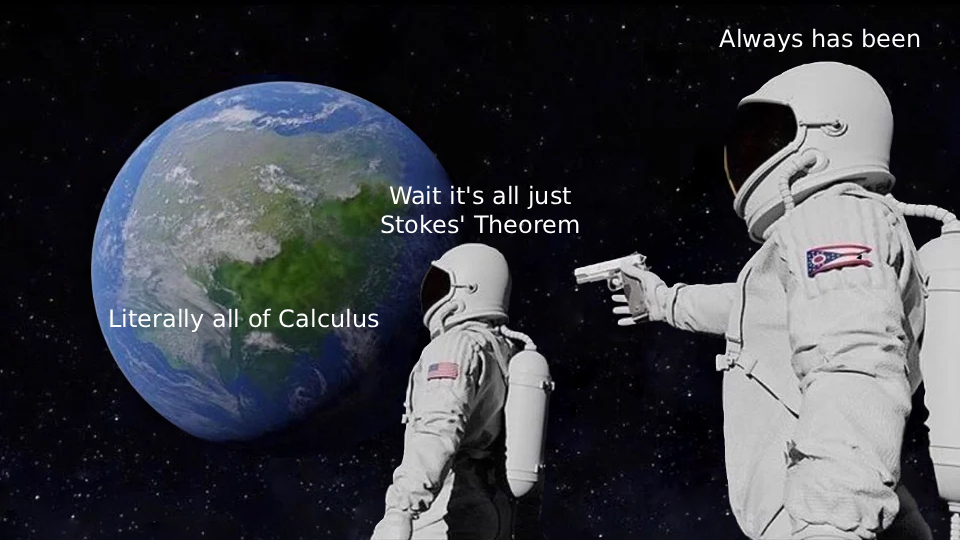
That moment when you realize the universe is just a giant integral. Spent years struggling through Green's theorem, Stokes' theorem, Gauss' theorem... only to discover they're all just special cases of one equation. The mathematical equivalent of finding out your entire research career could've been a one-line proof. Students in the back of the lecture hall never stood a chance.

My Crimes Have Both Direction And Magnitude

My Crimes Have Both Direction And Magnitude
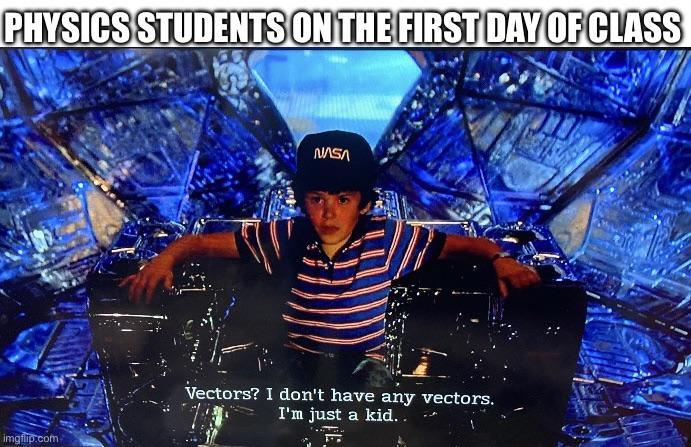
First day of physics class and you're already being assaulted by terms like "vectors" while your brain is still in summer mode. The title is a brilliant play on Vector's catchphrase from Despicable Me ("committing crimes with both direction AND magnitude!") mixed with the existential dread of every freshman who thought physics would be "fun." Spoiler alert: by week three, you'll be drawing free-body diagrams in your sleep and unconsciously calculating the trajectory of your falling self-esteem.

Flag Of Sweden If Jesus Died On A Cross Product

Flag Of Sweden If Jesus Died On A Cross Product
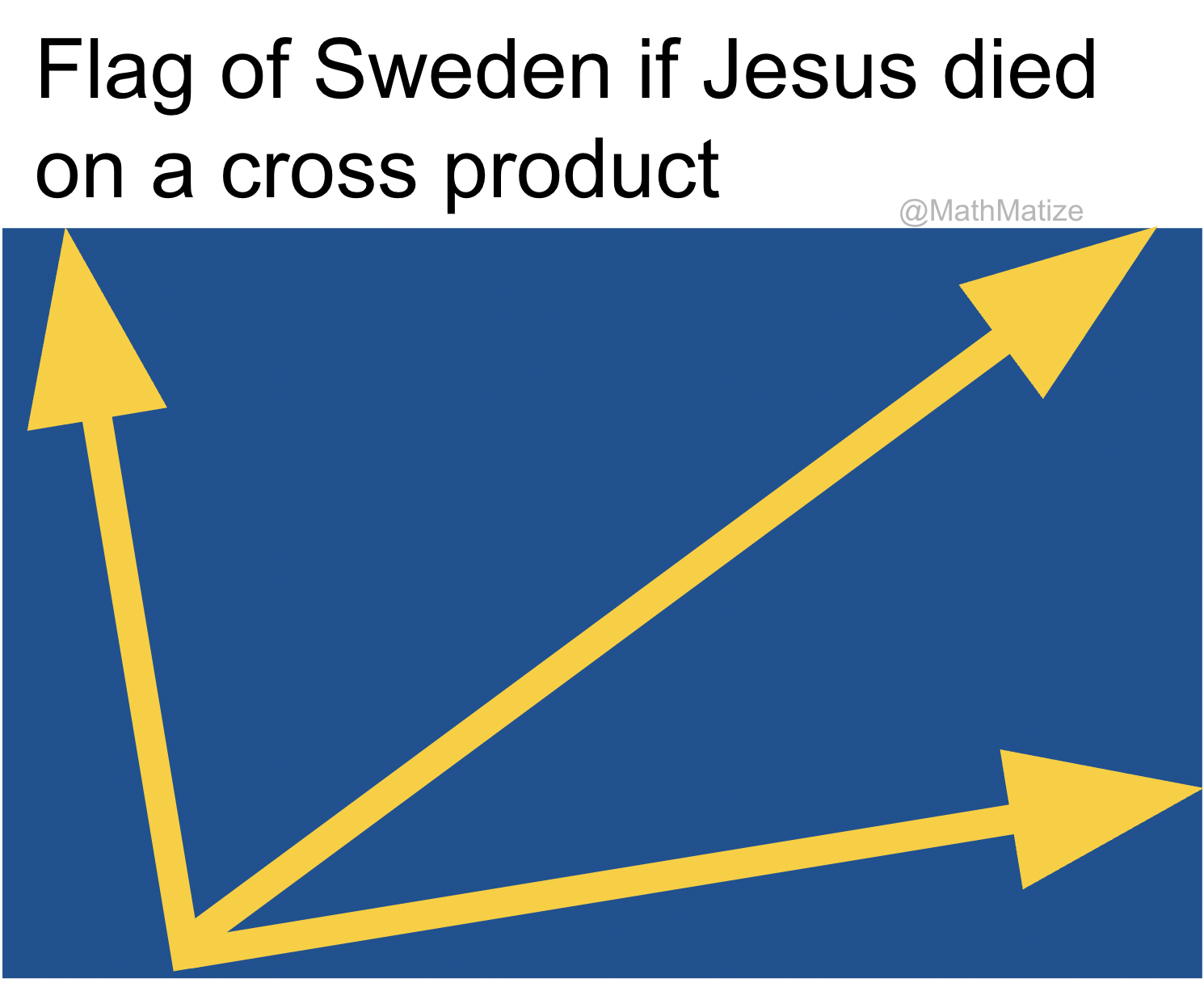
This is mathematical brilliance disguised as a flag redesign! The meme transforms Sweden's iconic blue and yellow cross flag by replacing it with vector arrows representing a cross product in linear algebra. In mathematics, a cross product results in a vector perpendicular to two input vectors, creating this arrow-based design instead of the traditional cross shape. The historical/religious reference adds an extra layer of clever wordplay since "cross" has dual meaning here. Vector calculus students are silently nodding in appreciation while everyone else wonders why Sweden suddenly looks like a physics diagram.

The Spider-Theorem Of Vector Calculus

The Spider-Theorem Of Vector Calculus
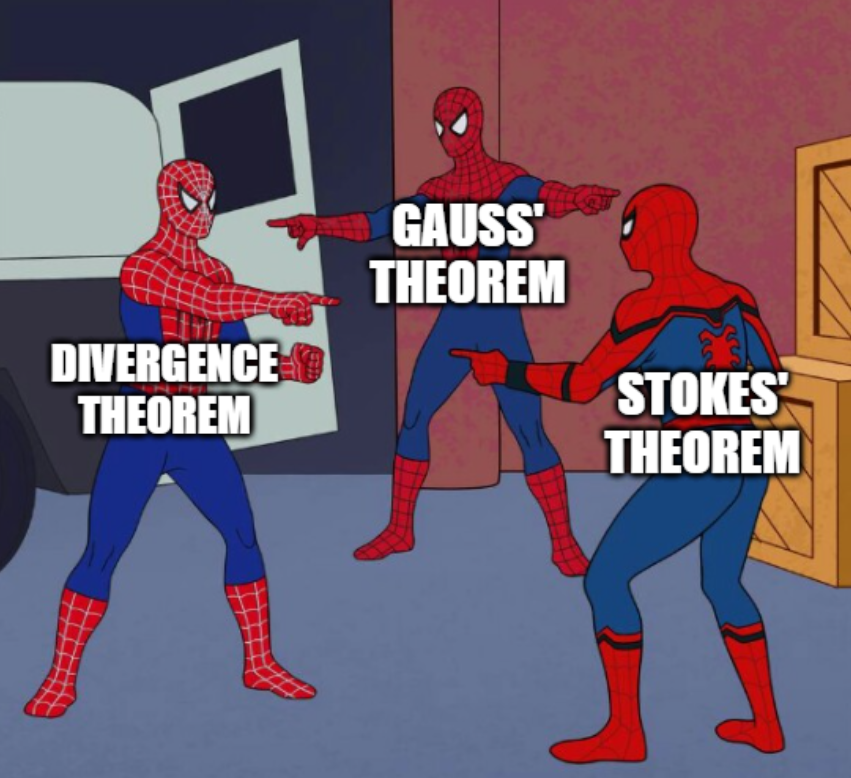
The Spider-Man pointing meme has infiltrated vector calculus. Divergence, Gauss', and Stokes' theorems are essentially the same mathematical concept wearing different costumes—they all relate flux through a surface to properties inside or along boundaries. Physics grad students secretly call this the "Spider-Theorem" when professors aren't listening. Next time you're integrating vector fields, just remember: with great mathematical power comes absolutely no practical applications you can explain at parties.

Curls: Physical Vs. Mathematical

Curls: Physical Vs. Mathematical
The ultimate nerdy flirtation! While he's talking about bicep curls with dumbbells, she's flexing her mathematical prowess with Stokes' Theorem. The equation ∮ S ∇ × F · dS = ∮ C F · dr relates a surface integral to a line integral along its boundary - basically the multivariable calculus version of a pickup line. It's the perfect mathematical pun - his "curls" involve physical force, while her "curls" involve vector calculus operators! The workout isn't just in the gym; it's happening in the brain too!

Mathematicians vs Physicists: The Great Translation Battle

Mathematicians vs Physicists: The Great Translation Battle
The eternal battle between theoretical and applied science in one perfect meme! Mathematicians describe Green's Theorem with intimidating notation and jargon that would make anyone's brain melt. Meanwhile, physicists cut through the mathematical fog with "little inside swirls combine into one big outside swirl" - which is honestly a brilliant intuitive explanation that actually helps you visualize what's happening. This is exactly why physicists get invited to parties and mathematicians are left solving integrals on napkins in the corner. The beautiful simplicity of physics vs the "but actually" precision of mathematics captured in their natural habitat!

Maxwell's Lonely Disciple

Maxwell's Lonely Disciple
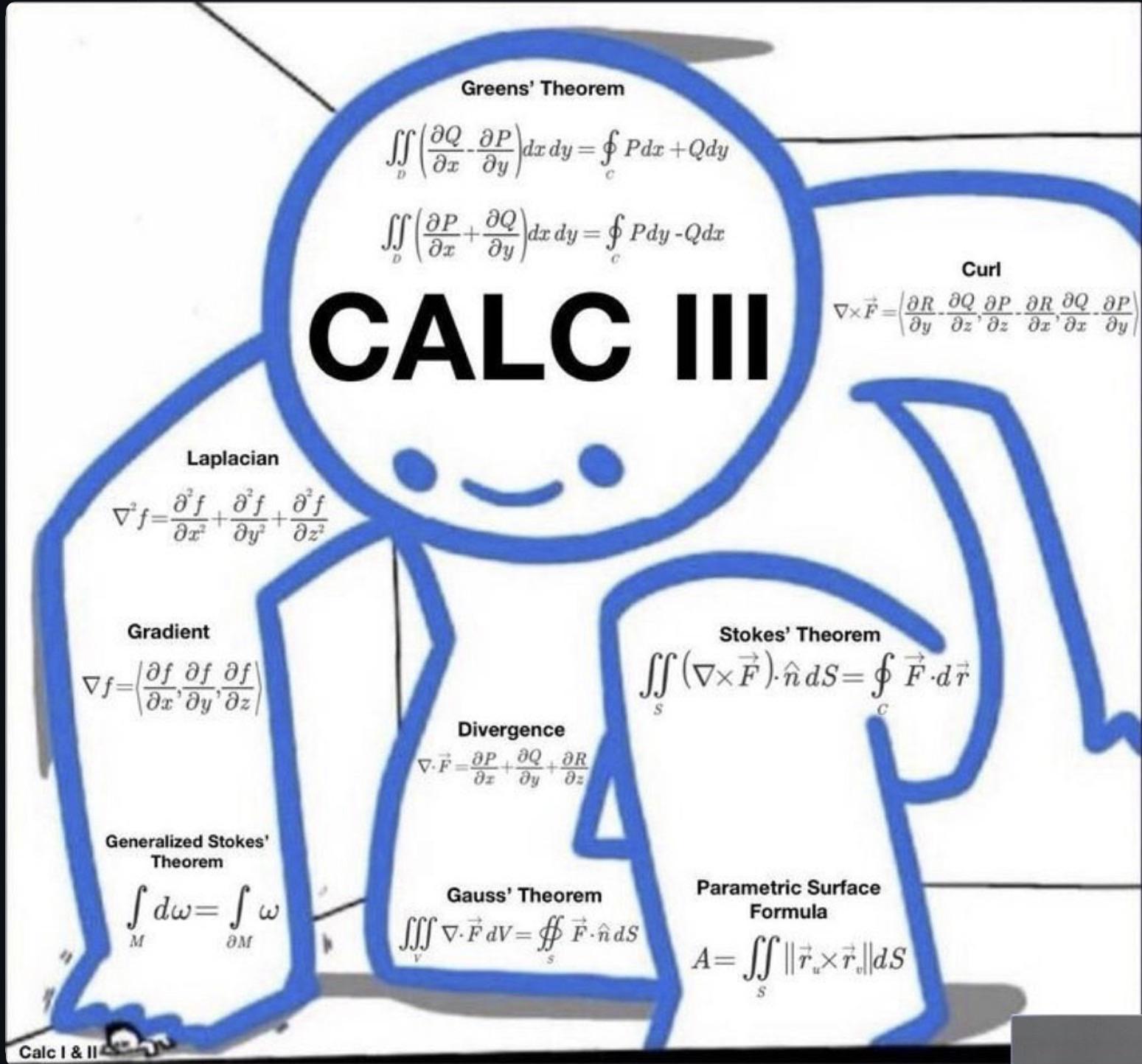
Physics students everywhere having breakdowns over electromagnetic field equations! The right-hand rule is supposed to help you figure out the direction of magnetic fields, but somehow your thumb always points to the dimension of pure confusion. Meanwhile, the magnetic field is doing gymnastics perpendicular to everything like it's training for the Olympics of perplexity. And there you are, waiting for Maxwell's equations to suddenly make sense without triggering an existential crisis. Spoiler alert: still waiting. The four horsemen of the physics apocalypse aren't war, famine, pestilence, and death—they're curl, divergence, gradient, and Laplacian.