
Units Memes

Posts tagged with Units

The Conversions In Units For Pressure Are Some Of The Worst I've Come Across Yet

The Conversions In Units For Pressure Are Some Of The Worst I've Come Across Yet
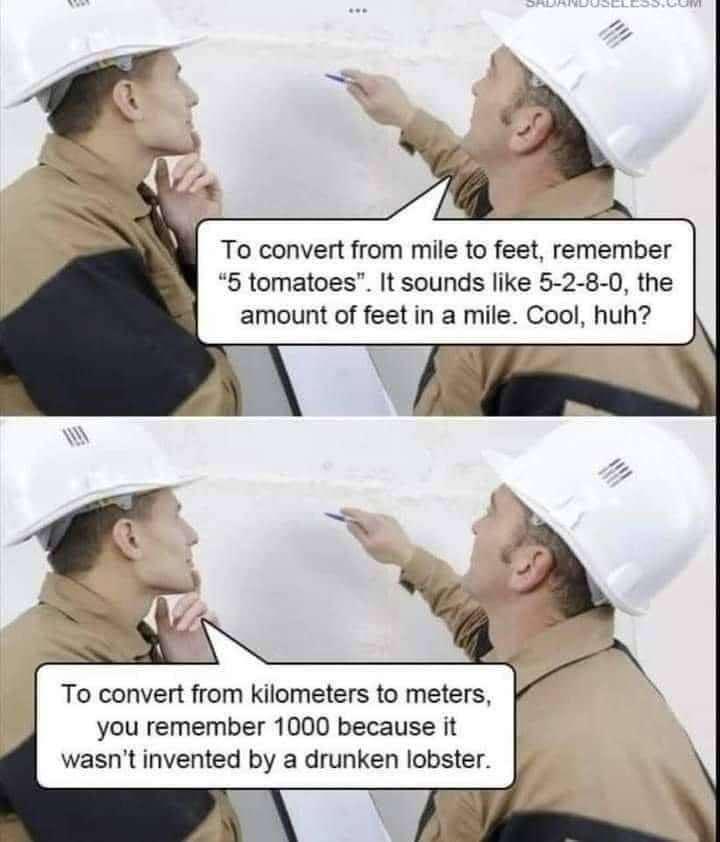
Engineers wearing hard hats explaining unit conversions is peak comedy because one system makes logical sense while the other requires memorizing random vegetable mnemonics. The metric system just casually multiplies by 1000 like a normal, sane measurement system, while the imperial system is out here asking you to remember "5 tomatoes" (5-2-8-0) to get 5,280 feet in a mile. Who came up with this? A committee of chaos agents? The "drunken lobster" line is absolutely sending me because it perfectly captures the absurdity of imperial units. Meanwhile, pressure conversions are genuinely nightmarish: Pascals, bar, psi, atmospheres, torr, mmHg... it's like every field of science decided to invent their own unit just to spite students. At least kilometers to meters won't make you question your life choices. Fun fact: 1 atmosphere = 101,325 Pascals = 1.01325 bar = 14.7 psi = 760 mmHg = 760 torr. You're welcome for that nightmare fuel.

You Can't Hear An Image

You Can't Hear An Image
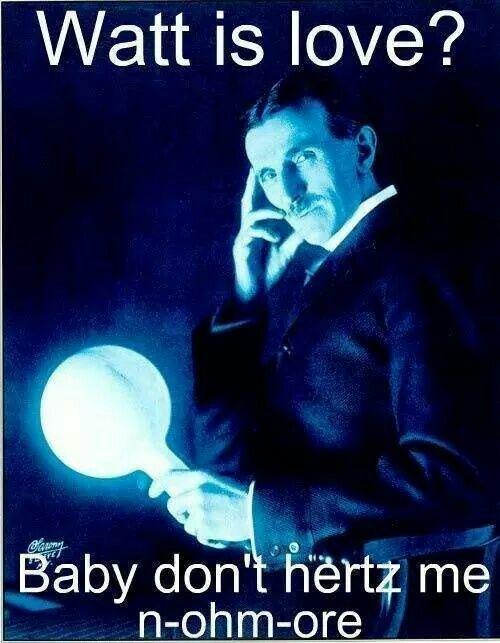
If you didn't immediately hear this in the tune of "Baby Don't Hurt Me" by Haddaway, congratulations—you're probably under 25 or living in a cave. This is Nikola Tesla casually holding a light bulb powered by his wireless electricity experiments, looking like the world's most photogenic electrical engineer. The pun game here is absolutely electric: "Watt is love?" (unit of power), "don't hertz me" (unit of frequency), "n-ohm-ore" (unit of resistance). It's basically a physics unit triple threat disguised as a 90s dance anthem. Tesla would probably appreciate the wordplay, though he'd be mildly annoyed you're not asking about alternating current instead. The fact that this works on multiple levels—visual pun, auditory memory, and legitimate electrical engineering terminology—makes it chef's kiss tier science humor.

Why Do These Even Exist

Why Do These Even Exist
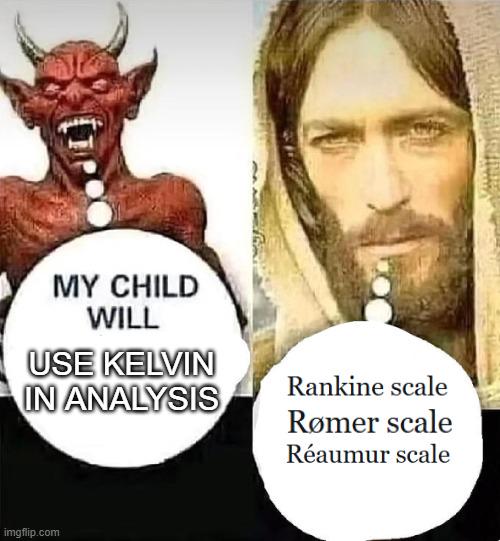
Devil: "My child will use Kelvin in analysis" versus Jesus blessing us with Rankine, Rømer, and Réaumur scales. The unholy trinity of temperature scales nobody asked for! While Kelvin actually serves a purpose in thermodynamics (absolute zero at 0 K, no negative temperatures, makes equations cleaner), these other three are like that drawer in your kitchen filled with gadgets you've never used. Rankine is basically Kelvin's American cousin—it uses Fahrenheit-sized degrees but starts at absolute zero. Rømer was an early attempt from 1701 where water freezes at 7.5° (because why not?). Réaumur sets water's boiling point at 80° instead of 100°. These scales exist purely to torture engineering students who stumble upon old European scientific papers and have to convert everything back to something remotely usable. Fun fact: There are actually even MORE obscure temperature scales like Newton, Delisle, and Wedgwood. Scientists really went wild inventing these things before everyone agreed to just stick with Celsius and Kelvin.

Perfectly Balanced

Perfectly Balanced
Nothing screams "scientific consistency" quite like measuring distance in football fields, liquid volume in bathtubs, and somehow ending up with tablespoons and gallons in the same recipe. Meanwhile, the rest of the world is out here with their metric system—where everything converts by powers of 10 like some kind of mathematical utopia. Want to convert milliliters to liters? Just move a decimal. Need to go from centimeters to kilometers? Child's play. But hey, at least the imperial system keeps things interesting! Who doesn't love memorizing that there are 5,280 feet in a mile, 3 feet in a yard, and 12 inches in a foot? It's like a math puzzle nobody asked for. The metric system may be "perfectly balanced," but where's the adventure in that? Give me chaos or give me... wait, how many ounces are in a gallon again?

The Real Truth

The Real Truth
Look, both camps have their reasons, but let's be real here—one is objectively superior for science, and the other just wants to avoid typing two extra letters. Celsius gives you water freezing at 0°C and boiling at 100°C, which is beautifully logical for literally anyone doing chemistry, biology, or just existing in a lab. Meanwhile, someone out there is defending Fahrenheit because "Celsius" has more keystrokes than "Fahrenheit"... which, by the way, makes zero sense as an argument. The scientific community settled this debate decades ago, but sure, keep using a scale where water freezes at 32 and boils at 212 because some guy in the 1700s thought mercury and ice baths were a vibe. At least we can all agree that Kelvin users are the true psychopaths—nobody wants to hear that it's 298 degrees outside.

Hubble Constant Meme

Hubble Constant Meme
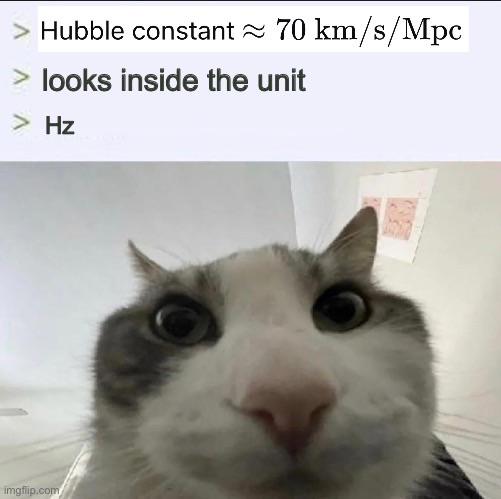
So the Hubble constant tells us how fast the universe is expanding—about 70 kilometers per second per megaparsec (Mpc). But wait, what's that unit doing there? Hz? That's Hertz, which measures frequency (cycles per second), not cosmic expansion rates. Someone just looked at "km/s/Mpc" and thought "hmm, that's got an 's' in the denominator, must be Hz!" Nope. That's like saying your car's fuel efficiency is measured in decibels because both involve division. The horrified cat perfectly captures every astrophysicist's face when they see dimensional analysis butchered this badly. The Hubble constant has units of inverse time when you break it down (since Mpc is a distance), but it's definitely NOT frequency. It's the rate of expansion per unit distance, not oscillations per second. Dimensional homogeneity is weeping in the corner right now.

Well There Goes My Time!

Well There Goes My Time!
Teachers really out here choosing violence by using kmh⁻¹ (kilometers per hour inverse) instead of the perfectly functional ms⁻¹ (meters per second). Because nothing says "I care about your education" quite like forcing students to do unnecessary unit conversions that add exactly zero pedagogical value. It's like watching someone meticulously arrange beakers in alphabetical order while the lab is on fire. For context: kmh⁻¹ is technically just 1/(km/h), which is... hours per kilometer? So you're measuring how many hours it takes to travel one kilometer. It's the speed unit equivalent of measuring your height in inverse meters. Technically correct, maximally cursed. Meanwhile ms⁻¹ is the standard SI unit that every physics problem actually wants. The Breaking Bad meme format captures that exact moment of malicious precision—carefully, deliberately making things harder than they need to be. Chemistry teacher energy, honestly.

The Failure Chain Never Ends

The Failure Chain Never Ends
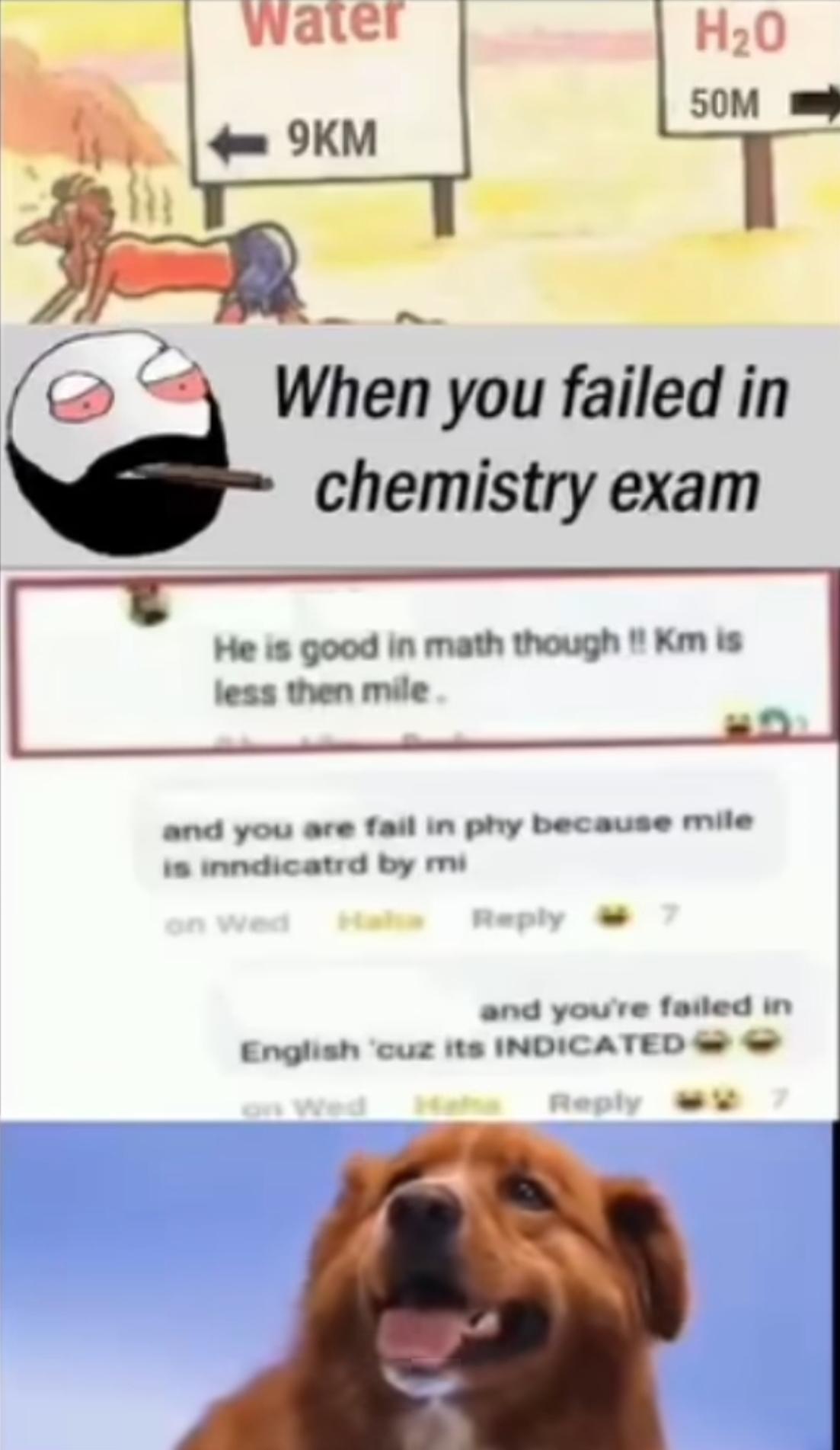
This is the academic equivalent of dominoes falling, except each domino is a different subject roasting you. You bomb your chemistry exam, and someone tries to comfort you by saying "well at least you're good at math!" because kilometers are less than miles. But WAIT—you then fail physics because you can't convert miles to meters properly. And just when you think it can't get worse, English swoops in for the knockout punch because you wrote "INDIDCATED" instead of "indicated." It's like a beautifully tragic chain reaction where every subject you thought was your safety net turns out to be another trapdoor. The exhausted desert traveler crawling toward water that's 9 kilometers away (only to realize that's actually 50 miles) is just *chef's kiss* perfect for capturing that moment when you realize your entire academic foundation is crumbling simultaneously. The smiling dog at the end? That's you accepting your fate with the grace of someone who's completely given up. Welcome to interdisciplinary failure!

300 Kelvin Is Not A Room Temperature

300 Kelvin Is Not A Room Temperature
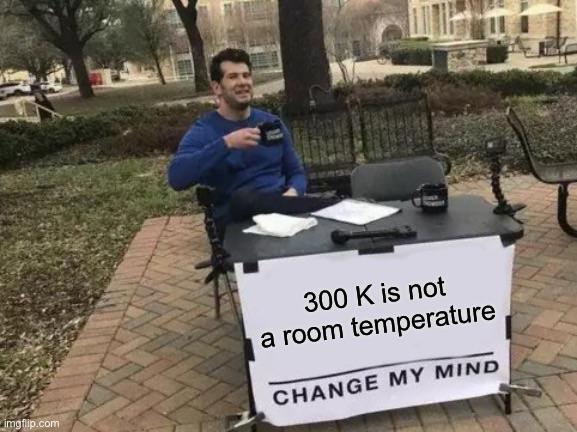
Physicists and chemists are DYING right now! 🔥 This meme hits that sweet spot between science humor and absolute truth. 300 Kelvin equals about 27°C (80°F), which is actually a pretty comfy room temperature! The joke plays on the classic "change my mind" format while sneakily teaching us about temperature scales. Scientists use Kelvin for precise measurements because it starts at absolute zero - no negative numbers needed! Next time someone complains about room temperature, just say "at least it's not 300K" and watch the confusion spread!

Watt, Are You Deaf?!

Watt, Are You Deaf?!
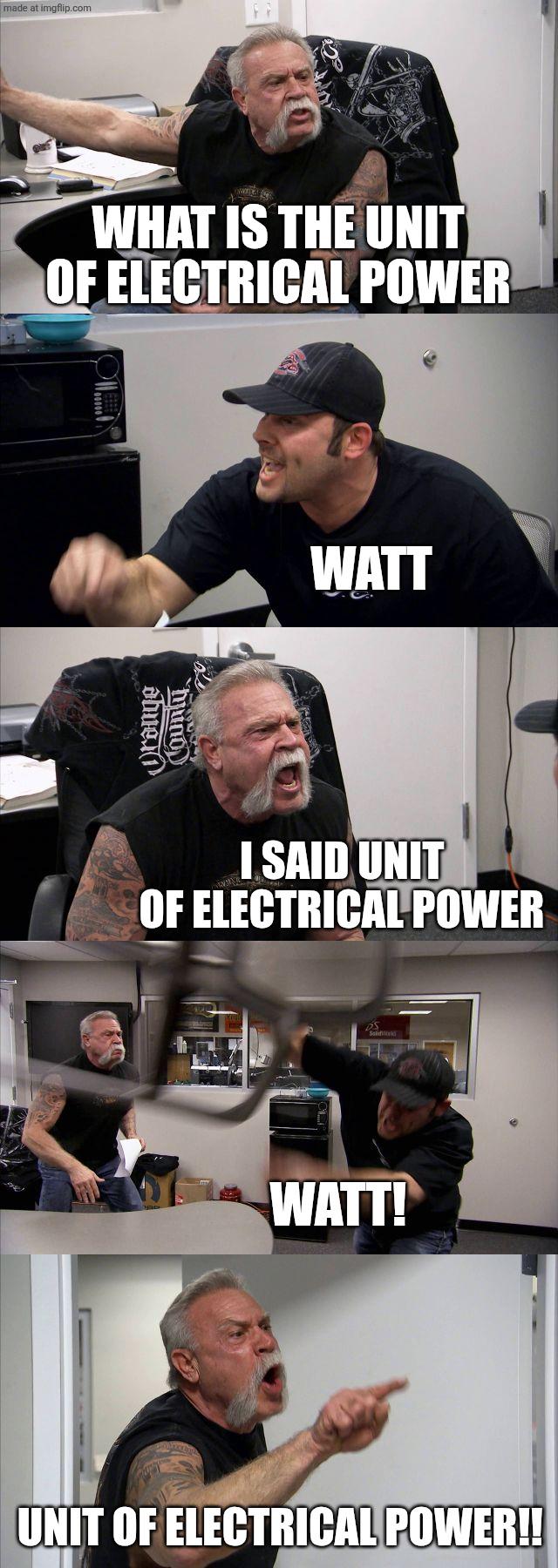
The perfect storm of physics knowledge and hearing problems! This guy's just trying to teach basic electrical units, but his student keeps answering "WATT" (which is actually correct) while the teacher thinks he's saying "what?" in confusion. The escalating frustration is giving me flashbacks to every lab partner who didn't read the pre-lab instructions. The irony is *chef's kiss* - the teacher's getting increasingly enraged while the student is technically giving the right answer the whole time. This is why clear communication is critical in science... and why I always bring a whiteboard to noisy conferences.

Same Units, Different Nightmares

Same Units, Different Nightmares
Same notation, WILDLY different implications! For mechanical engineers, "10 rad/s" is just angular velocity—how fast something spins. Chill, normal, everyday physics. But for nuclear engineers? That's 10 radiation units per second —basically a one-way ticket to Glow-in-the-Dark Town! No wonder the nuclear engineer looks terrified while the mechanical engineer is all smiles. Engineering fields: where identical units can either mean "spinning motor" or "call the hazmat team immediately!"

Watt Is The Unit Of Electrical Power

Watt Is The Unit Of Electrical Power
Classic case of scientific miscommunication in the wild. One guy is asking for the unit of electrical power (which is indeed the watt, named after James Watt). The other guy keeps answering "watt" but the first guy thinks he's saying "what?" and gets progressively more enraged. This is basically every lab meeting I've ever attended. The number of physics jokes that rely on unit puns is directly proportional to how long we've been stuck in the lab without sunlight.