
Unit vectors Memes

Posts tagged with Unit vectors
True

True
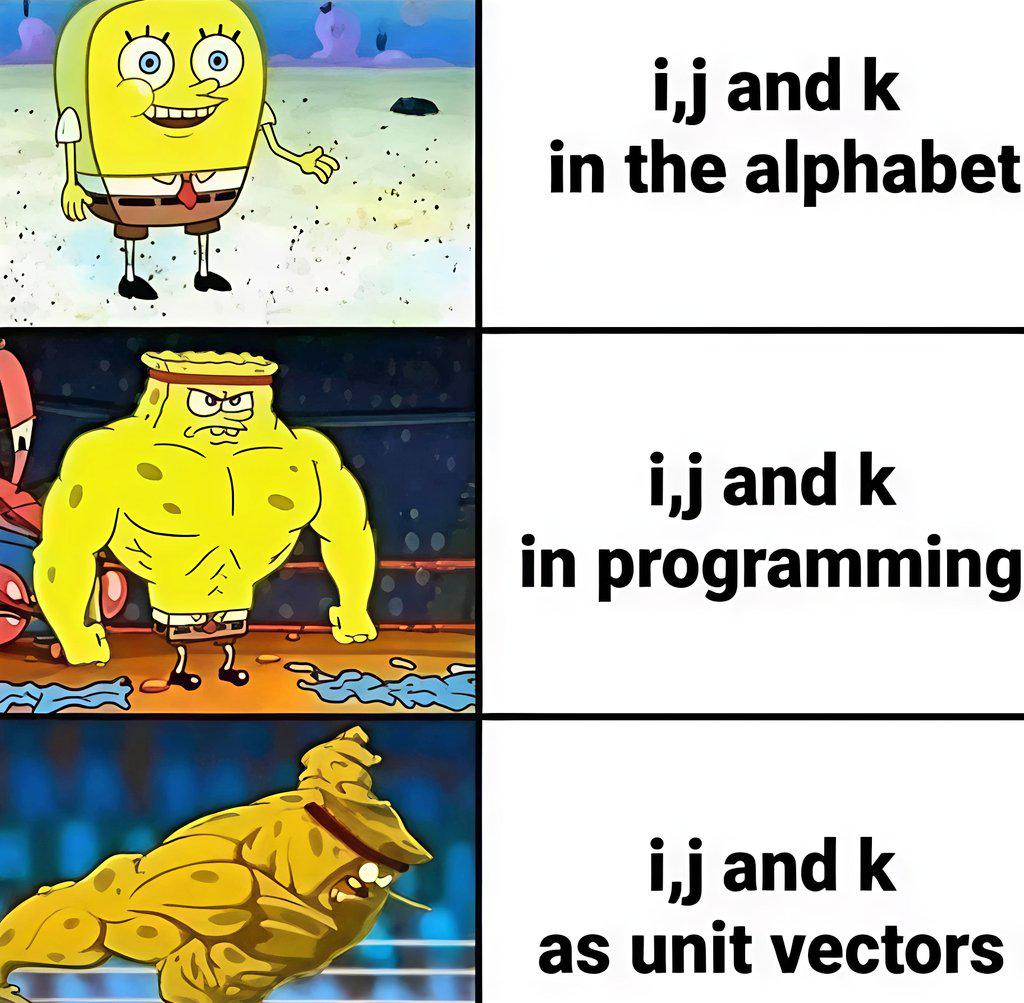
So we've got i, j, and k just chilling in the alphabet, looking all innocent and normal. Then they show up in programming as loop variables and suddenly they're RIPPED—carrying the weight of nested loops and array indexing like it's nothing. But wait till you see them as unit vectors in physics and math... they've transcended into their FINAL FORM, basically god-tier mathematical entities representing directions in 3D space. For those who haven't met these legends yet: i , j , and k are the standard unit vectors pointing along the x, y, and z axes respectively. They're the backbone of vector calculations, cross products, and basically any time you need to describe something moving through space. Meanwhile, programmers are just using them to count from 0 to n-1 in for-loops. The power gap is REAL.

When Unit Vectors Have Commitment Issues

When Unit Vectors Have Commitment Issues
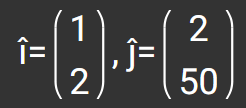
The forbidden love story between i-hat and j-hat, the unit vectors of coordinate systems everywhere. One's a simple (1,2) while the other's a complicated (2,50) - talk about dating outside your orthogonal basis! Their relationship will never work because they're not perpendicular to each other. The cross product of their love would yield a vector pointing in some weird direction that makes mathematicians uncomfortable. This is what happens when vectors ignore the fundamental rules of orthonormality!

Vector Gang Representation

Vector Gang Representation
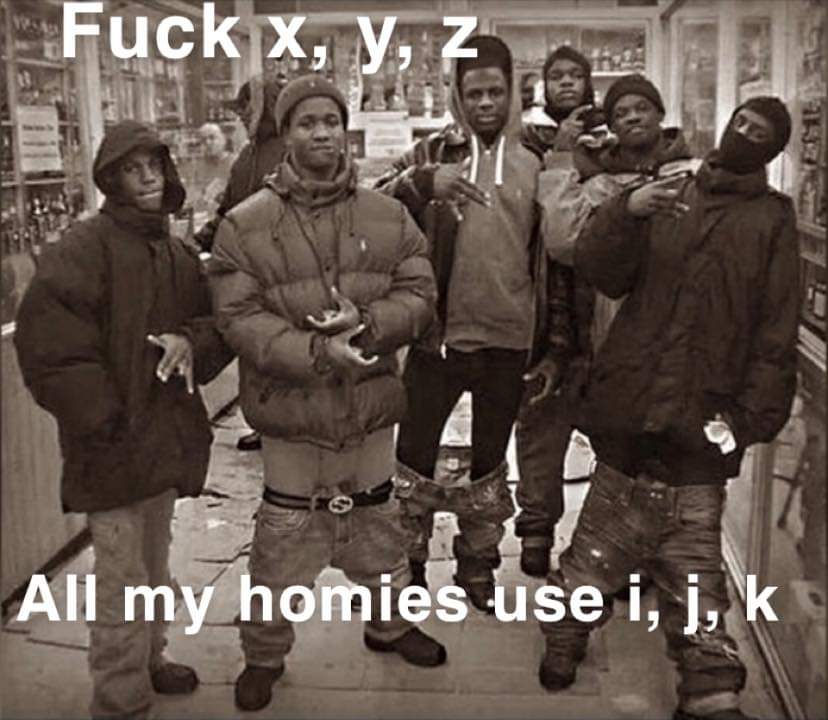
Mathematicians and programmers unite in rebellion! The top text declares war on the traditional Cartesian coordinates (x, y, z), while the bottom proudly proclaims allegiance to the unit vectors (i, j, k) used in vector calculus and physics. It's basically the math equivalent of choosing sides in a neighborhood turf war! Vector notation gang representing! 💯 For the uninitiated, both systems represent the same 3D space, but i, j, k notation is often preferred in engineering and physics when dealing with vectors. It's like having two different languages to describe the exact same thing - and mathematicians have STRONG opinions about which is better!