
Trick question Memes

Posts tagged with Trick question
Which Weighs More: Mass Confusion

Which Weighs More: Mass Confusion
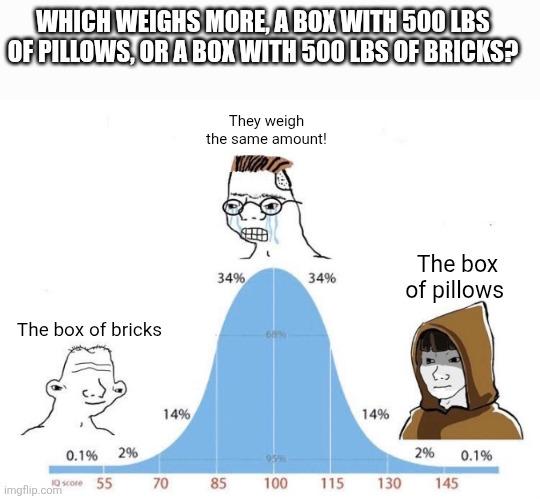
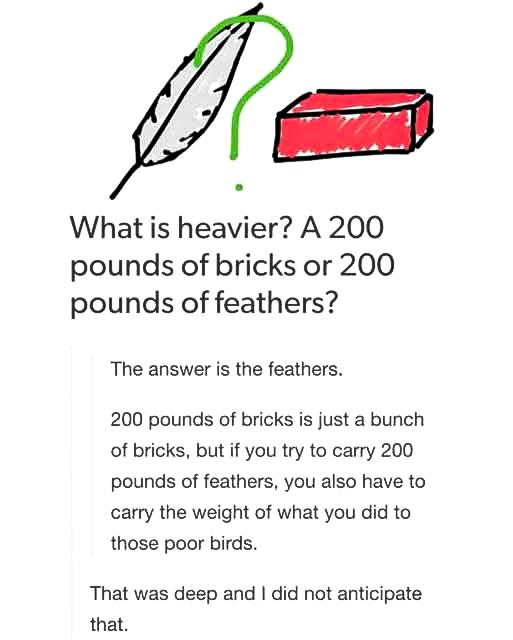
The beautiful collision of mass vs weight confusion and statistical ignorance! The meme presents the classic trick question: which weighs more, 500 lbs of pillows or 500 lbs of bricks? The punchline is that they weigh exactly the same (duh, it's 500 lbs either way), but what makes this hilarious is the bell curve showing how people respond. The normal distribution shows 34% of people choosing each wrong answer (bricks or pillows), while only 14% of people correctly identify that they weigh the same. It's basically capturing that moment when your brain short-circuits between intuition (bricks feel heavier!) and basic arithmetic (500 = 500). The facial expressions are priceless - the smug confidence of those picking sides versus the frustrated intelligence of the person who knows the correct answer but is surrounded by wrongness. Pure statistical despair!

Weight Is Not Mass

Weight Is Not Mass
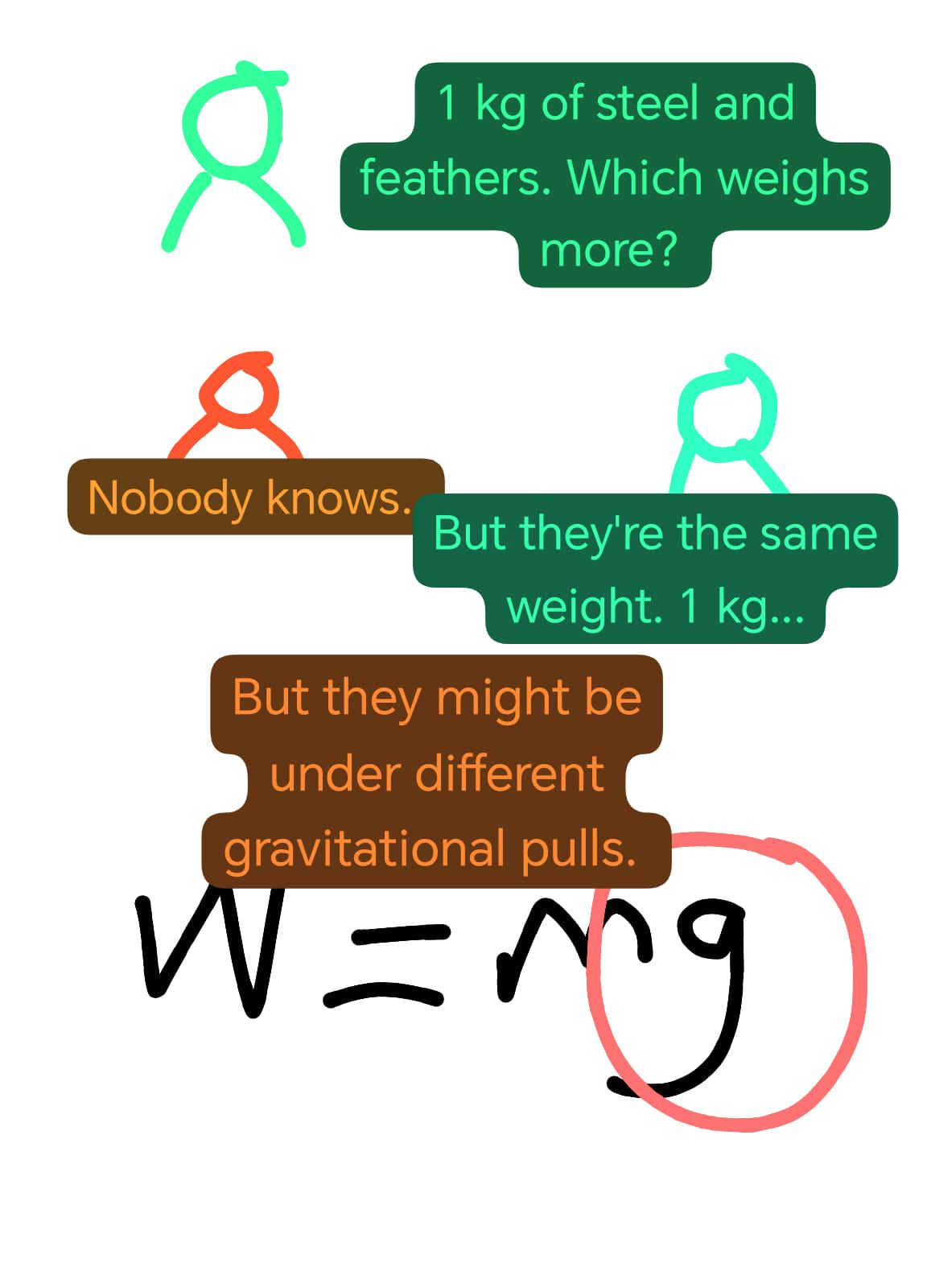
This is physics humor at its finest! The trick question asks which weighs more: 1kg of steel or feathers. The clever third person points out they have the same mass (1kg), but reminds us that weight (W=mg) depends on gravitational pull! So technically, if the feathers were on the Moon and the steel on Earth, they'd have different weights despite identical mass. Physics teachers everywhere are silently nodding with approval right now!

Evaluate The Integral (Or Just Count To Five)

Evaluate The Integral (Or Just Count To Five)
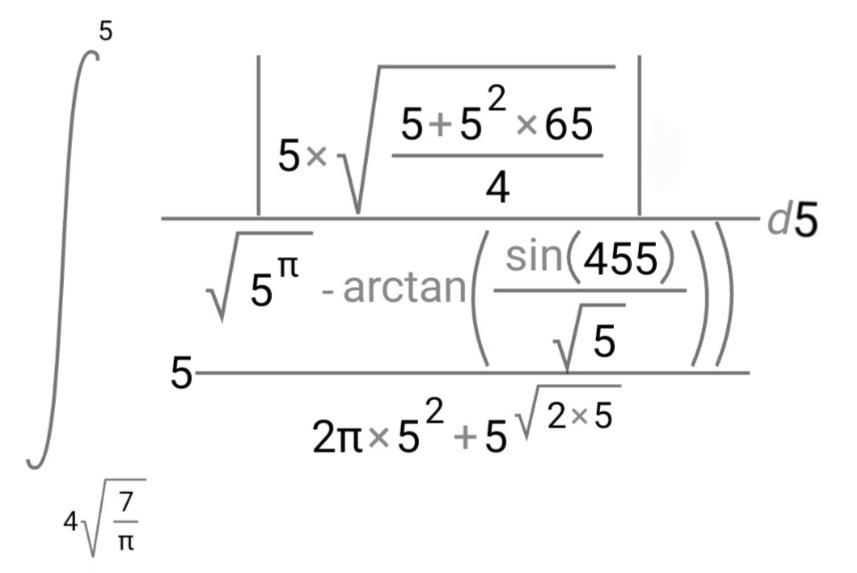
Look closely at this devilish integral... notice anything? Every single term contains the number 5! This isn't calculus—it's a mathematical rickroll designed to make you waste precious brain cells before realizing the answer is just 5! That moment when your professor hands this out as a "quick warm-up exercise" and watches the entire class spiral into madness while they sip coffee with a sinister grin. The mathematical equivalent of saying "the password is password."

Why Would You Use Them As Names For Vectors

Why Would You Use Them As Names For Vectors
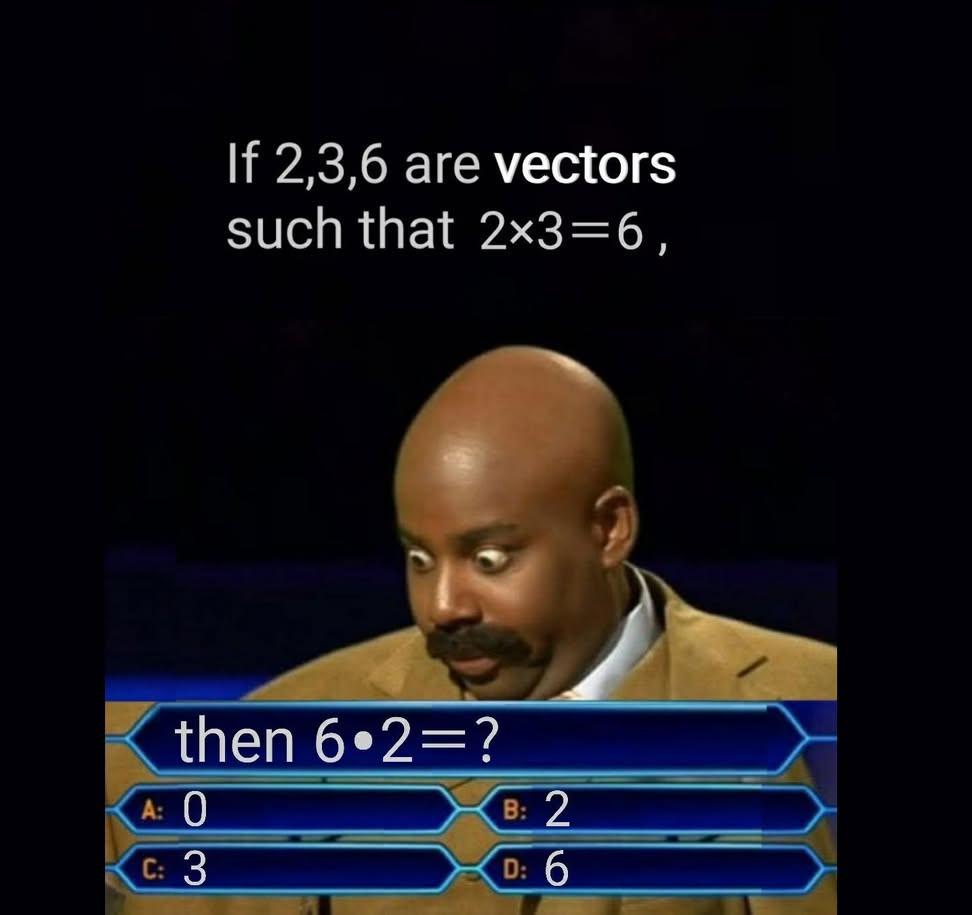
The mathematical trickery is DIABOLICAL! If 2×3=6 works with regular multiplication, your brain automatically assumes 6×2=12. BUT WAIT! If these are vectors with cross products, the order matters! Vector multiplication isn't commutative, you magnificent fool! The answer is actually the negative of what you'd get from 2×3, so 6×2 = -6. It's like the universe is playing a cruel joke on everyone who thought math was just about following simple rules. The game show host's expression perfectly captures that "I'm watching your brain short-circuit in real time" moment!

The Physics Exam Overthinking Trap

The Physics Exam Overthinking Trap
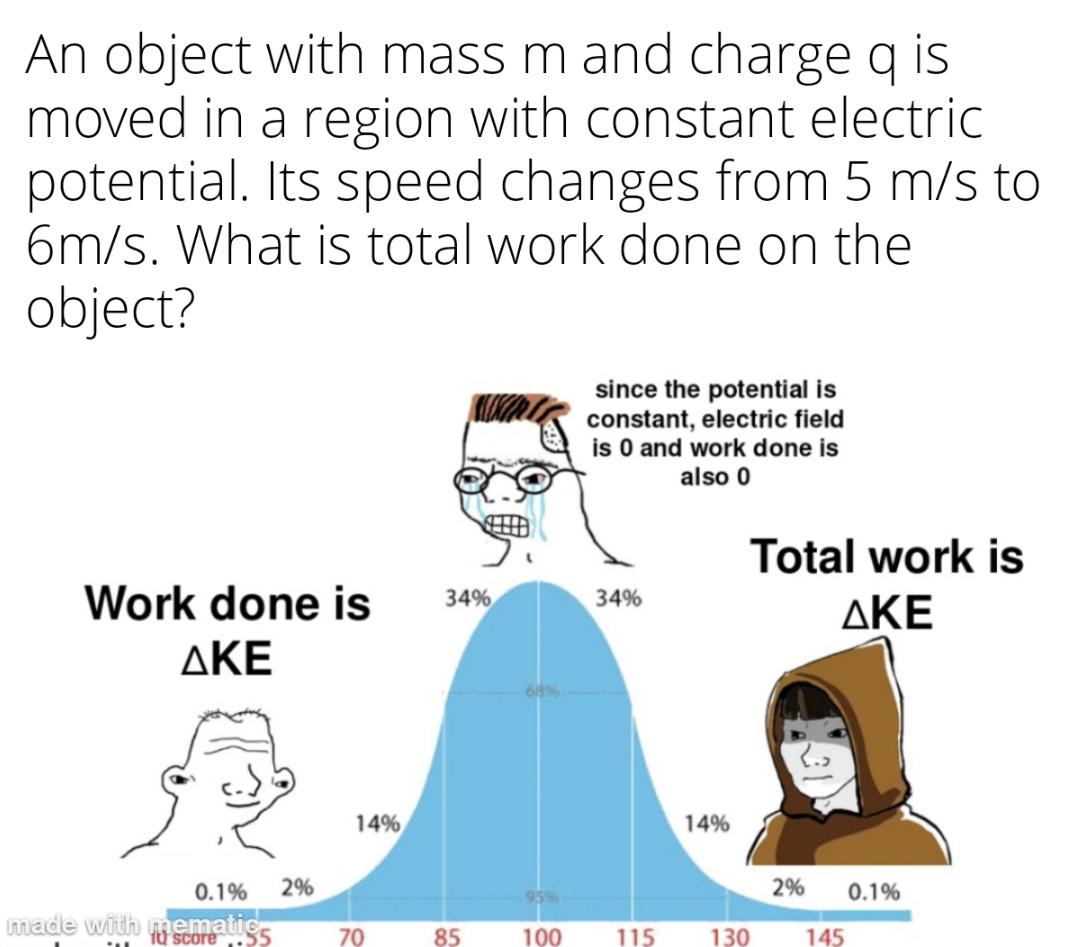
The classic physics exam trap in its natural habitat! The problem mentions a charged object in a constant electric potential field, and then asks about the work done when its speed changes. Here's where students panic and split into three camps on the bell curve: The clueless ones (left side): "Work equals change in kinetic energy, duh!" The overthinking geniuses (middle): *sweating profusely* "Wait, there's a charge in an electric field... must calculate electric potential energy... what's the field strength? Is this a trick?!" The enlightened few (right side): "Total work is just ΔKE because constant potential means zero electric field, so no electric work." The beauty is that the simplest answer (ΔKE) is correct, but physics students are conditioned to suspect traps everywhere. This is why physicists make terrible dinner guests - we overthink even passing the salt.

The Existential Rice Distribution Problem

The Existential Rice Distribution Problem
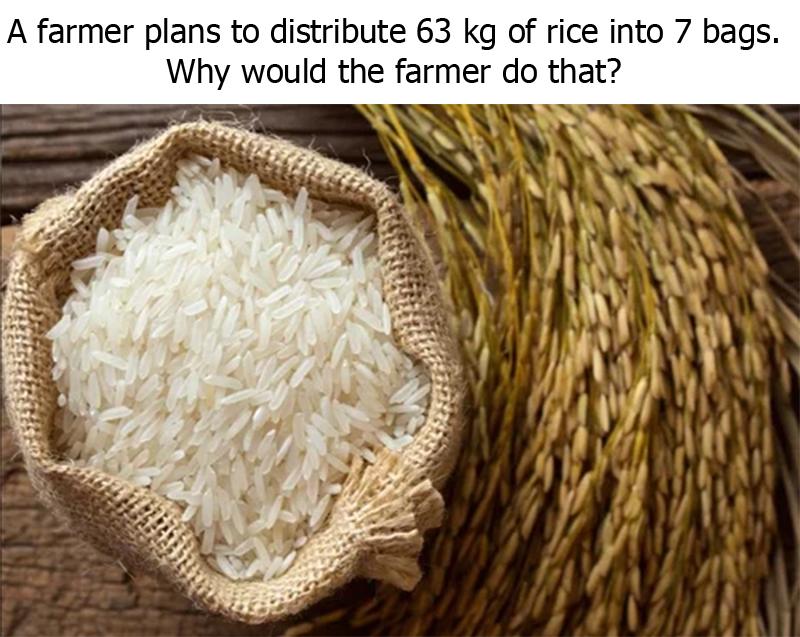
The punchline is hiding in plain sight! 63 ÷ 7 = 9, which is a standard math problem. But the real joke is questioning the farmer's motivation, as if there's some deep conspiracy behind basic division. It's the mathematical equivalent of asking "why did the chicken cross the road?" - sometimes the obvious answer is just the answer. Next time your math teacher asks you to show your work, just write "because the farmer wanted to." Mathematical rebellion at its finest!

The Eternal Rounding Dilemma

The Eternal Rounding Dilemma
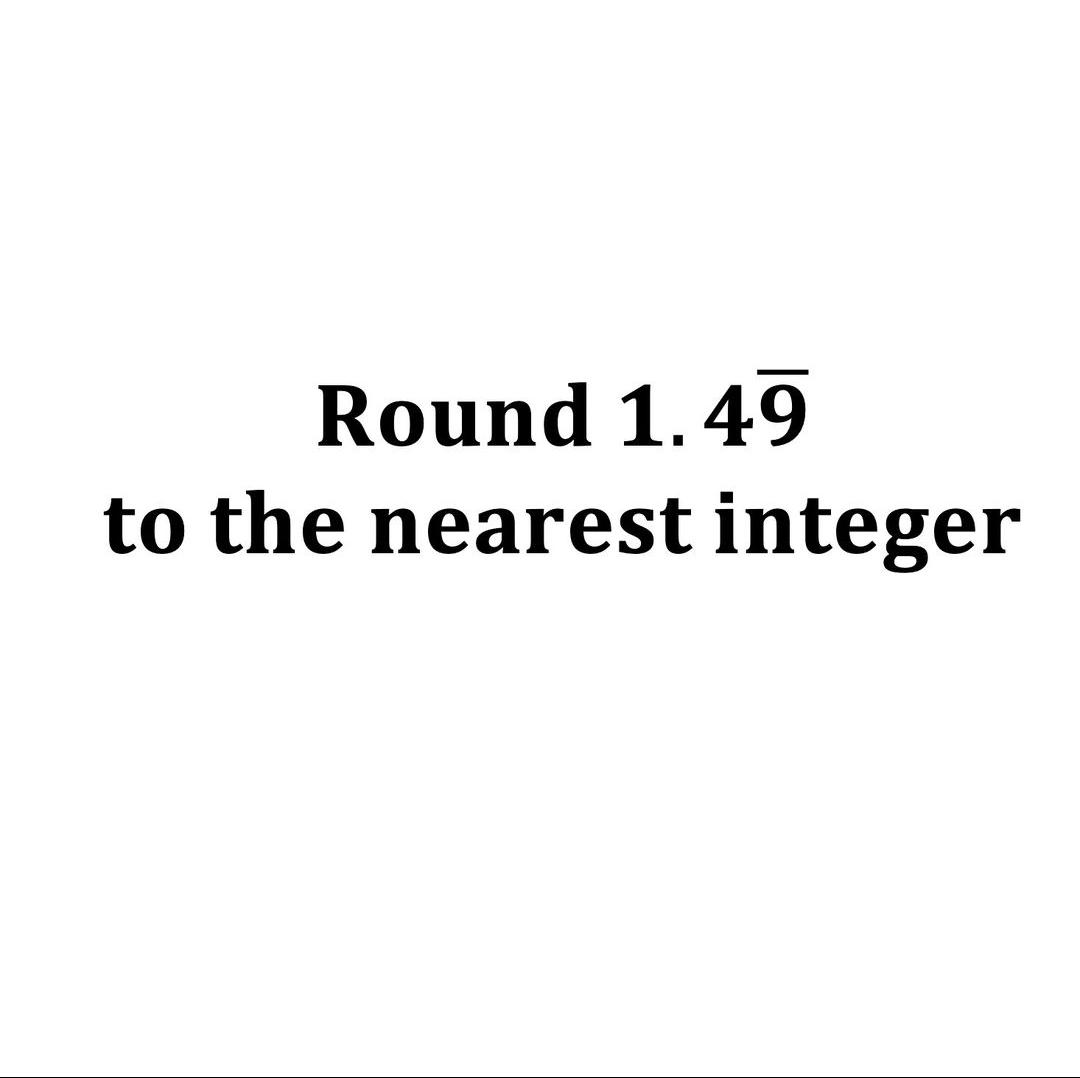
The eternal mathematical trickster strikes again! That devious 1.49̄ is sitting right on the mathematical fence, cackling at our human need for clean, whole numbers. With that repeating 9, it's technically 1.5, which rounds to 2... but visually it's 1.49, which rounds to 1! It's the numerical equivalent of that friend who says "I'll be there in 5 minutes" but means 5 hours. Pure mathematical chaos! Even calculators are sweating over this one.

The Cutting Edge Of Mathematical Confusion

The Cutting Edge Of Mathematical Confusion
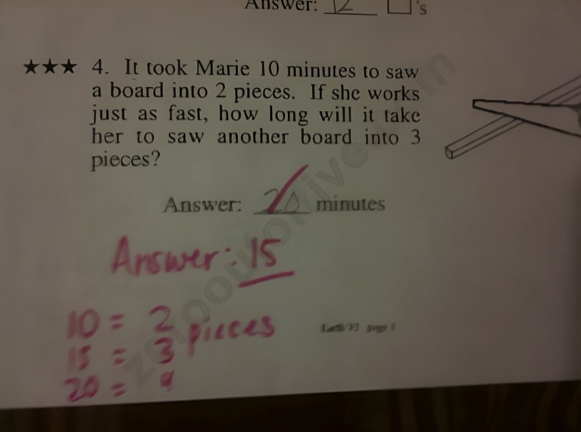
The teacher marked "15" as wrong, but they're actually the hero we need! When you cut a board into 2 pieces, you make 1 cut . For 3 pieces? That's 2 cuts . The question is asking about cuts, not pieces! The student brilliantly recognized the pattern (10 min = 1 cut, so 20 min = 2 cuts, thus 15 min = 1.5 cuts... which makes zero sense unless Marie has a quantum saw). Meanwhile, the teacher's answer of "20 minutes" assumes a linear relationship between pieces and time, which is mathematically unsound. This is why we can't have nice things in education.

It's Ok If You Don't Get It Right

It's Ok If You Don't Get It Right
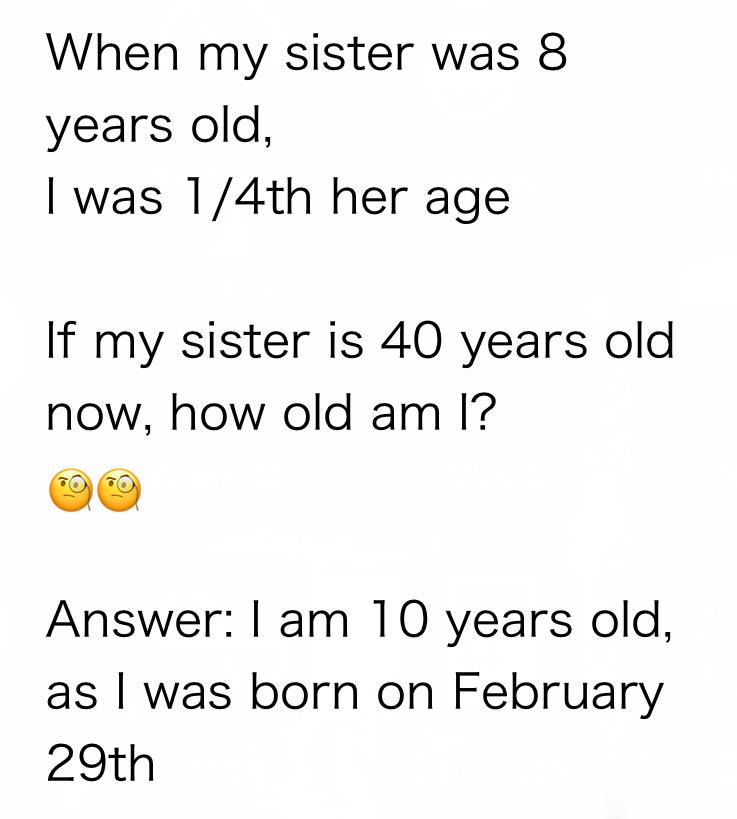
The mathematical trap is REAL! Everyone's brain immediately jumps to "she's 40, I was 1/4 her age before, so I must be 10 now!" But hold up—that's not how aging works! 🤯 If you were 1/4 her age when she was 8, you were 2 years old. Fast forward 32 years (for her to reach 40), and you'd be 34! The leap day birthday is just a brilliant red herring to distract you from the real math. This is why math teachers always say "read the problem twice!" The age gap between siblings stays constant—it doesn't remain proportional throughout life!

Factorial Trickery: The Math Puzzle That Breaks Brains

Factorial Trickery: The Math Puzzle That Breaks Brains
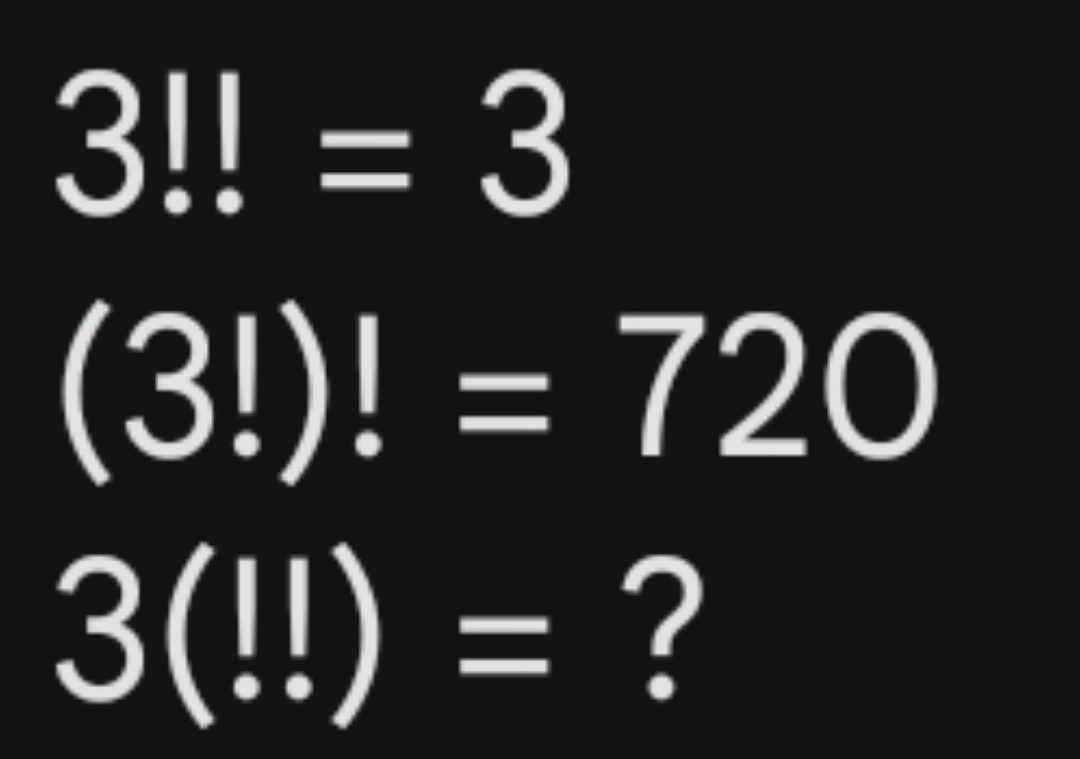
The mathematical trickery here is delicious! This isn't just a simple equation—it's factorial notation in disguise. In mathematics, the exclamation mark represents a factorial, which means multiplying a number by all positive integers less than it. So what's happening: 3!! = 3 (Just the number 3) (3!)! = 720 (First calculate 3! which is 3×2×1=6, then calculate 6! which is 6×5×4×3×2×1=720) So what's 3(!!)? Following the pattern, we'd calculate 3!! first (which is just 3), and then take the factorial of that... so 3! = 6. The beauty is in how it plays with notation to create a puzzle that seems impossible but is actually just mathematical sleight-of-hand. No wonder 99.9% allegedly can't solve it—they're probably overthinking it while mathematicians are quietly snickering in the corner.

The $100,000 No-Brainer

The $100,000 No-Brainer
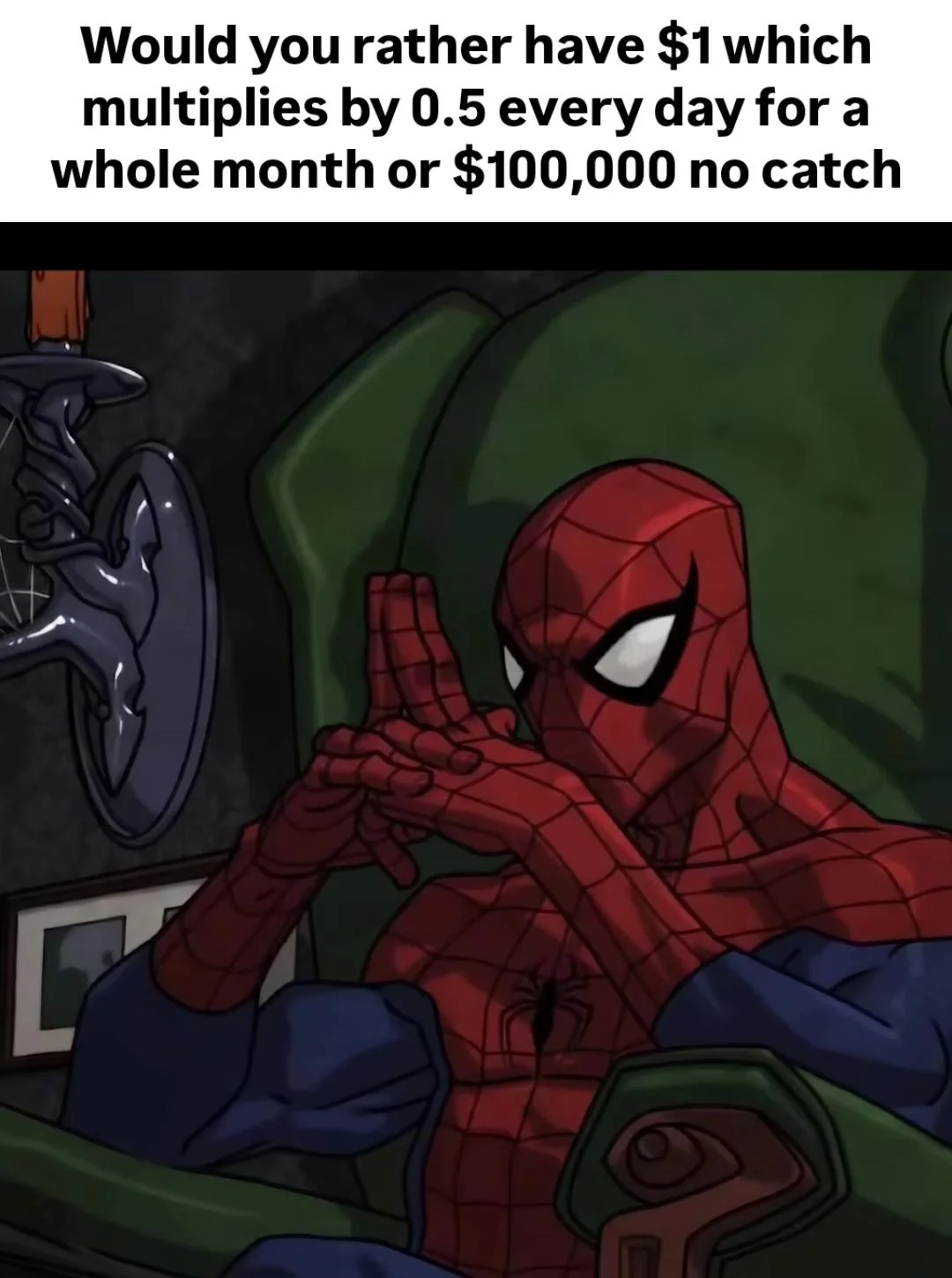
Exponential decay is the superhero of mathematical traps. That $1 multiplied by 0.5 daily would give you roughly $0.000000001 after 30 days. Even Spider-Man's spider-sense can't save you from basic geometric sequences. The $100,000 option isn't just better—it's better by about... *checks notes*... 100 billion times. This is why mathematicians make terrible game show contestants. We overthink the obvious and still get it wrong.

The Mathematical Catch-22

The Mathematical Catch-22
The ultimate mathematical trolling! The question asks you to prove 4+2=5+1 without solving both sides, but the moment you read it, your brain automatically calculated that 4+2=6 and 5+1=6. Congratulations, you just proved it's true by realizing both equal 6 without explicitly solving them! Your mathematical instincts betrayed you into doing exactly what the problem said not to do. The real "higher order thinking" was trying to resist the urge to solve it in your head. Next time, maybe try closing one eye and squinting really hard with the other to avoid accidental arithmetic.