
Time Memes

Posts tagged with Time
Insomnia Inducing Thoughts

Insomnia Inducing Thoughts
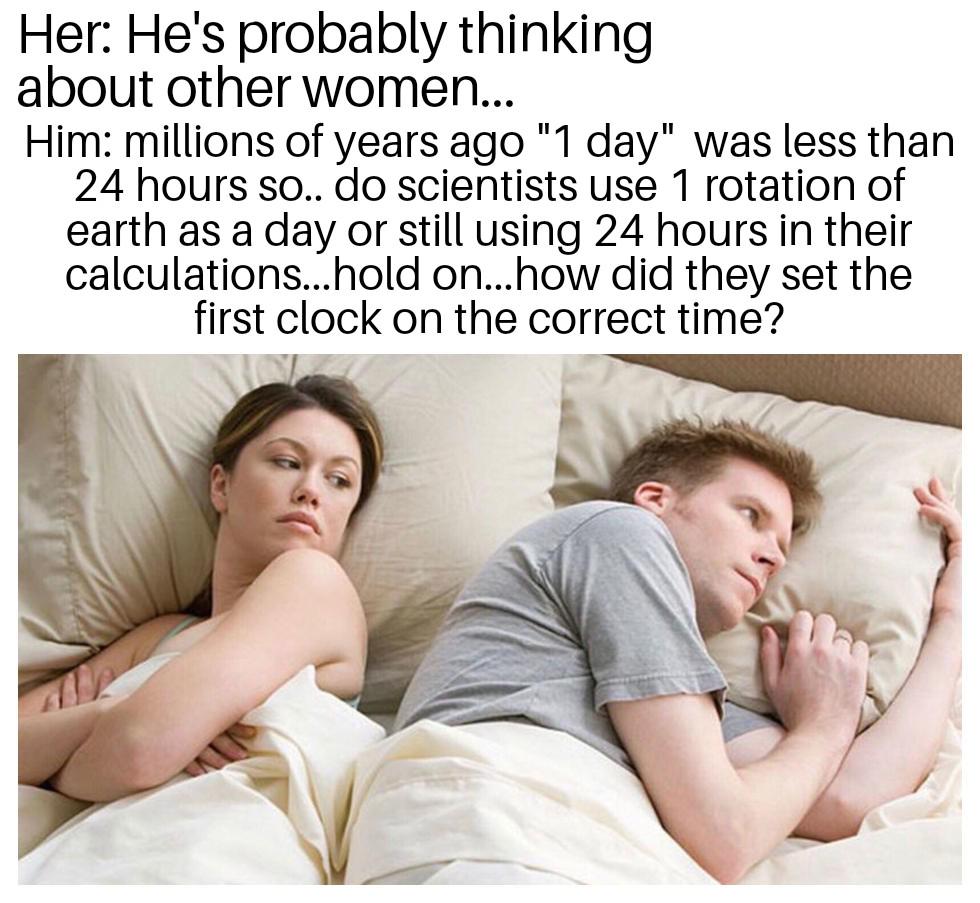
The classic relationship assumption meets scientific existential crisis! While she's worried about romantic competition, his brain is spiraling down a geological time-travel rabbit hole. The Earth's rotation has actually been slowing down over millions of years (by about 2.3 milliseconds per century), meaning prehistoric days were indeed shorter. Scientists use atomic clocks and radiometric dating to measure these changes, but his 2 AM brain can't handle the temporal paradox of how the first accurate timepiece was calibrated without a reference point. It's the perfect example of how science brains derail into fascinating but utterly useless thought experiments exactly when they should be sleeping.

Half-Life, Half-Product: The Uranium Unboxing

Half-Life, Half-Product: The Uranium Unboxing
The world's most patient customer finally opened his uranium ore delivery after 4.47 billion years, only to discover half of it had ghosted him through radioactive decay. Talk about the ultimate "contents may settle during shipping" excuse! The half-life of uranium is literally the punchline here—what you ordered vs. what you got after waiting just a tad too long. Next time maybe spring for the express shipping option that beats the half-life clock? And three stars? Pretty generous review for a product that's been playing atomic hide-and-seek since before Earth had oxygen.

Sunrise And Sunsets: It's Complicated

Sunrise And Sunsets: It's Complicated
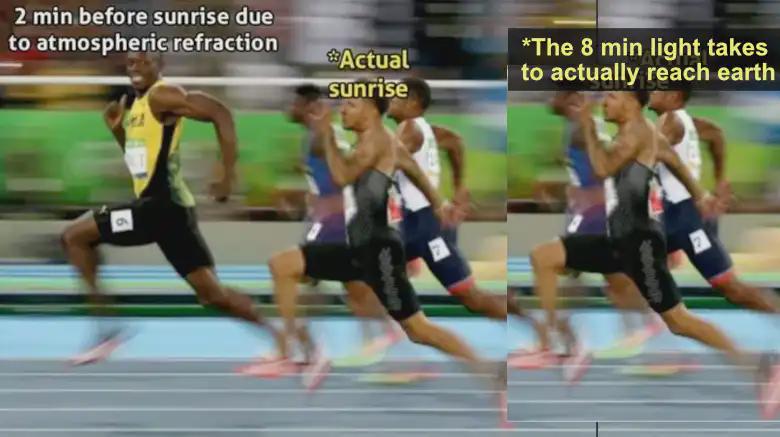
That moment when you realize the sun is playing mind games with us! What we call "sunrise" is actually a triple illusion. First, we see it 2 minutes before it's actually there thanks to atmospheric refraction bending light around our curved planet. Second, the "actual sunrise" happened 8 whole minutes ago because light takes its sweet time traveling from the sun. Third, the sun doesn't even "rise" - we're the ones spinning! The entire concept of sunrise is just our tiny human brains trying to make sense of cosmic mechanics while standing on a rotating space rock. Next time someone invites you to watch the sunrise, hit them with "which one?" and enjoy the confusion.

Dinosaur Banking Problems

Dinosaur Banking Problems
The geological equivalent of writing last year's date in January. These poor dinosaurs lived through the Paleozoic-Mesozoic transition (251 million years ago) and still can't update their checkbooks. Honestly, who hasn't forgotten what geological period they're in while paying bills? At least they're not dealing with direct deposit or cryptocurrency—imagine explaining Bitcoin to a T-Rex with those tiny arms trying to manage a digital wallet.

The Arbitrary Cosmic Position Celebration

The Arbitrary Cosmic Position Celebration
Physicists reading the newspaper on January 1st like... 👀 "So you're telling me everyone's losing their minds over the Earth reaching some completely arbitrary point in its elliptical orbit? The cosmic indifference is strong with this one!" The Tom-from-Tom-and-Jerry expression perfectly captures that mix of irritation and superiority when you realize calendars are just human constructs while the universe continues its business completely unbothered by our champagne and countdowns. Time is relative, but the physics eye-roll is universal!

The Real Time Machine

The Real Time Machine
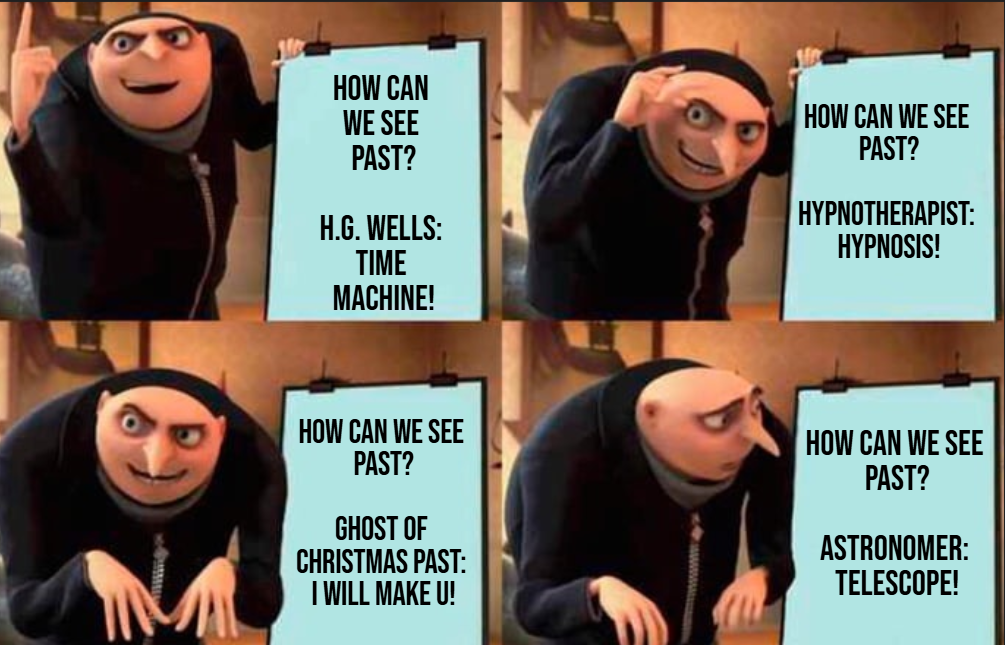
Looking for ways to see the past? Skip the sci-fi fantasies and pseudoscience! The final panel reveals the only legitimate answer that doesn't require fictional technology, supernatural intervention, or lying on a couch telling a stranger about your childhood traumas. Telescopes literally show us the past because light takes time to travel. That distant galaxy you're observing? You're seeing it as it was millions of years ago. The Sun? That's 8 minutes ago. Your lab partner's confused face? That's still about a nanosecond in the past. The universe is the ultimate time machine for the patient observer. No DeLorean required.

Time Travel Through A Telescope

Time Travel Through A Telescope
The existential crisis of time observation hits different when you're desperate! First panel: Science fiction solution (H.G. Wells' time machine) - totally reasonable to a sci-fi nerd. Second panel: Psychology approach (hypnosis) - because repressed memories are totally reliable data points, right? Third panel: Literary intervention (Ghost of Christmas Past) - because nothing says "empirical evidence" like a Dickensian apparition. Final panel: The horrified realization that astronomy actually has a legitimate answer - telescopes literally let us see the past because light takes time to reach Earth! The farther you look, the further back in time you're seeing. The cosmic microwave background is basically baby photos of the universe from 13.8 billion years ago. Mind = blown.

I'm Sure Time's Related To It In More Than One Way

I'm Sure Time's Related To It In More Than One Way
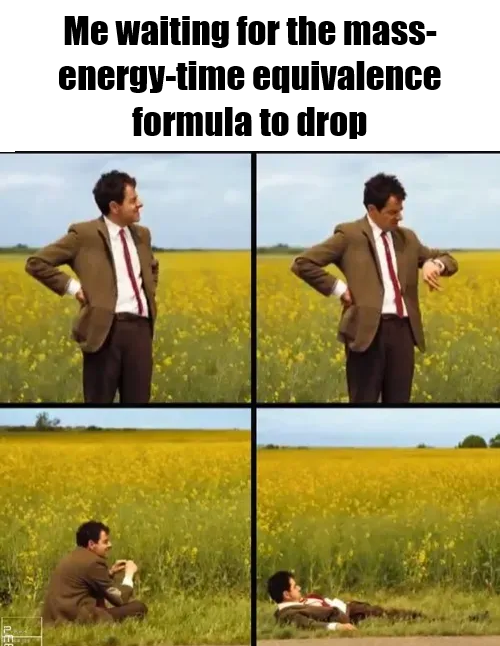
Physics students be like: *checks watch for the 57th time* "E=mc² should've been released by now!" The irony of growing impatient while waiting for an equation that literally connects time to energy is just *chef's kiss*. Einstein probably laughed from the grave watching us collapse into quantum puddles of despair while waiting for formulas that already exist! The ultimate scientific paradox - spending time waiting for the time-energy relationship to materialize. Next up: standing in a field waiting for gravity to drop!

Metric System Vigilante Strikes Again

Metric System Vigilante Strikes Again
The metric system purist in me is screaming! The timer shows 0:16:84, claiming those are "84 milliseconds" but that's fundamentally wrong. Milliseconds are 10 -3 seconds (thousandths), so they only go up to 999 before rolling over to a full second. With only two decimal places shown (84), those are actually centiseconds (10 -2 or hundredths of a second)! The proper display would be 0:16.84 or 0:17.24 depending on whether it's a timer or stopwatch. Every precision measurement scientist just felt a disturbance in the force.

The Leap Year Intelligence Paradox

The Leap Year Intelligence Paradox
The bell curve of intelligence strikes again! This meme perfectly captures the horseshoe theory of knowledge about leap years. People with very low or very high IQs confidently (but wrongly) claim "2000 is a leap year," while those with average intelligence correctly state "2000 is not a leap year." Plot twist: 2000 was actually a leap year! The leap year rule most people know (divisible by 4) is incomplete. The full rule: years divisible by 4 are leap years, except years divisible by 100, unless they're also divisible by 400. So 2000, being divisible by 400, was indeed a leap year! The genius of this meme is that it makes you question your own position on the curve. Where do YOU fall? The calendar doesn't care about your IQ score, but February 29, 2000 definitely happened!

The Temporal Euphoria Coefficient

The Temporal Euphoria Coefficient
The exponential relationship between student excitement and lecture dismissal time is a phenomenon well-documented in the hallowed halls of academia. A 5-minute early release barely registers on our emotional Richter scale, but those rare 30-minute reprieves trigger a neurochemical response rivaling that of winning the lottery. Statistically speaking, the probability of maintaining composure during a half-hour windfall approaches zero—a fact that requires no peer review.

The Four Phases Of Academic Signature Entropy

The Four Phases Of Academic Signature Entropy
The evolution of a scientist's signature over their career is the most accurate representation of academic entropy! First day: beautiful cursive with flourishes. Mid-career: still recognizable but getting wobbly. Late career: abstract scribble art. Final form: literally just a vertical line because who has time for loops when there are 47 papers to review? The conservation of energy applies to signatures too—minimum effort for maximum authentication!