
Thermodynamics Memes

Posts tagged with Thermodynamics
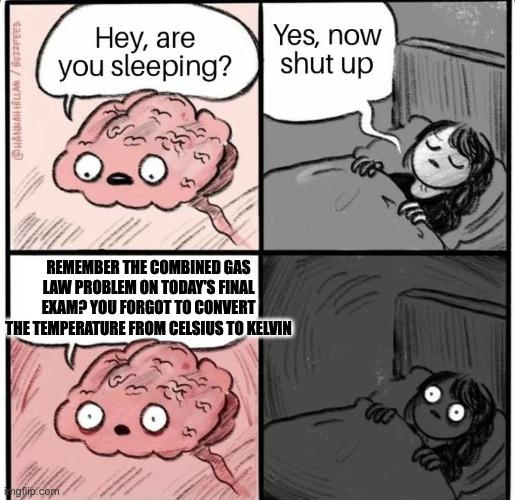
Combined Gas Law Equation Meme

Combined Gas Law Equation Meme
Your brain really knows how to pick its moments, doesn't it? You're drifting off to sleep, finally at peace, when suddenly it decides to remind you about that one tiny detail that could tank your entire chemistry final: converting Celsius to Kelvin in the combined gas law. For those blissfully unaware, the combined gas law relates pressure, volume, and temperature of gases. The catch? Temperature must be in Kelvin, not Celsius. Forget to add 273.15 to your Celsius value, and congratulations—you've just violated the laws of thermodynamics and lost half your points. Your brain knows this is the kind of mistake that haunts you for years, which is exactly why it's bringing it up at 2 AM instead of, you know, during your study session. The real tragedy? Your brain will remember this panic attack perfectly but somehow forget the actual conversion when you're sitting in the exam hall.

Sorry, I Wasn't Asking

Sorry, I Wasn't Asking
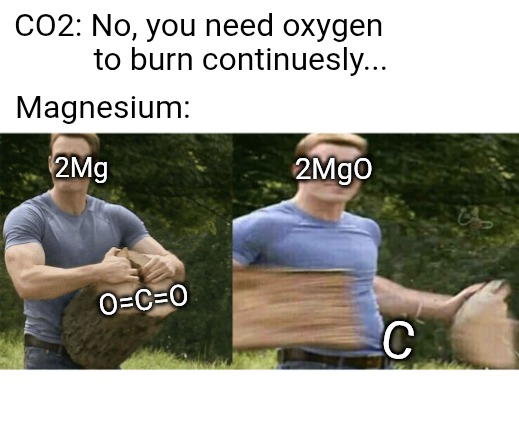
Magnesium is literally the most dramatic element on the periodic table. While CO2 is over here giving sensible chemistry advice about needing oxygen for combustion, magnesium just straight-up ignores it and yoinks the oxygen right out of carbon dioxide itself. That's right—magnesium burns so intensely (around 3,100°C!) that it can rip oxygen atoms away from one of the most stable molecules around, leaving behind pure carbon and magnesium oxide. This is why you should NEVER use a CO2 fire extinguisher on a magnesium fire. You're basically just giving it more fuel to feast on. It's like trying to put out a fire with gasoline, but make it chemistry. Magnesium's reaction is so aggressive that firefighters use special Class D extinguishers with dry powder instead. The meme format perfectly captures magnesium's "I didn't ask for your opinion" energy as it casually performs one of the most thermodynamically savage reactions in basic chemistry.

Well Well

Well Well
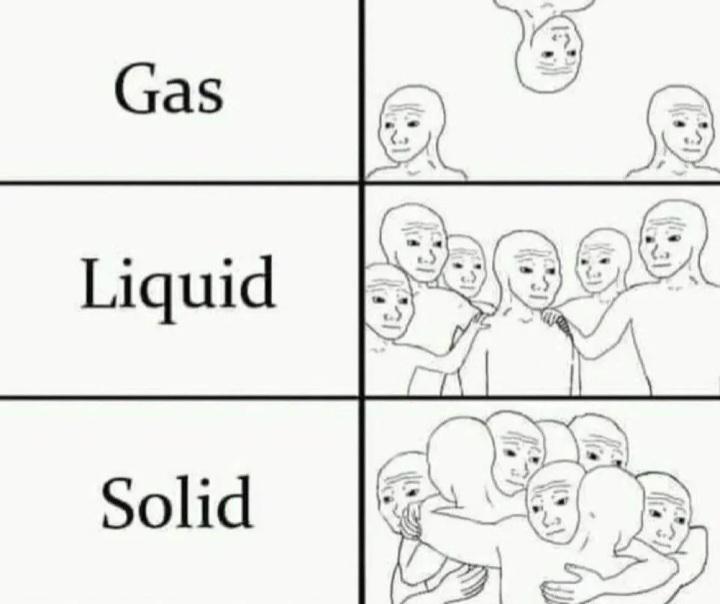
Turns out molecules are just like people at parties. Gas phase? Classic introvert energy—everyone's avoiding eye contact, floating around solo in their own personal space bubble. Liquid? Now we're getting somewhere. A few friendly acquaintances, some casual mingling, molecules actually acknowledging each other's existence. But solid? That's full-on group hug territory. Everyone's locked in tight formation, maximum bonding energy, no personal space whatsoever. The intermolecular forces really said "we're all in this together now."

Steam Go Brrrrrrr

Steam Go Brrrrrrr
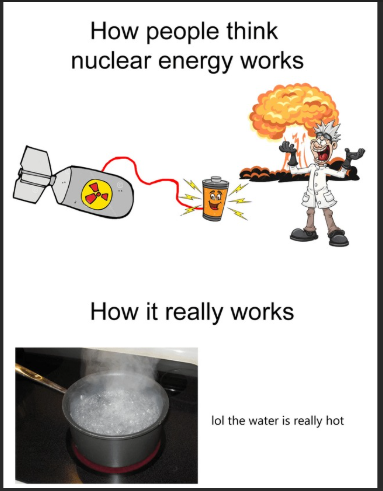
Nuclear power sounds like this ultra-futuristic sci-fi energy source, but at its core? It's literally just fancy water heating. We split atoms to... boil water. That's it. That's the whole thing. People imagine nuclear reactors as these wildly complex machines shooting lightning bolts everywhere, but really we're just using the most expensive kettle in human history to make steam that spins a turbine. Nuclear fission releases massive amounts of heat, which heats water, which makes steam, which turns generators. It's the same basic principle as a coal plant or even a steam engine from the 1800s—we've just upgraded the heat source from "burning stuff" to "controlled atomic reactions." Fun fact: About 80% of electricity generation worldwide involves spinning something to make power. Wind? Spinning. Hydro? Spinning. Coal, gas, nuclear? All just different ways to make things spin. We're really not that creative when it comes to making electricity—we just keep finding new ways to heat water or push air.

Am I Just A Fluctuation?

Am I Just A Fluctuation?
Your brain at 3 AM asking the real questions. The Boltzmann brain is this delightful thought experiment where, given infinite time and random quantum fluctuations, it's statistically more likely that a single conscious brain would spontaneously assemble in the void of space than an entire universe would form naturally. So technically, you could just be a disembodied brain floating in space with false memories of everything you've ever experienced. Sleep tight. The real kicker? You can't prove you're NOT a Boltzmann brain. Philosophy majors and physicists have been losing sleep over this for decades, so your brain is just keeping up with tradition by bringing it up at bedtime.

Asked My Husband To Put The Groceries In The Fridge

Asked My Husband To Put The Groceries In The Fridge
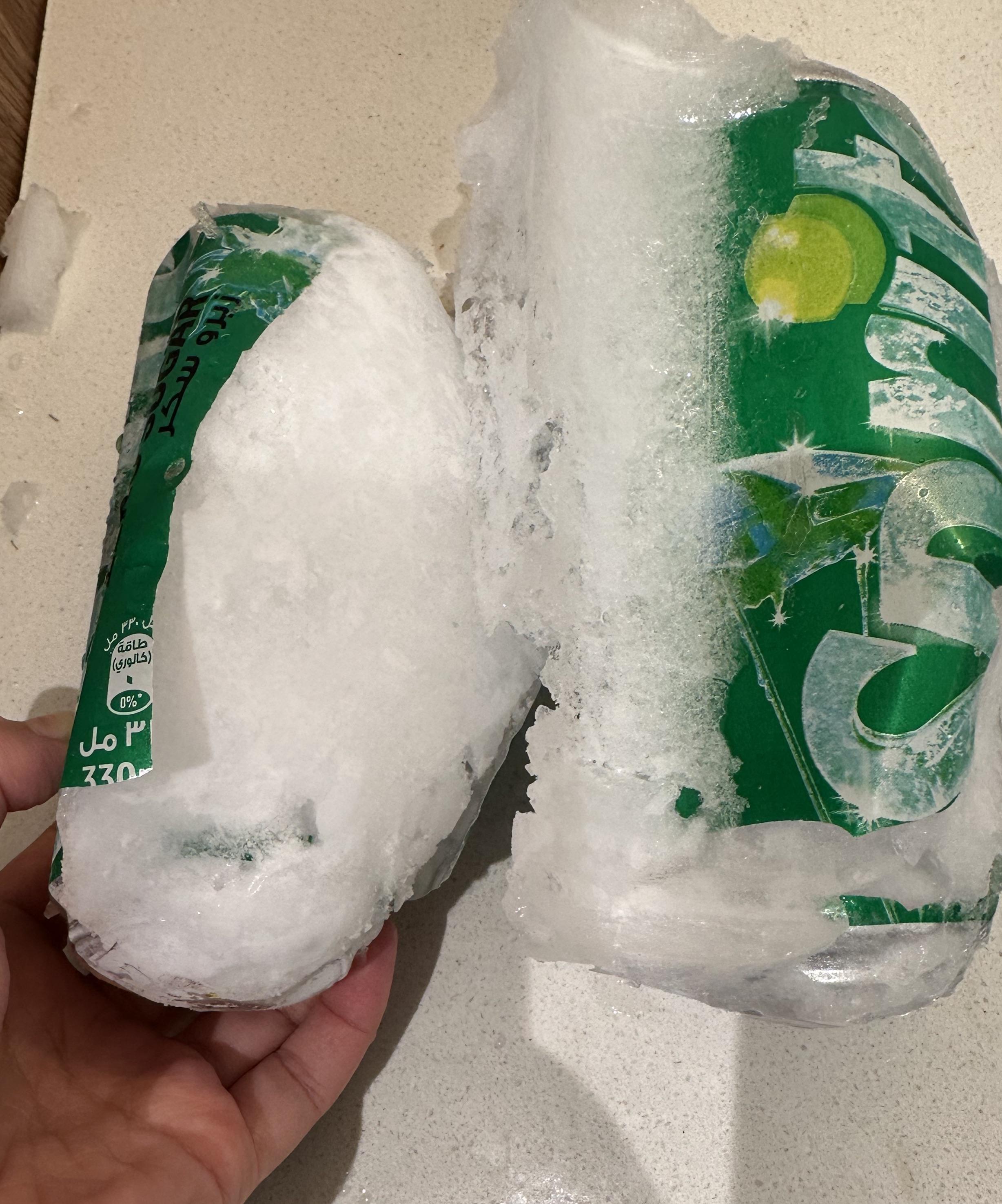
Well, technically he followed instructions! These soda cans are absolutely encased in frost like they've been through a cryogenic experiment gone wrong. Someone clearly cranked that fridge temperature down to Arctic expedition levels. What we're witnessing here is some serious ice crystal formation—when the fridge is set way too cold (probably below 0°C/32°F), the moisture in the air freezes directly onto the cans. The result? Beverages that look like they were excavated from a glacier instead of just placed in cold storage. Fun fact: if these cans were left much longer, the liquid inside could freeze and expand, potentially causing them to burst. Carbonated drinks are especially risky because dissolved CO₂ creates extra pressure. So this is less "refreshingly cold" and more "potential freezer bomb." Maybe next time include "at a reasonable temperature" in those instructions!

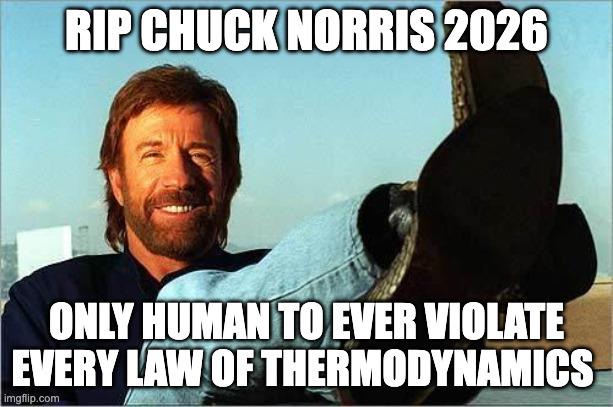
Chuck Norris Is Not Dead He Is Just Living His Life By Travelling Back In Time

Chuck Norris Is Not Dead He Is Just Living His Life By Travelling Back In Time

We'Ll Thermodynamics Are Predictible Atleast

We'Ll Thermodynamics Are Predictible Atleast

300 Kelvin Is Not A Room Temperature

300 Kelvin Is Not A Room Temperature
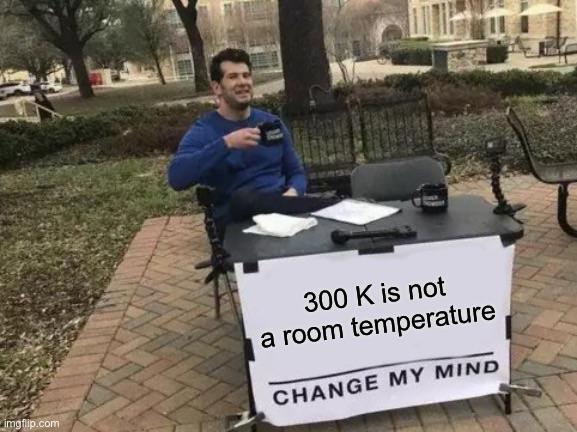
Physicists and chemists are DYING right now! 🔥 This meme hits that sweet spot between science humor and absolute truth. 300 Kelvin equals about 27°C (80°F), which is actually a pretty comfy room temperature! The joke plays on the classic "change my mind" format while sneakily teaching us about temperature scales. Scientists use Kelvin for precise measurements because it starts at absolute zero - no negative numbers needed! Next time someone complains about room temperature, just say "at least it's not 300K" and watch the confusion spread!

300K Is Not A Room Temperature

300K Is Not A Room Temperature
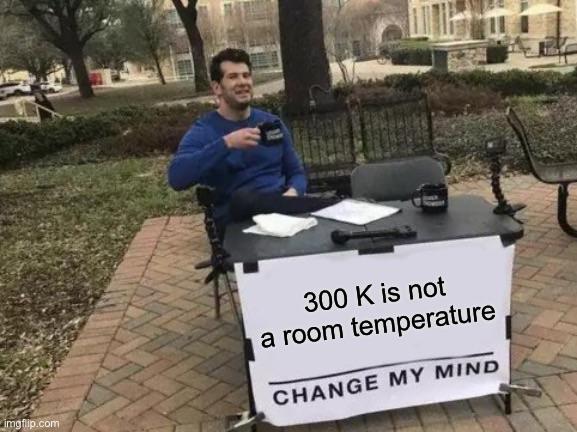
The scientific precision here is *chef's kiss*. Room temperature is typically defined as 20-25°C (68-77°F), which equals about 293-298 Kelvin. So technically, 300K is indeed slightly above standard room temperature. Only physicists and chemists would set up a debate table to die on this hill of a 2-7 degree Kelvin difference. Next they'll be arguing whether 101 kPa is standard atmospheric pressure while the rest of us just call it "air."

Kelvin Doesn't Care About Your Comfort Zone

Kelvin Doesn't Care About Your Comfort Zone
Physicists and chemists are silently screaming at this guy. Room temperature is typically around 20-25°C (293-298 Kelvin), but this brave soul is out here claiming 300K isn't room temperature? That's only a few degrees off! It's like arguing that $19.95 isn't basically $20. The Kelvin scale, where absolute zero is 0K and water freezes at 273.15K, makes 300K a perfectly reasonable room temperature—unless you're conducting precision experiments or enjoy sweater weather in the Sahara. Next up: this guy probably thinks Avogadro's number is just a wild guess.

What A Warming Relationship

What A Warming Relationship
The only successful application of thermodynamics to dating. Heat transfer between cold and warm hands creates the perfect equilibrium state—nature's way of saying some relationships are energetically favorable. The second law finally found its romantic loophole. Next paper title: "Entropy Reduction Through Selective Hand-Holding: A Case Study."