

Theory Memes

Posts tagged with Theory
Name It

Name It
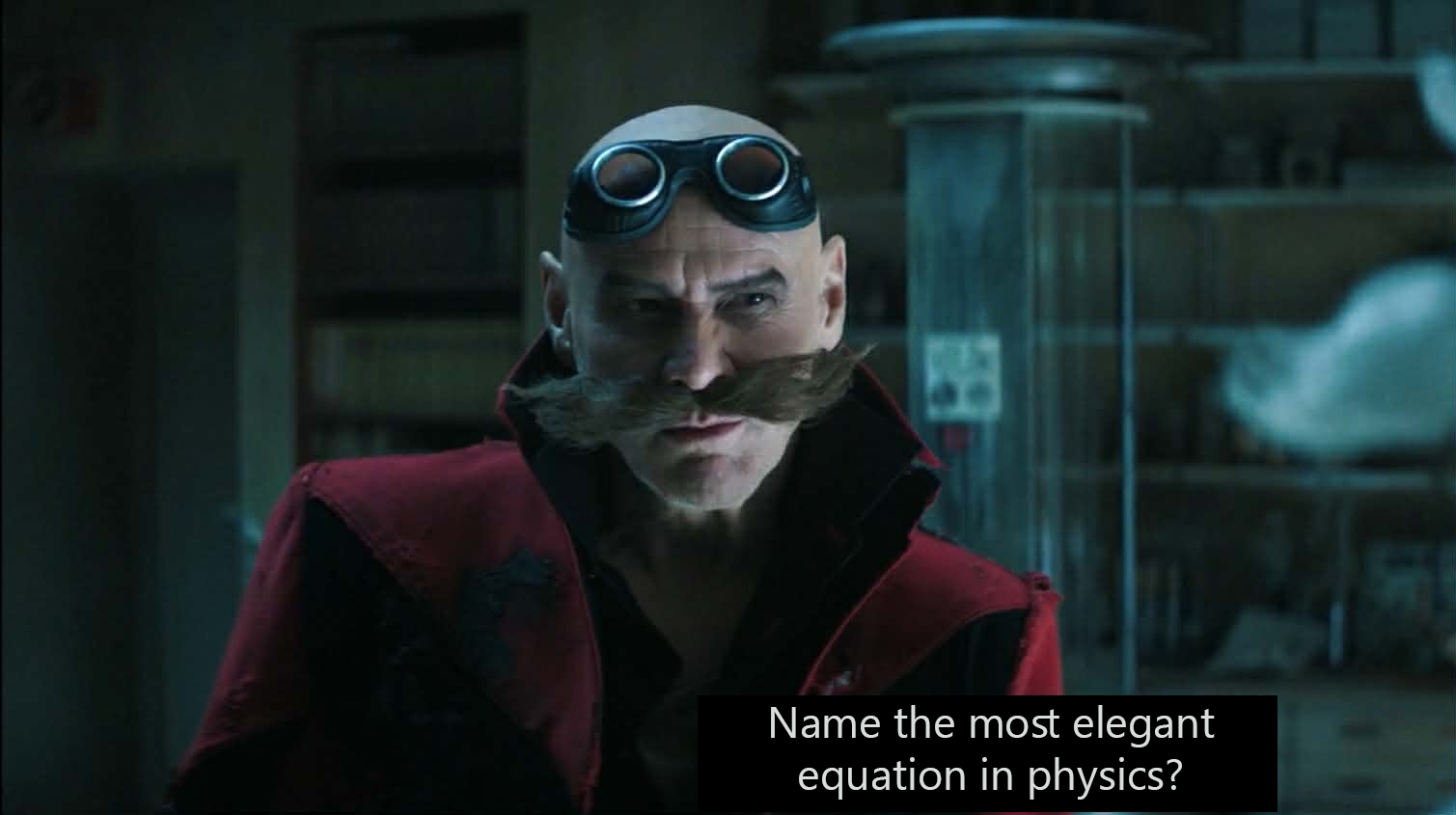
You know you're talking to a real physicist when they get that gleam in their eye about "elegant" equations. Every physicist has their favorite—some swear by Maxwell's equations for their symmetry, others get misty-eyed over E=mc², and then there's the quantum crew who won't shut up about Schrödinger's equation. But here's the thing: asking a physicist to pick THE most elegant equation is like asking someone to choose their favorite child. You're about to get a 45-minute lecture complete with hand gestures, whiteboard diagrams, and possibly some tears. Einstein's field equations? Euler's identity? The Dirac equation? Each one has a fan club ready to fight in the comments. That villainous grin says it all—whoever's asking this question knows exactly what chaos they're unleashing. It's the scientific equivalent of asking "which Star Wars movie is best?" at a convention. Grab your popcorn, folks.

On The Wall Of My Laser Lab

On The Wall Of My Laser Lab
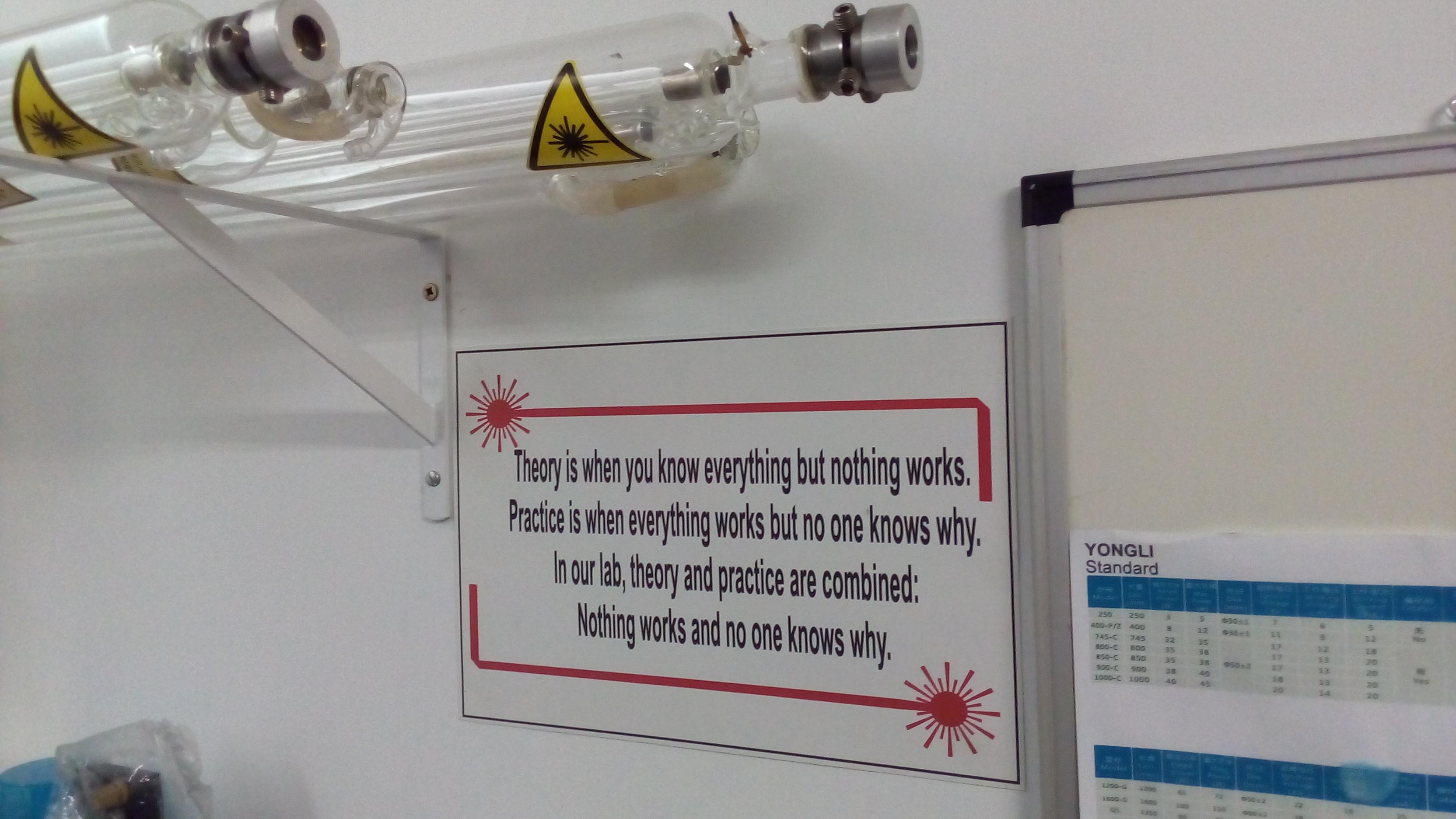
This perfectly captures the existential crisis of experimental physics. The quote breaks down the gap between theory and practice: theorists understand all the equations but can't get anything to actually work, while experimentalists get things working through sheer trial-and-error but couldn't explain the underlying physics if their grant depended on it. But in a laser lab? You get the worst of both worlds. Your laser system is simultaneously too complicated to fully model AND refuses to cooperate. That optical alignment you spent three hours perfecting yesterday? Mysteriously misaligned this morning. The laser that worked flawlessly during setup? Dead silent during your advisor's visit. Nothing works, nobody knows why, and the equipment just sits there with its little warning stickers mocking your PhD. The laser icons decorating the sign are a nice touch—like putting smiley faces on a disaster report. At least they have a sense of humor about their collective suffering.

Problem Of Induction Meme

Problem Of Induction Meme
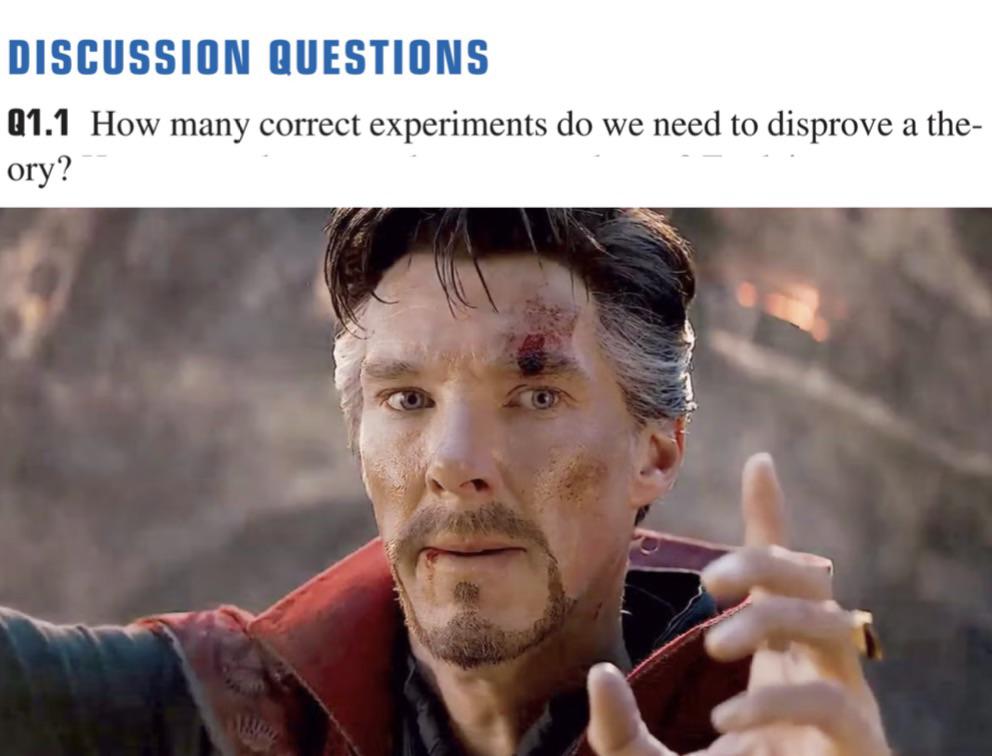
The beautiful irony here is that the question itself reveals a fundamental misunderstanding of how science works. You don't need multiple experiments to disprove a theory—you need exactly one that contradicts it. Meanwhile, you could run a million confirming experiments and still not "prove" the theory true, because that's the problem of induction David Hume warned us about centuries ago. The problem of induction is basically this: just because something has happened repeatedly in the past doesn't logically guarantee it'll happen in the future. The sun rose yesterday, today, and a billion times before, but that doesn't prove it'll rise tomorrow—we just have really strong inductive reasoning to believe it will. So the answer to Q1.1? One. Just one contradictory experiment can shatter a theory. But the student asking probably expects some large number, which is why Doctor Strange here is holding up that iconic finger like "buddy, we need to talk about falsification."

I Liked When Science Was Like Trivia. How About You?

I Liked When Science Was Like Trivia. How About You?
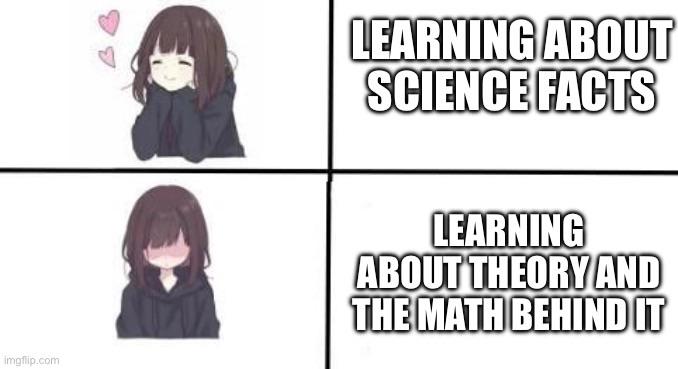
Remember when science class was just memorizing that mitochondria is the powerhouse of the cell and moving on with your life? Good times. Then suddenly you're expected to understand why ATP synthase works like a molecular turbine and derive equations for reaction kinetics. The transition from "fun fact: water boils at 100°C" to "calculate the change in entropy when accounting for atmospheric pressure variations and intermolecular forces" hits different. We all signed up for the trivia night version of science, not the existential crisis mathematical proof edition. That cute anime girl with hearts represents our innocent joy at learning cool facts, while the second panel captures our soul leaving our body when someone mentions partial differential equations.

Our Understanding Of The Physical World Is So Fragile. Thanks Hume. Now I Have Anxiety

Our Understanding Of The Physical World Is So Fragile. Thanks Hume. Now I Have Anxiety
David Hume really woke up one day and said "hey, you know how you think the sun will rise tomorrow because it always has? Yeah, you can't actually prove that." And scientists have been having existential crises ever since. The brutal truth is that it only takes ONE experiment to completely demolish a theory, but you could run a million successful experiments and still not prove it's universally true. You're just building confidence on a foundation of "well, it hasn't failed YET." This is the problem of induction that keeps philosophers of science up at night. We assume nature follows consistent patterns, but that assumption itself can't be proven—it's just something we kinda have to accept to do science at all. Doctor Strange here holding up one finger perfectly captures that sinking feeling when you realize your entire understanding of reality is built on observations that could theoretically be wrong tomorrow. Sleep tight!

In Recent Developments...

In Recent Developments...
Every researcher's worst nightmare: watching your beautiful hypothesis get absolutely demolished by reality. You spend months crafting the perfect conjecture, building elegant theoretical frameworks, only to have the counterexample factory working overtime to mass-produce exceptions to your rule. The cat's business-casual tie really sells the professional devastation here. That's the look of someone who just got their paper rejected because reviewer #2 found seventeen counterexamples in the supplementary materials. The factory smokestacks in the background? Chef's kiss. They're literally churning out evidence against you at industrial scale. Fun fact: In mathematics, a single counterexample is enough to destroy an entire conjecture, no matter how many supporting cases you've found. Could've worked for 999 cases, but that 1000th one? Game over. Science doesn't care about your feelings or your grant deadline.

Before The Experiment, The Experimental Subject Was Taught Relevant Theories As Information

Before The Experiment, The Experimental Subject Was Taught Relevant Theories As Information
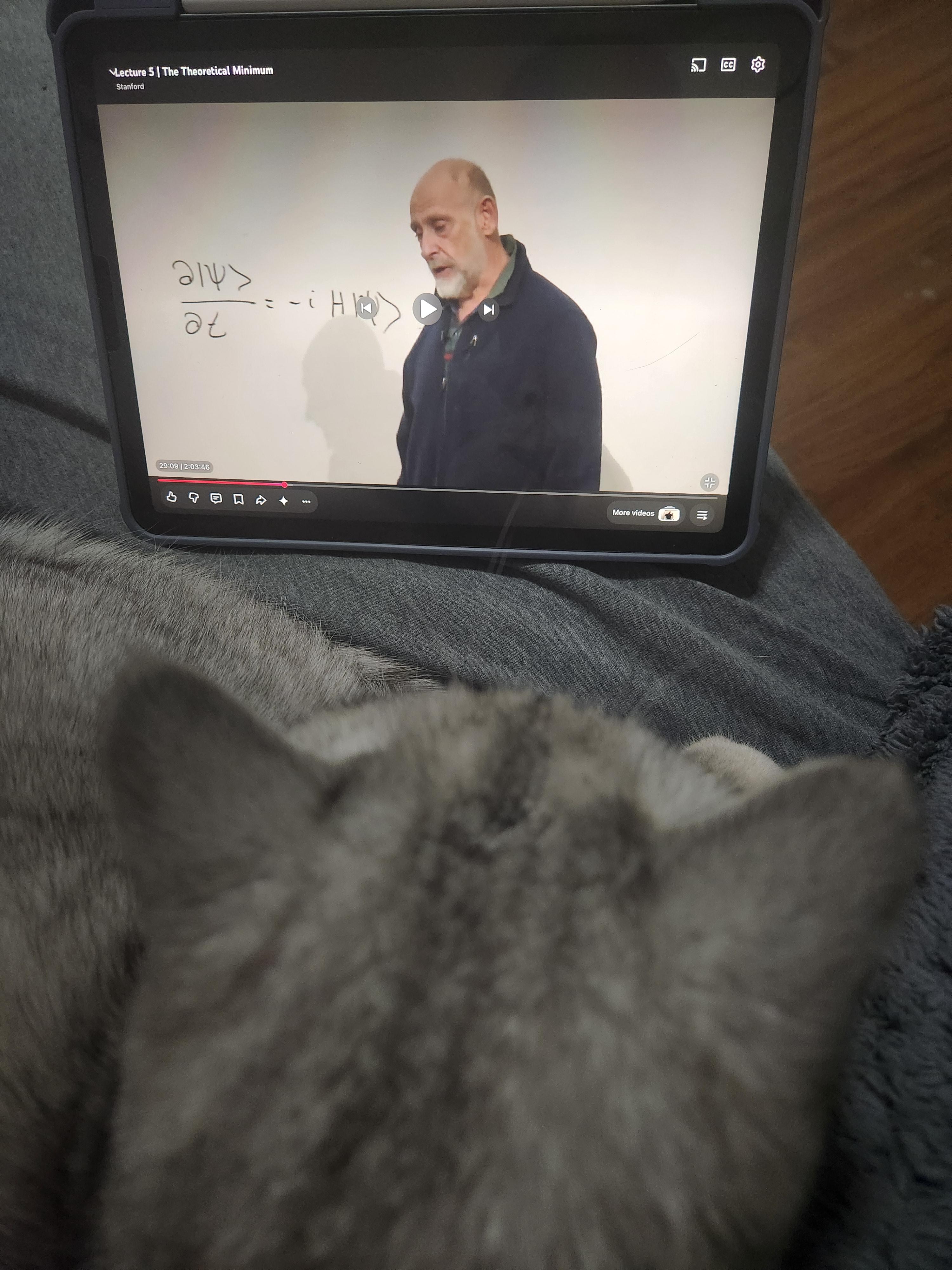
Someone's cat just became an involuntary participant in a quantum mechanics lecture. The experimental subject here appears to be receiving "theoretical minimum" education via Stanford lecture video, though judging by that blissful sleeping position, the information retention rate is approximately zero. The setup is perfect: you've got a serious physics professor explaining partial derivatives on screen, and your furry research participant has clearly decided that nap time > Hamiltonian mechanics. The cat's contribution to science? Demonstrating that comfort and cozy blankets have a 100% success rate in overriding any educational content, no matter how theoretical. Fun fact: cats sleep 12-16 hours a day, which means this one is actually conducting a highly efficient time-management experiment by multitasking sleep with "learning." The real question is whether the cat absorbed any knowledge through osmosis, or if it just proved that even theoretical physics can't compete with a good blanket.

Physicists Dodging The Quantum Gravity Question

Physicists Dodging The Quantum Gravity Question
The perfect metaphor for theoretical physics progress! Over a century after Einstein revolutionized our understanding of gravity with general relativity (describing it as spacetime curvature rather than a force), physicists are STILL struggling to reconcile it with quantum mechanics. Just like someone deflecting deep questions about physics by pointing to stock market numbers, the field keeps dodging the quantum gravity problem. String theory? Loop quantum gravity? We've thrown brilliant minds at this for decades and basically still have Einstein's description plus a bunch of fancy math and zero experimental proof. The graviton remains as elusive as a consistent explanation from a politician!

What Is A Number? The Question That Breaks Mathematicians

What Is A Number? The Question That Breaks Mathematicians
Innocent question: "What is a number?" Mathematicians: *descends into existential crisis with conspiracy board* That simple question unleashes CENTURIES of mathematical philosophy! Are numbers just symbols? Abstract concepts? Do they exist independently of human thought? Is 0 really a number? What about infinity? Is π more real than √-1? Next time you want to see a mathematician's brain short-circuit, just ask this seemingly innocent question and watch them spiral into the mathematical abyss! 🧮🤯

Scientific Falsifiability: One Black Swan To Rule Them All

Scientific Falsifiability: One Black Swan To Rule Them All
Behold! The perfect illustration of Karl Popper's falsifiability principle in science! 🧪 Our brave knight declares "ALL SWANS ARE WHITE" - a hypothesis that seems rock-solid until... BOOM! One black swan appears and completely demolishes it! 🦢 This is scientific method in its purest form - no matter how many white swans you've counted, it takes just ONE contrary example to disprove your theory. That's why good scientists don't say "I'm definitely right" but rather "I haven't been proven wrong... yet!" *maniacal scientist laugh* Fun fact: Europeans really did think all swans were white until 1697 when Dutch explorers found black swans in Australia. Talk about a medieval knight's worst nightmare!

Elite Ball Knowledge: When Your Theories Are Too Advanced For Academia

Elite Ball Knowledge: When Your Theories Are Too Advanced For Academia
Ever had that moment when you think you've solved the mysteries of the universe but can't get anyone to listen? The "Elite ball knowledge" mug is the perfect gift for that friend who swears they've unified quantum mechanics with general relativity... during a shower thought! It's the scientific equivalent of "trust me bro" evidence. Universities aren't returning your calls about your groundbreaking theory on how aliens built the pyramids? Just sip from this mug and embrace your unrecognized genius! The academic gatekeeping is real, folks!

The Physics Duality Principle

The Physics Duality Principle
The duality of physics enthusiasm is real! Top panel: falling asleep during structured physics class with textbooks that somehow make quantum mechanics more boring than watching paint dry. Bottom panel: the same person at 3 AM, frantically connecting red strings between sticky notes, convinced they've discovered how to unify quantum mechanics and general relativity while chugging their fifth energy drink. The transformation from classroom zombie to backyard Einstein is the scientific equivalent of "don't talk to me before my coffee vs. after."