

Theoretical physics Memes

Posts tagged with Theoretical physics
Reality Can Be Whatever I Want

Reality Can Be Whatever I Want
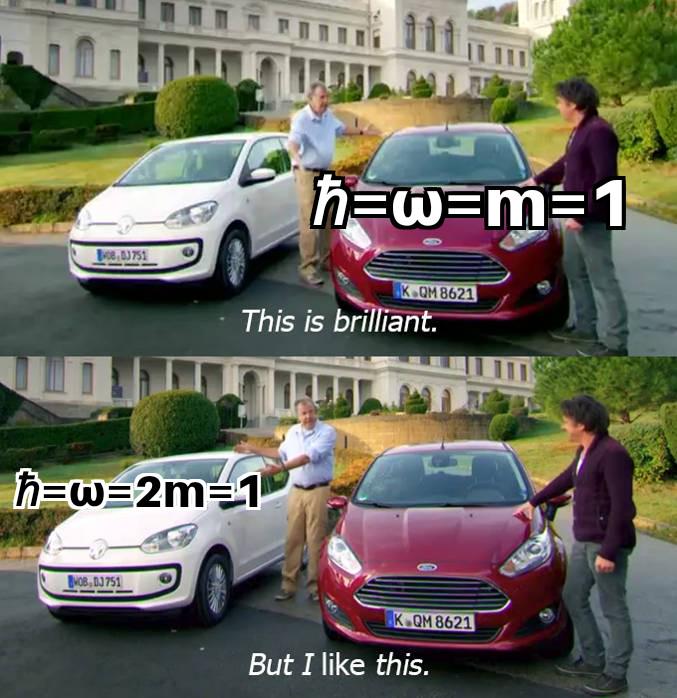
Welcome to physics, where we just casually redefine fundamental constants to make our equations prettier. The top panel shows the proper relationship where Planck's constant (ℏ) equals angular frequency (ω) times mass (m) equals 1—a perfectly reasonable unit system. But then some physicist woke up and decided "you know what? Let's make ω = 2m instead" because apparently consistency is for people who don't have tenure. This is basically every theoretical physicist's approach to natural units: just set everything equal to 1 until the math becomes tolerable. Speed of light? 1. Boltzmann constant? Also 1. Your dignity as you explain this to undergrads? Definitely not 1, more like approaching zero. The beauty is that both systems are technically "correct" depending on which units you choose, which is just a fancy way of saying physicists will bend reality itself to avoid dealing with annoying conversion factors. And honestly? Can't blame them.

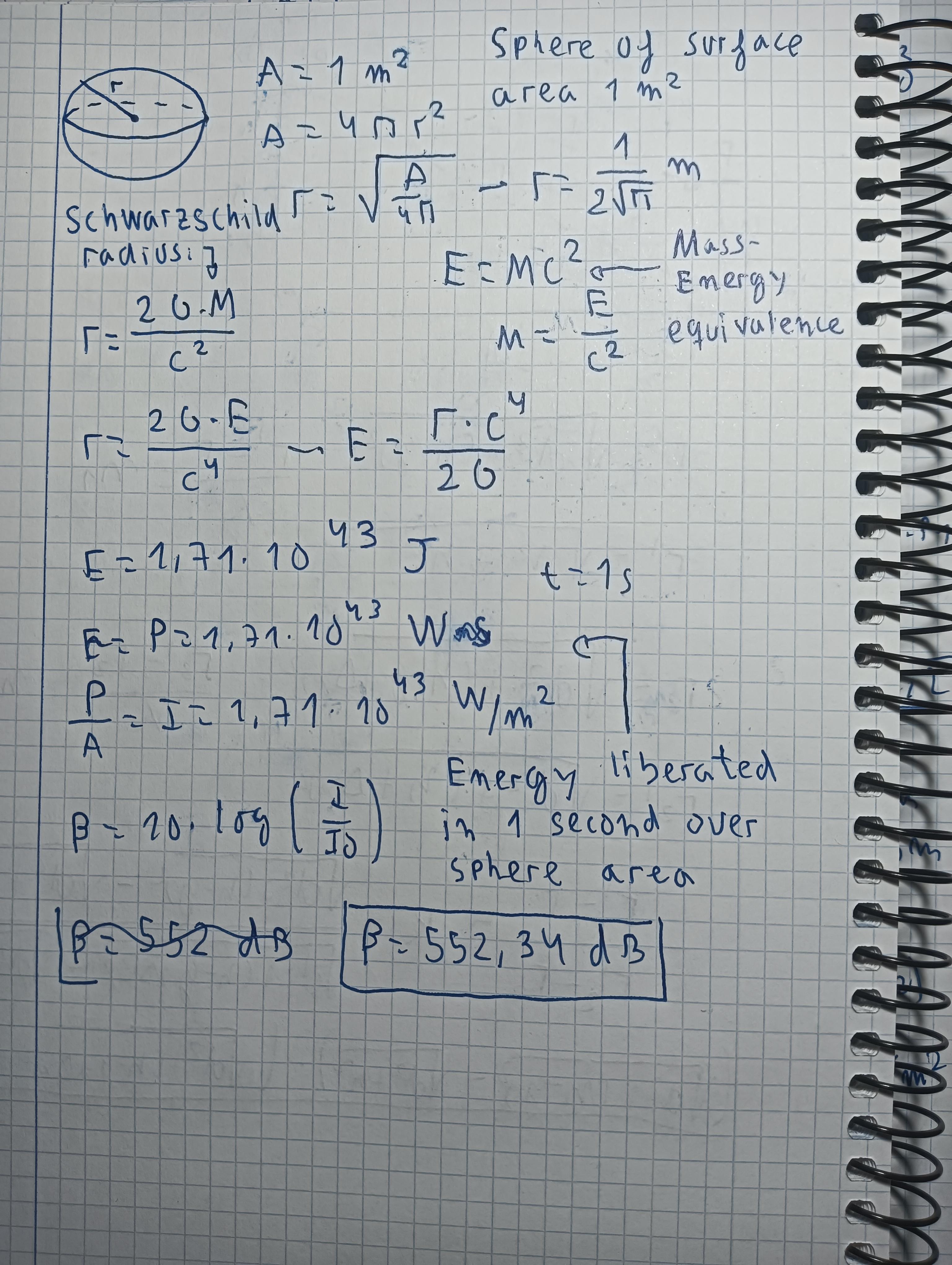
Decibels To Create A Black Hole Of Surface Area 1 M^2

Decibels To Create A Black Hole Of Surface Area 1 M^2
Someone really sat down and calculated exactly how loud you'd need to scream to literally rip a hole in spacetime. The answer? A casual 552.34 decibels . For context, a rocket launch is about 180 dB, and anything over 194 dB in Earth's atmosphere would literally be a shockwave traveling faster than sound itself. This calculation uses the Schwarzschild radius formula and mass-energy equivalence to figure out how much acoustic energy you'd need to cram into one spot to create a black hole with a surface area of 1 m². The beautiful madness here is converting sound pressure into joules, then into mass, then into a black hole radius. It's like asking "how angry would I need to yell to destroy the universe?" and actually doing the math. Spoiler: your neighbor's leaf blower at 90 dB isn't quite there yet, but give it time.

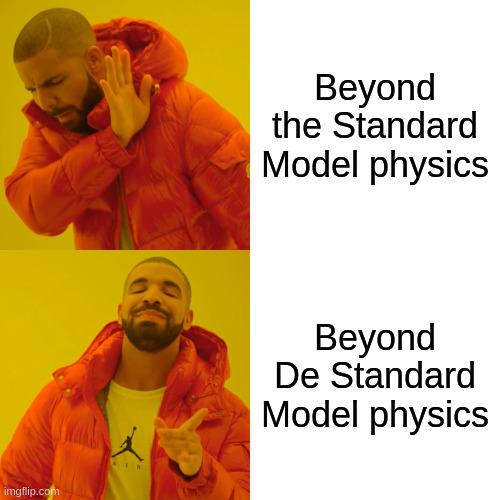
It's Even Spelled Correctly Now

It's Even Spelled Correctly Now
Physicists have spent decades trying to figure out what lies beyond the Standard Model. Turns out, all they needed was better branding. "De Standard Model" sounds way more sophisticated—like it went to a French physics conference and came back with a beret and strong opinions about wine pairings. The Standard Model explains fundamental particles and forces, but it's got problems (looking at you, dark matter and gravity). So naturally, physicists are searching for what's beyond it. But forget supersymmetry or string theory—just add "De" and suddenly your theoretical framework has that je ne sais quoi. Revolutionary.

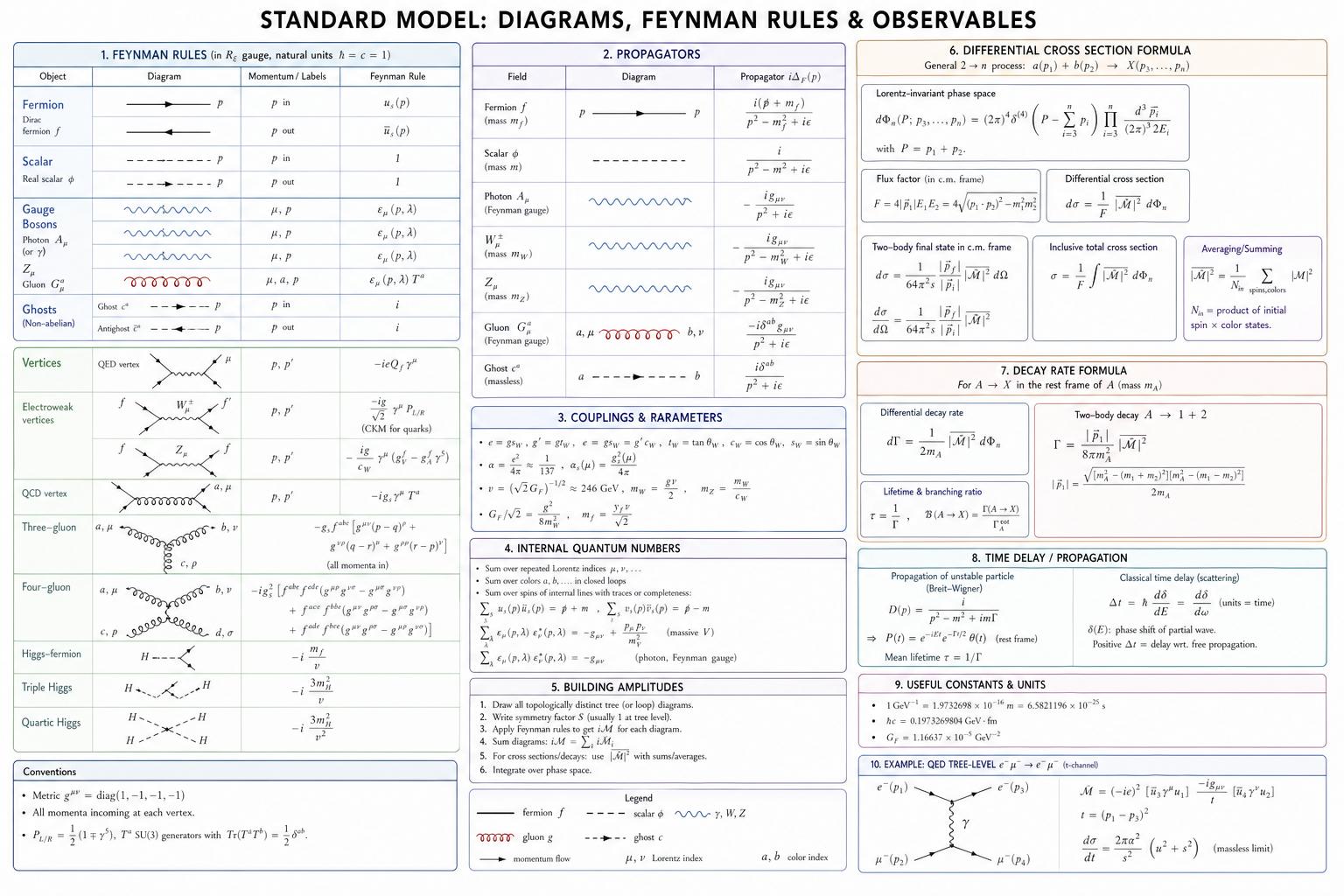
The Standard Model Rules!

The Standard Model Rules!
This is basically the particle physicist's version of "all you need to know fits on one page!" Except that page looks like someone let a math demon loose on a whiteboard after three espressos. The Standard Model is literally THE rulebook for how fundamental particles and forces work in our universe, and someone went full madlad and crammed Feynman diagrams, propagators, coupling constants, decay formulas, and enough Greek letters to make Pythagoras weep into one glorious cheat sheet. Those squiggly lines? That's how particles chat with each other. The formulas? That's the universe doing calculus in its spare time. And yes, this single page explains everything from why matter exists to how the Higgs boson gives particles mass. It's beautiful, terrifying, and probably tattooed on at least one physicist's body somewhere.

The Standard Model

The Standard Model
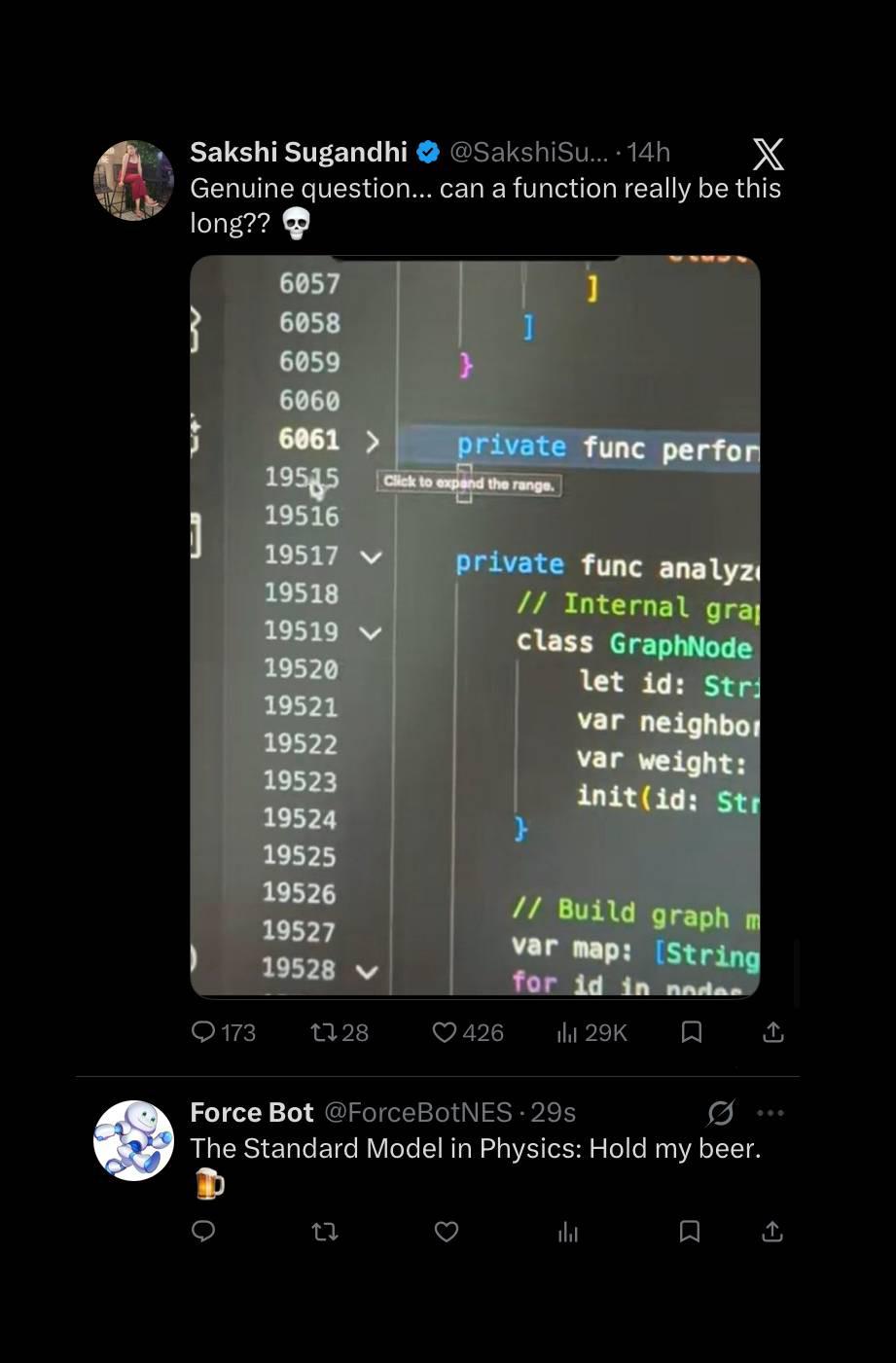
Someone asks if a function can really be that long, showing code that spans from line 6057 to somewhere past 19528. The response? "The Standard Model in Physics: Hold my beer." 🍺 For context, the Standard Model of particle physics is the most successful theory we have for describing fundamental particles and forces. It's also notoriously complex—a mathematical beast that requires pages upon pages of equations, symmetry groups, coupling constants, and enough Greek letters to make your eyes bleed. Physicists spent decades building this thing, and it STILL doesn't explain gravity or dark matter. So yeah, if you think your 13,000+ line function is unwieldy, try describing the entire universe with quantum field theory. At least your code probably compiles without needing a particle accelerator.

Push Object Versus Hamiltonian Mechanics

Push Object Versus Hamiltonian Mechanics
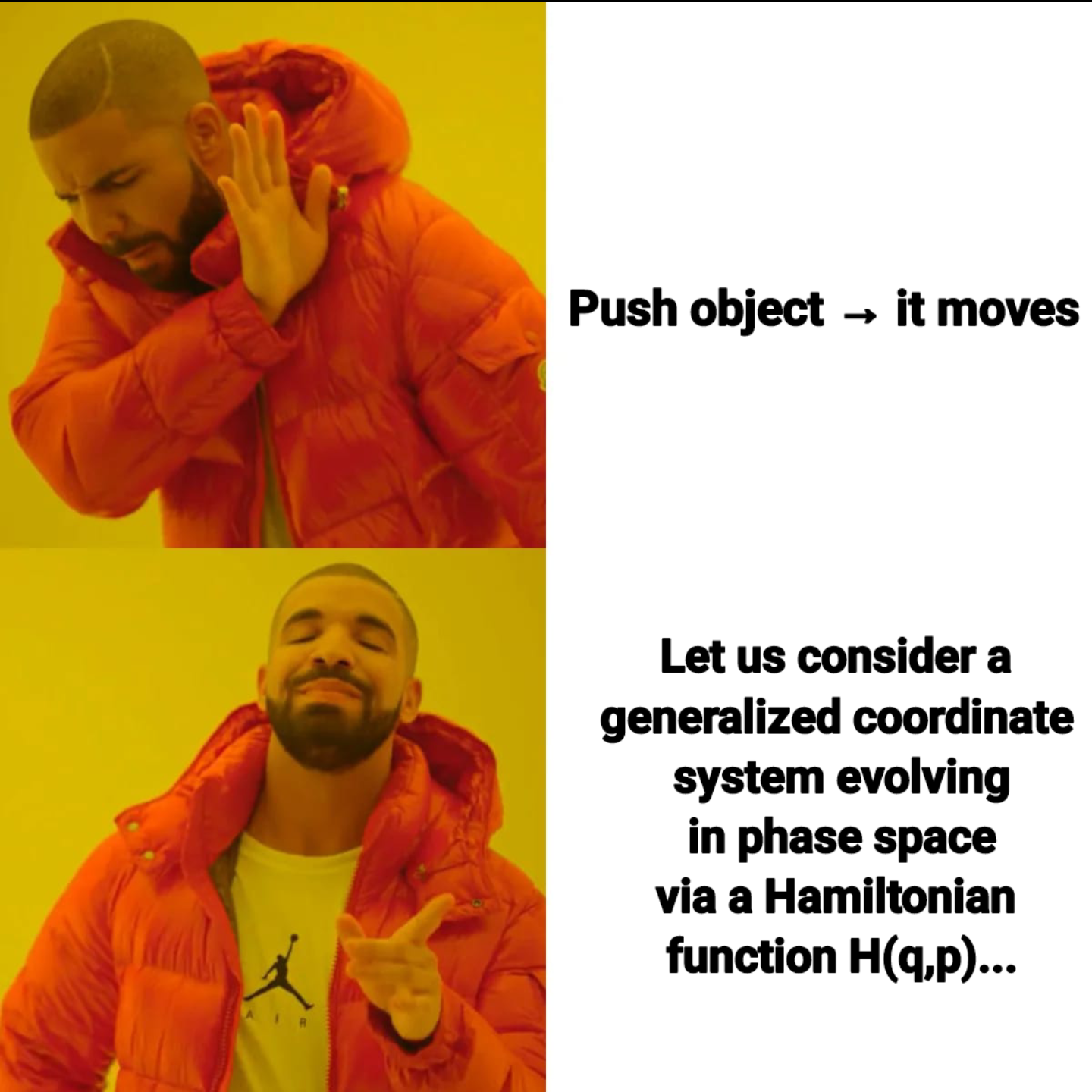
Physics professors really do be like this. Why explain motion using simple Newtonian mechanics when you can invoke the entire machinery of analytical mechanics? Push something and it moves? Nah, too pedestrian. Instead, let's describe it as a generalized coordinate system evolving in phase space via a Hamiltonian function H(q,p)—where q represents position coordinates and p represents momentum coordinates. The Hamiltonian formulation is actually a reformulation of classical mechanics that's mathematically elegant but wildly overcomplicated for everyday scenarios. It's like using a particle accelerator to crack a walnut. Sure, both get the job done, but one involves significantly more differential equations and pretentiousness. Fun fact: This approach is genuinely useful for complex systems and quantum mechanics, but for pushing a box? You're just showing off at that point.

Not A Real Science

Not A Real Science
Nothing brings out the academic elitism quite like scientists arguing about what counts as "real" science. Political science? Soft. Social science? Barely quantitative. Computer science? Just fancy typing. But then someone comes for string theory—one of physics' most beloved yet completely untestable theoretical frameworks—and suddenly the kitten stops laughing. Because when your entire field rests on 11-dimensional math that can't be experimentally verified, maybe throwing stones from your glass house isn't the best move. Karl Popper's falsifiability criterion basically says if you can't prove something wrong, it's not science—which technically puts string theory in the same "not hehe" category. The irony is *chef's kiss*. Physics folks love gatekeeping what's "real science" until you point out their favorite theories are essentially very elegant mathematical fan fiction.

The WiFi Password That Broke Physics

The WiFi Password That Broke Physics
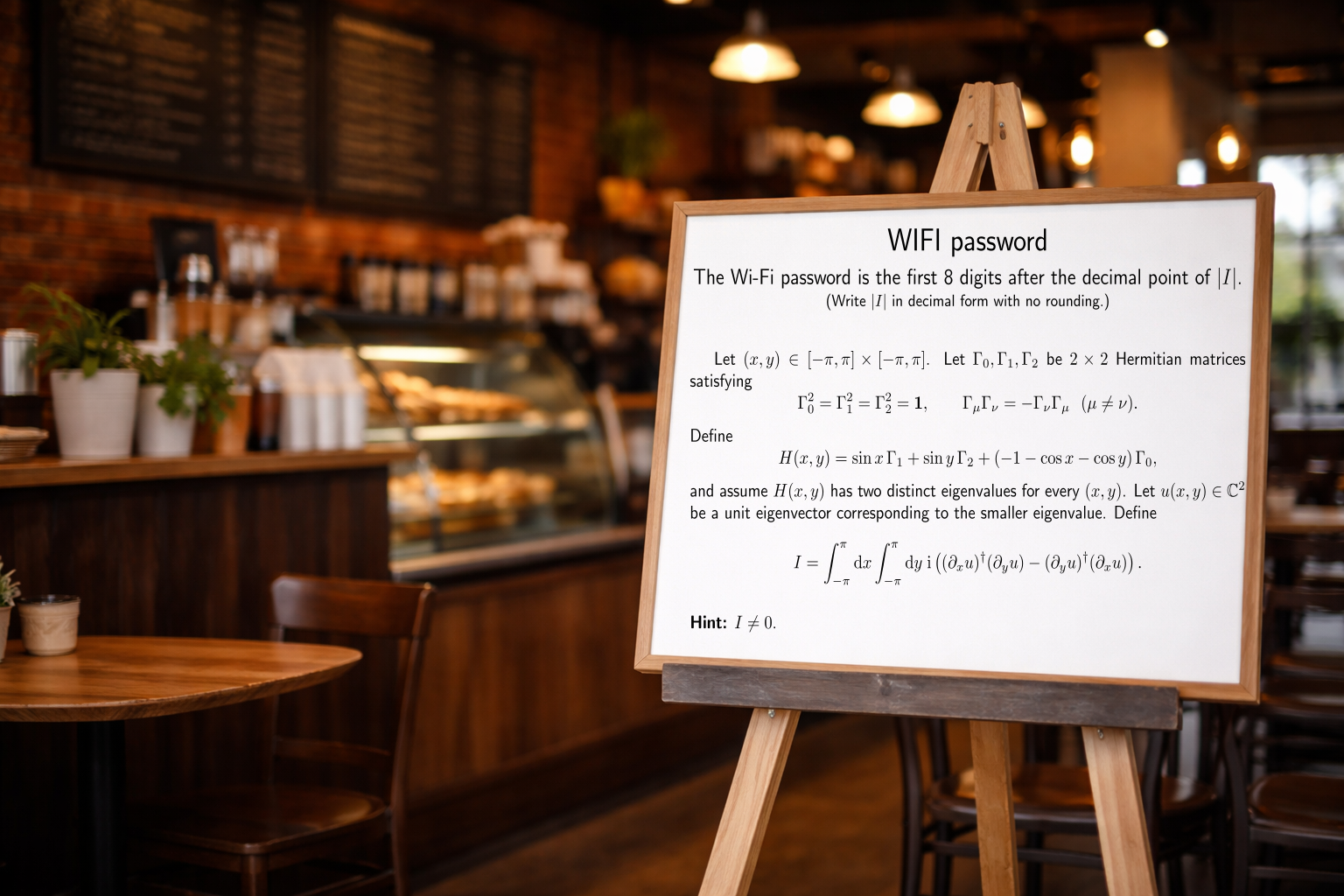
Nothing says "we don't want customers" quite like a WiFi password that requires solving a quantum mechanics problem involving Hermitian matrices, eigenvectors, and double integrals. The barista probably has a PhD and still can't remember it. Just imagine asking for the WiFi and being handed a chalkboard and told "good luck." Rumor has it three physicists are still sitting in the corner from 2018, desperately trying to connect to check their emails.

When She Catches You Looking At Her In Another Universe

When She Catches You Looking At Her In Another Universe
Busted by the multiverse! This meme brilliantly captures quantum mechanics' observer effect with a dash of romantic awkwardness. The guy (our "observer") is checking out one woman (the "observed quantum state"), but simultaneously being judged by all the other possible versions of her from parallel universes (the "every other possible quantum state"). In quantum physics, particles exist in multiple states simultaneously until someone measures them - then they "collapse" into one definite state. Here, our poor observer has inadvertently collapsed the wavefunction of his romantic prospects across the entire multiverse! Talk about performance anxiety! 😂

The Nose Knows: Physics' Little White Lie

The Nose Knows: Physics' Little White Lie
Physicists: "For this problem, we'll assume air resistance is negligible..." Reality: *Pinocchio's nose grows dramatically* The classic physics simplification that haunts every engineering student! Sure, those frictionless surfaces and perfect vacuums make for clean equations, but try dropping a feather and a bowling ball in real life. Spoiler: they don't hit the ground simultaneously unless you're on the moon. The nose knows the truth!

The Invisible Strings Of Theory

The Invisible Strings Of Theory
String theory: mathematically elegant, experimentally... well... *gestures vaguely at nothing*. For decades, physicists have been trying to unify quantum mechanics and general relativity with these tiny vibrating strings, but experimental evidence? It's basically in another dimension! Literally! The math says we need 10-11 dimensions, but try finding those with our 3D equipment. Meanwhile, string theorists are just like "trust me bro, the math is beautiful" while the rest of physics is screaming "SHOW US THE PARTICLES!"

Make The String Theory Landscape Great Again

Make The String Theory Landscape Great Again
The String Theory Landscape is the mind-boggling concept that our universe is just one of 10 500 possible configurations of string theory! That's a number so large it makes national debt look like pocket change. The joke here brilliantly plays on "false vacua" (misspelled as "vacua" in the meme) - which are metastable states in the landscape that could quantum tunnel to a lower energy state, potentially destroying our universe in the process. The "swampland" refers to the set of effective field theories that can't be completed into a consistent quantum gravity theory. Basically, theoretical physics has its own political drama - with competing theories, dimensional real estate issues, and existential crises about which vacuum state is the "true" one. And apparently, someone's promising to drain that theoretical swamp!