

Textbook Memes

Posts tagged with Textbook
Proof By "Go Take Another Math Class For The Proof"

Proof By "Go Take Another Math Class For The Proof"
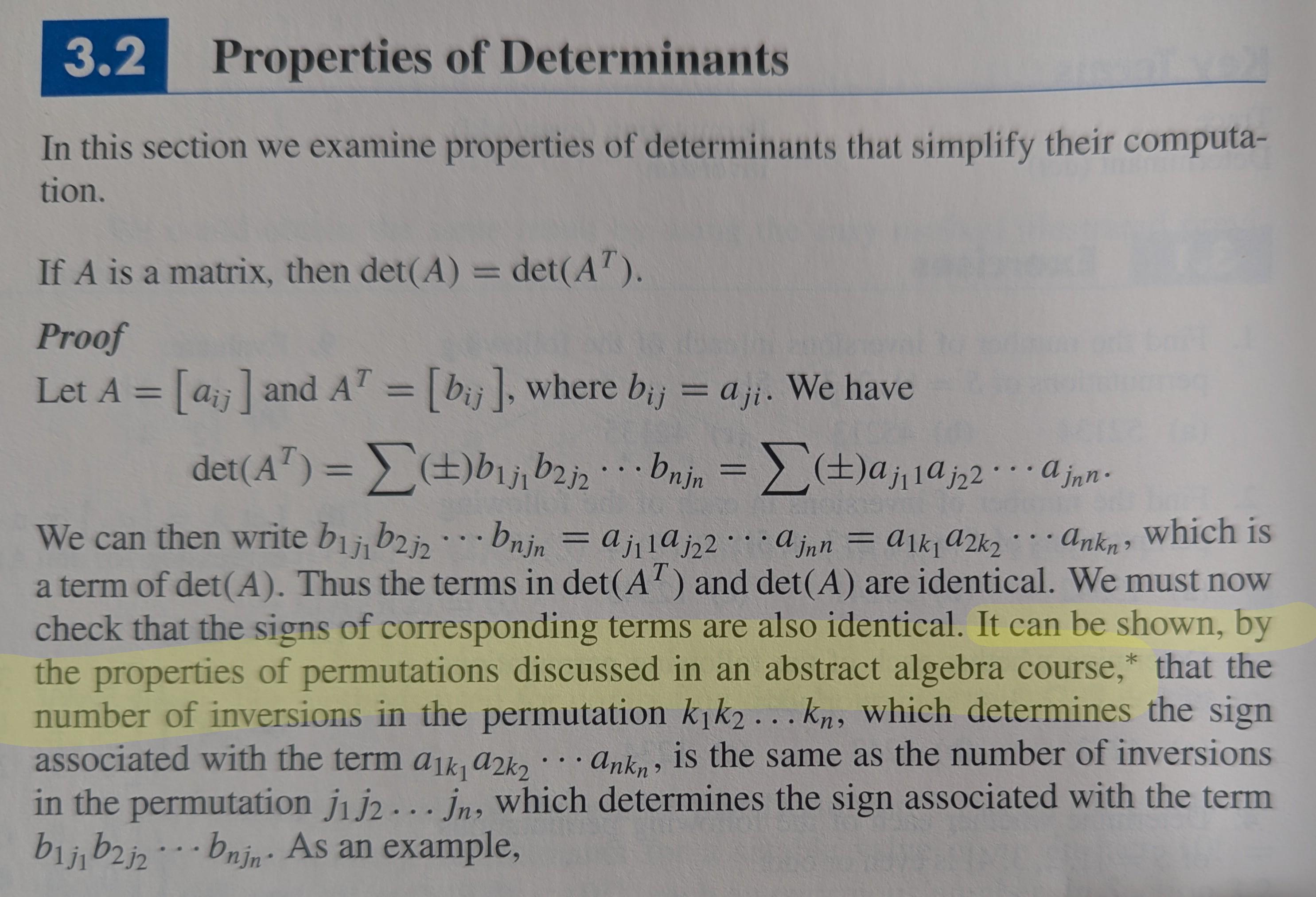
You know that feeling when your linear algebra textbook is almost done proving something, and then suddenly drops "It can be shown, by the properties of permutations discussed in an abstract algebra course,*" with a little asterisk like it's no big deal? That's basically the mathematical equivalent of "trust me bro" but with extra steps and a reading list. The textbook is literally saying "yeah we COULD prove this determinant property right here, but nah—go take an entirely different upper-level math course first." It's the academic version of gatekeeping, except instead of a bouncer at a club, it's your textbook casually suggesting you need another semester of coursework to understand one sentence. Nothing says "simplifying computation" quite like requiring knowledge from a completely different branch of mathematics! The highlighted section is basically math's way of saying "the proof is left as an exercise for the reader" but with more passive-aggressive energy. Classic textbook move.

Strogatz Is So Goated

Strogatz Is So Goated
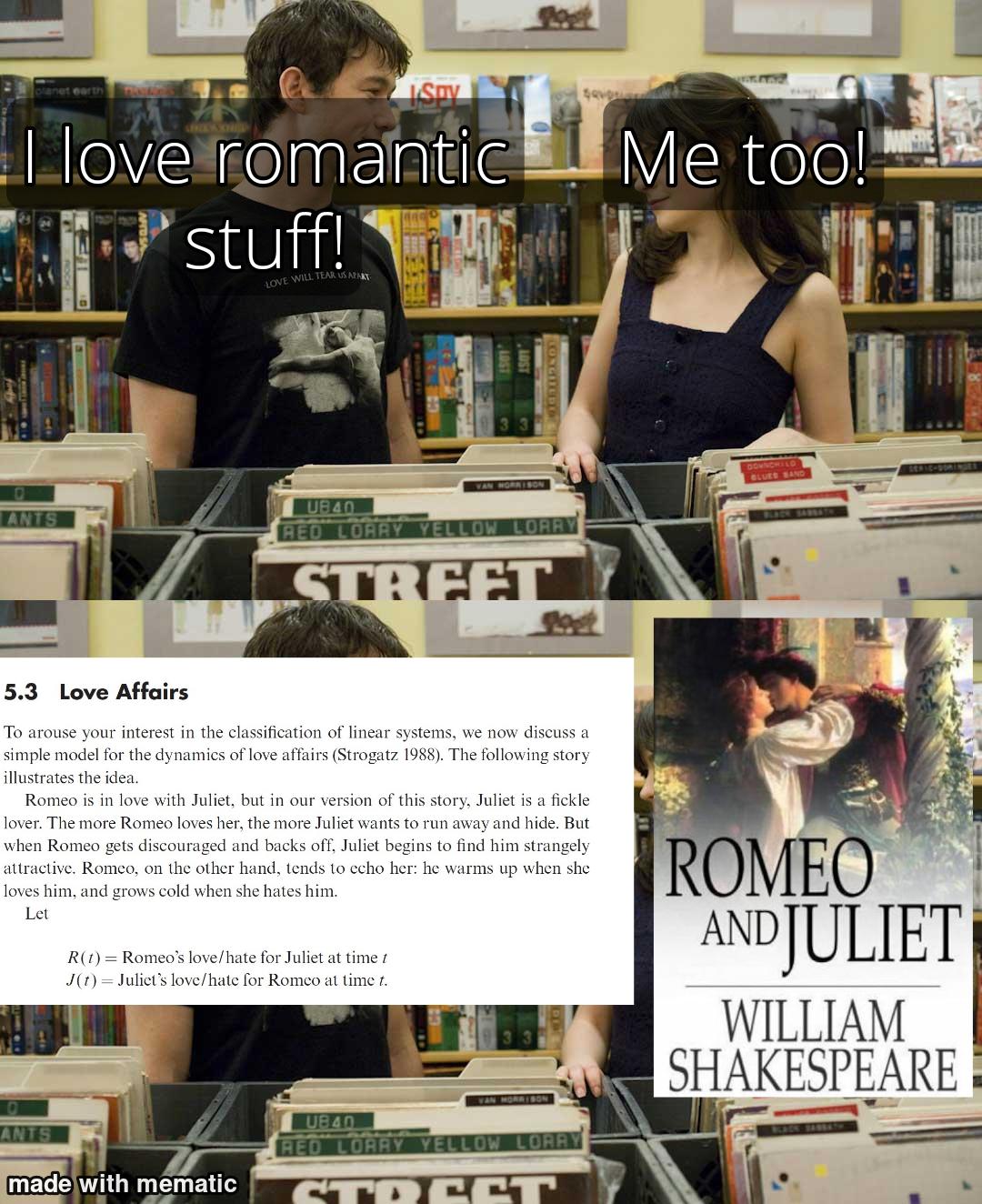
Steven Strogatz really said "let me model toxic relationships with differential equations" and created one of the most iconic examples in nonlinear dynamics. The man took Romeo and Juliet—Shakespeare's tragic masterpiece—and turned it into a system of coupled ODEs where love literally oscillates based on how much the other person is into you or running away. Here's the genius part: Juliet is modeled as a "fickle lover" who wants what she can't have. When Romeo loves her (R positive), she pulls away (J decreases). When Romeo backs off (R negative), suddenly she's interested (J increases). Romeo, meanwhile, is the classic echo chamber—he just mirrors her energy. It's basically every situationship ever, but with phase portraits. Math nerds everywhere get to bond over this example because it makes differential equations feel relatable instead of soul-crushing. Nothing says "romantic stuff" quite like analyzing the stability of coupled linear systems. Shakespeare would be... confused? Proud? Probably both.

Yeah Right

Yeah Right
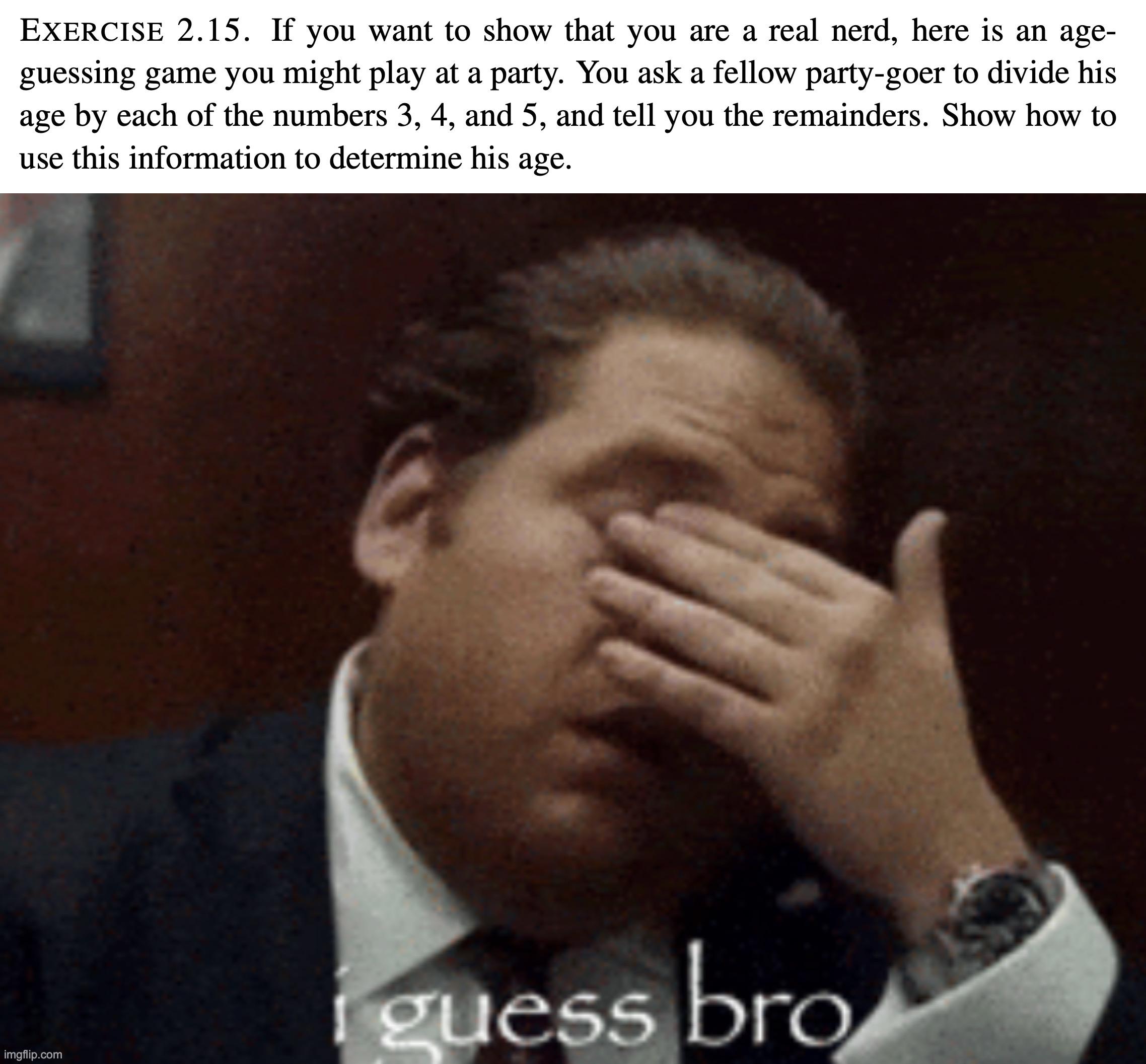
Nothing screams "party animal" quite like whipping out the Chinese Remainder Theorem at a social gathering. The textbook suggests you can determine someone's exact age just by knowing the remainders when divided by 3, 4, and 5. Because apparently, normal people at parties are totally down to do modular arithmetic instead of, you know, just asking "how old are you?" The facepalm reaction is spot-on because the textbook's definition of "real nerd" is someone who thinks party guests will enthusiastically participate in number theory exercises. Sure, the math works (since 3, 4, and 5 are pairwise coprime, you can uniquely determine any age up to 59), but good luck finding anyone who won't immediately walk away when you start asking for division remainders. Fun fact: This is actually a legitimate application of ancient Chinese mathematics, but using it as a party trick is the mathematical equivalent of bringing a graphing calculator to a bar. Technically impressive, socially questionable.

Hint For The Proof: Obvious

Hint For The Proof: Obvious
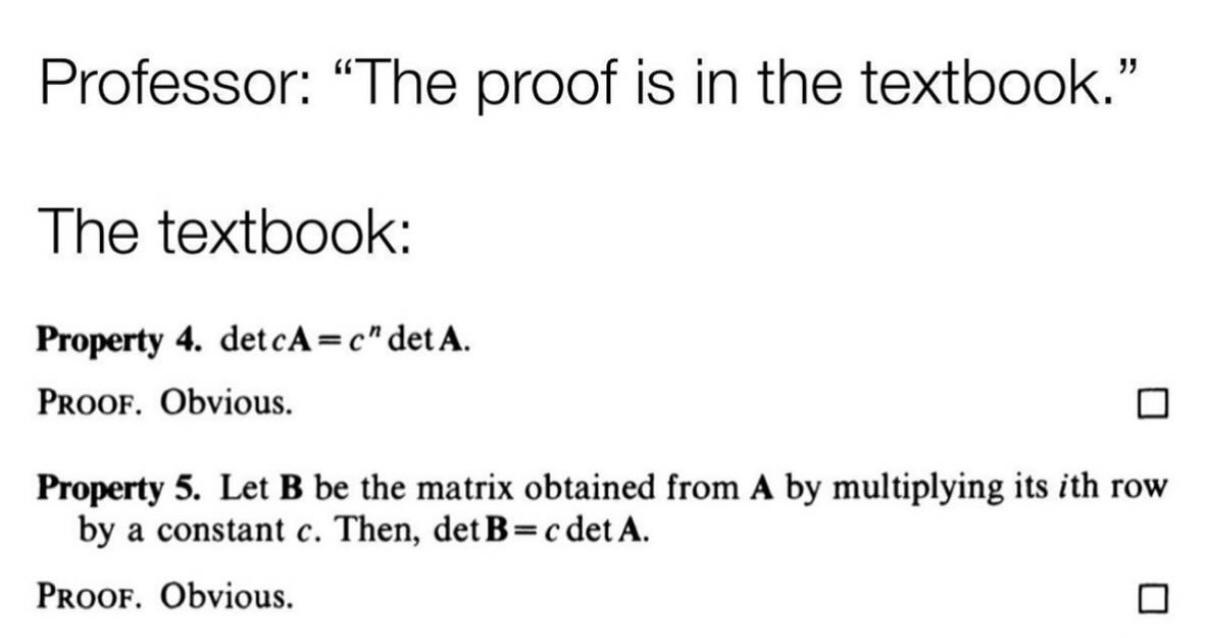
Nothing strikes fear into a math student's heart quite like the word "obvious" in a textbook. You're staring at some property about determinants, desperately trying to understand why det(cA) = c^n det(A), and the textbook just casually drops "PROOF. Obvious." with a little checkbox like you're supposed to nod knowingly and move on. Spoiler alert: it's never obvious. What's obvious to a mathematician who's been doing linear algebra for 30 years is NOT obvious to someone who just learned what a determinant is last week. That little "Obvious" is doing some seriously heavy lifting—probably hiding about 47 steps of algebraic manipulation and three lemmas you haven't covered yet. Textbook authors really said "I'm not gonna show my work" and expected everyone to be cool with it. The academic equivalent of "trust me bro." Meanwhile, you're spending 2 hours trying to figure out why multiplying one row by a constant only multiplies the determinant by that constant once, not n times. Fun fact: that's actually the difference between Properties 4 and 5—one scales the entire matrix, the other just one row!

Mole

Mole
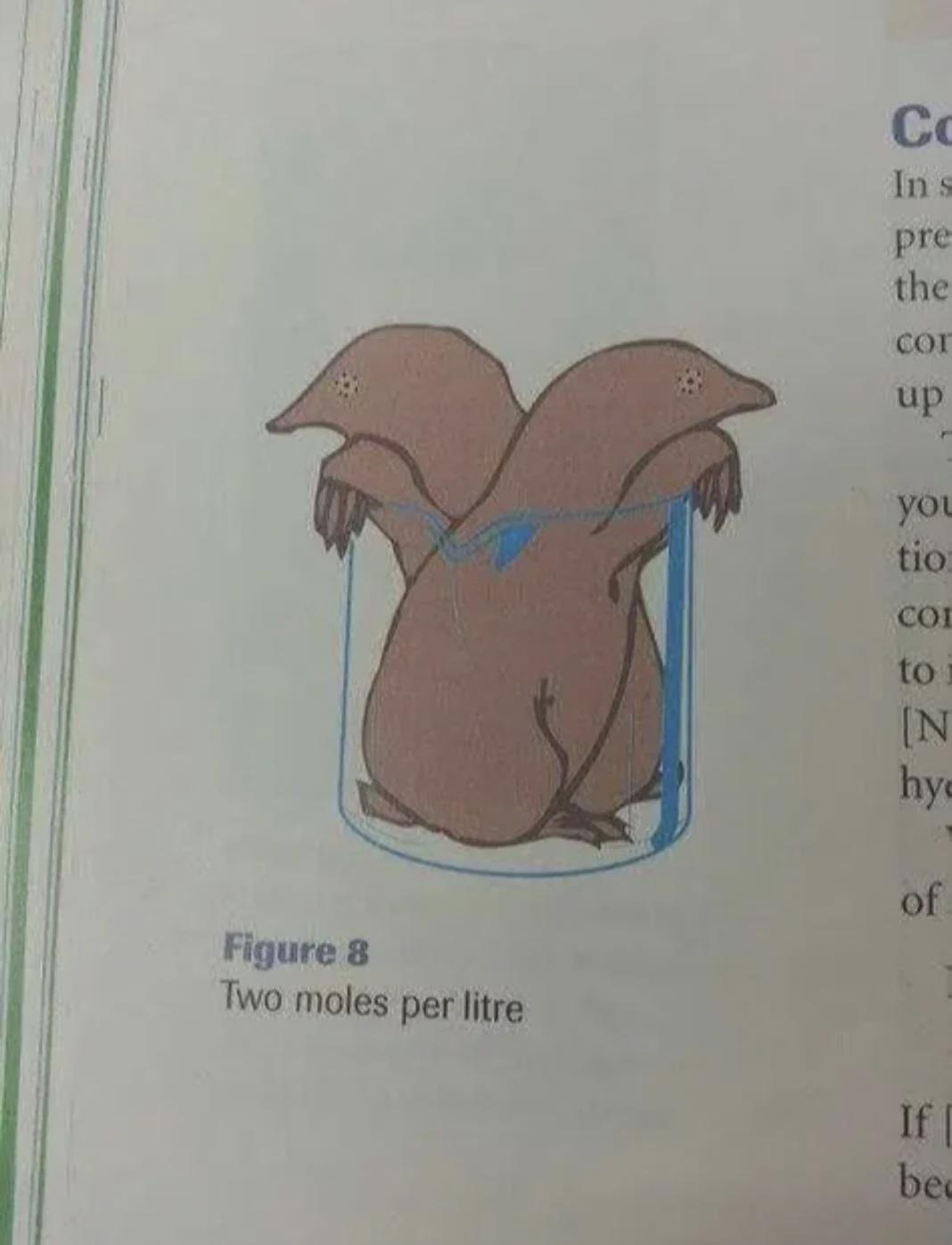
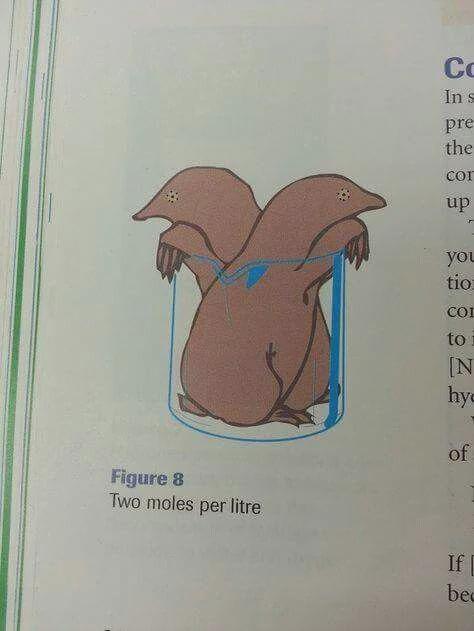
Someone at the textbook publishing company really said "yeah, let's illustrate molarity with two literal rodents crammed into a beaker" and nobody stopped them. I've been teaching chemistry for years and I'm still not over how beautifully cursed this is. For those blissfully unaware: a mole in chemistry is Avogadro's number (6.02 × 10²³) of particles—you know, the unit that makes stoichiometry possible. But these textbook designers took the homophone route and gave us two actual moles (the animals) stuffed in a graduated cylinder to represent "two moles per litre." It's technically educational and simultaneously the most unhinged diagram you'll find in a legitimate science textbook. The poor creatures look absolutely done with this situation, which is exactly how students feel when calculating limiting reagents at 2 AM. Educational? Debatable. Memorable? Absolutely. Will I ever unsee this? Never.

32

32!
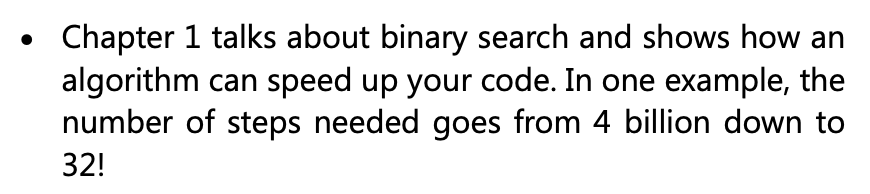
Binary search: the algorithm that makes you feel like a coding god by reducing 4 billion steps down to a mere 32. That's going from "heat death of the universe" territory to "I can grab a coffee while this runs" levels of efficiency. The exclamation mark here is doing double duty—expressing both excitement and also technically representing factorial notation, which would make 32! equal to approximately 2.6×10^35, ironically bringing us right back to astronomical numbers. Computer science textbooks love this dramatic reveal because nothing sells algorithmic efficiency quite like watching O(n) get absolutely demolished by O(log n). It's like showing up to a knife fight with a logarithm.

A French Anatomy Book Trying To Illustrate How Horses Bones Are Similar To Ours

A French Anatomy Book Trying To Illustrate How Horses Bones Are Similar To Ours
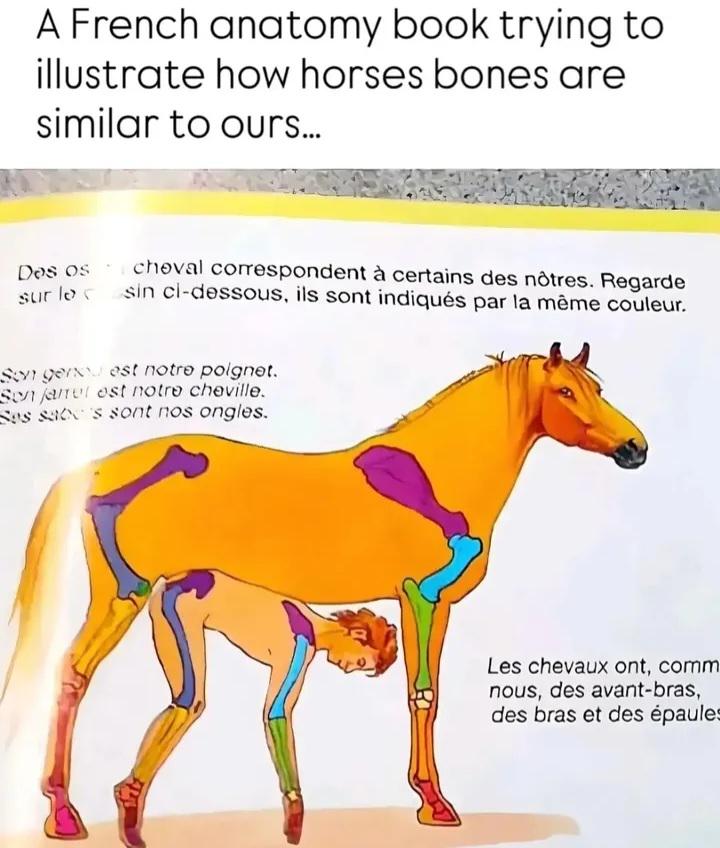
So this French anatomy textbook decided the best way to teach comparative anatomy was to create what can only be described as a fever dream rainbow horse that looks like it wandered out of a Lisa Frank nightmare. The color-coding is actually genius though—each bone group gets its own fabulous shade to show how horse bones map onto human anatomy. Your wrist? That's basically a horse's knee. Your fingers? Those are the horse's entire lower leg bones, which is why horses are essentially tiptoeing around on one giant middle finger. Evolution really said "let's take a hand, stretch it out, and make it fast" and honestly? Iconic. The French really know how to make comparative anatomy look like a party.

Me When I Finish My Semester Of Linear Algebra

Me When I Finish My Semester Of Linear Algebra
You know that feeling when you've just survived a semester of eigenvectors, matrix transformations, and abstract vector spaces? You emerge from the final exam thinking you've mastered the universe, only to realize your brain has been transformed into a tangled mess of confusion. Someone literally took Sheldon Axler's famous "Linear Algebra Done Right" textbook and scribbled "Done Right" into "Done Wrong" with a chaotic red scribble that perfectly represents every student's mental state after cramming determinants and orthogonal projections. The irony is *chef's kiss* because Axler's book is supposed to be the "elegant" approach to linear algebra (no determinants until chapter 10!), but by the end you're still questioning your life choices and whether you actually understand what a linear transformation even is. That red scribble? That's your brain. That's all of our brains.

Two Moles Per Litre

Two Moles Per Litre
Figure 8 shows the most literal interpretation of "two moles per liter" in chemistry history. While your professor drones on about concentration calculations, the textbook illustrates the concept with actual burrowing mammals stuffed into laboratory glassware. Chemistry puns: the only reactions that consistently proceed as expected in undergraduate labs.

Math Textbook's Casual War Crime

Math Textbook's Casual War Crime
When math textbooks casually drop a derivative of the delta function like it's no big deal! The left side shows someone smiling confidently ("The") while the right side shows the same person having an existential crisis ("What?") after seeing that cursed equation. For the uninitiated, the delta function is already a mathematical oddity (it's infinitely tall at one point and zero everywhere else), but taking its derivative is like dividing by zero while riding a unicycle on a tightrope. Even seasoned math majors get that "brain.exe has stopped working" feeling when they encounter this monstrosity in their textbooks!

The Cat Strikes Back

The Cat Strikes Back
The ultimate physicist's revenge fantasy! Schrödinger creates a thought experiment about a cat in a quantum superposition state, and now the cat is demanding a retraction of this fake quote. Imagine spending eternity as the poster child for quantum uncertainty, only to find yourself simultaneously famous AND misquoted. The cat's expression screams "I'm both offended and not offended until you observe my reaction." Even in the multiverse, no version of Schrödinger regretted meeting that cat—the thought experiment made him immortal in physics textbooks. Though I suspect in at least one universe, the cat got its revenge by putting Schrödinger in a box with a radioactive atom...

Pants-ception: It's Recursion All The Way Down

Pants-ception: It's Recursion All The Way Down
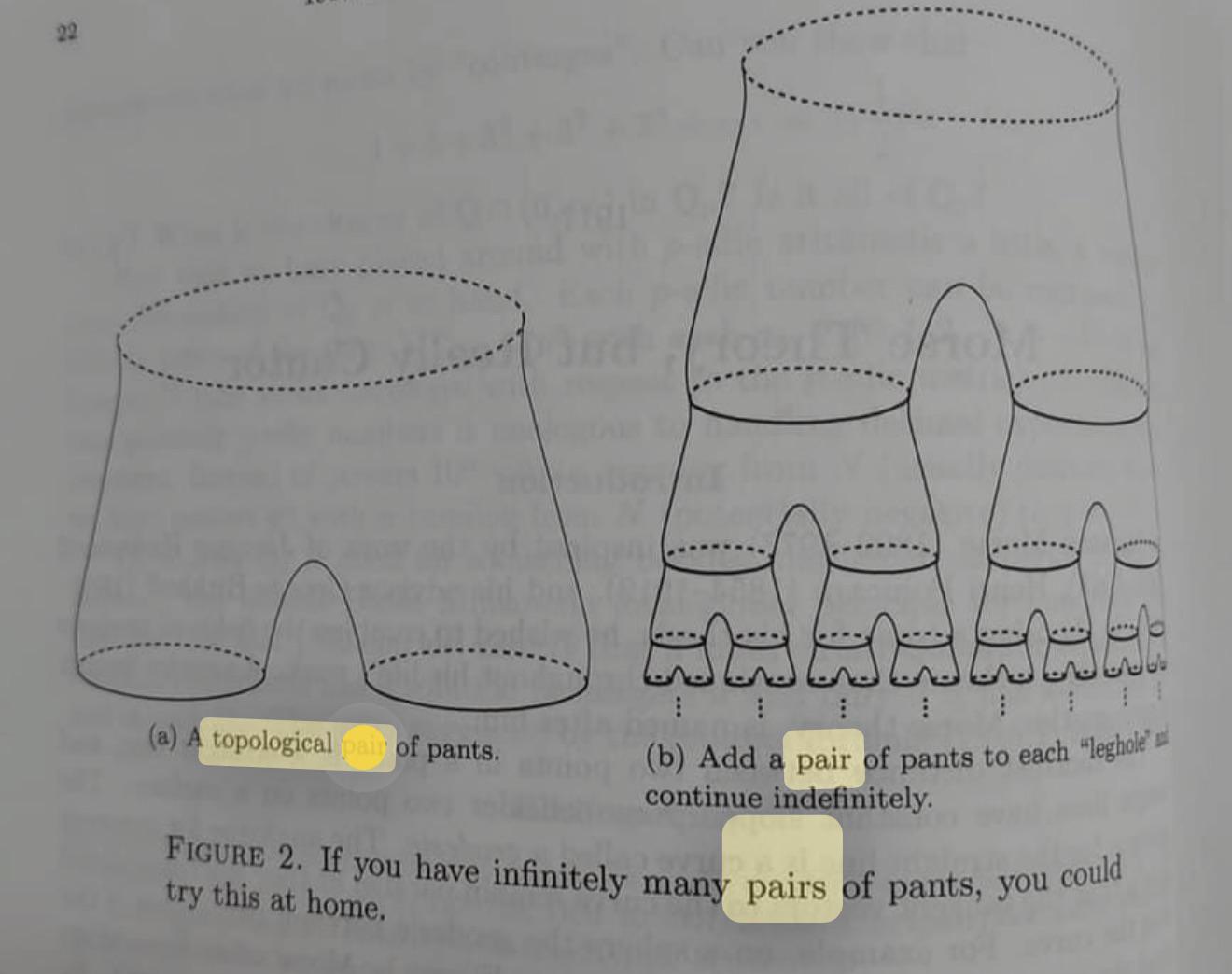
Behold! The mathematical madness of infinite pants recursion! Mathematicians don't just prove theorems—they also contemplate the existential question of what happens when you put pants inside pants inside pants... 👖➡️👖➡️👖... That sassy "try this at home" suggestion is peak mathematician humor. Sure, I'll just grab my INFINITE COLLECTION of pants from my non-Euclidean closet! The topological transformation of pants into more pants is basically the fashion equivalent of a fractal—it's pants all the way down! Next time someone asks what mathematicians do all day, just show them this. We're not solving equations, we're solving the REAL problems: how many pants can theoretically fit inside other pants.