

Student life Memes

Posts tagged with Student life
The Circuit On Paper: "Easy." The Circuit In Real Life: "See You After 4 Years."

The Circuit On Paper: "Easy." The Circuit In Real Life: "See You After 4 Years."
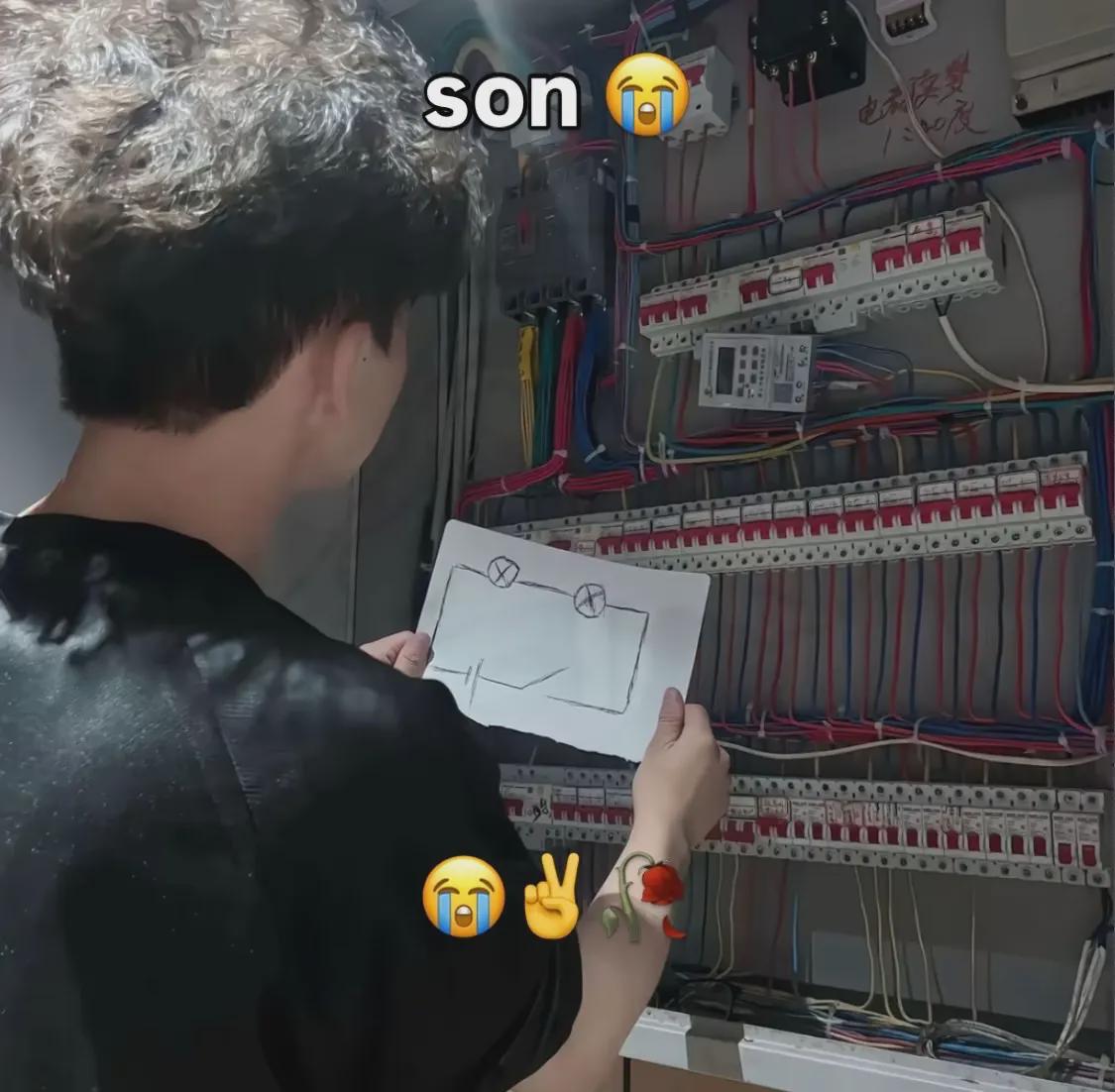
Every engineering student has experienced this exact moment of betrayal. You draw a simple circuit diagram with two lightbulbs and a battery—looks clean, straightforward, maybe takes 30 seconds to sketch. Then you walk into the electrical panel and it's like someone threw a rainbow of wires into a blender and hit "chaos mode." That innocent little loop on paper has somehow transformed into a labyrinth of circuit breakers, terminal blocks, and enough color-coded wiring to make you question your career choices. The "son 😭" caption perfectly captures that moment when theory meets reality and reality wins by knockout. Those four years? That's not just your degree—that's how long it'll take to trace where that one red wire actually goes. The real kicker is that both circuits technically do the same thing. But one exists in the beautiful, simplified world of textbooks, while the other lives in the harsh reality of safety codes, wire management, and the fact that electricity doesn't care about your neat diagram.

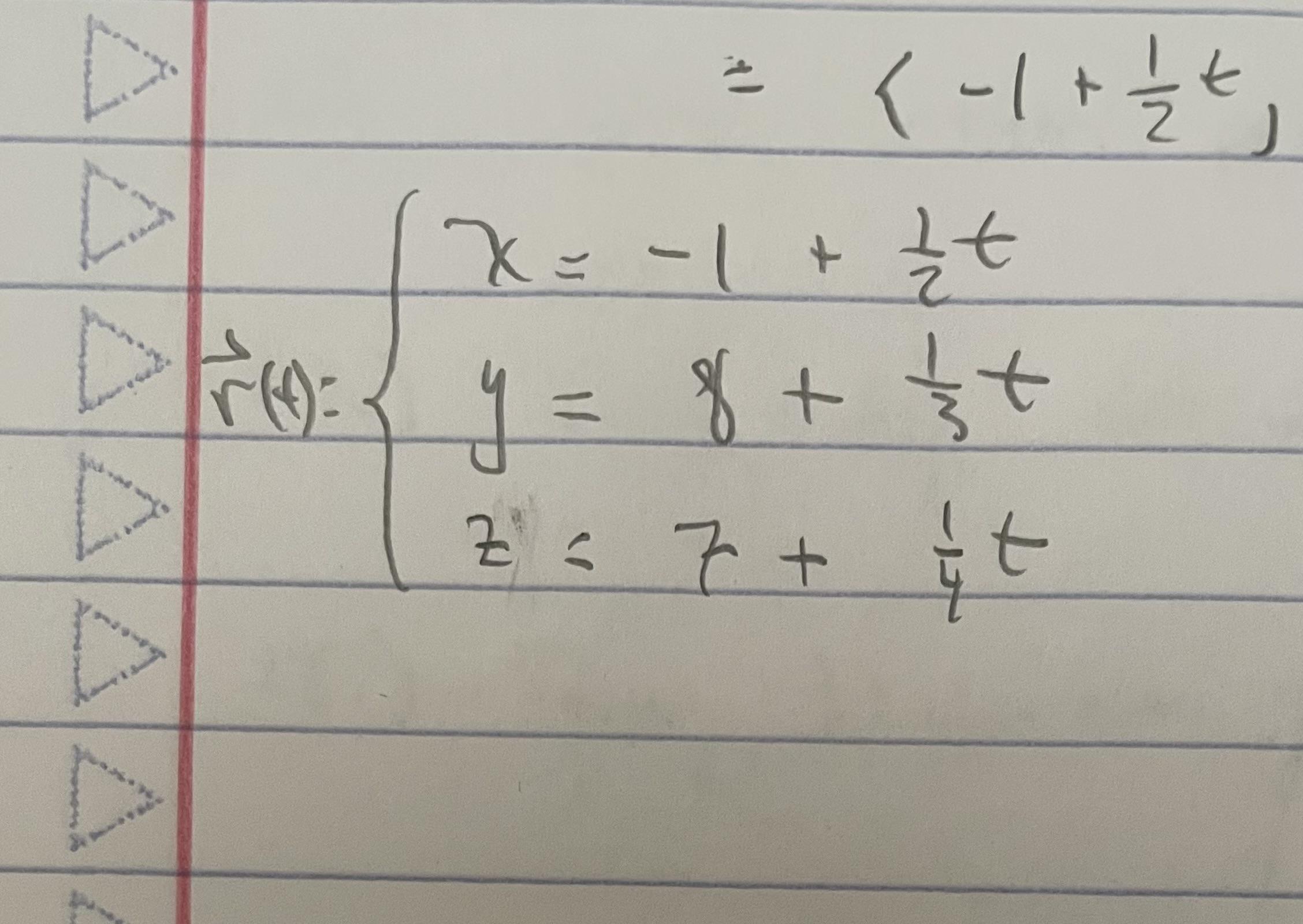
Holy Curly Bracket

Holy Curly Bracket
Someone just discovered that if you squint hard enough at a piecewise function, it looks like the Virgin Mary appeared in your calculus homework. And honestly? I see it. That majestic curly bracket holding together a system of equations has transcended its mathematical purpose and achieved divine status. Move over, Jesus on toast—we've got the Holy Bracket of Piecewise Functions blessing this notebook paper. The little triangles in the margin are probably meant to mark important problems, but now they're just witnesses to this mathematical miracle. Someone call the Vatican, because we need to verify this relic. Nothing says "I've been doing math too long" quite like seeing religious iconography in your notation. Take a break, friend. Maybe go outside.

Organic Chem Exam Scores: You Vs. Linda Walker Be Like...

Organic Chem Exam Scores: You Vs. Linda Walker Be Like...
There's always that one person in organic chemistry who somehow aces the exam while everyone else is barely scraping by. You got 67 out of 800 points and you're crying into your molecular model kit. Meanwhile Linda Walker over here casually pulls a 719 like she's been synthesizing complex molecules since kindergarten. The crying cat perfectly captures that moment when you realize you studied the wrong chapters, mixed up SN1 and SN2 reactions for the fifteenth time, and somehow drew benzene as a hexagon with feelings. Linda probably has a color-coded reaction mechanism notebook and dreams in stereochemistry. The rest of us are just trying to remember which way the arrows go.

Every Week Takes Me One Step Closer To The Edge

Every Week Takes Me One Step Closer To The Edge
Welcome to the academic cycle of despair, where confidence has a half-life shorter than francium-223. You walk into Monday's lecture thinking you've finally cracked the code, feeling like Newton under that apple tree. Fast forward 48 hours and you're staring at your notes like they're written in ancient Sumerian. By Thursday, you've accepted your fate as an intellectual fraud who somehow fooled the admissions committee. The real kicker? Next week the professor drops another knowledge bomb, you understand approximately 30% of it, and boom—you're back at "I think I get it now" like some kind of academic Sisyphus. Rinse, repeat, question your life choices, wonder if it's too late to become a barista. Pro tip: Everyone in your class is trapped in the same cycle. That person who always asks questions? Also clueless. Your professor? Probably felt this way during their PhD. It's the circle of academic life, and it moves us all toward imposter syndrome and caffeine dependency.

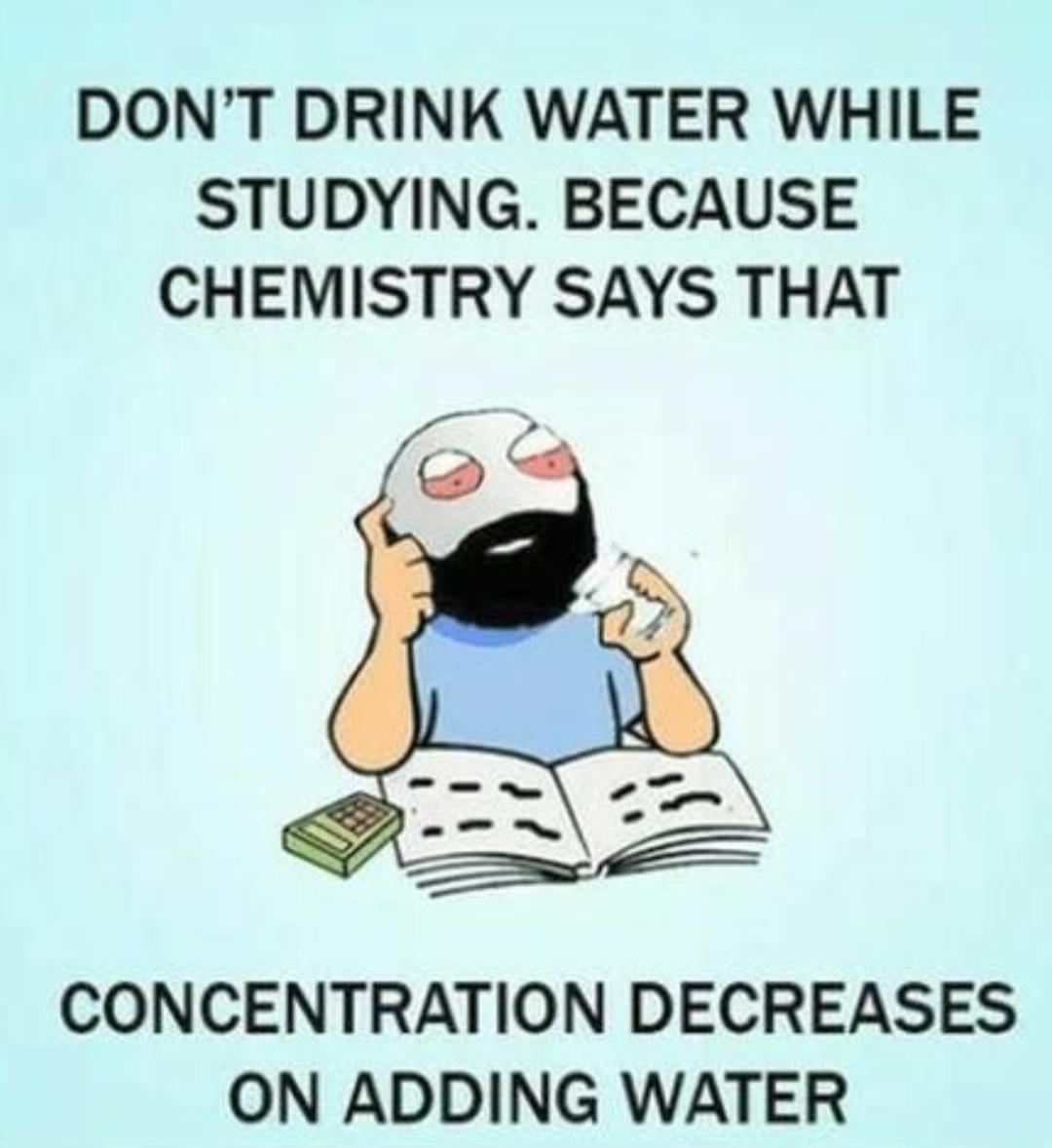
Don't Drink Water While Studying

Don't Drink Water While Studying
Taking chemistry concepts way too literally here. Yes, when you add water to a solution, you increase the volume while keeping the solute amount constant, which mathematically decreases concentration (molarity = moles/liters). But applying that to your brain? Genius move. By that logic, you should probably avoid breathing too because adding oxygen might dilute your knowledge of oxidation-reduction reactions. The beauty of student logic is finding creative ways to blame chemistry for procrastination. "Sorry professor, I couldn't focus on my studies—I was too hydrated and my brain concentration dropped to 0.001 M." Pretty sure dehydration-induced headaches will decrease your concentration faster than any dilution principle, but hey, who am I to argue with science?

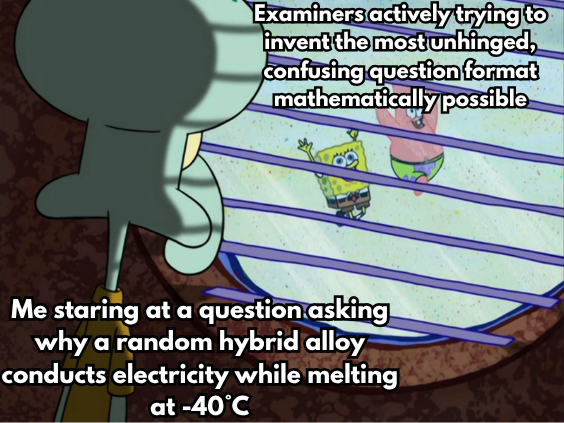
POV: You Spent Days Memorising Giant Covalent Structures And Ionic Lattices Because Your Teacher Guaranteed A Standard Structure And Bonding 6-Marker

POV: You Spent Days Memorising Giant Covalent Structures And Ionic Lattices Because Your Teacher Guaranteed A Standard Structure And Bonding 6-Marker
Nothing quite captures the betrayal of exam season like grinding through diamond structures and sodium chloride lattices for days, only to have the examiner hit you with "explain why this completely fictional hybrid alloy conducts electricity while simultaneously melting at temperatures that would make liquid nitrogen jealous." Your teacher promised you a nice, predictable 6-mark question about ionic bonding or metallic structures. Instead, you're sitting there watching SpongeBob's confused face mirror your own internal screaming as you try to logic your way through a material that apparently defies the laws of thermodynamics. Because sure, let's just casually conduct electricity in a solid state while melting at -40°C—totally normal behavior for matter. This is the chemistry exam equivalent of studying for a history test on World War II and getting asked to analyze the socioeconomic impact of a war between fictional civilizations. The examiners really woke up and chose psychological warfare that day.

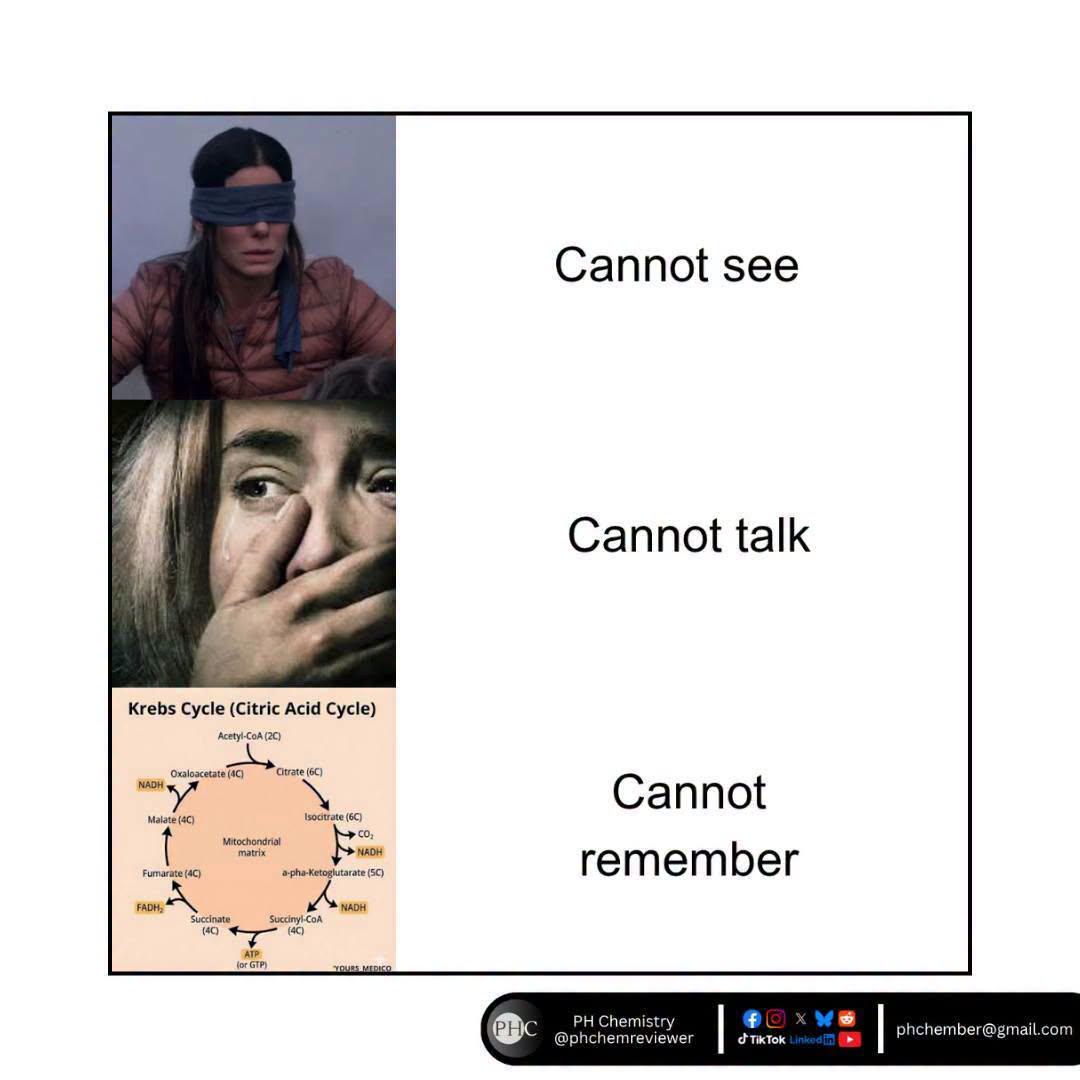
Pyruvate? Acetyl-CoA? My Brain Left The Chat

Pyruvate? Acetyl-CoA? My Brain Left The Chat
The Krebs Cycle is that one biochemistry topic that makes every biology student question their life choices. You walk into the exam thinking you've got it down, but the second you see that circular nightmare with its eight steps, multiple enzymes, and random molecules like α-ketoglutarate, your brain just... nopes out. Cannot see the logic. Cannot talk through the steps. Cannot remember if FADH₂ comes before or after succinyl-CoA. It's the metabolic pathway equivalent of trying to remember everyone's names at a party where they all look the same and keep changing positions. Sure, it's "just" cellular respiration—the thing keeping you alive—but memorizing it feels like your neurons are running on fumes instead of ATP.

Me Presenting My Senior Design Prototype To The Department Faculty

Me Presenting My Senior Design Prototype To The Department Faculty
You know that special moment when you've spent months on your capstone project, survived on energy drinks and false confidence, and now you're about to demo your "solution" for the first time in front of a room full of faculty who've seen every possible failure mode? That's this energy right here. The senior engineers are literally packed in there like they're waiting for a demolition show—because let's be real, they probably are. Nothing brings the department together quite like watching a student nervously press the power button while silently praying to the engineering gods that their code compiles, their circuit doesn't smoke, or their mechanical design doesn't immediately disintegrate. Pro tip: The more confident you look walking up to that prototype, the more spectacular the failure will be. It's like an unwritten law of senior design presentations. Bonus points if something catches fire or makes a sound it definitely shouldn't make.

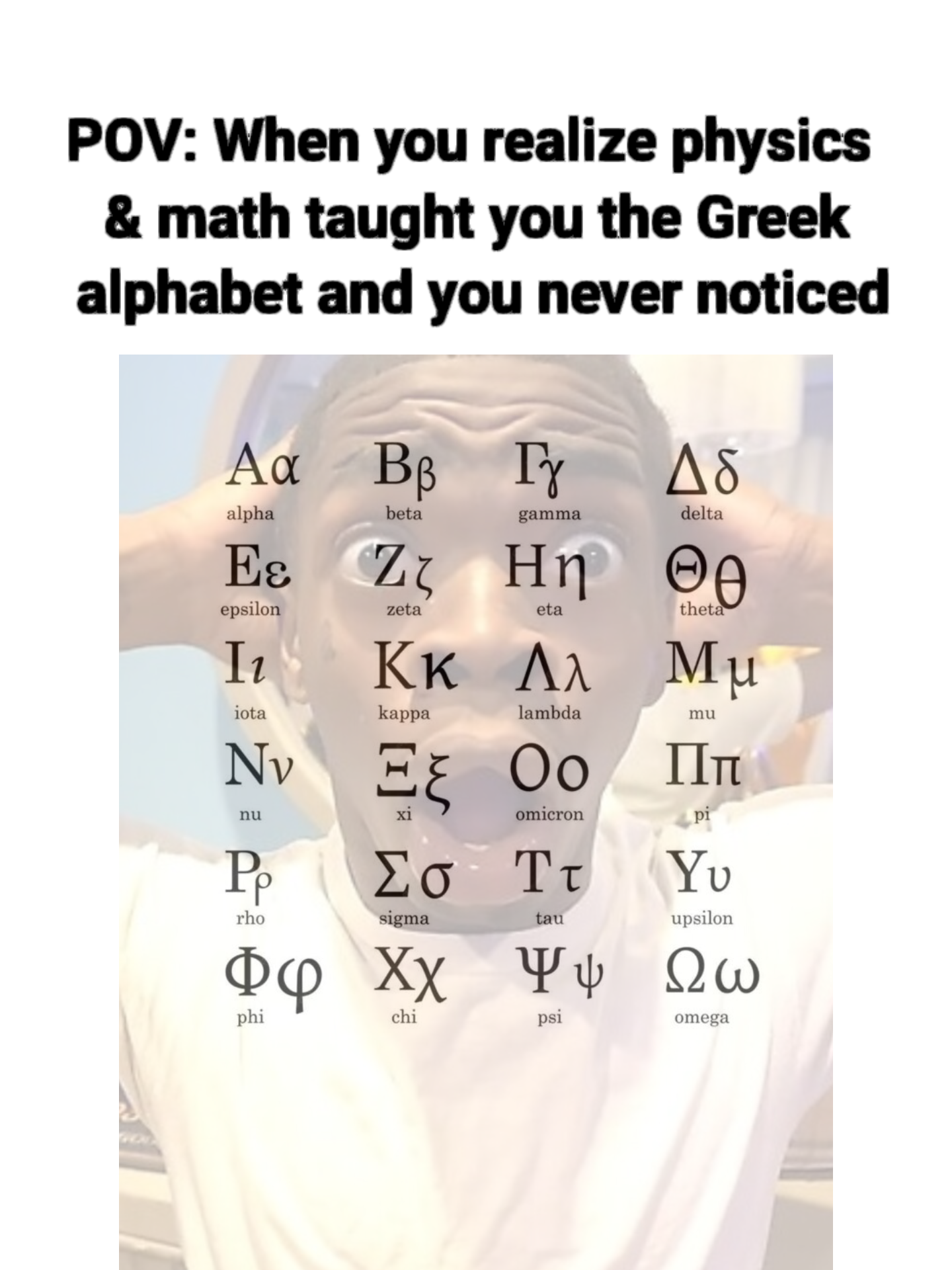
When Physics And Math Secretly Taught You Greek

When Physics And Math Secretly Taught You Greek
That moment when you realize you can recite the entire Greek alphabet forwards and backwards, but only because physics and math professors have been drilling it into your brain through equations. You never sat down to actually learn Greek letters—they just osmosed into your consciousness through sheer exposure to α (alpha particles), β (beta decay), γ (gamma rays), Δ (change in literally everything), θ (angles galore), λ (wavelength), μ (coefficients of friction and micro-prefixes), π (not just for circles anymore), Σ (summation nation), Ω (resistance is futile), and ψ (wave functions). Meanwhile, classics majors actually studied Greek for years and you just absorbed it through problem sets like some kind of academic sponge. The best part? You probably know how to write ξ (xi) perfectly but still can't spell "necessary" without spellcheck.

I Liked When Science Was Like Trivia. How About You?

I Liked When Science Was Like Trivia. How About You?
Remember when science class was just memorizing that mitochondria is the powerhouse of the cell and moving on with your life? Good times. Then suddenly you're expected to understand why ATP synthase works like a molecular turbine and derive equations for reaction kinetics. The transition from "fun fact: water boils at 100°C" to "calculate the change in entropy when accounting for atmospheric pressure variations and intermolecular forces" hits different. We all signed up for the trivia night version of science, not the existential crisis mathematical proof edition. That cute anime girl with hearts represents our innocent joy at learning cool facts, while the second panel captures our soul leaving our body when someone mentions partial differential equations.

The Answer Is 1

The Answer Is 1
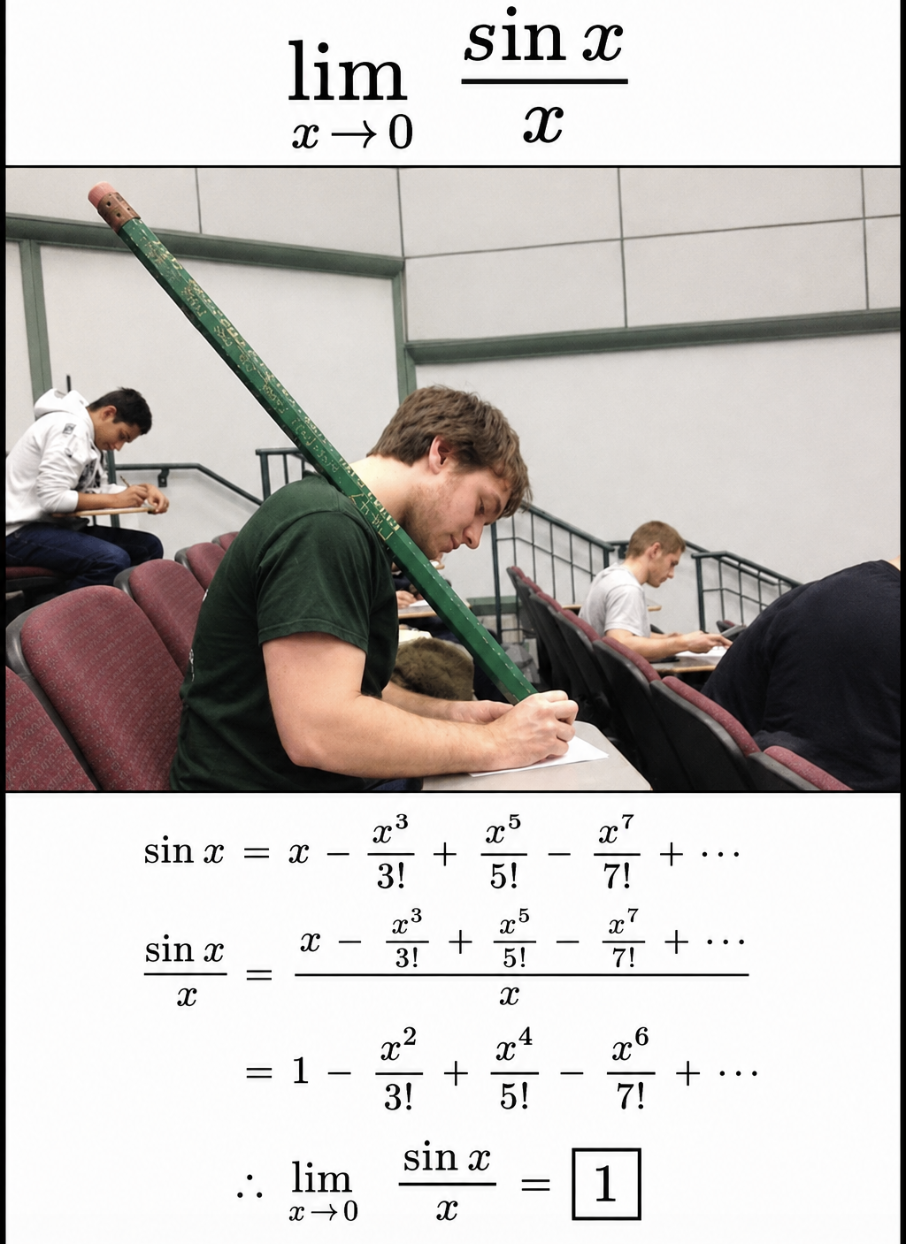
You know that limit that shows up in literally every calculus course? The one where sin(x)/x approaches 1 as x goes to 0? Yeah, it's elegant and beautiful on paper. But getting there requires busting out the Taylor series expansion like you're defusing a bomb—carefully dividing terms, canceling x's, and praying you don't mess up the factorials. Meanwhile, that giant pencil hovering menacingly over the student perfectly captures the existential weight of proving something so "simple." The proof involves expanding sin(x) into an infinite series, dividing everything by x, then watching as x approaches 0 and all those higher-order terms vanish into mathematical oblivion. What remains? Just 1. Clean, pure, inevitable. The pencil represents every professor who's ever said "this is trivial" before writing three blackboards worth of algebra. Fun fact: this limit is actually the foundation for deriving the derivative of sine, so if you ever wondered why d/dx(sin x) = cos x, blame this bad boy right here.

Um Excuse Me 🤓👆 Can Anybody Help Me Out Here??

Um Excuse Me 🤓👆 Can Anybody Help Me Out Here??
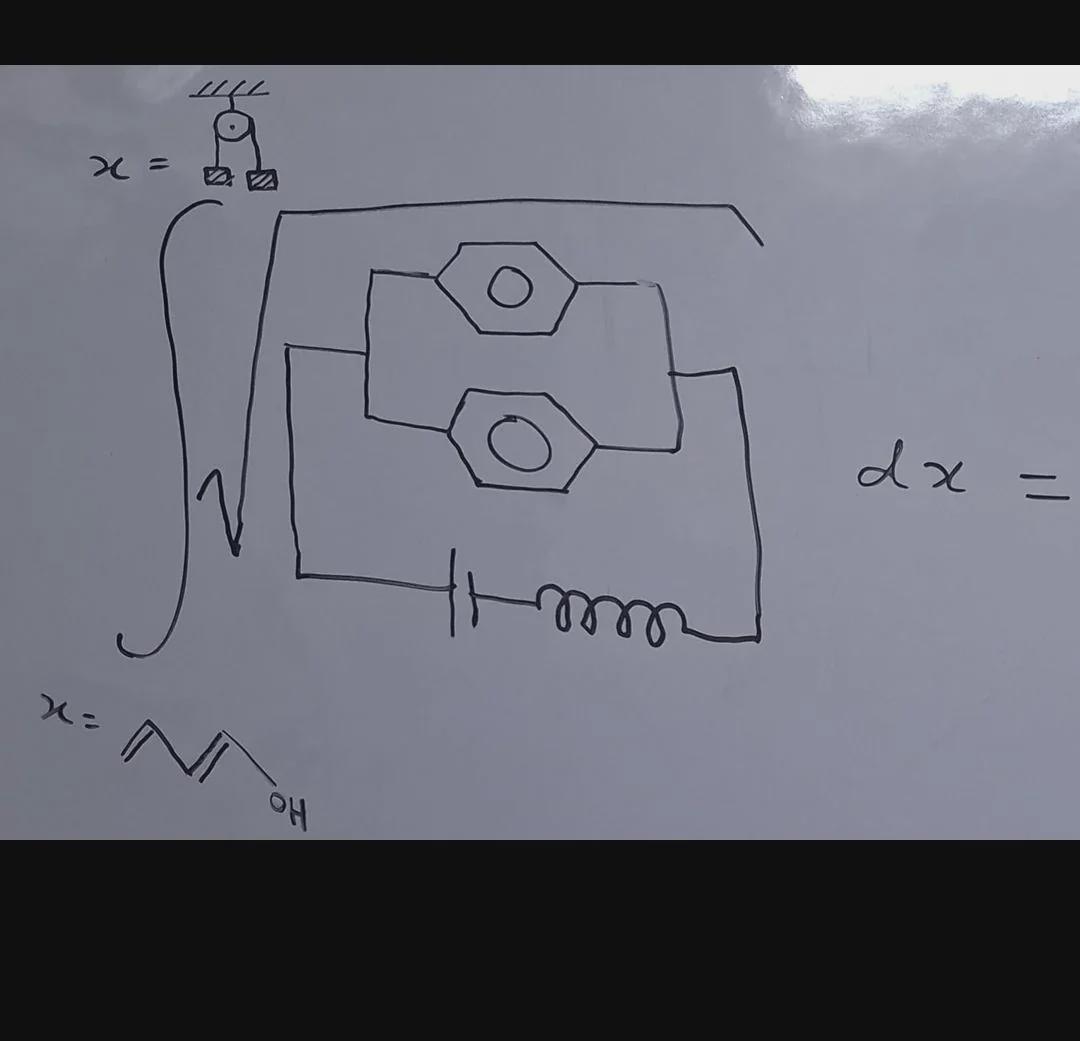
Someone's organic chemistry homework just took a hard left into nightmare territory. We've got what appears to be a benzene ring doing absolutely NOTHING it's supposed to do, some squiggly lines that might be bonds (or maybe just existential dread), and molecular structures that look like they were drawn by someone having a fever dream about hexagons. The real comedy gold here is the three different attempts at defining X, each more chaotic than the last. Top left shows what might be a toilet paper roll with anger issues, the middle is giving "robot face made of nuts and bolts," and bottom left is an alcohol group attached to... zigzag lines? The derivative dx on the right side is just sitting there like "yeah, I'm not touching this mess." Every organic chemistry student has been here—staring at their notes at 2 AM, wondering if they accidentally invented a new branch of abstract art instead of solving for substituents. The professor would take one look at this and either give full credit for creativity or immediately schedule office hours.