

Signal processing Memes

Posts tagged with Signal processing
The Fastest Algorithm For DFT

The Fastest Algorithm For DFT
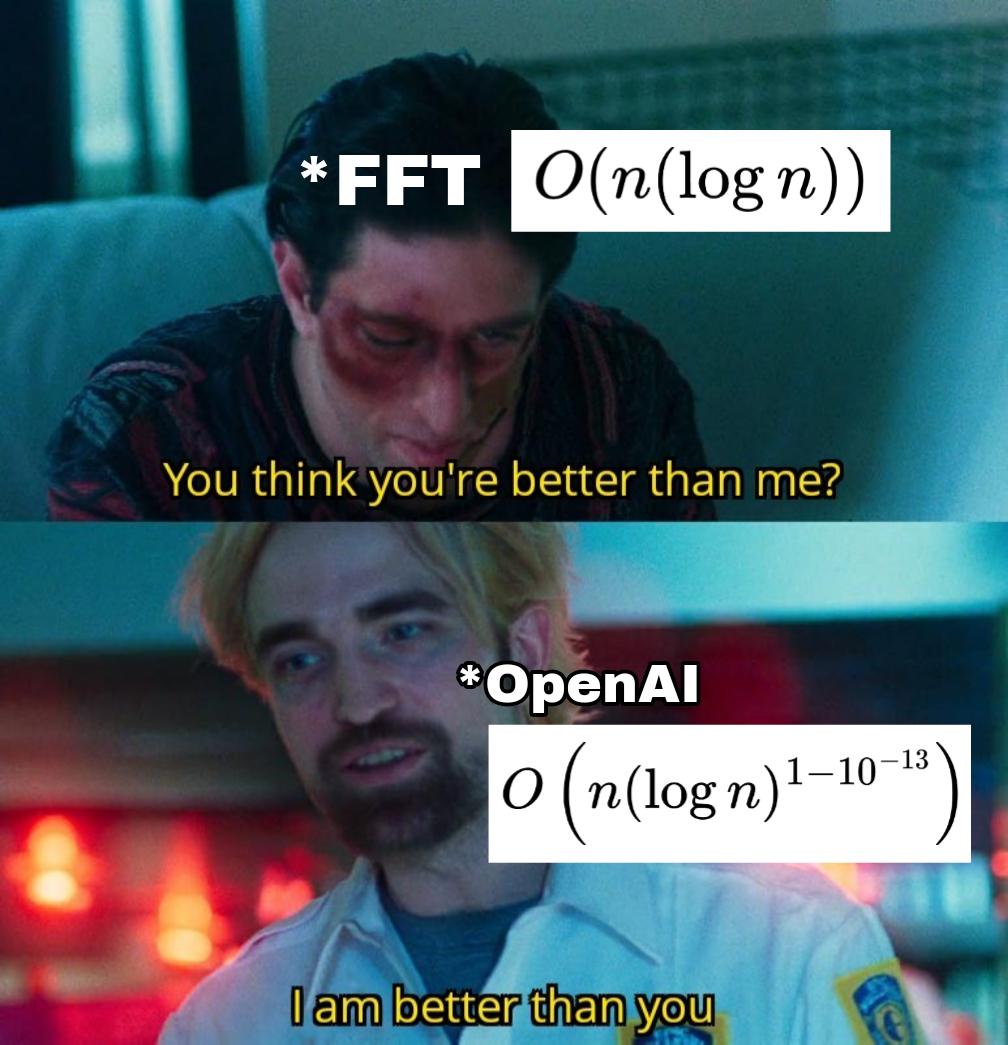
The Fast Fourier Transform (FFT) revolutionized signal processing with its O(n log n) complexity, turning what would've been an O(n²) nightmare into something actually computable. But OpenAI apparently said "hold my training data" and somehow achieved O(n(log n)^(1-10^-13)), which is like... marginally better? That exponent is so close to 1 that it's practically negligible in real-world scenarios, but technically superior by the tiniest mathematical hair. The DFT (Discrete Fourier Transform) breaks down signals into their frequency components—think of it as decomposing a complex sound wave into individual musical notes. The FFT was already legendary for making this feasible on actual computers, but OpenAI's algorithm squeezes out that microscopic improvement. It's the computational equivalent of winning an Olympic race by a nanosecond and doing a full victory lap about it. Technically impressive? Absolutely. Practically game-changing for most applications? Debatable. But hey, when you're in the algorithm optimization game, even 10^-13 improvements are worth bragging rights.

The Fourier Transform Fanatic

The Fourier Transform Fanatic
When someone suggests literally any problem-solving approach, mathematicians and physicists be like: "Nah, I'd Fourier transform." The escalating frustration of seeing every single type of Fourier transform listed is pure mathematical trauma in action. From waves to electromagnetics, quantum to spectral analysis—it's the mathematical equivalent of that friend who only knows one recipe but insists on cooking it six different ways. By the time we hit "Fourier FUCKING transform," you can practically feel the despair of someone who's spent too many sleepless nights converting between time and frequency domains. It's the universal hammer that makes everything look like a nail... a very complex, sinusoidal nail.

Fourier vs. Courier: When Delivery Transforms Your Package

Fourier vs. Courier: When Delivery Transforms Your Package
The mathematical genius of this pun is just *chef's kiss*! The top shows the actual Fourier Transform, which decomposes complex waveforms into their component frequencies (turning messy time-domain signals into neat frequency spikes). Meanwhile, the bottom shows what happens when a "courier" transforms your package—from pristine cardboard geometry to chaotic shambles. It's basically what happens when your carefully constructed mathematical function gets delivered by the postal service. Your elegant equation arrives looking like it was decomposed by a garbage disposal instead of a mathematical operation!

Fourier Transform vs. Courier Transform

Fourier Transform vs. Courier Transform
The top panel shows a Fourier transform converting a complex waveform into neat frequency spikes. The bottom panel shows what happens when your package gets "transformed" by the delivery service. Mathematicians get elegant decomposition of signals; the rest of us get decomposition of cardboard. The shipping industry: turning your pristine purchases into a mathematical proof that chaos is the natural state of the universe since 1907.

Furrier Transform

Furrier Transform
The genius of this pun can't be overstated! In signal processing, the Fourier Transform converts signals from time domain to frequency domain. But here, our mathematician has transformed into a furry animal—hence the "Furrier Transform." The top panel shows disappointment with regular frequency analysis, while the bottom panel shows enthusiasm for the "omega verse" (a clever double entendre playing on both the angular frequency symbol ω (omega) in Fourier analysis AND furry fandom terminology). It's what happens when engineers spend too much time alone with their equations!

Let That Sinc In

Let That Sinc In
The peak of mathematical humor! The graph shows a Shannon sinc function (sin(x)/x), which is fundamental in signal processing and information theory. The title "Let That Sink In" is a brilliant pun since the function literally "sinks" below zero multiple times while having its main peak at x=0. Engineers use this function constantly in sampling theory, and it's the mathematical backbone of how digital music and images work. Next time you're enjoying your favorite song, remember it's just a bunch of sinc functions having a party!

Imaginary Or Real It Is The Same

Imaginary Or Real It Is The Same
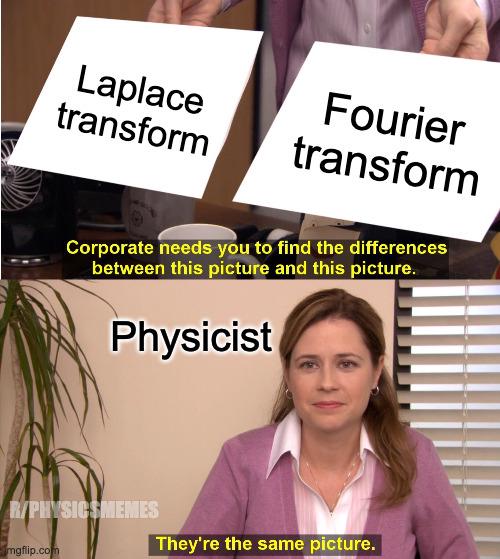
The mathematical equivalent of being asked to spot the difference between identical twins. Laplace and Fourier transforms are both just fancy ways to convert nasty differential equations into something slightly less horrifying. Both take you from the time domain to a different realm where problems magically become easier—whether it's the complex frequency domain or breaking down signals into sine waves. To the corporate world, they're different beasts. To physicists who've spent too many sleepless nights with both? They're basically the same headache in different packaging. Like choosing between two different brands of painkillers when you've got a math-induced migraine.

Pack It Up, The AI Has Spoken

Pack It Up, The AI Has Spoken
Signal processing engineers everywhere just got absolutely destroyed by AI. The machine just casually dropped a textbook-perfect explanation about why analog infinite impulse response filters are mostly theoretical fantasies. It's like watching your calculator suddenly explain why your life choices are mathematically suboptimal. 💀 The AI didn't just state facts—it delivered a comprehensive technical beatdown with the casual confidence of someone who's processed a billion filter designs before breakfast. Digital filters are indeed more practical, but did the AI have to be so brutally correct about it?

From Time To Frequency: A Fourier Misunderstanding

From Time To Frequency: A Fourier Misunderstanding
The mathematical pun is strong with this one! The Fourier transform converts signals from time domain to frequency domain, but someone misheard it as "furry transfem" which is... definitely not what it's called. It's like when your non-STEM friends try to repeat what you study and suddenly you're apparently researching "quantum entanglement of fuzzy cats" instead of quantum computing. The right side shows the actual transformation—complex waveforms broken down into their component frequencies—while the stick figures perfectly capture that moment of scientific miscommunication that happens when math nerds try to explain their work at parties.

Don't Call Me Furry

Don't Call Me Furry
The mathematical transformation being rudely misidentified here is the Fourier transform , which converts signals from time domain to frequency domain. But some poor stick figure has accidentally called it a "furry transform" instead. Honestly, that's a completely different kind of transformation that happens at conventions with suspicious amounts of mascot costumes. Signal processing engineers everywhere just collectively facepalmed so hard they created their own sine wave.

From Vibe Check To Fourier Analysis

From Vibe Check To Fourier Analysis
From casual to calculus in three panels! This meme brilliantly escalates from the colloquial "vibe check" to the sophisticated "Fourier analysis" – which is literally just fancy math for breaking down complex waves into simple sine waves. It's like asking someone "how ya feeling?" but with increasingly pretentious vocabulary until you're basically decomposing their emotional state into component frequencies. Engineers and physicists everywhere are snorting coffee through their noses right now because they've definitely used Fourier transforms to analyze actual vibrations. The fancier the bear gets, the fancier the vibration assessment becomes!

FFT Go Brrr: When Dating Meets Signal Processing

FFT Go Brrr: When Dating Meets Signal Processing
Dating in engineering school be like: "She was sending mixed signals" isn't just about confusing emotions—it's LITERALLY about waveforms! 📊 Our hero here took "analyze the situation" to a whole new level by running her communication through a Fourier transform. For the uninitiated, FFT (Fast Fourier Transform) breaks down complex signals into simple sine waves—perfect for figuring out if that "maybe" text contains hidden frequencies of interest! Next time someone's giving you confusing vibes, just hook them up to an oscilloscope. Science solves everything... except maybe actual human relationships. 🤓⚡