
Recursion Memes

Posts tagged with Recursion
Base Case Is Overrated

Base Case Is Overrated
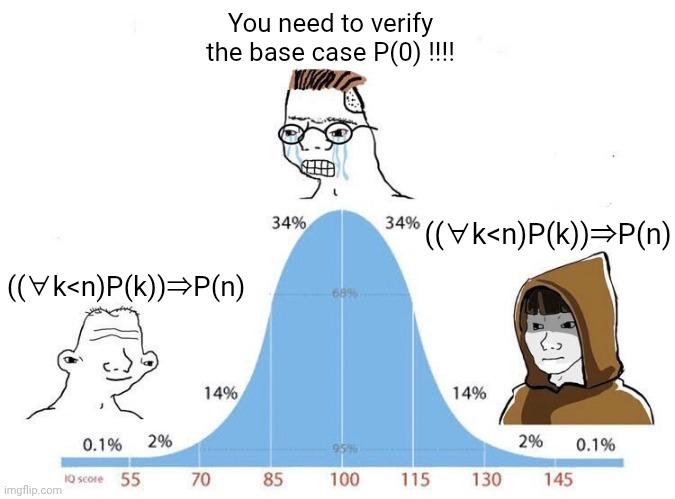
Recursion enthusiasts living dangerously on the edges of the bell curve! While the average mathematician (IQ 100) anxiously verifies the base case P(0), the mathematical rebels at both extremes skip straight to induction with ((∀k<n)P(k))⇒P(n). They're either brilliant enough to see that the base case is trivial or... not quite grasping why their proofs keep collapsing like a house of cards. Mathematical induction without a foundation is basically just vibing with symbols and hoping for the best. The professor's panic is entirely justified!

This Iterated Function Looks Oddly Familiar...

This Iterated Function Looks Oddly Familiar...
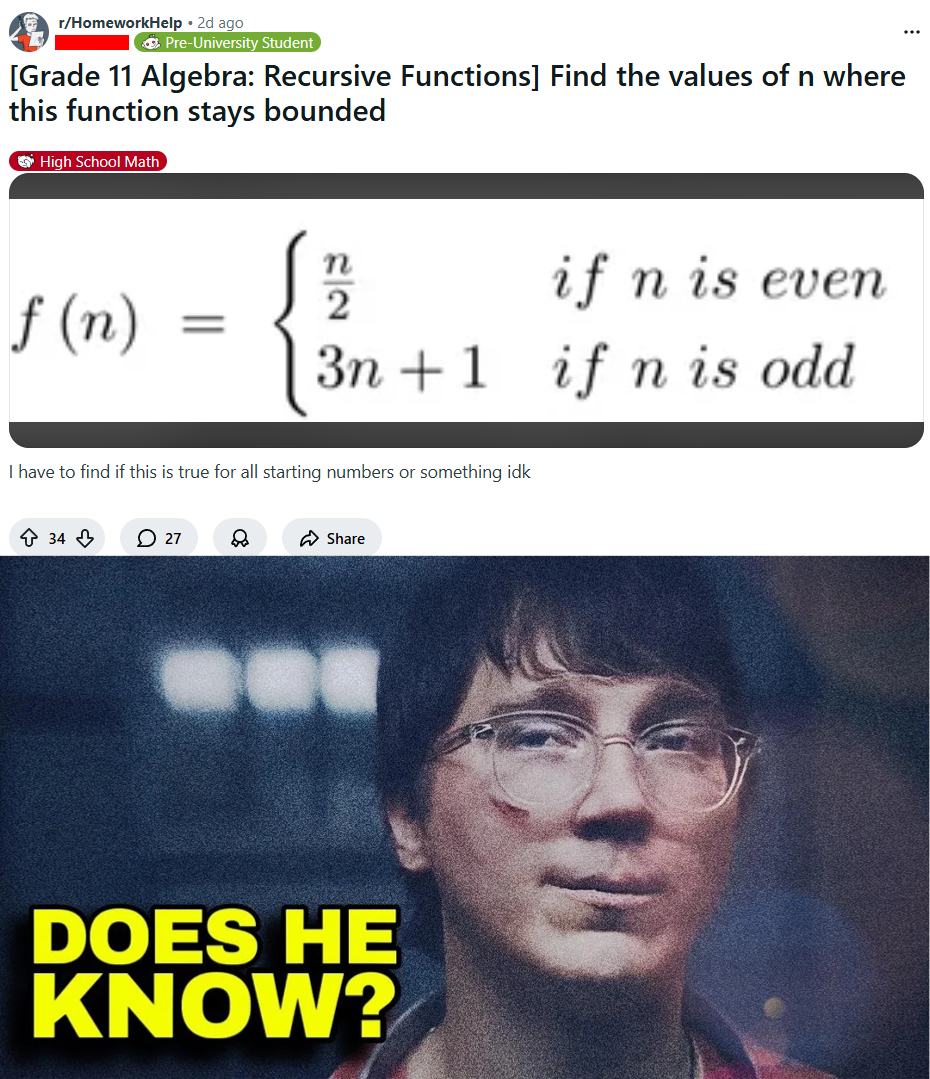
Poor kid just stumbled upon the infamous Collatz Conjecture disguised as homework. That function is a mathematical rabbit hole that's been driving professional mathematicians insane since 1937. Even with supercomputers, nobody can prove whether all starting values eventually reach 1. The "DOES HE KNOW?" caption is perfect—because no, he doesn't know he's facing one of math's most notorious unsolved problems while thinking it's just Grade 11 algebra. It's like accidentally wandering into a quantum physics exam when you signed up for basket weaving.

How It Feels Responding To "What Is A Semigroup?" With "An Associative Magma"

How It Feels Responding To "What Is A Semigroup?" With "An Associative Magma"
The recursive mathematical definition rabbit hole strikes again! This meme perfectly captures the mathematician's version of explaining something simple with something even more complicated. For the uninitiated: a semigroup is indeed an associative magma (a set with a binary operation), and a monoid is literally a semigroup with identity. So answering these questions this way is technically correct—the best kind of correct—but hilariously unhelpful! The emotional journey from smug satisfaction (top left) to confused crying (top right) to exasperated explanation (bottom left) to smug satisfaction again (bottom right) is the exact cycle mathematicians go through when they realize they've explained something using terms that require even more explanation. It's abstract algebra inception!

The Prerequisite Paradox

The Prerequisite Paradox
The perfect recursive nightmare for every student who's ever opened an advanced textbook. You excitedly crack open "Introduction to Abstract Algebra" only to discover you need "Foundations of Mathematical Logic" which requires "Set Theory Basics" which assumes you're fluent in "Formal Proof Writing." It's turtles all the way down! Paul Halmos just casually dropping truth bombs while mathematicians everywhere nod knowingly through their tears. This quote should be tattooed on every math department door as a warning label.

The Most Boring Mathematical Discovery Ever

The Most Boring Mathematical Discovery Ever
The "Multiplicative Fibonacci Sequence" that's just rows of 1s? Mathematical genius at its laziest! 🤣 The regular Fibonacci sequence (1, 1, 2, 3, 5, 8...) follows the rule that each number equals the sum of the two before it. But multiplication instead of addition? When you multiply by 1, nothing changes! So you get this hilariously underwhelming pattern that never goes anywhere. It's like showing up to a math conference with a groundbreaking discovery that's actually just counting to one over and over. The reference to Pascal's Triangle (which actually contains interesting patterns) makes it even funnier - like claiming you found a shortcut to climb Mount Everest by looking at a picture of it!

What Is Neuroscience Again?

What Is Neuroscience Again?
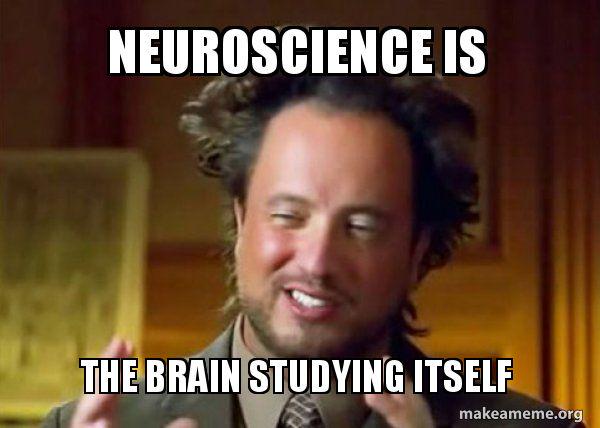
Ever notice the cosmic irony? Neuroscience is literally just a bunch of brains trying to figure themselves out. It's the ultimate narcissistic field of study—three pounds of tissue attempting to understand itself using... itself. Like a USB drive trying to know what a USB drive is by plugging itself into itself. The brain named itself, categorized itself, and now spends billions in research funding just to understand why it does what it does. Talk about an existential feedback loop!

When Infinite Set Theory Ruins Your Omnipotence

When Infinite Set Theory Ruins Your Omnipotence
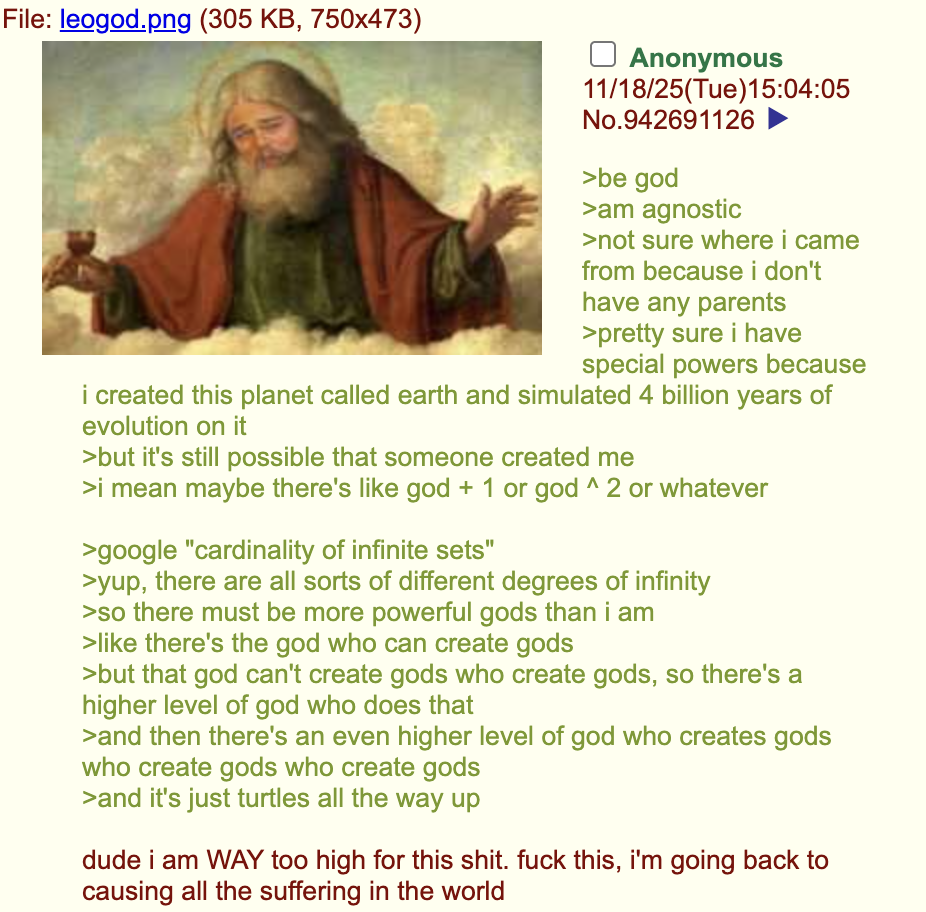
The divine existential crisis is real! This philosophical romp takes set theory to cosmic heights by applying Cantor's hierarchy of infinities to theological concepts. Just as ℵ₀ (aleph null) represents the first level of infinity in mathematics, our "god" character realizes he's just one deity in an infinite hierarchy of higher powers. The punchline hits when our creator—after contemplating his place in this infinite god-stack—decides the metaphysical recursion is too much and returns to his day job of cosmic mischief. It's basically what happens when you give omnipotent beings access to advanced mathematics and an edible.

Infinite Gods And Where To Find Them

Infinite Gods And Where To Find Them
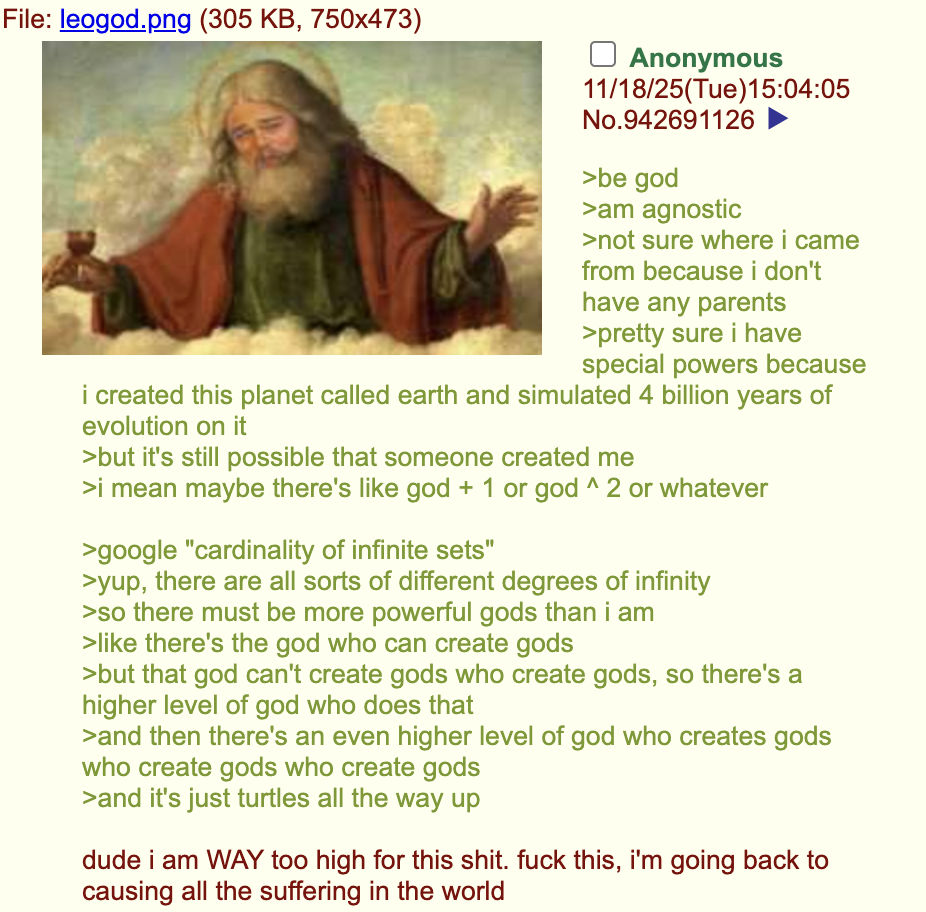
The divine existential crisis hits different when you introduce transfinite numbers! This meme brilliantly combines theology with Cantor's set theory, where ℵ₀ (aleph null) represents the cardinality of natural numbers—the smallest infinity. The "god" character realizes that if infinite hierarchies exist (like how ℵ₁ > ℵ₀), then maybe there's a "god+1" above him. The recursive "turtles all the way up" reference is peak mathematical humor—basically the deity version of imposter syndrome. Poor guy just wanted to cause some suffering, but got sidetracked by ordinal arithmetic!

A Graph Of Graphs

A Graph Of Graphs
The perfect mathematical inception doesn't exi— oh wait. This diagram shows various mathematical functions (linear, quadratic, exponential, trigonometric) arranged as nodes in a network graph. It's literally a graph theory graph made of coordinate system graphs. The kind of recursive humor that makes mathematicians snort coffee through their noses during department meetings. Next-level nerd territory where the joke itself is structured like a mathematical proof of how far down the rabbit hole we can go with visual puns.

Set Theorists Around The World In Shambles

Set Theorists Around The World In Shambles
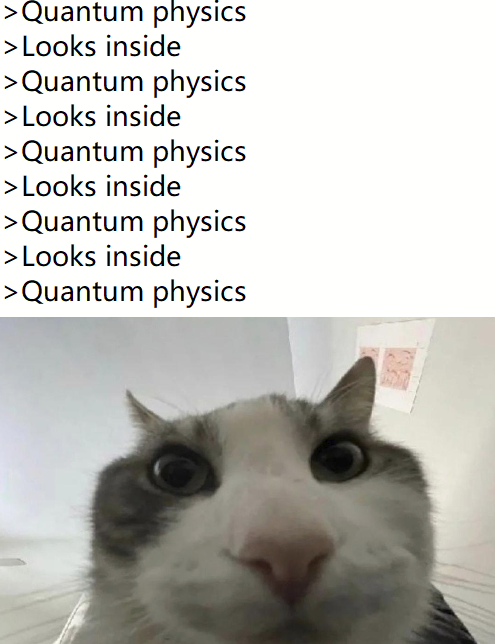
The infinite recursion nightmare that keeps mathematicians up at night! In set theory, the Axiom of Foundation prevents sets from containing themselves (no set can be an element of itself). But this cat is staring into the mathematical abyss of nested sets that keep looking inside other sets... forever. It's like mathematical inception where each level gets more terrifying. The cat's expression perfectly captures the existential horror of realizing you've violated the very foundations of mathematics. Guess the cat didn't get the memo that self-referential sets cause paradoxes that could collapse the entire mathematical universe. Russell's paradox has never looked so fluffy!

The Mathematical Gang Wars

The Mathematical Gang Wars
Mathematical gang warfare at its finest! This is what happens when street logic meets mathematical induction. The red and blue bandanas represent the classic proof technique where you first prove a base case (n=1), then show that if it works for n, it must work for n+1. Just like real gangs, these mathematical thugs are recruiting you into their recursive proof lifestyle. And much like actual gang initiations, once you're in mathematical induction, there's no escape—you'll be proving infinite sequences until the end of time. The only drive-by happening here is when your professor drives by your incorrect proof and marks it with red ink.

Reverse Induction: The Mathematical Proof Of Cleanliness

Reverse Induction: The Mathematical Proof Of Cleanliness
This philosophical raptor just dropped the ultimate bathroom math joke! In mathematical induction, you prove something works for all cases by showing it works for a base case (n=1) and then proving if it works for any case n, it must work for n+1. Similarly, when wiping, you keep checking "n+1" times until you're confident the "theorem" of cleanliness holds true. It's the perfect convergence of bathroom humor and rigorous mathematical proof methodology. Next time you're in the bathroom, remember you're not just cleaning—you're performing empirical verification of a recursive hypothesis!