

Quantum mechanics Memes

Posts tagged with Quantum mechanics
A Cat In A Box

A Cat In A Box
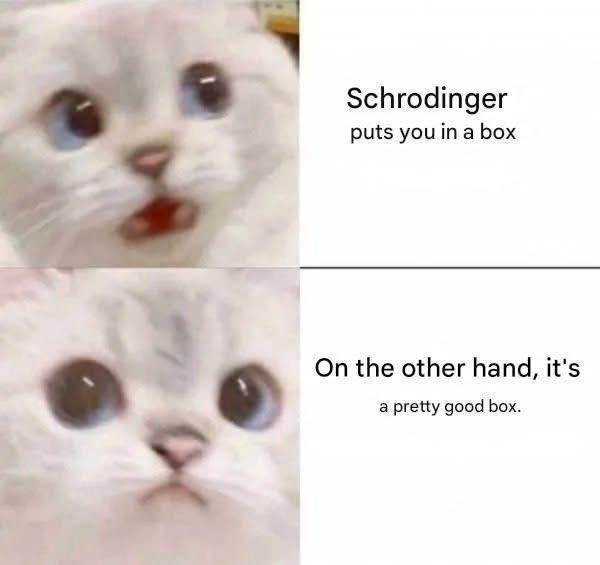
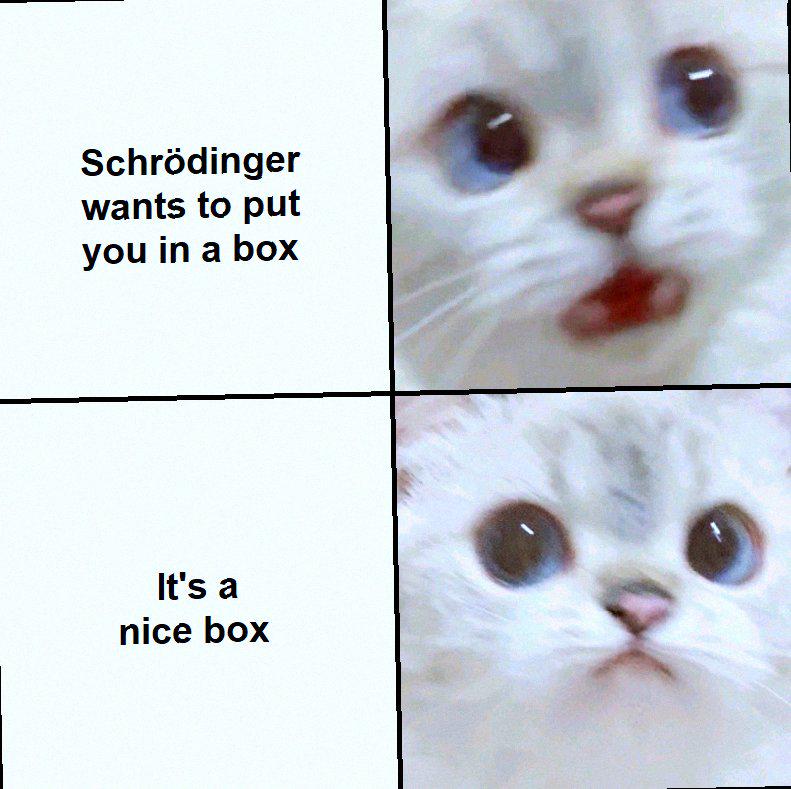
This is playing on Schrödinger's famous thought experiment where a cat is sealed in a box with a radioactive atom that has a 50% chance of decaying and triggering a poison. Until you open the box and observe, quantum mechanics says the cat exists in a superposition—simultaneously alive AND dead. It's meant to show how bizarre quantum mechanics gets when applied to everyday objects. But this cat? This cat is totally chill with the whole arrangement. First panel: mild concern about being boxed up for a quantum mechanics demonstration. Second panel: actually, this box is pretty cozy, and being in an indeterminate state of existence sounds like a solid nap opportunity. The cat's gone from "please don't" to "you know what, I'm into this" faster than a wavefunction collapse. Cats do love boxes, after all. Even hypothetical quantum ones. Schrödinger really should have seen this coming—he picked the one animal that would actually volunteer for box duty.

No Kitty That's My Pretty Good Box!

No Kitty That's My Pretty Good Box!
Schrödinger's cat just pulled a reverse uno card on the physicist. Instead of being trapped in a box wondering if it's dead or alive, the cat has decided YOU'RE going in the box now. And honestly? The cat makes a compelling argument—it IS a pretty good box. The genius here is the dual emotional state captured by the cat's expressions. First panel: absolute horror at the prospect of being boxed. Second panel: grudging acceptance because, well, the box quality is undeniable. It's like the cat exists in a superposition of "this is terrible" and "this is actually fine" until you observe which emotion wins out. For context: Schrödinger's famous thought experiment involved a cat in a sealed box with a quantum mechanism that might kill it, illustrating how quantum superposition gets weird at macro scales. The cat would theoretically be both alive AND dead until observed. But nobody ever asked what the cat thought about the box itself. Turns out: positive reviews, would recommend.

Real Reason People Hate Copenhagen Interpretation

Real Reason People Hate Copenhagen Interpretation
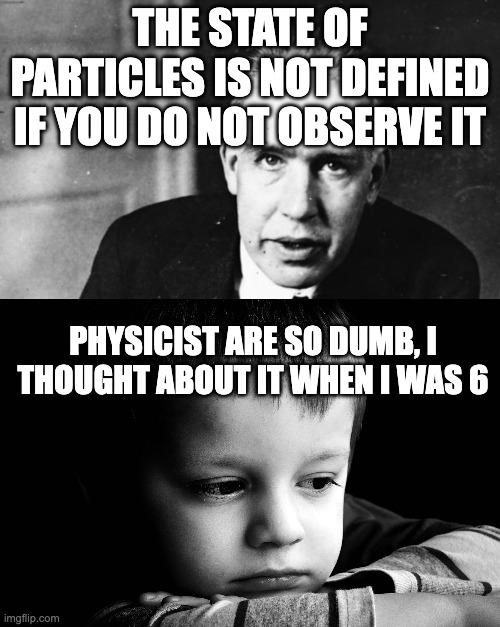
The Copenhagen interpretation basically says that quantum particles exist in superposition until you measure them—which sounds profound until you realize it's just fancy physics speak for "we don't know what's happening when we're not looking." The meme nails why this bothers people: it genuinely does sound like something a six-year-old would come up with. "If a tree falls in the forest and no one's around, does it make a sound?" meets particle physics, and physicists have been arguing about it for a century. The interpretation works mathematically, sure, but philosophically? It's giving "I didn't do my homework because my dog ate my wave function." Most physicists just shut up and calculate at this point.

Drugs Are Shit, But Quantum Physics Is Another Level

Drugs Are Shit, But Quantum Physics Is Another Level
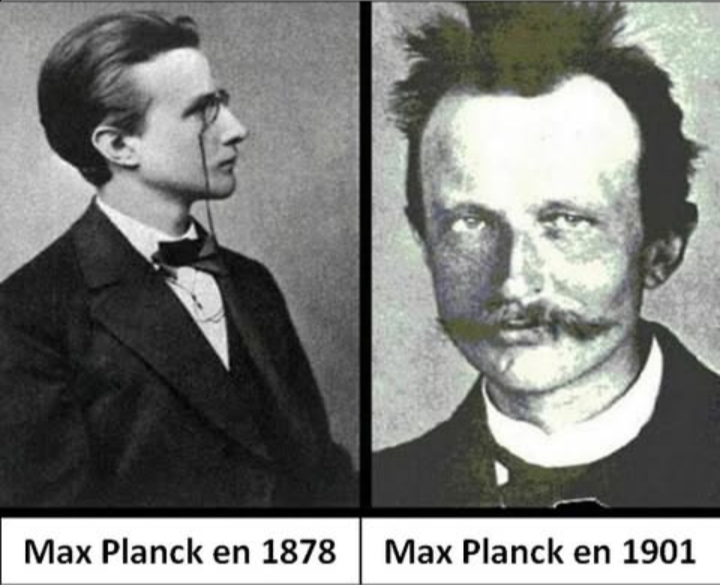
Max Planck went from looking like a respectable 19th-century gentleman who definitely uses the word "indubitably" in casual conversation to looking like he just discovered that particles can exist in multiple states simultaneously and his brain has never been the same since. In 1878, he's fresh-faced and optimistic. By 1901, after birthing quantum mechanics and realizing that energy comes in discrete packets (quanta), the man looks like he's seen things—things that violate everything classical physics promised him. That wild hair and thousand-yard stare? That's what happens when you accidentally create a theory so weird that even Einstein spent decades trying to prove it wrong. Forget psychedelics—nothing scrambles your perception of reality quite like discovering that the universe operates on probabilistic dice rolls at the fundamental level. Poor Max basically took the red pill before The Matrix was even a thing.

Reality Can Be Whatever I Want

Reality Can Be Whatever I Want
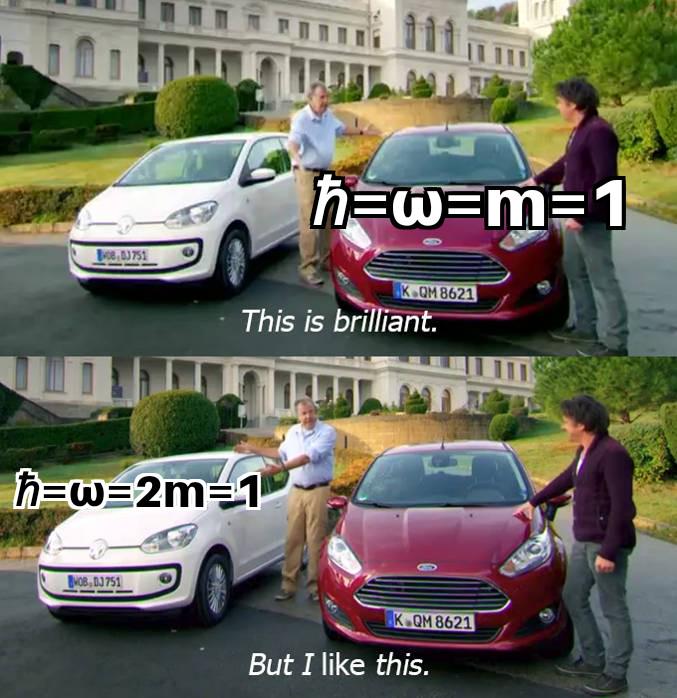
Welcome to physics, where we just casually redefine fundamental constants to make our equations prettier. The top panel shows the proper relationship where Planck's constant (ℏ) equals angular frequency (ω) times mass (m) equals 1—a perfectly reasonable unit system. But then some physicist woke up and decided "you know what? Let's make ω = 2m instead" because apparently consistency is for people who don't have tenure. This is basically every theoretical physicist's approach to natural units: just set everything equal to 1 until the math becomes tolerable. Speed of light? 1. Boltzmann constant? Also 1. Your dignity as you explain this to undergrads? Definitely not 1, more like approaching zero. The beauty is that both systems are technically "correct" depending on which units you choose, which is just a fancy way of saying physicists will bend reality itself to avoid dealing with annoying conversion factors. And honestly? Can't blame them.

Particle Logic

Particle Logic
This is Heisenberg's Uncertainty Principle in cookie banner form! According to quantum mechanics, you fundamentally cannot know both a particle's exact position and momentum simultaneously—the more precisely you measure one, the fuzzier the other becomes. It's not a measurement problem, it's literally how the universe works at the quantum level. So when a website tries to track both where you are AND where you're going (your momentum through the internet), quantum physics is basically like "pick a lane, buddy." The universe said no to surveillance capitalism before it was cool. Werner Heisenberg: the original privacy advocate since 1927.

The Cop Was Einstein And He Let Them Go Because Speed Is Relative

The Cop Was Einstein And He Let Them Go Because Speed Is Relative
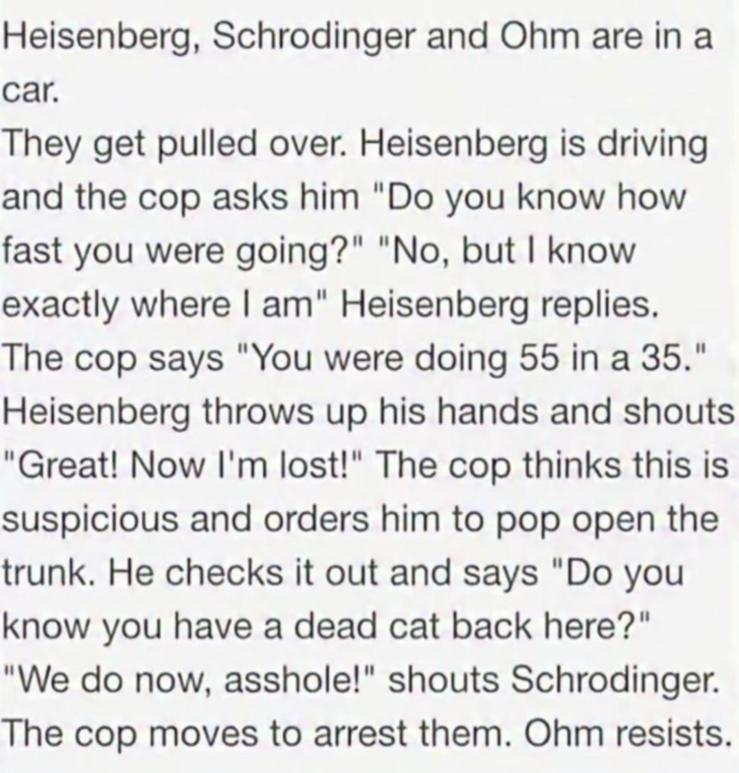
Three physics legends walk into a traffic stop, and each one perfectly embodies their most famous principle. Heisenberg's uncertainty principle states you can't simultaneously know both position and momentum with precision—so naturally he knows his exact location but has no clue about his speed. Schrödinger's cat exists in a superposition of alive and dead states until observed, which is why opening the trunk collapses the wave function and forces the cat into a definite (unfortunate) state. And Ohm? He resists. Because resistance is literally his thing (V=IR, anyone?). This is what happens when you let theoretical physicists operate motor vehicles. The cop probably needed a PhD just to write the incident report.

Physicss Ahhhh!!

Physicss Ahhhh!!
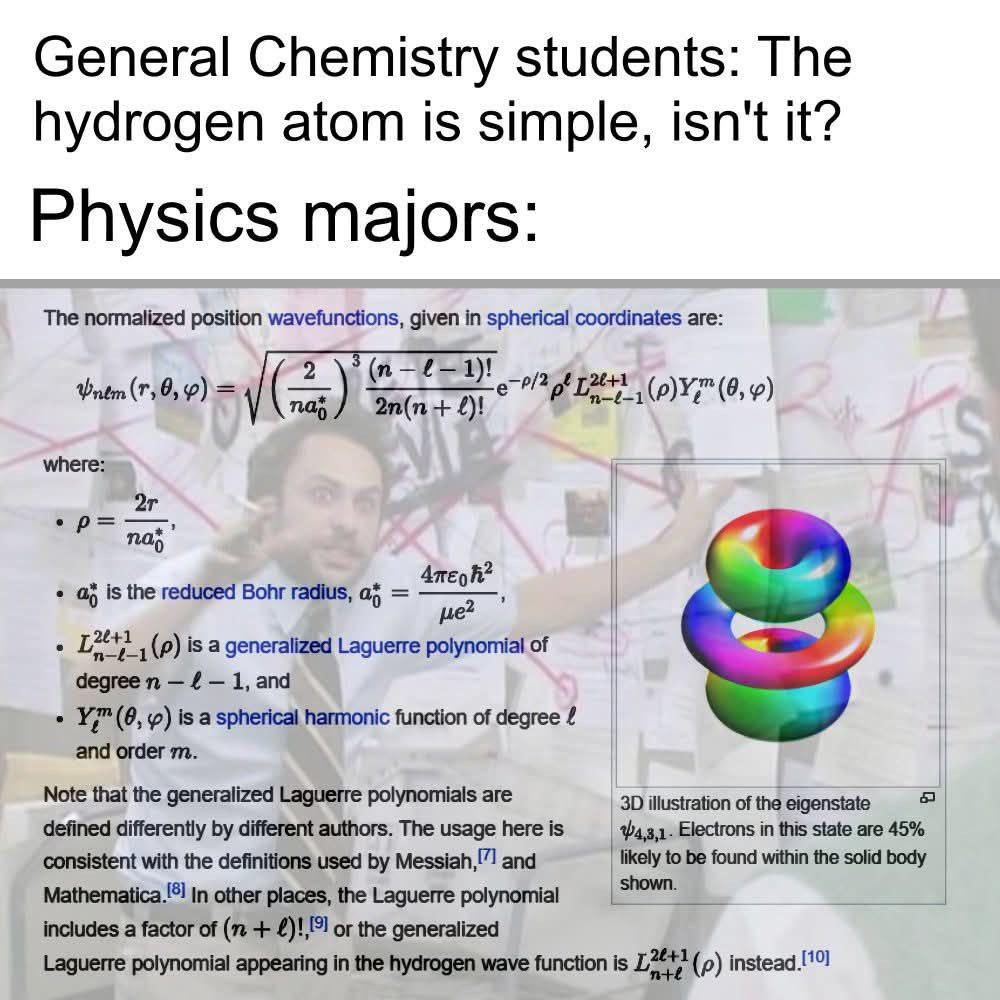
Chemistry students think the hydrogen atom is just one proton and one electron doing a little dance—simple, right? WRONG. Physics majors enter the chat with normalized wavefunctions in spherical coordinates, generalized Laguerre polynomials, spherical harmonics, and enough subscripts and superscripts to make your eyes bleed. That colorful 3D orbital visualization? Yeah, that's what happens when you solve the Schrödinger equation and physics majors get to flex their quantum mechanics muscles. Turns out describing where an electron "probably" hangs out requires more math than a NASA mission. Chemistry students just want to know if it bonds or not, but physics majors need to know the exact mathematical poetry of its quantum state. It's like asking for directions and getting a detailed topographical map with GPS coordinates instead.

Atoms Touch Each Other

Atoms Touch Each Other
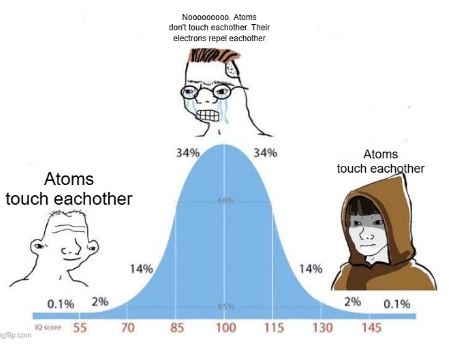
Here we have the eternal debate that breaks every physics student's brain: do atoms actually touch? The smug guy on the left thinks they do (bless his heart), while the "well actually" nerd in the middle is having a full meltdown explaining that electron clouds repel each other, so technically nothing ever truly touches anything. Meanwhile, the person on the right has ascended to enlightenment and circled back to "atoms touch each other" – because if we're getting philosophical about it, the electromagnetic repulsion IS the interaction, so... they ARE touching? Quick physics reality check: atoms get close enough that their electron clouds overlap and repel via electromagnetic forces. So you're not actually sitting on your chair – you're hovering nanometers above it, held up by electron repulsion. Your entire life is a lie. You've never touched anything. You're welcome for that existential crisis. The bell curve format nails it because the average person and the expert both arrive at the same answer, just for wildly different reasons. One doesn't know enough to care, the other knows too much to care.

Schrödinger's Cat Be Like

Schrödinger's Cat Be Like
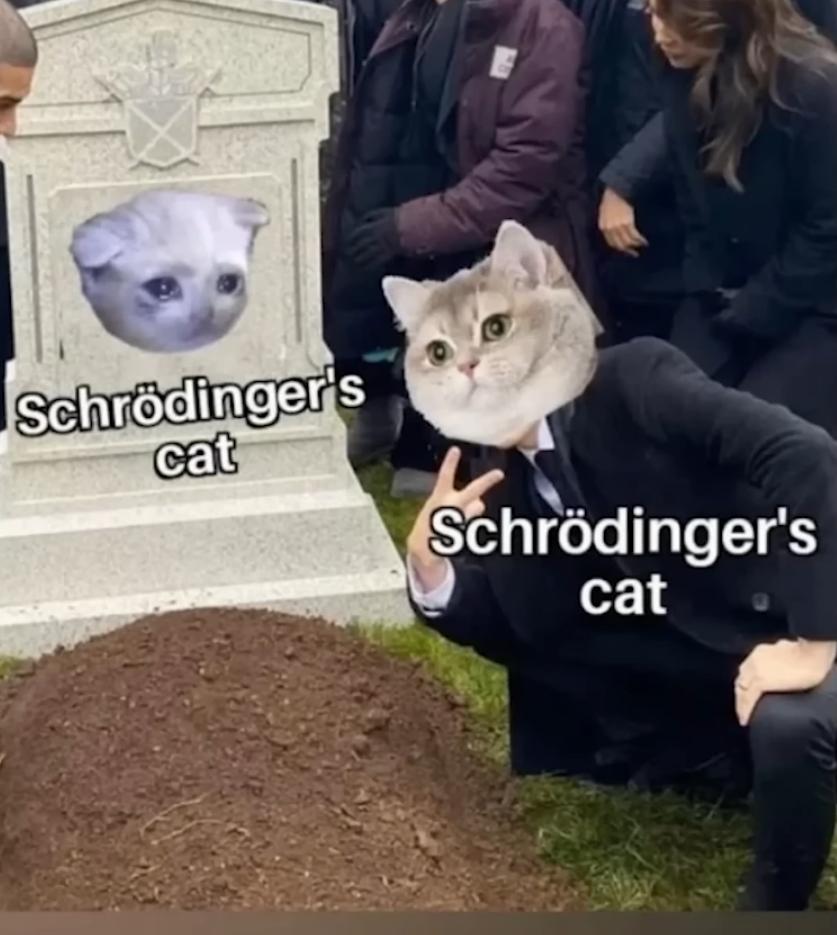
So you're telling me the cat is simultaneously dead AND alive at a funeral? Peak quantum mechanics energy right here. The famous thought experiment gets hilariously literal when you've got one cat chilling on a gravestone (representing the dead state) while another identical cat is very much alive and being petted (the alive state). Schrödinger probably didn't expect his paradox to manifest at what appears to be his own funeral, but here we are. For those who need a refresher: Schrödinger's cat is a thought experiment illustrating quantum superposition—where a cat in a sealed box with a radioactive atom could be both alive and dead until you observe it. Opening the box collapses the superposition into one state. Except in this case, someone opened the box AND didn't open it, and now we have two cats existing in different states simultaneously. Quantum physics just got a whole lot more confusing, or maybe more accurate? Either way, both cats are getting the attention they deserve.

Happy Life

Happy Life
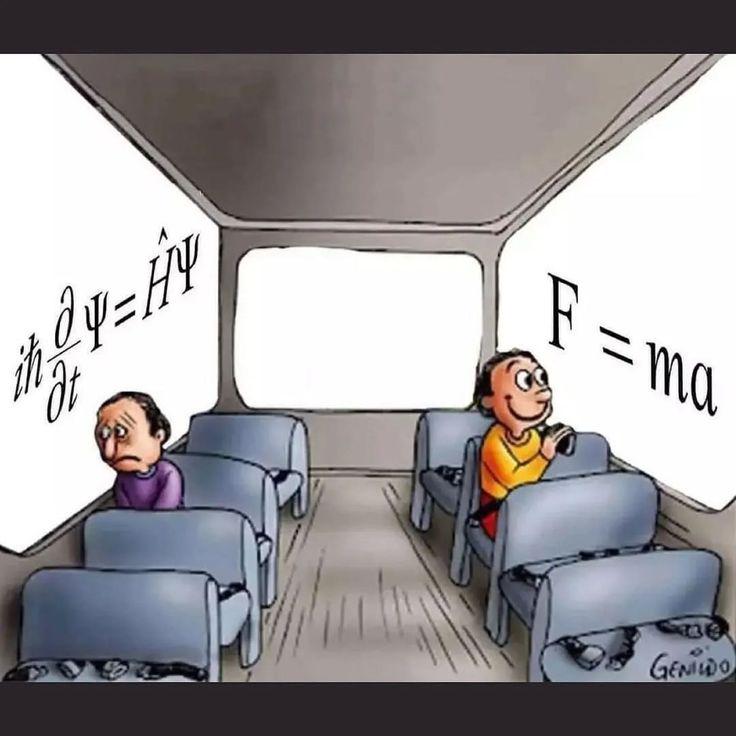
You've got two types of people on this bus ride called life. On the left, someone's contemplating the Schrödinger equation—that gnarly partial differential equation describing how quantum states evolve over time. Just casually pondering wave functions and Hamiltonians, you know, light commute reading. Meanwhile, on the right, someone's vibing with Newton's second law (F=ma), probably the most chill equation in physics. "Force equals mass times acceleration"—simple, elegant, gets the job done. The contrast is *chef's kiss*. One person chose quantum mechanics as their life philosophy and looks absolutely miserable, while the other stuck with classical mechanics and is having a grand old time. Moral of the story? Sometimes overthinking the universe at the subatomic level isn't the path to inner peace. Maybe just calculate some forces and call it a day. Your mental health will thank you.

Duality Of Light

Duality Of Light
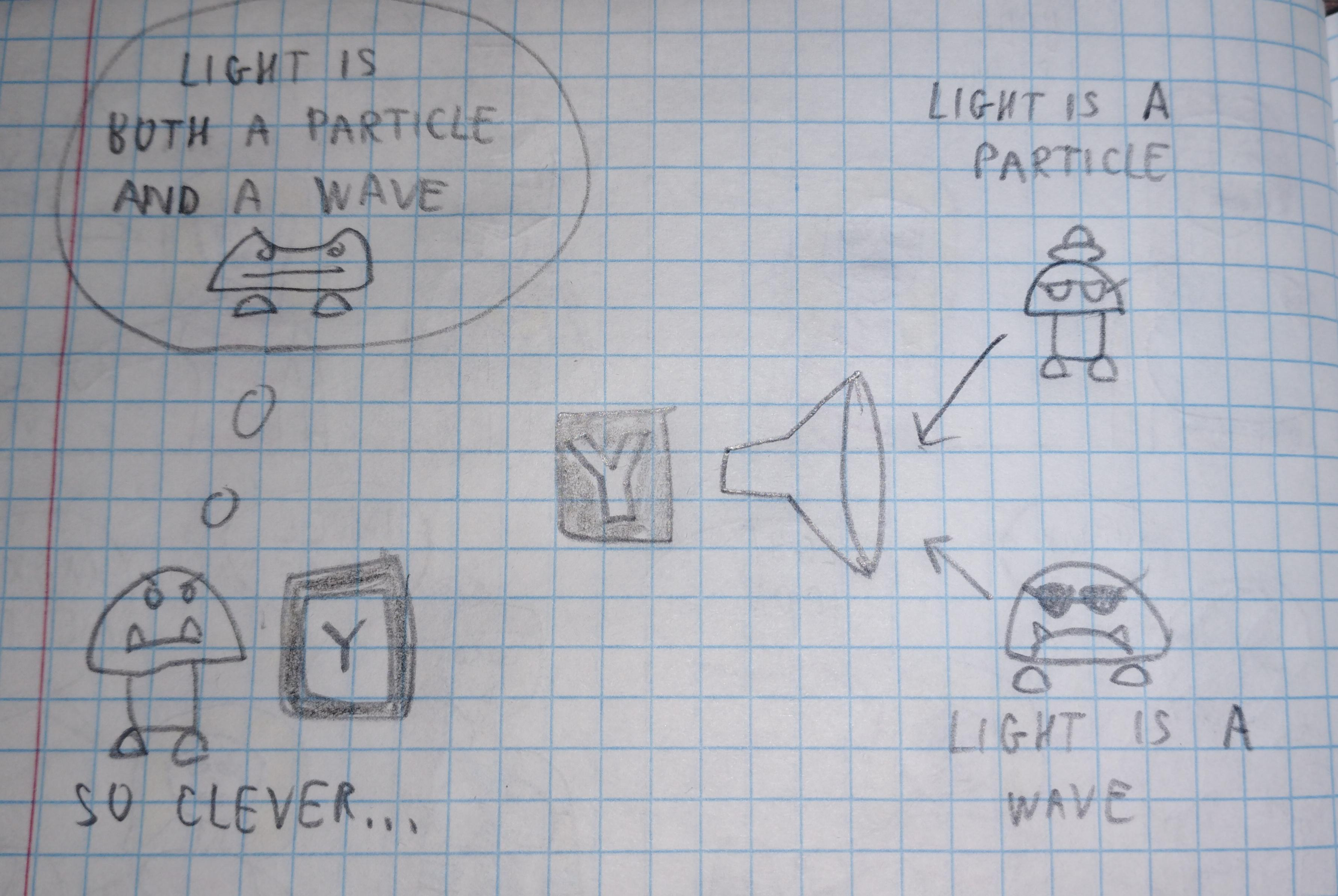
Wave-particle duality is giving these little physics characters a full identity crisis. Top left is smug about understanding both natures simultaneously, top right is confidently team particle with those cool shades, bottom right has committed to team wave, and bottom left is just... existentially confused by the whole situation, sarcastically noting "SO CLEVER..." The double-slit experiment in the middle really ties it together—literally the experiment that broke everyone's brain in the early 1900s. Light goes through two slits and creates an interference pattern (wave behavior), but when you try to observe which slit it goes through, it suddenly acts like a particle. It's like light knows you're watching and changes its behavior accordingly, which is both fascinating and deeply annoying if you're trying to understand reality. Fun fact: This quantum weirdness isn't just for light—electrons, atoms, and even molecules do this too. The universe really said "why pick one when you can be both?" and left physicists to deal with the philosophical fallout.