

Precision Memes

Posts tagged with Precision

5 Centimeters Per Second Meme

5 Centimeters Per Second Meme
Every lab instructor has lived this nightmare. You've explained significant figures until you're blue in the face, written it on the board, sent reminder emails, probably tattooed it on your forehead, and yet somehow students still submit "34.64 cm" when measuring something with a ruler that has centimeter markings. Buddy, your ruler can't measure to the hundredth of a centimeter—you're not wielding some NASA-grade precision instrument here, it's a plastic stick from the supply closet. The rule is simple: report what you can actually measure plus one estimated digit. If your ruler shows centimeters, you write "34.6 cm" or maybe "35 cm" depending on the markings. That extra ".04" is pure fiction, a number pulled from the void of academic optimism. It's like claiming you can taste individual molecules in your coffee—technically impressive, completely impossible. The frustration is real because this isn't advanced quantum mechanics—it's basic measurement literacy that somehow evaporates the moment students touch a lab report. Five times. FIVE. TIMES.

Perfectly Content

Perfectly Content
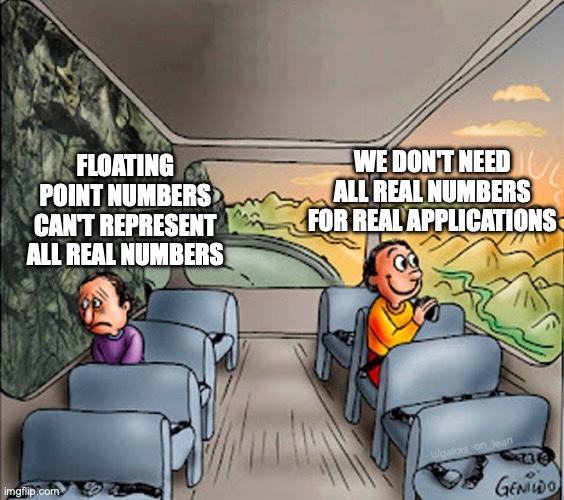
Computer scientists living their best life while mathematicians spiral into existential dread over floating-point arithmetic. Here's the thing: floating-point numbers (like the ones your computer uses) can't actually represent every real number—they're approximations with finite precision. Try calculating 0.1 + 0.2 in most programming languages and you'll get 0.30000000000000004. Mathematicians are having a full breakdown because this violates the sacred completeness of the real number line, while engineers and programmers are just vibing because, honestly? Close enough for building bridges, running simulations, and launching rockets. The IEEE 754 standard says "good enough" and that's exactly what it is—good enough to get stuff done without needing infinite memory to store π to infinite decimal places.

Rocket Goes Brrr: Decimal Place Showdown

Rocket Goes Brrr: Decimal Place Showdown
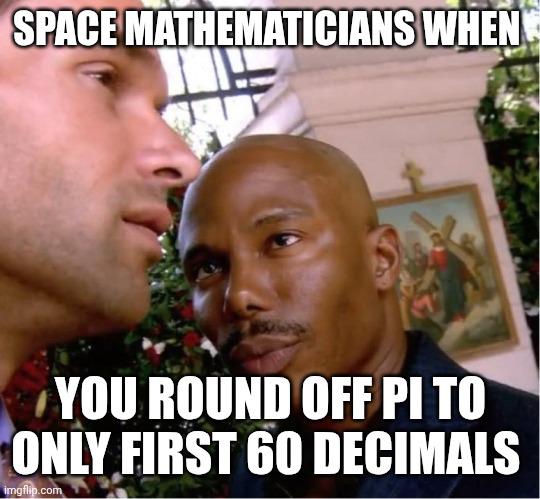
The sheer audacity of rounding π to a mere 60 decimal places! In aerospace engineering, precision is everything—each additional decimal potentially means the difference between landing on Mars or yeeting your billion-dollar spacecraft into deep space. NASA actually only uses about 15 decimal places for most calculations (3.141592653589793), which gives accuracy within the width of a hydrogen atom over a multi-billion-mile journey. So rounding to 60 places isn't just overkill, it's mathematical showboating of the highest order!

The Different Sciences And Their Measurement Tolerance

The Different Sciences And Their Measurement Tolerance
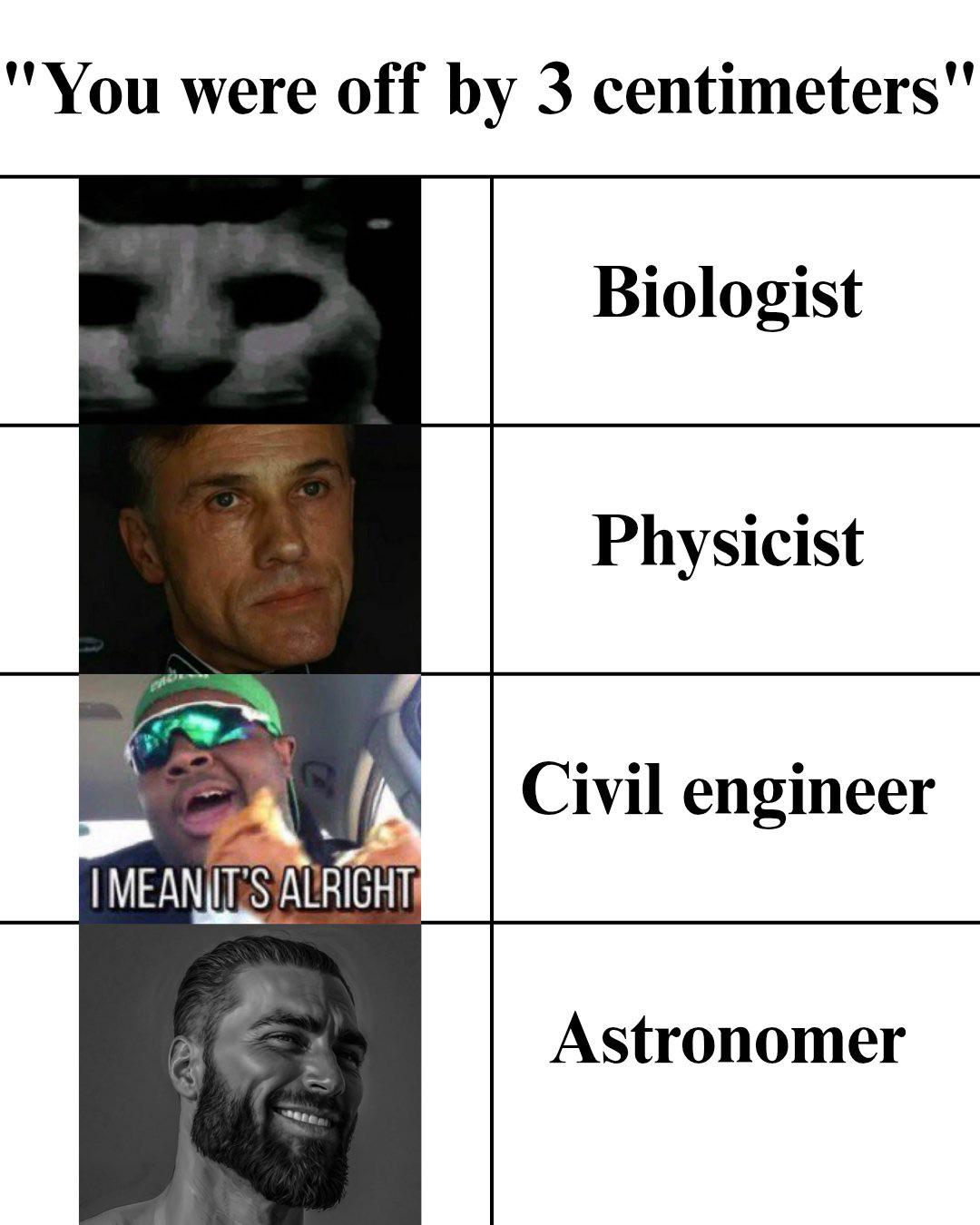
The precision standards across scientific fields are hilariously accurate! 🔬 When told "You were off by 3 centimeters," each scientist has their own reaction: Biologist: *horrified cat face* - Because in microbiology, 3cm might as well be the Grand Canyon! Physicist: *concerned face* - That's a catastrophic error when you're measuring fundamental particles! Civil Engineer: "I MEAN IT'S ALRIGHT" - Because when you're building bridges, a few centimeters? Pfft, we've got safety factors for that! Astronomer: *laughing hysterically* - When you're measuring distances in light-years, being off by 3cm is like worrying about a grain of sand on a beach! Next time your measuring tape shows you're off by a bit, just ask yourself: "What kind of scientist am I today?" 📏✨

The Precision Spectrum: 3 Centimeters Of Scientific Panic

The Precision Spectrum: 3 Centimeters Of Scientific Panic
The precision hierarchy in science is too real! Biologists freak out over 3cm errors because that could mean mistaking a mouse for an elephant (kidding). Physicists just nod stoically—they've seen worse in quantum measurements. Civil engineers? "It's alright" because bridges need wiggle room anyway! But astronomers? They're cackling because 3cm is basically NOTHING when you're measuring objects billions of light-years away. For them, being off by 3cm is like missing a galaxy by the width of an atom. The measurement tolerance spectrum across scientific disciplines is basically a meme unto itself!

Mathematicians Vs Cosmologists: The Precision Paradox

Mathematicians Vs Cosmologists: The Precision Paradox
The duality of scientific precision! Mathematicians have an existential crisis if their solution is off by 0.0001%, while cosmologists are popping champagne when they're only wrong by a factor of 100,000. In cosmology, being within five orders of magnitude is basically bullseye territory. "Is dark energy 70% of the universe or 7,000,000%? Eh, close enough for a Nobel Prize!" Meanwhile, mathematicians are in therapy because they rounded π to 3.14159 instead of carrying it to the billionth decimal place.

The Y=2^-X Look

The Y=2^-X Look
Ever notice how mathematicians have the most precise haircut requests? This guy asked for the exponential decay function and got exactly what he ordered. The line follows a perfect y=2^-x curve - starting high at the front and rapidly approaching zero as it moves back. The barber understood the assignment with surgical precision. Next time just say "fade" like a normal person instead of flexing your calculus knowledge in the chair.

Accurate To How Many Decimal Places?

Accurate To How Many Decimal Places?
Particle physicists at CERN spent billions on the Large Hadron Collider to measure the mass of the top quark and Higgs boson with extreme precision. Meanwhile, their data analysis meetings consist of saying "eh, close enough" while eating waffles. Significant figures become surprisingly optional when breakfast is involved.

Always Use Metric Units

Always Use Metric Units
The sophisticated bear knows that saying "1 atom" is for amateurs. Real scientists express it as "1.66 yoctomoles" because nothing says "I have a PhD" quite like using the most obscure SI unit possible. This is the scientific equivalent of ordering coffee in Italian at Starbucks when everyone else just points and says "that one."

You Were Off By 3 Centimeters

You Were Off By 3 Centimeters
The precision hierarchy in science is REAL! 🔬 Biologists are horrified by a 3cm error because it could mean studying the wrong cell type entirely! Physicists look mildly disappointed - that error just invalidated months of careful experimental setup. Meanwhile, civil engineers are like "It's all good!" because hey, that bridge is still standing, right? What's 3cm between friends? And astronomers? They're THRILLED to be that close! When you're measuring things in light-years, being off by 3cm is basically perfect! That's like hitting a bullseye from another galaxy!

Gotta Remember Buoyancy Correction

Gotta Remember Buoyancy Correction
The physics lab horror story in three acts: Act 1: Naive physicist thinks "mass of bricks equals mass of feathers" - simple enough! Act 2: Realization hits that density matters (ρ Bricks > ρ feathers ). The sweat begins. Act 3: Full breakdown as buoyancy correction enters the chat with those horrifying formulas accounting for air displacement. That beautiful bell curve shows the distribution of mental stability during precise measurements. This is why physicists wake up screaming at 2AM. Your "simple" mass measurement just became a nightmare of air density corrections, and now your lab report is due tomorrow. The 58% in the middle? Those are the ones still trying to convince themselves that rounding errors are acceptable.

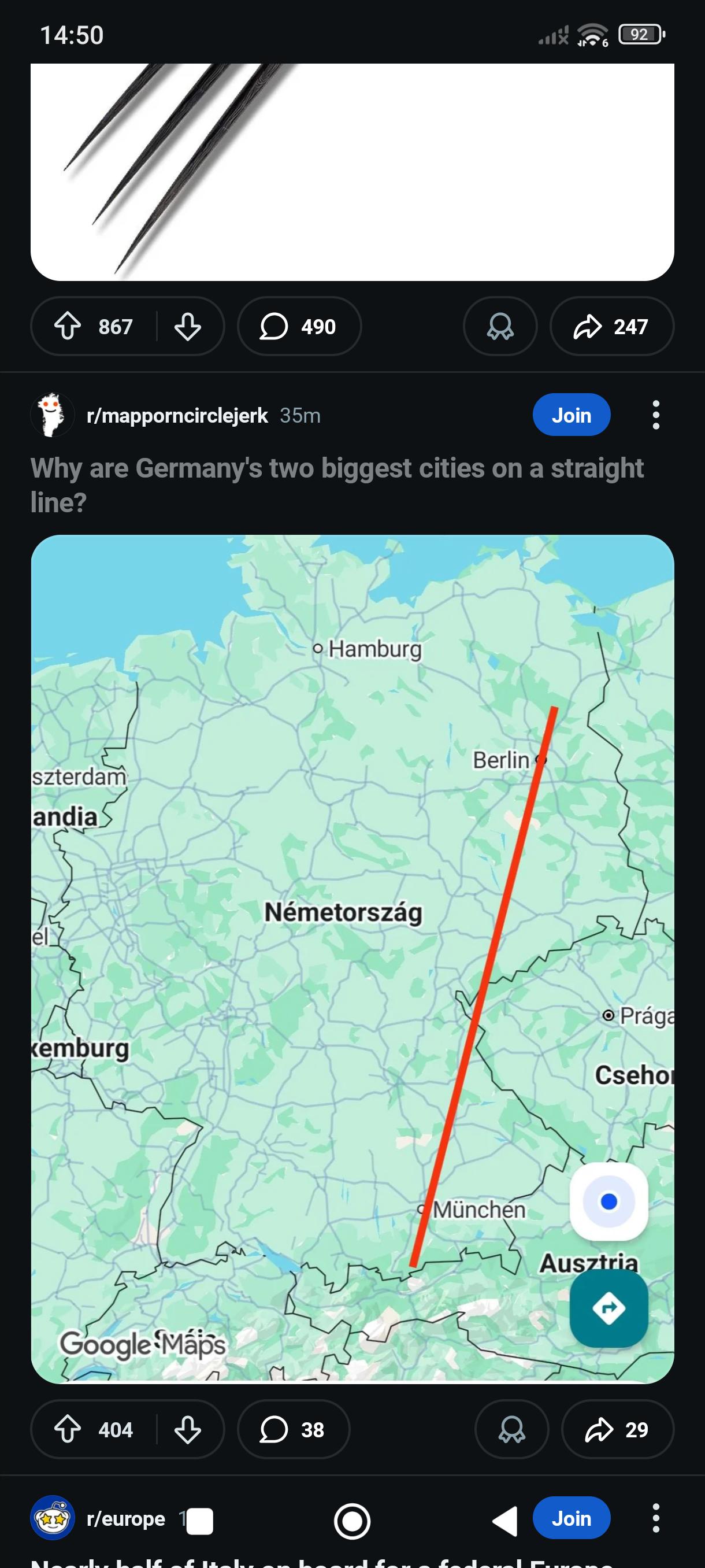
German Geographical Precision

German Geographical Precision
The Germans are notorious for efficiency, even in their urban planning apparently. Berlin and Munich forming a perfect straight line isn't coincidence—it's just German engineering at its finest. Next you'll tell me their train schedules are actually accurate. The real conspiracy here isn't aliens or Illuminati—it's that German city planners have been hiding their ruler-straight perfection from the rest of us chaotic city-builders for centuries. Meanwhile, Boston's streets still look like they were designed by a toddler with a crayon.