
Nasa Memes

Posts tagged with Nasa
NASA Should Recreate This Meme When They Land On The Moon In 2028

NASA Should Recreate This Meme When They Land On The Moon In 2028
Two astronauts chilling on the Moon, casually pointing at Earth like "look at those idiots down there." It's the ultimate flex—standing 238,855 miles away from all the chaos, traffic, taxes, and Twitter drama, just gesturing at humanity's collective mess from the serene vacuum of space. With NASA's Artemis program planning to return humans to the lunar surface in 2028 (fingers crossed for no more delays), someone absolutely needs to stage this shot. Imagine the PR team's brief: "Okay team, we need you to take a break from collecting regolith samples and conducting groundbreaking science to... point at Earth and look smug." Worth it. Fun fact: From the Moon, Earth appears about 4 times larger in the sky than the Moon appears from Earth, making it the perfect backdrop for cosmic shade-throwing. The Apollo astronauts described seeing the entire planet in one view as deeply humbling, but clearly they weren't thinking about meme potential.

The Cursed Implement Marches On

The Cursed Implement Marches On
Nothing says "we definitely thought this through" like watching 60% of your Mars missions crash and burn while one little rover just refuses to die. Engineers designed it for 90 days. It lasted 15 years. On Mars. With dust-covered solar panels that should've killed it in month three. The failed missions are watching from the great scrap heap in the sky, wondering what kind of dark magic NASA accidentally summoned. Meanwhile, mission control is frantically updating spreadsheets like "uh, we didn't budget for Year 14 operations." The rover just kept going, powered by spite and Martian dust devils that occasionally cleaned its panels like some kind of cosmic car wash. This is Opportunity, by the way. The little rover that could, and did, and wouldn't stop until a planet-wide dust storm finally took it out in 2018. Rest in peace, you overachieving legend.

It Turned 90 Days Into 15 Years

It Turned 90 Days Into 15 Years
NASA's Opportunity rover was designed for a 90-day mission on Mars. Instead, this overachieving little beast kept going for 15 years, exploring craters and sending back data like the energizer bunny on steroids. Then in 2019, a massive dust storm blocked out the sun, and Oppy sent its last transmission: essentially "my battery is low and it's getting dark." If you didn't tear up reading that, you might actually be a robot yourself. Engineers literally tried everything to wake it up for months afterward. They played wake-up songs, sent thousands of commands, but our little rover was done. Meanwhile, some dude not crying at Titanic is apparently the emotional benchmark? Please. Opportunity's death hit different because it gave us 15 years when we only asked for 90 days, and went out like a tired explorer watching the sunset. That's the kind of dedication that makes grown scientists weep into their keyboards.

You're Our Slingshot

You're Our Slingshot
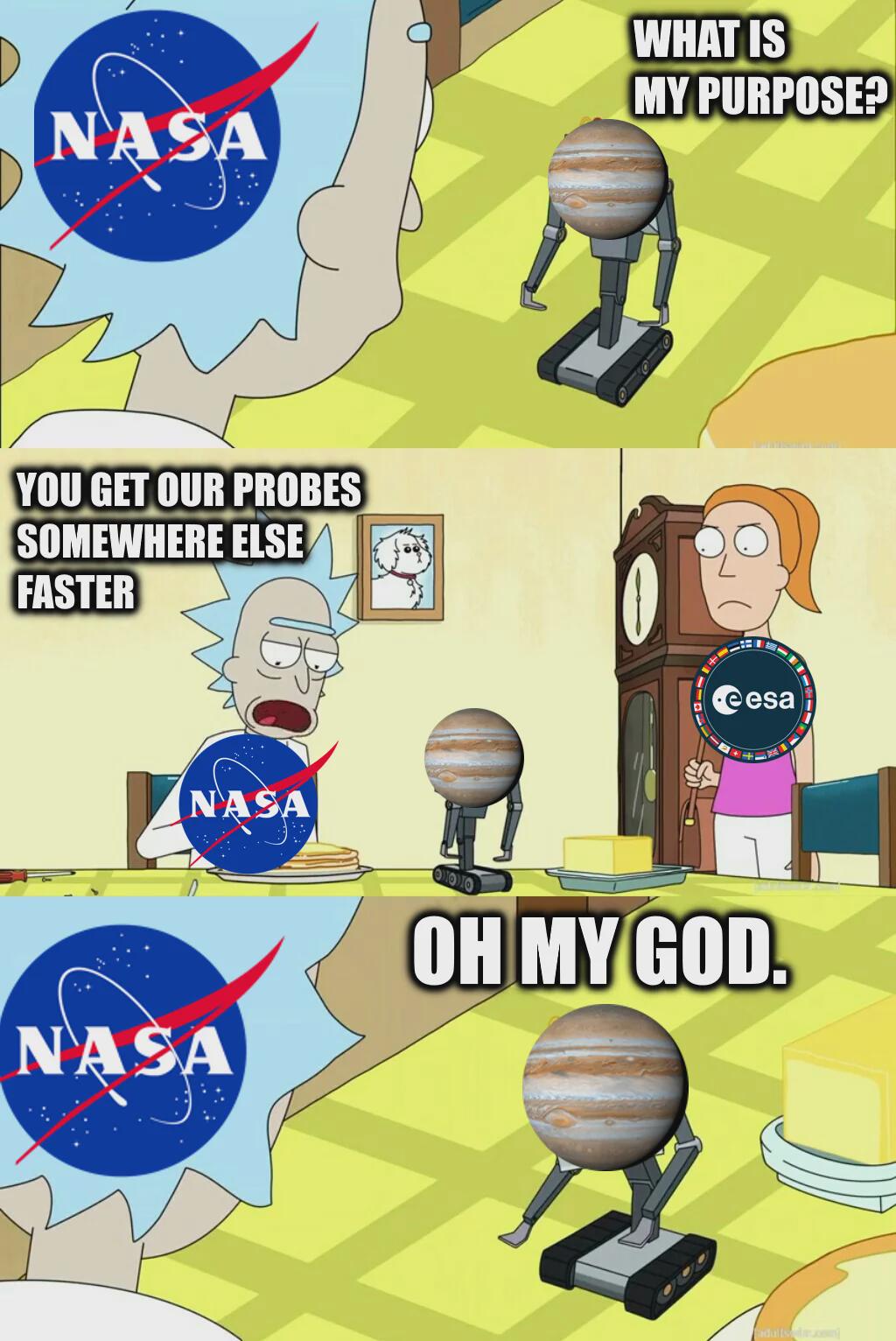
Jupiter's having an existential crisis, and honestly, who can blame it? The gas giant thought it was just vibing out there in the outer solar system, minding its own business with its 95 moons, but turns out NASA's been using it as a cosmic catapult this whole time. Gravitational assist maneuvers (or gravity slingshots) let spacecraft steal a tiny bit of a planet's orbital momentum to speed up without burning fuel. Jupiter's massive gravity well makes it the MVP of interplanetary shortcuts—missions like Voyager, Galileo, and Juno have all used Jupiter to yeet themselves across the solar system. ESA's just standing there awkwardly because they also use Jupiter for the same thing, making this planetary exploitation a truly international effort. Poor Jupiter. It's basically the universe's free Uber driver, and nobody even asked if it was cool with that.

Pookie Planet To The Rescue As Always

Pookie Planet To The Rescue As Always
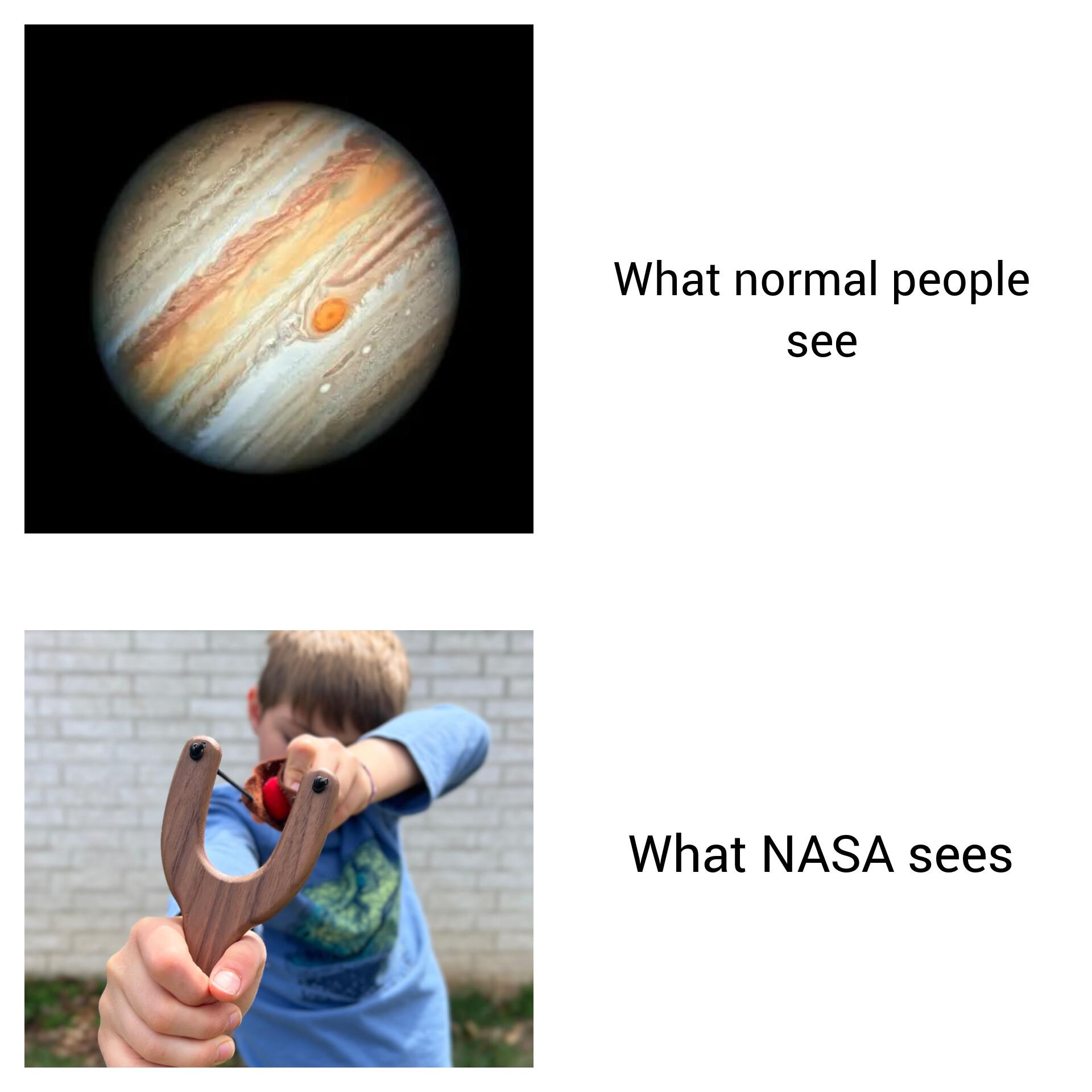
Jupiter really is the solar system's MVP bodyguard. While most folks just see a pretty gas giant with fancy stripes, NASA scientists see a massive cosmic slingshot that's been yeeting asteroids and comets away from Earth for billions of years. With a gravitational pull so strong it's basically the bouncer of our neighborhood, Jupiter catches or deflects space rocks that would otherwise turn us into the dinosaurs 2.0. That gravitational field is about 2.5 times stronger than Earth's, and it's positioned perfectly in the outer solar system to intercept incoming threats. So yeah, normal people see a planet, but planetary scientists see our ride-or-die bestie who's been taking bullets (literally flaming space bullets) for us since day one. The Shoemaker-Levy 9 comet impact in 1994? Jupiter took that hit like a champ, with impact scars bigger than Earth itself. Absolute legend behavior.

Paper Beats Rock: The Ultimate Planetary Defense Strategy

Paper Beats Rock: The Ultimate Planetary Defense Strategy
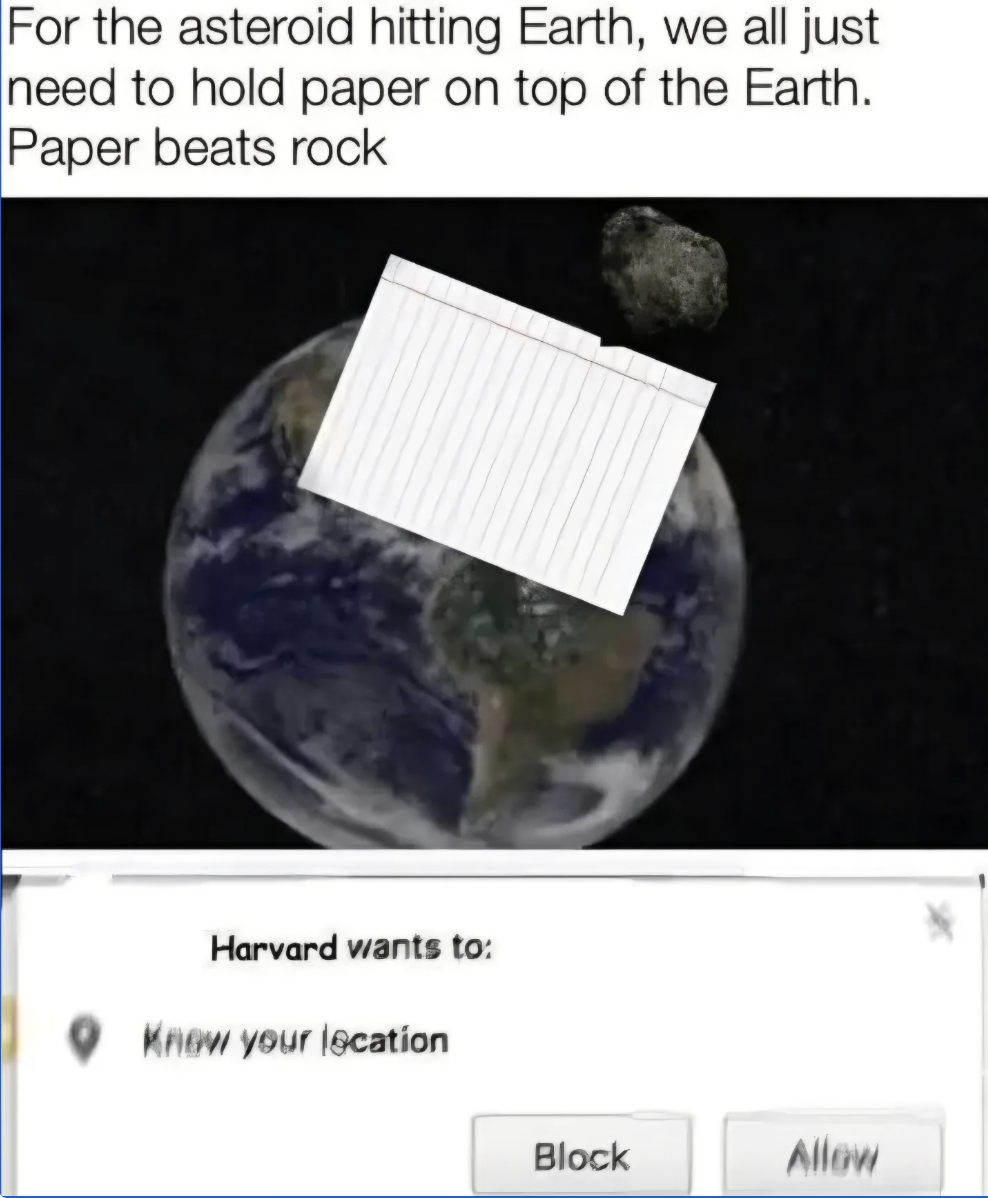
Who needs billion-dollar asteroid defense systems when we've got NOTEBOOK PAPER?! This meme brilliantly takes the childhood game of rock-paper-scissors to a cosmic level! Just slap some college-ruled on top of the planet and BOOM—asteroid problem solved! It's the ultimate budget cut for NASA. And then Harvard jumps in wanting your location because they're ready to offer you a professorship for such GROUNDBREAKING science! Clearly this is the kind of out-of-the-box thinking we've been missing in planetary defense strategies. Next up: using scissors to cut through climate change!

Rocket Goes Brrr: Decimal Place Showdown

Rocket Goes Brrr: Decimal Place Showdown
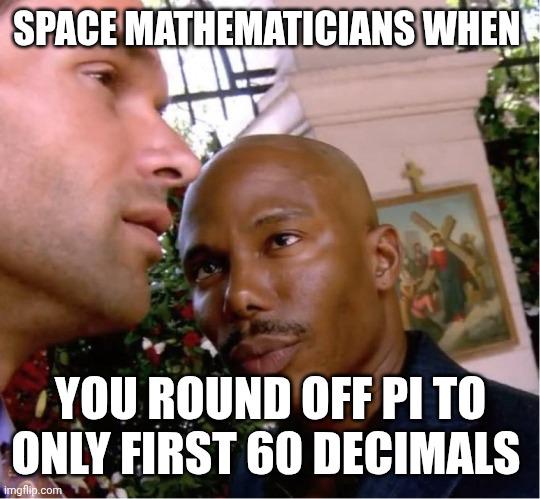
The sheer audacity of rounding π to a mere 60 decimal places! In aerospace engineering, precision is everything—each additional decimal potentially means the difference between landing on Mars or yeeting your billion-dollar spacecraft into deep space. NASA actually only uses about 15 decimal places for most calculations (3.141592653589793), which gives accuracy within the width of a hydrogen atom over a multi-billion-mile journey. So rounding to 60 places isn't just overkill, it's mathematical showboating of the highest order!

Is This A Good Telescope For Beginners?

Is This A Good Telescope For Beginners?
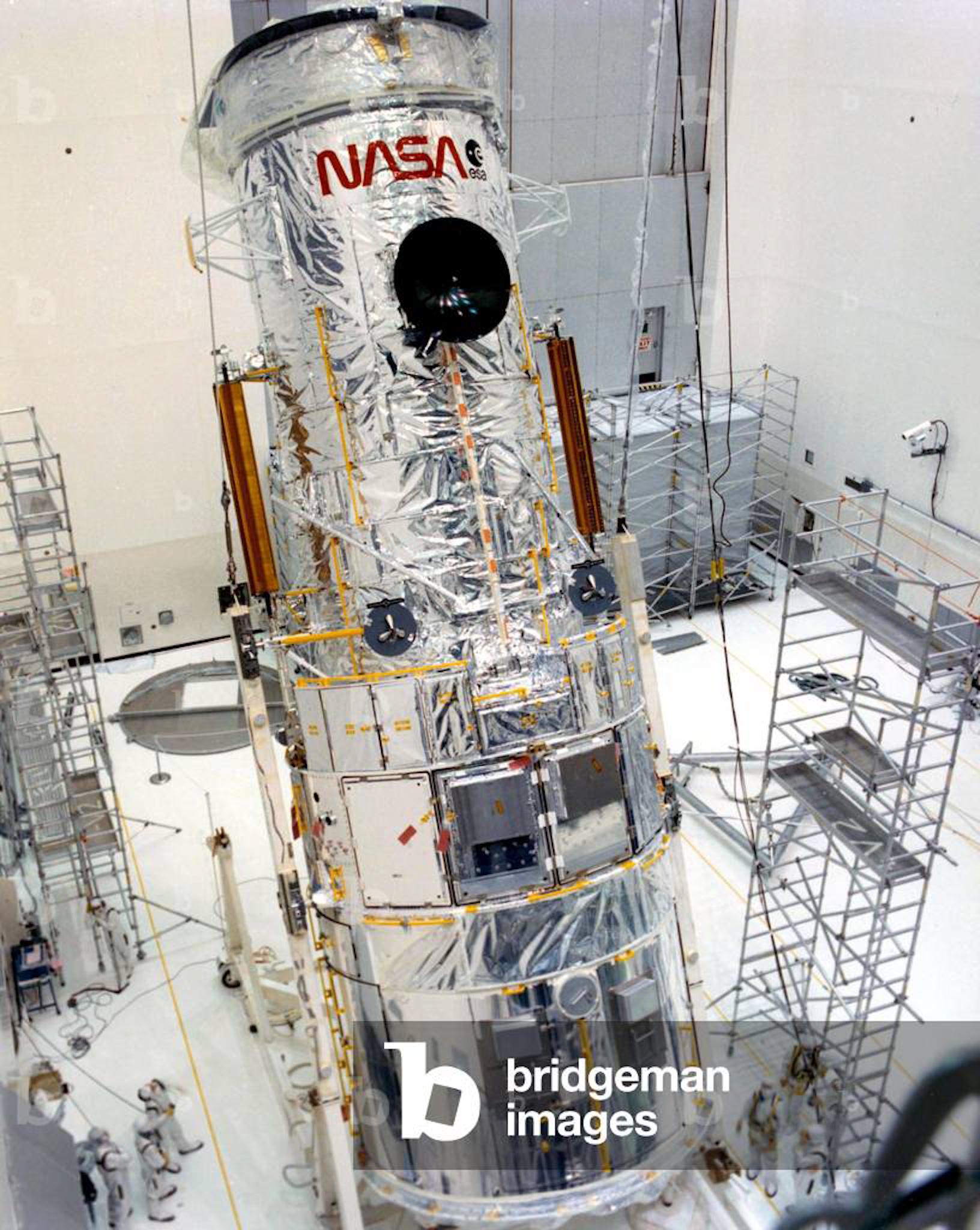
Sure, if your budget is $4.75 billion and you have NASA on speed dial! What we're looking at is the Hubble Space Telescope - basically the Ferrari of stargazing equipment. Built to orbit Earth at 340 miles up, this bad boy can see galaxies billions of light-years away while your "beginner telescope" from Amazon struggles to spot the moon on a cloudy night. The irony of asking if one of humanity's most sophisticated scientific instruments is "good for beginners" is just *chef's kiss*. Like asking if a nuclear submarine is good for your kid's first swimming lesson.

Metric > Imperial: The Scientific Affair

Metric > Imperial: The Scientific Affair
Even American scientists can't resist sneaking a peek at the metric system while being officially married to imperial units! It's the scientific equivalent of texting your ex while your current partner is watching. 🧪📏 Fun fact: NASA lost a $125 million Mars orbiter because one team used metric units while another used imperial. Talk about an expensive unit conversion error! The rest of the scientific world just watches this relationship drama unfold with popcorn in hand. 🍿

Measurement Error: When Unit Conversions Cost $125 Million

Measurement Error: When Unit Conversions Cost $125 Million
Remember that $125 million Mars Climate Orbiter that crashed in 1999? Yeah, that's what happens when one team uses metric and the other uses imperial. The cosmic equivalent of trying to fit a USB plug in the wrong way—except instead of flipping it three times, you lose a spacecraft. NASA engineers were probably like "Houston, we have a... unit conversion problem." Next time someone tells you unit conversions don't matter, just point to the $125 million space debris circling Mars that proves otherwise.

Eight Minutes Of Blissful Ignorance

Eight Minutes Of Blissful Ignorance
The existential comedy here is peak astrophysics humor! Light from the Sun takes approximately 8 minutes to reach Earth, so if the Sun suddenly disappeared or went supernova, we'd continue existing in blissful ignorance for those 8 minutes before the catastrophic effects hit us. These scientists just realized they miscalculated something major about the Sun's stability, but there's literally nothing they can do except... offer a cookie? The perfect representation of scientific fatalism - when you discover an extinction-level event and all that's left is gallows humor and snacks. At least they'll get to finish their coffee before the solar radiation hits!

Buncha Dumbasses Indeed

Buncha Dumbasses Indeed
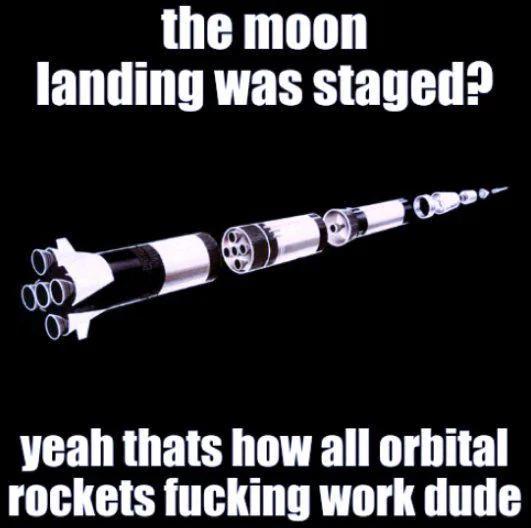
The perfect response to moon landing conspiracy theorists who don't understand basic rocket science. The Saturn V rocket had multiple stages that separated during ascent—not because Hollywood needed better props, but because physics demands shedding mass to reach orbit efficiently. Imagine thinking rocket engineers designed multi-stage rockets just to fool you personally, rather than to, you know, actually reach the moon. Next they'll claim gravity is just a government plot to keep us all down.