
Mathematics Memes

Posts tagged with Mathematics
Mathematical Paradise Lost And Found

Mathematical Paradise Lost And Found
The ultimate mathematical troll job! This meme plays on Georg Cantor and David Hilbert, two mathematical giants who revolutionized our understanding of infinity. The joke is that Cantor, who literally invented set theory and different sizes of infinity, is described as "unable to count" (which is hilariously backward). Meanwhile, Hilbert's actual quote about Cantor's work—"No one shall expel us from the paradise that Cantor has created for us"—is reimagined as a sleep-deprived hotel rant! It's basically math history getting the tabloid treatment. The irony is magnificent since Cantor's work on transfinite numbers showed that some infinities are actually "bigger" than others. So in a weird way, he did prove counting gets really complicated!

Proof By Overkill

Proof By Overkill
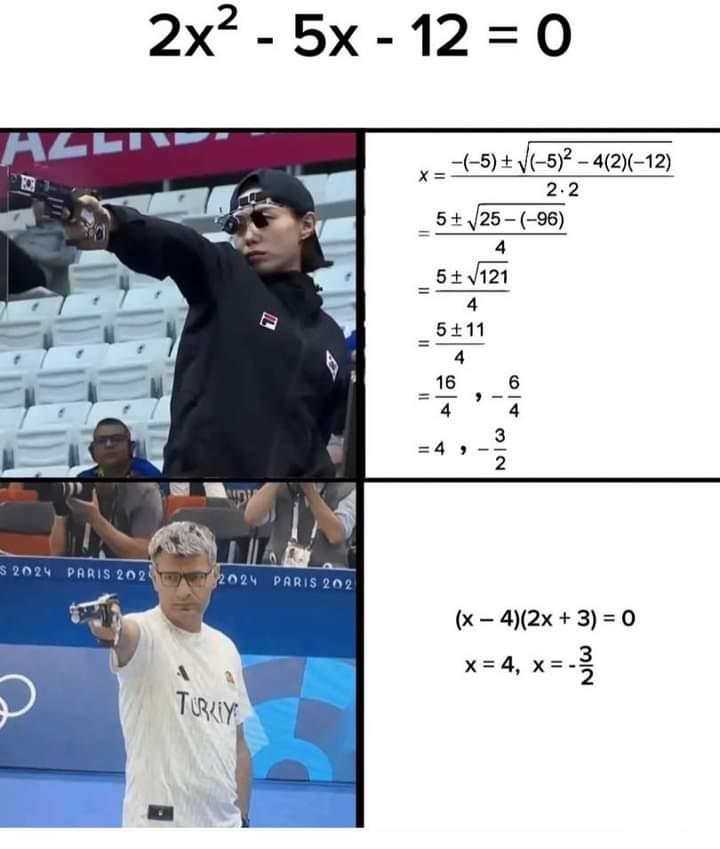
When a simple equation like x² - 1 = 0 shows up on your math test, but you've spent the last 48 hours mainlining caffeine and studying the quadratic formula... so you bring out the MATHEMATICAL TANK! Why solve x = ±1 directly when you can obliterate it with the full quadratic artillery? It's like using a nuclear missile to kill a spider—mathematically satisfying but wildly unnecessary. The quadratic formula doesn't care about your simple factoring tricks—it's here to CRUSH ALL EQUATIONS with brute computational force!

The Imaginary Battle Of The Sciences

The Imaginary Battle Of The Sciences
The physicist and chemist are playing fast and loose with math, trying to prove that 23 = 77 through some seriously questionable symbol manipulation. The physicist uses the square root of iridium (Ir), while the chemist goes for square root of negative iridium. Neither makes ANY mathematical sense—they're just abusing notation to force an equality. Meanwhile, the mathematician is having an existential crisis because THAT'S NOT HOW MATH WORKS. This is basically the academic equivalent of watching someone cut pizza with scissors—mathematicians die a little inside when other scientists treat math like it's optional.

Chemistry With Physics Is Such A Paradox

Chemistry With Physics Is Such A Paradox
The eternal struggle between notation systems! The physicist writes √=Ir (square root equals current times resistance), while the chemist writes √=23 and Ir=77 (iridium's atomic number). When combined, we get 23=77, which makes the mathematician have an existential crisis. This is what happens when different scientific languages collide - mathematical impossibilities that would make Euler roll in his grave! Interdisciplinary communication: 0, Scientific confusion: 100.

String Theorists Be Like

String Theorists Be Like
String theorists explaining their work to regular physicists is like trying to describe 11-dimensional vibrating strings to someone who just wants to know why their coffee gets cold. The equation at the bottom is probably what they mutter under their breath while gesturing wildly at abstract mathematical concepts that can't be experimentally verified. Meanwhile, the rest of us are still trying to figure out if Schrödinger's cat is alive, dead, or just tired of being in thought experiments.

Need Help With My Multi-Monitor Setup. Is This Layout Optimal?

Need Help With My Multi-Monitor Setup. Is This Layout Optimal?
What happens when a mathematician configures their desktop? This monstrosity. Someone's clearly applying non-Euclidean geometry to their monitor setup. Those rotated displays aren't just breaking Windows conventions—they're breaking the laws of productivity and possibly spacetime itself. The real question isn't whether this layout is optimal, but rather what interdimensional beings they're trying to communicate with using this configuration. I bet they also organize their desktop icons by prime factorization.

A Physicist And A Chemist Against A Mathematician

A Physicist And A Chemist Against A Mathematician
The physicist works with imaginary numbers (√-1 = i), the chemist works with chemical elements (√-23 and Ir-77, which don't actually exist), and together they "prove" that 23=77. Meanwhile, the mathematician is having an existential crisis because this mathematical atrocity violates everything sacred in their universe. This is basically what happens when experimental sciences try to do math without adult supervision. Pure mathematicians spend years developing rigorous proofs, and then physicists and chemists just waltz in with their "close enough" approximations and wonder why mathematicians develop eye twitches.

Thanks Math Book, I Totally Remember My "Basic" Sheaf Cohomology

Thanks Math Book, I Totally Remember My "Basic" Sheaf Cohomology
Ever opened a math textbook that casually drops "as we know from basic sheaf cohomology" like you learned it in kindergarten? Meanwhile, your brain is struggling to recall that i=√-1, the imaginary unit we learned in high school! Advanced math textbooks exist in a parallel universe where everyone apparently has a PhD before reading chapter 1. Sheaf cohomology is literally a graduate-level topic involving abstract algebra and topology, but sure, let's pretend that's "basic" while we're still trying to remember if negative times negative equals positive.

The Mathematical Flex

The Mathematical Flex
Regular humans: "3 equals 1+1+1. Simple addition. Moving on." Srinivasa Ramanujan: "Hold my infinite nested radical expression." This is peak mathematical showboating. Ramanujan was that friend who'd solve a problem using calculus when simple arithmetic would do. The equation is actually valid—proving that mathematical geniuses will always find the most unnecessarily complex way to express something just to make the rest of us feel inadequate. Thanks, Ramanujan.

What's The Common Thing Among These Graphs?

What's The Common Thing Among These Graphs?
Mathematicians spend years studying graph theory only to realize these 15 different network diagrams are actually identical under isomorphism. The punchline is devastatingly accurate for anyone who's ever stared at a whiteboard for hours before realizing two seemingly different mathematical structures are fundamentally the same thing. It's that special moment of clarity when you've wasted an entire afternoon proving something that was obvious from the beginning. Graduate students worldwide just felt a collective shudder.

The Uninvited Vector In The Equation

The Uninvited Vector In The Equation
The mathematical betrayal is too real! Vector D is literally just sitting there with all 1's thinking it's special, when it can be created by adding vectors A, B, and C together. In linear algebra, when vectors can be expressed as a linear combination of other vectors, they're considered "linearly dependent" - basically redundant and bringing nothing new to the vector space party. Poor D is the uninvited guest who doesn't realize everyone's silently thinking "why are you even here?" The mathematical equivalent of showing up to a meeting that could've been an email!

Depends On The Equation

Depends On The Equation
The eternal dance between pure mathematicians and engineers. Mathematicians live in a world of perfect proofs while engineers subsist on "good enough" approximations. Then suddenly, a mathematician offers something useful for approximations and the engineer's entire worldview shifts. It's like finding out your annoying neighbor who only talks about abstract art actually fixed your car while you weren't looking. Pure math becoming practical is the scientific equivalent of finding money in your winter coat pocket.