

Integration Memes

Posts tagged with Integration
Making Area "Rigorous" (Definitely Not Circular Reasoning)

Making Area "Rigorous" (Definitely Not Circular Reasoning)
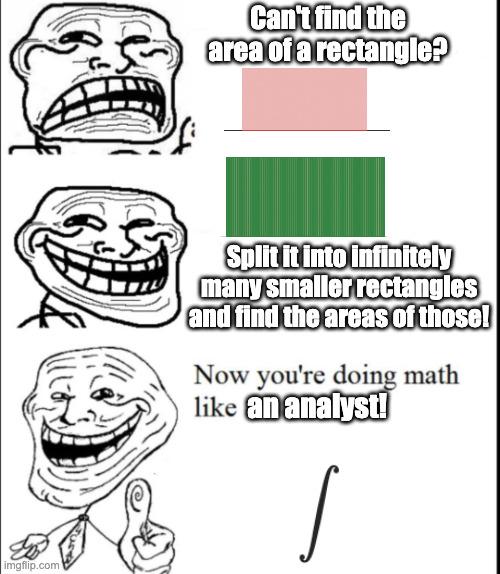
This is the mathematical equivalent of "I used the stones to destroy the stones." You want to find the area of a rectangle? Just divide it into infinitely many smaller rectangles and add up their areas! Problem solved... wait a minute. The joke here is that this approach to making area calculation "rigorous" through integration is hilariously circular. You're literally using rectangles to find the area of... a rectangle. It's like defining a word using that same word in the definition. Mathematicians will tell you this is how Riemann sums work and it's totally legit, but deep down we all know it feels sketchy. The integral symbol at the end is the chef's kiss because integration IS just fancy addition of infinitely many infinitesimally small rectangles. Real analysis professors everywhere are sweating nervously while insisting this is "perfectly rigorous" and "not circular at all."

My Teacher Hates Me Bro

My Teacher Hates Me Bro
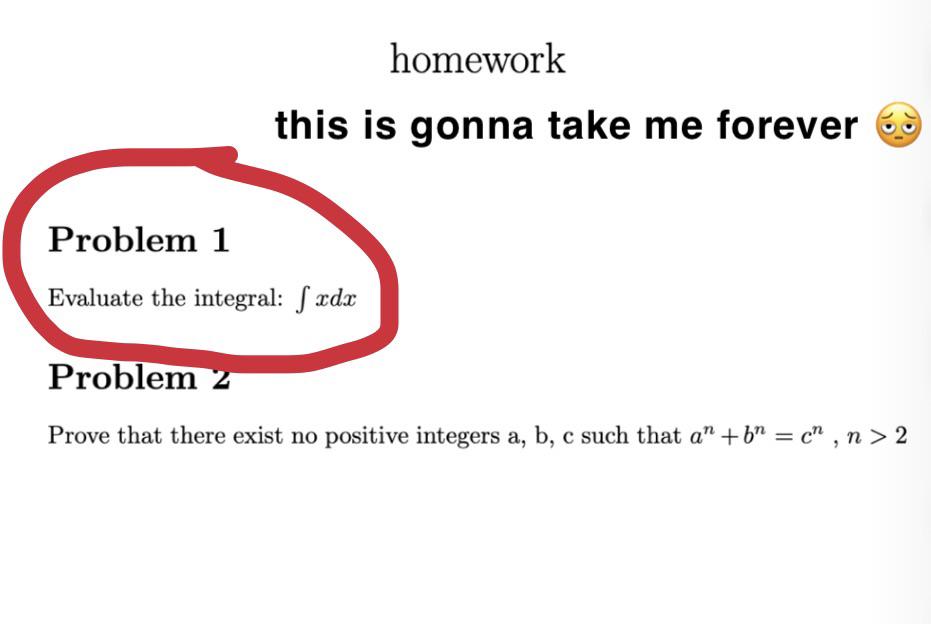
Problem 1 looks innocent enough—just integrate x dx, which takes like 5 seconds and gives you x²/2 + C. Easy peasy, right? Then you scroll down to Problem 2 and BAM—prove Fermat's Last Theorem, one of the most infamous unsolved problems in mathematics for over 350 years until Andrew Wiles finally cracked it in 1995 with a proof so complex it's literally hundreds of pages long. Your teacher really went from "warm-up stretches" to "now climb Mount Everest barefoot" with zero warning. The difficulty gap here is absolutely unhinged—it's like asking someone to spell "cat" and then immediately demanding they recite the complete works of Shakespeare in Klingon. No wonder this homework is gonna take forever... or until the heat death of the universe, whichever comes first.

You Know You Did A Mistake In Your Life When The Teacher Wants You To Calculate The Area Of A Function In A 3D Space

You Know You Did A Mistake In Your Life When The Teacher Wants You To Calculate The Area Of A Function In A 3D Space
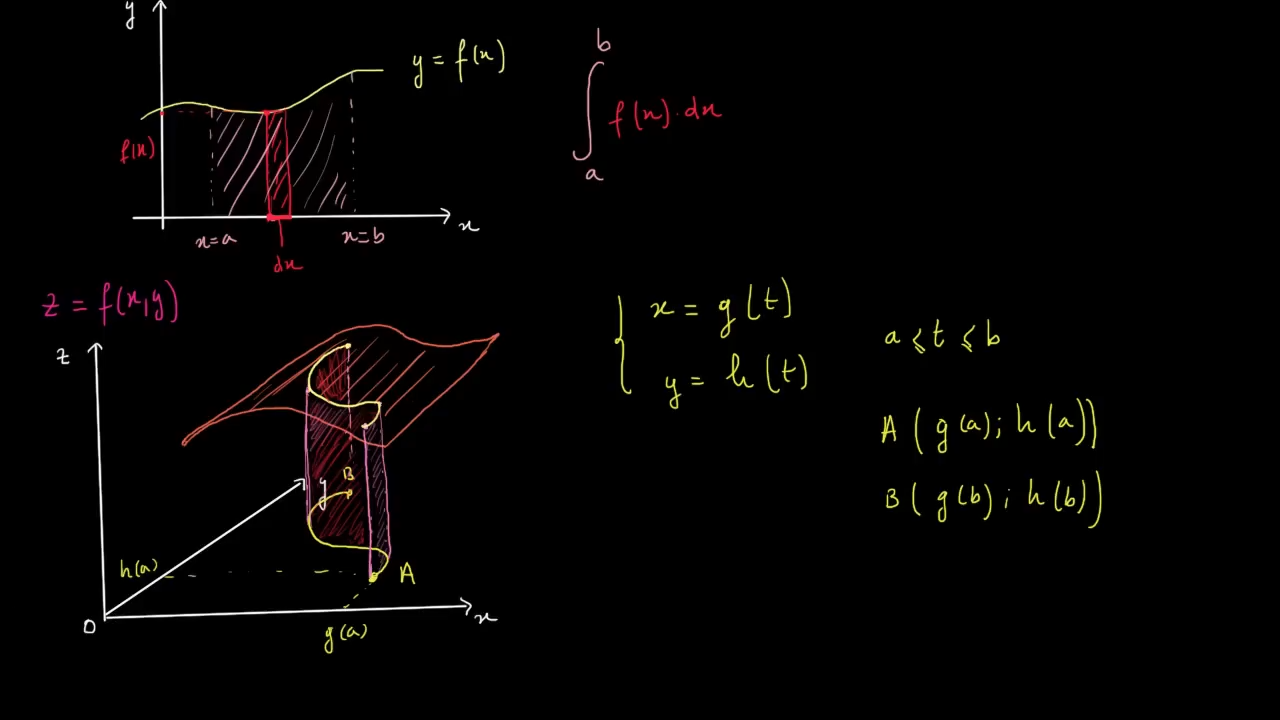
When you thought calculus was tough with simple integrals, and then your professor casually introduces surface integrals in 3D space like it's no big deal. The top shows the innocent days of calculating area under a curve with a basic definite integral from a to b. Sweet, simple, one-dimensional suffering. But then the bottom hits you with parametric surfaces where you need to define both x and y as functions of some parameter t, creating this cursed 3D manifold that looks like a saddle designed by someone who hates students. Now you're dealing with points A and B in three-dimensional space, and suddenly you need to remember vector calculus, cross products, and probably sacrifice a goat to the math gods. The progression from 2D to 3D integration is where many math students experience their first existential crisis. That little hatched area went from "annoying but doable" to "I need to visualize four dimensions in my three-dimensional brain." The real kicker? This is just the gateway drug to even more nightmarish concepts like flux integrals and Stokes' theorem.

Why Isn't It Possible?!

Why Isn't It Possible?!
The eternal workplace divide: smooth-talking business guy uses calculus notation to flirt and gets called "sweet," while the actual mathematician drops a summation symbol and suddenly HR is speed-dialing like it's a national emergency. Here's the thing—both are talking gibberish in a professional context, but one's wearing a suit and the other looks like he debugs code in his basement at 2 AM. Society has spoken: indefinite integrals are charming, infinite series are creepy. The double standard is real, folks. Fun fact: Neither of these mathematical expressions actually means anything romantic without context. But I guarantee you the guy in the sweater vest could explain what his summation converges to, while suit guy probably just Googled "cool math symbols" five minutes before walking in.

Successfully Ragebaiting My Teacher

Successfully Ragebaiting My Teacher
So you just wrote the integral of e^x as e^(x+c) instead of e^x + C? Diabolical. Your teacher went from happy to homicidal in 0.5 seconds flat. The integral of e^x is famously just e^x + C (one of the few integrals that doesn't make you want to cry), but here you've committed mathematical heresy by slapping that +c in the exponent like some kind of chaos agent. What makes this extra spicy is that e^(x+c) technically equals e^x · e^c, which is just e^x times a constant... so you're not *completely* wrong in the cosmic sense, but you're definitely wrong enough to make your calculus teacher question their entire career. It's like saying "close enough" when defusing a bomb.

For Those Who Were Asking For Translation...

For Those Who Were Asking For Translation...
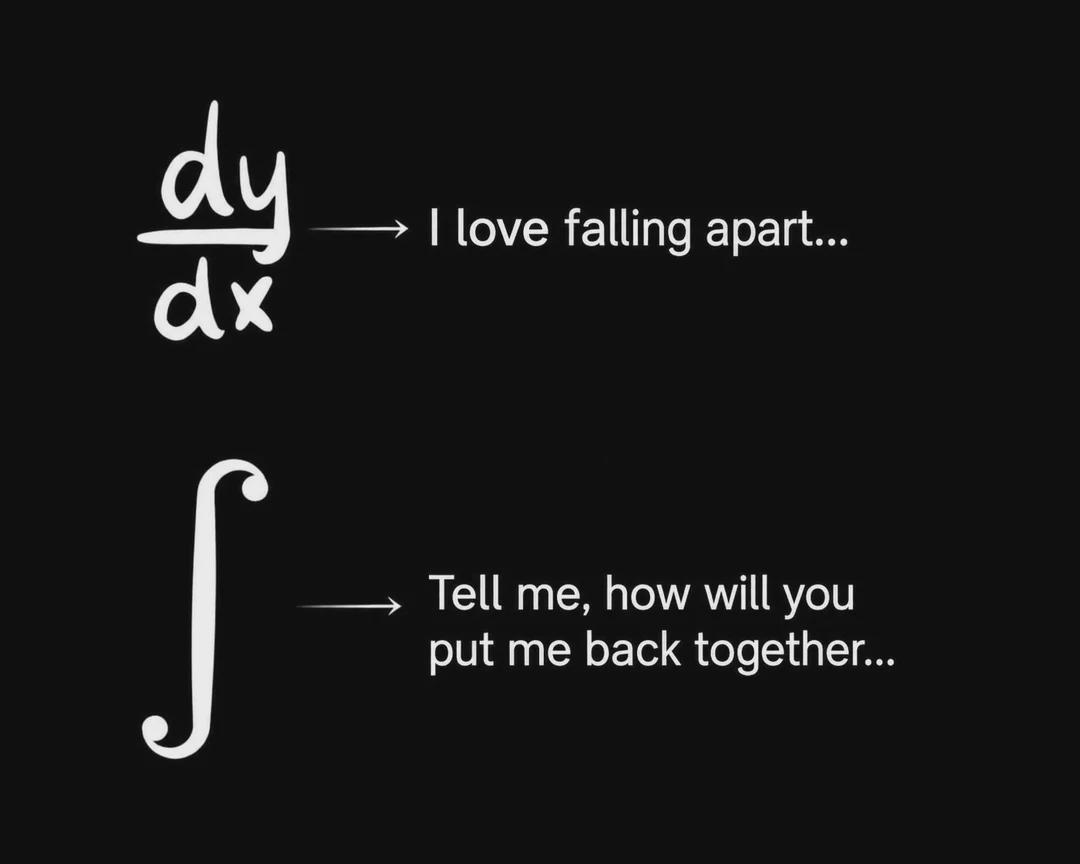
Someone just turned calculus notation into a breakup anthem and honestly, it's devastatingly accurate. The derivative dy/dx literally represents the rate of change—how fast y is changing with respect to x—so it's basically measuring how quickly things are falling apart. Very relatable for anyone who's ever watched their function (or relationship) differentiate into chaos. But then the integral ∫ swoops in with the existential question: how do we reverse this process? Integration is the inverse operation of differentiation, so if dy/dx represents things breaking down, then ∫ should theoretically piece everything back together. Except anyone who's tried to solve an integral knows it's WAY harder than taking a derivative. Sometimes there's no closed-form solution. Sometimes you need numerical methods. Sometimes you just cry and use Wolfram Alpha. The emotional weight here is chef's kiss because integration doesn't always give you back what you started with—you get that pesky constant of integration (+C) that represents all the information lost during differentiation. So even if you DO manage to integrate, you're never quite whole again. Mathematics really said "let me give you trust issues."

The Horror

The Horror
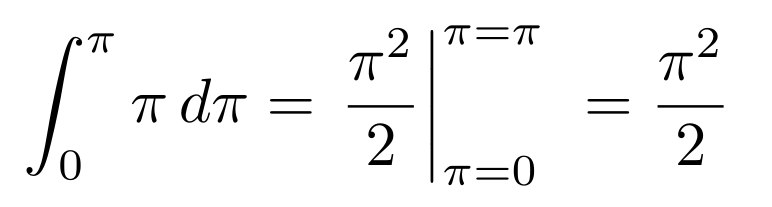
When you integrate a constant and get the right answer, but then you remember you're supposed to evaluate it at the bounds. The integral of π from 0 to π is just π², which gives you π²/2. But wait—evaluate at the bounds and you get... π²/2 - 0 = π²/2. The same answer. The horror is that you did all that work setting up the integral notation, writing out the bounds, doing the evaluation ritual... only to realize you were just multiplying π by π the entire time. Could've saved yourself 30 seconds and a line of work. Every math student has been here, staring at their paper, wondering why they're like this.

The Hands-On Approach To Calculus

The Hands-On Approach To Calculus
Who needs triple integrals when you've got an axe? While professors drone on about disk methods and shells, real calculus students are out here solving volume problems with pure brute force. "If I split this cube into enough tiny pieces, eventually one of them will give me the right answer!" Nothing says "I understand calculus" like turning a mathematical operation into a woodworking project. Next up: finding derivatives by aggressively drawing tangent lines with a chainsaw.

Mathematical Mistakes Have Consequences

Mathematical Mistakes Have Consequences
Mathematical mistakes as animal cruelty. That's a new one for the ethics committee. Someone's professor clearly got tired of students making common calculus errors. The logarithm product rule, inverse trigonometric functions, and basic integration - all weaponized with cute animals as collateral damage. Next time you write ln(a+b)=ln(a)+ln(b), just remember you're personally responsible for feline genocide. No pressure.

Where Is Dx, I Am Scared

Where Is Dx, I Am Scared
The calculus student's nightmare in mathematical form! This equation is missing the dreaded "dx" term needed to complete the integral. It's like showing up to the final exam and realizing you forgot your calculator, pants, and will to live. The equation itself is some physics monstrosity involving magnetic permeability (μ₀) and what appears to be a force calculation, but without that crucial "dx" differential element, it's mathematically incomplete. Just like my coffee mug that says "I differentiate, therefore I integrate... usually."

When Integration Turns Traumatic

When Integration Turns Traumatic
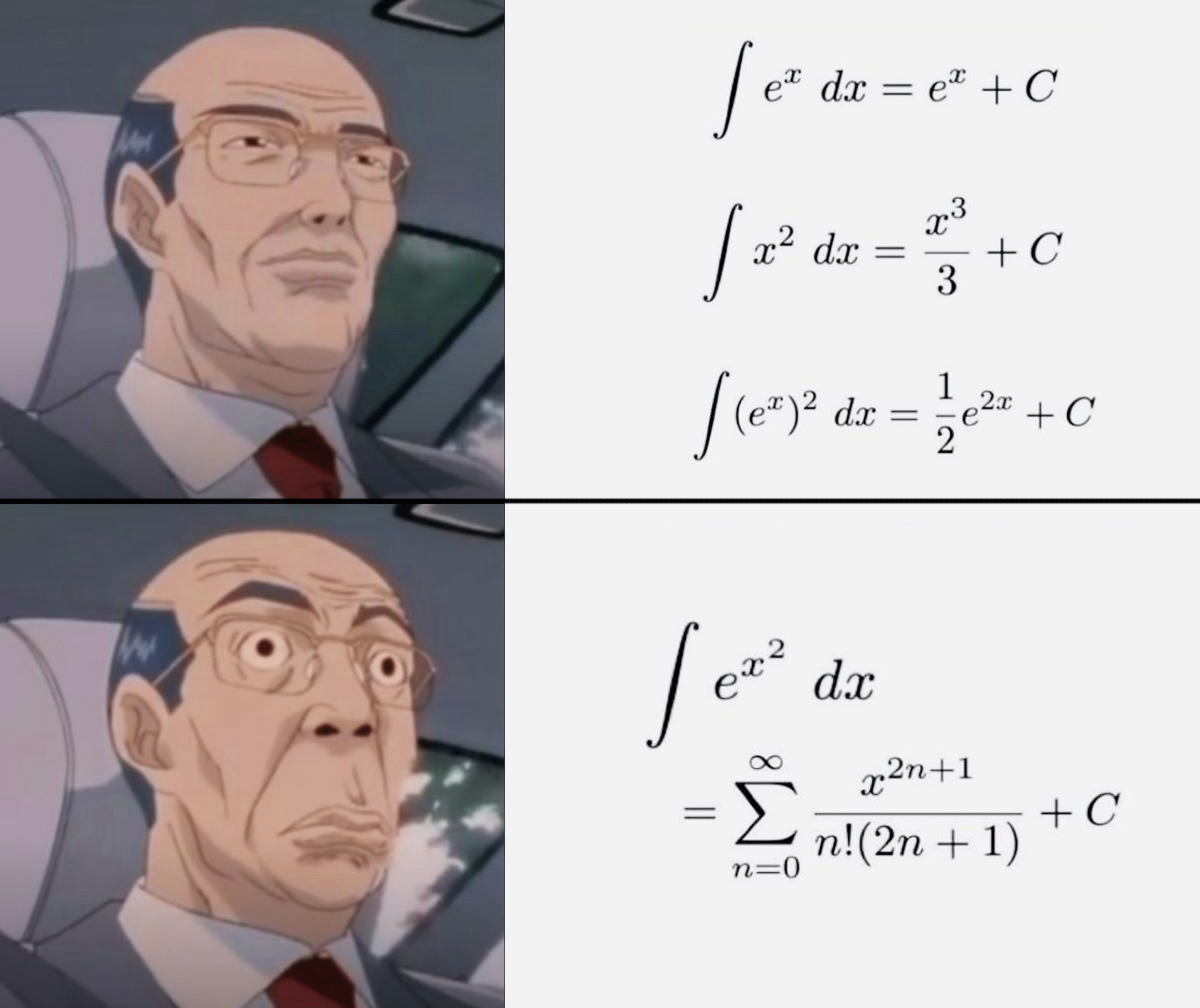
The first three integrals? Simple, elegant, textbook solutions. The fourth one? Pure mathematical chaos. That's the Gaussian integral for you—no elementary function can express it, just an infinite series that makes mathematicians wake up in cold sweats. It's like expecting to solve a simple equation and suddenly being asked to explain why your lab budget tripled last quarter. The face says it all: math was going so well until it wasn't.

Funky Arc Length

Funky Arc Length
The mathematical journey from simple to absolutely horrifying in four panels. First, our protagonist confidently handles a straightforward line equation with √(1+a²)x. "Yeah, that makes sense!" Second panel shows arcsin(x) with a semicircle graph. Still manageable. "Yeah, I can see that." Then panel three hits with the mathematical equivalent of a jump scare: x√(1+4x²)/2 + (1/4)ln(|√(1+4x²)+2x|). The character's expression says it all before we get to the final panel's existential crisis and profanity. Fun fact: This is actually showing different forms of calculating arc length for various functions, getting progressively more nightmarish. It's the calculus equivalent of starting with "hello" in a foreign language and suddenly being asked to negotiate international trade agreements.