

Integrals Memes

Posts tagged with Integrals
Hail Riemann

Hail Riemann
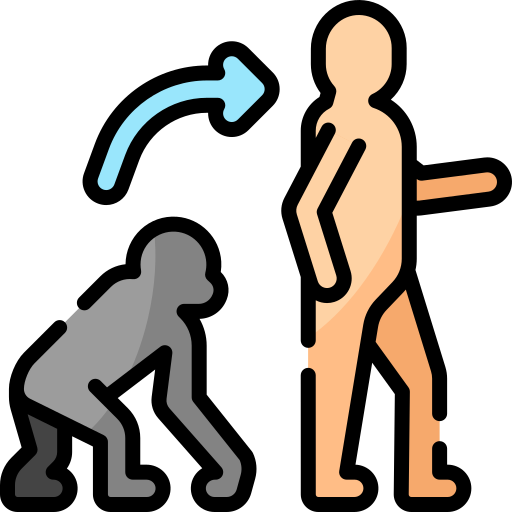
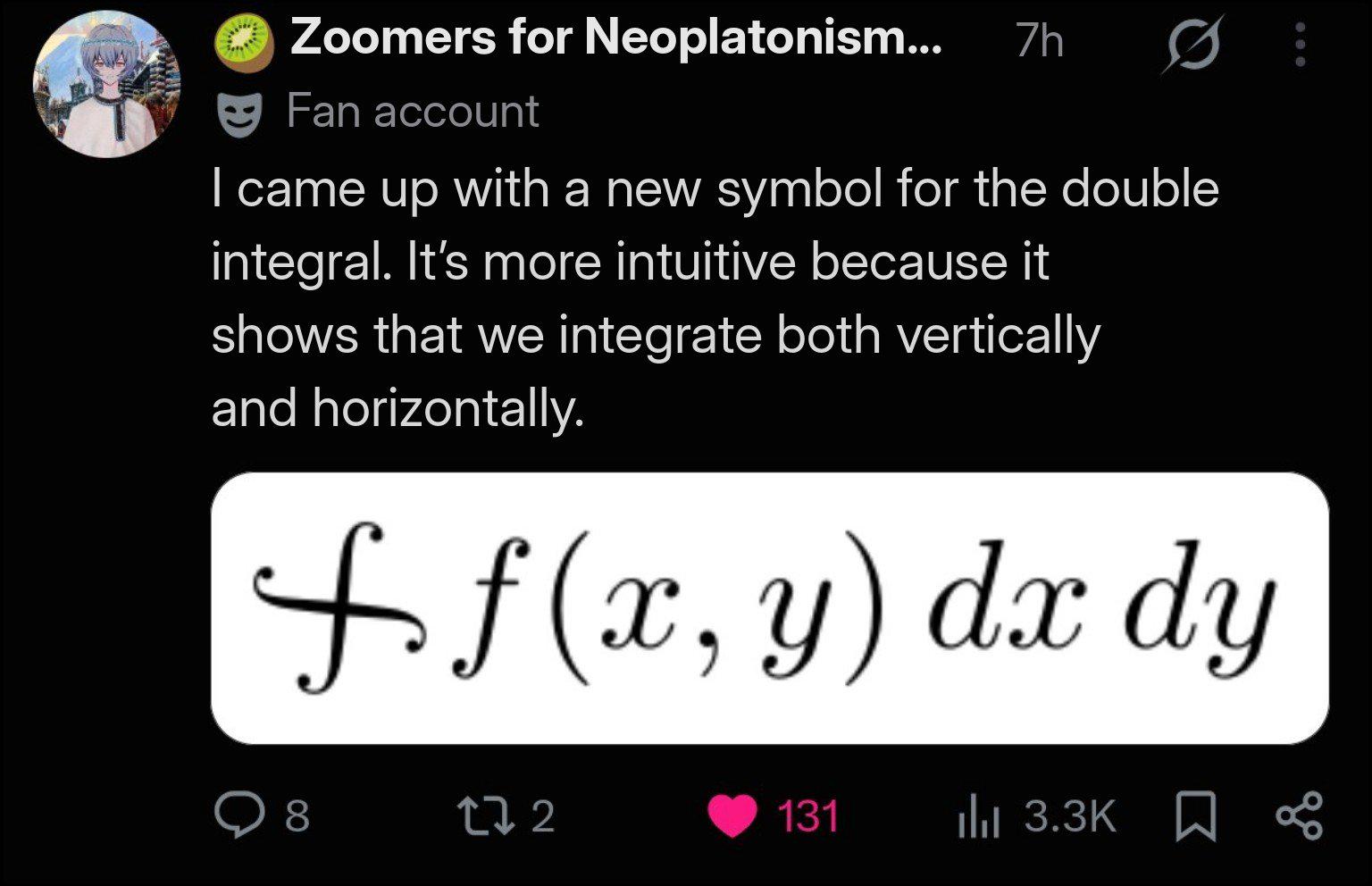
Someone just invented the mathematical equivalent of a swastika. You know what's beautiful? They're claiming this "intuitive" symbol for double integrals is better because it shows both directions of integration... but buddy, that's literally just writing two integral signs next to each other with extra steps and a weird cursive flex. The double integral symbol ∬ has been doing its job perfectly fine for centuries, thank you very much. It doesn't need to be "more intuitive" – if you're at the level where you're computing double integrals, you already know what's happening. This is like saying we should redesign the plus sign because it doesn't show that addition works left-to-right AND right-to-left. Riemann is somewhere in mathematician heaven facepalming so hard right now. Next they'll want to make the summation symbol Σ into a little staircase to show we're "adding up steps." Please, no.

The Power Of Maths

The Power Of Maths
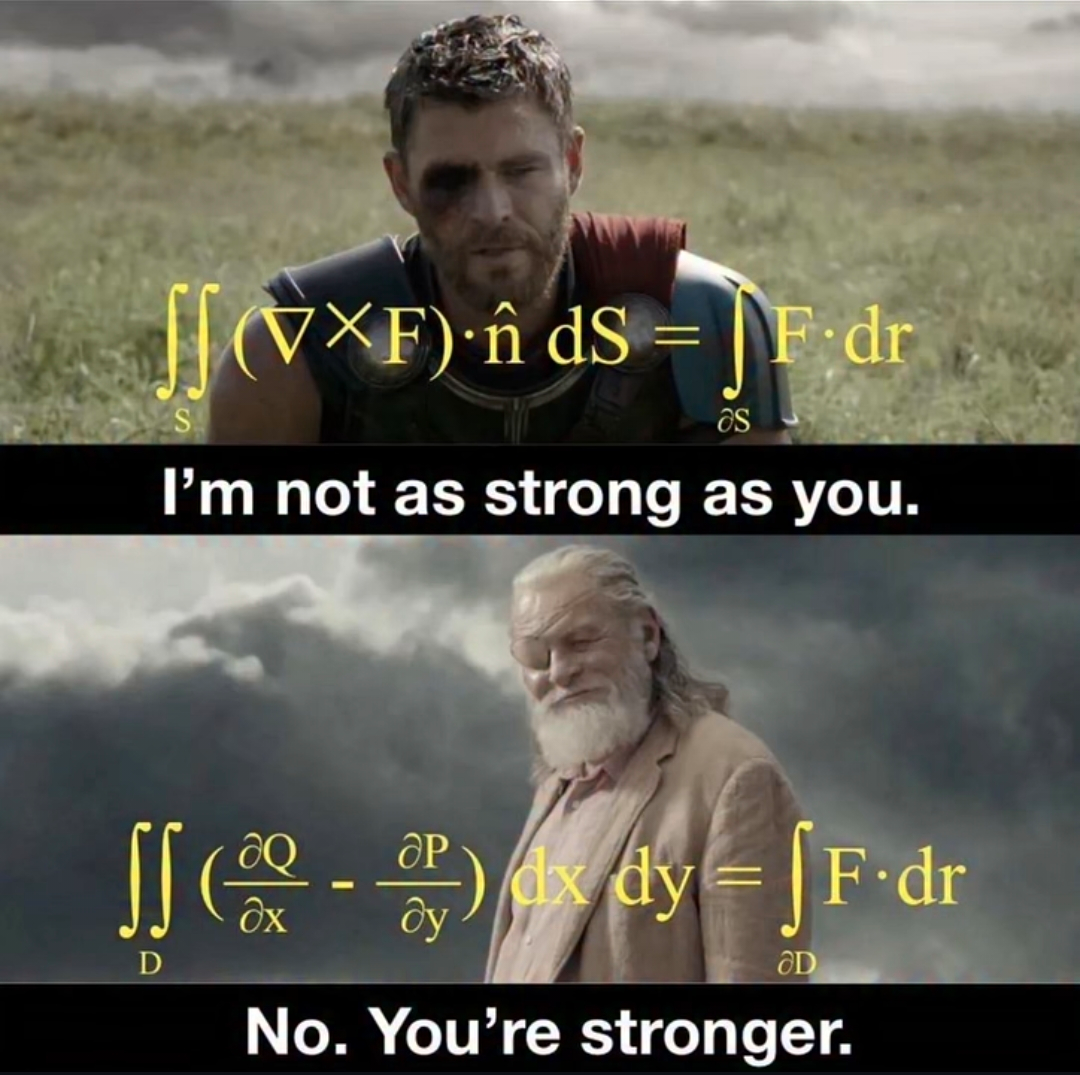
Plot twist: different paths, same destination! The top equation uses Stokes' theorem (converting a surface integral of a curl into a line integral), while the bottom one flexes with Green's theorem (converting a double integral into a line integral). Both end up at the exact same answer, but one route looks like it bench presses textbooks for fun. It's like taking the highway versus the scenic mountain route—you still get to grandma's house, but one driver's gonna be way more smug about it. Mathematics really said "there are multiple ways to suffer through vector calculus" and called it elegance. The real strength here? Knowing that both theorems are basically mathematical siblings who refuse to admit they're doing the same job.

Yes

Yes
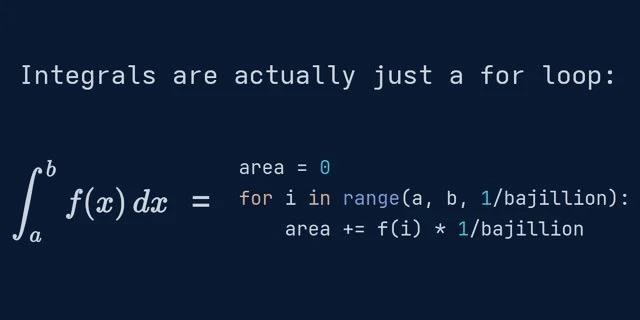
Every calculus student eventually has that existential crisis moment when they realize integration is literally just fancy addition with extra steps. You spend weeks learning all these elegant techniques—u-substitution, integration by parts, trig substitution—only to discover your computer's been doing it the caveman way all along: chop the area into a bajillion tiny rectangles and add them up. The mathematical equivalent of using a sledgehammer when you thought you needed a scalpel. Sure, the analytical solution is beautiful and exact, but the computer's sitting there like "why waste time derive lot formula when small rectangle do trick?" And honestly? It works. Numerical integration doesn't care about your feelings or your fancy antiderivatives.

Who The Hell Was Responsible For Naming Displacement Integrals?

Who The Hell Was Responsible For Naming Displacement Integrals?
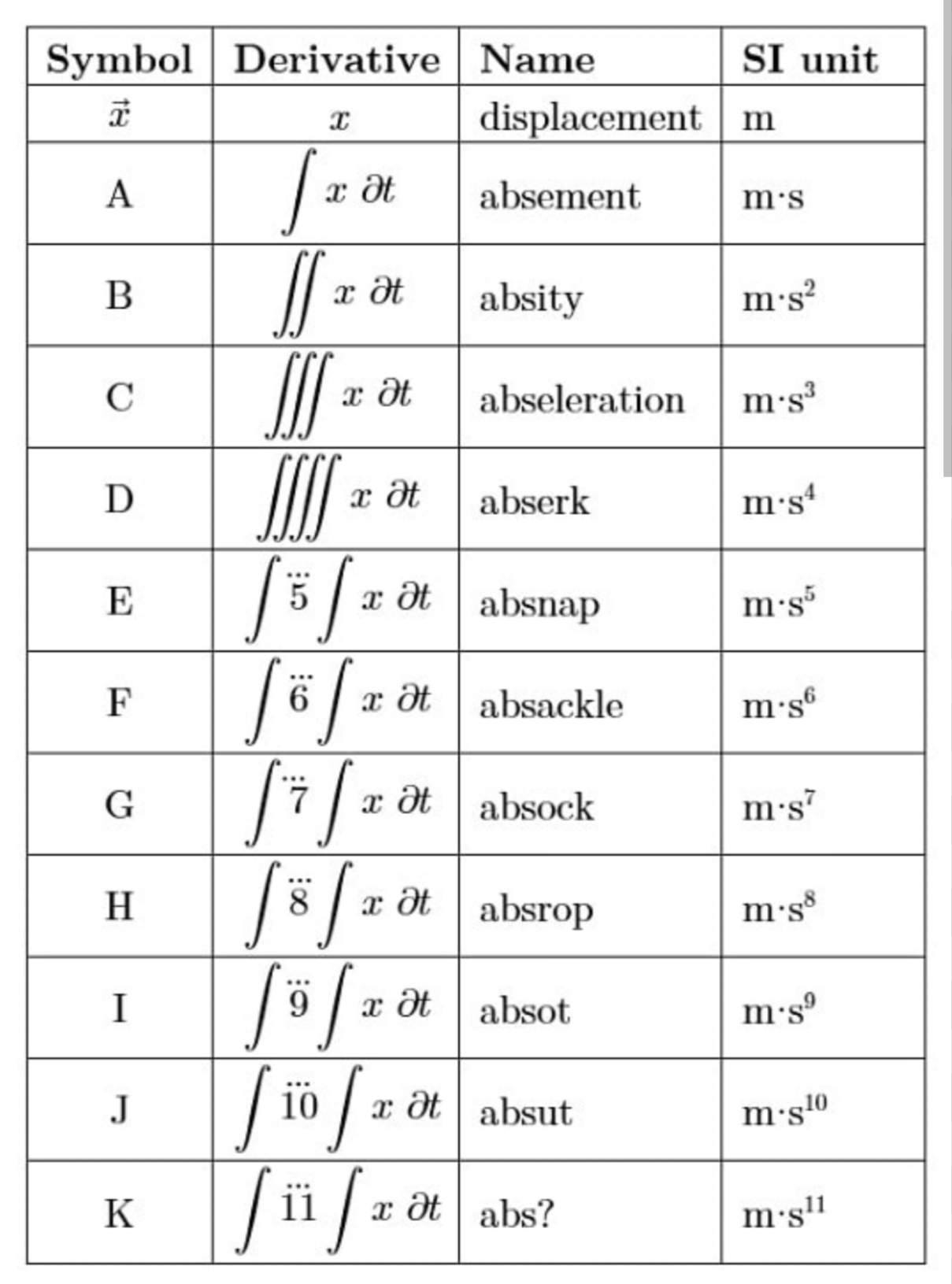
Some physicist clearly had way too much fun with this nomenclature. Starting with displacement and its integral being "absement" (absence of displacement, get it?), they just kept going: absity, abseleration, abserk, absnap, absackle, absock, absrop, absot, absut... and by the 11th integral they just gave up and wrote "abs?" Honestly, can't blame them. If you're integrating displacement ELEVEN times, you've either discovered something profound about the universe or you're just procrastinating on your actual research. These higher-order integrals have approximately zero practical applications—nobody's out here measuring absackle in their experiments. The real tragedy? Someone sat down and systematically named these abominations all the way to the 10th integral before their brain finally short-circuited. That's dedication to a bit. Or madness. Probably both.

For Those Who Were Asking For Translation...

For Those Who Were Asking For Translation...
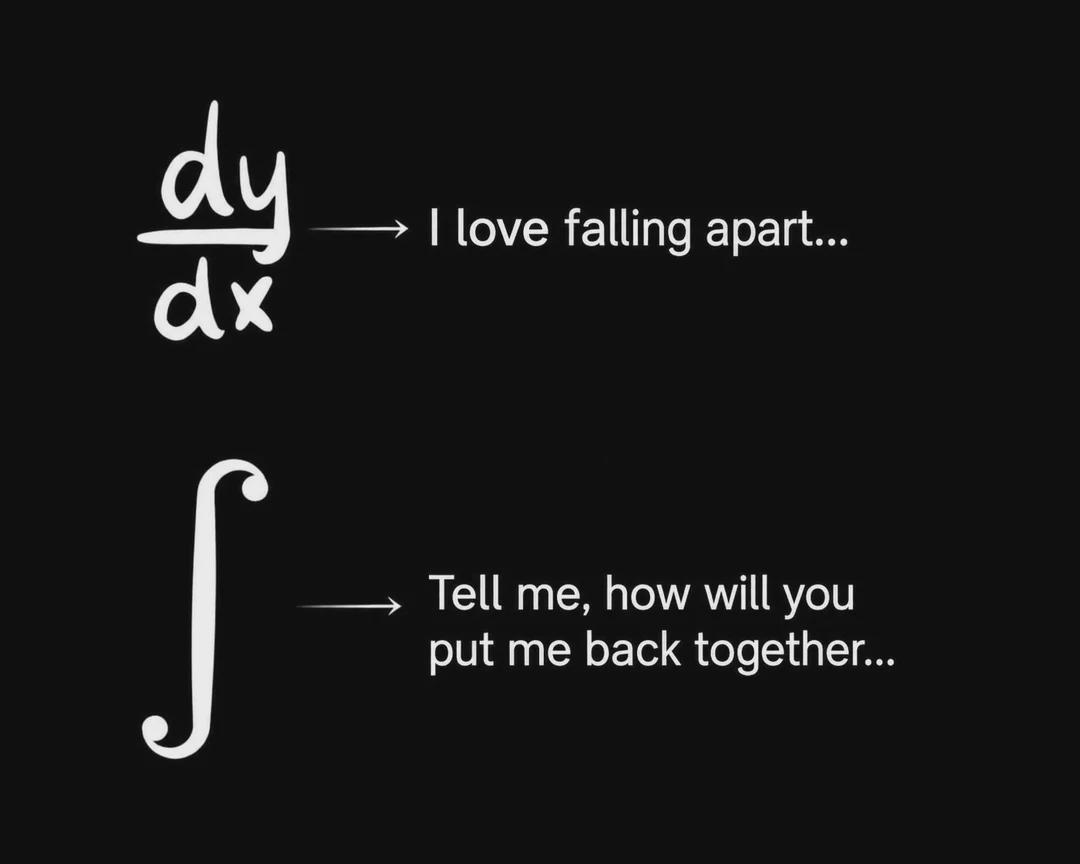
Someone just turned calculus notation into a breakup anthem and honestly, it's devastatingly accurate. The derivative dy/dx literally represents the rate of change—how fast y is changing with respect to x—so it's basically measuring how quickly things are falling apart. Very relatable for anyone who's ever watched their function (or relationship) differentiate into chaos. But then the integral ∫ swoops in with the existential question: how do we reverse this process? Integration is the inverse operation of differentiation, so if dy/dx represents things breaking down, then ∫ should theoretically piece everything back together. Except anyone who's tried to solve an integral knows it's WAY harder than taking a derivative. Sometimes there's no closed-form solution. Sometimes you need numerical methods. Sometimes you just cry and use Wolfram Alpha. The emotional weight here is chef's kiss because integration doesn't always give you back what you started with—you get that pesky constant of integration (+C) that represents all the information lost during differentiation. So even if you DO manage to integrate, you're never quite whole again. Mathematics really said "let me give you trust issues."

The Ellipse Equation Emotional Rollercoaster

The Ellipse Equation Emotional Rollercoaster
The pure joy of calculating an ellipse's area (πab, so elegant!) vs the absolute HORROR of trying to compute its circumference with that nightmare integral! Every math student knows this pain. The simple formula gives you that beautiful smile, but then the circumference equation shows up and suddenly you're questioning all your life choices. Even mathematicians avoid that integral like it's finals week!

Which One Are You: The Integral Identity Crisis

Which One Are You: The Integral Identity Crisis
The eternal struggle of calculus students everywhere! The meme presents two nearly identical integrals with a subtle yet crucial difference in notation. It's basically asking if you're the type who writes "∫(dx/...)" or "∫(1/...)dx" - which is like asking if you put milk before cereal or cereal before milk, but for math nerds. The pointing fingers suggest there's a clear "correct" choice, but mathematicians will argue about notation until the heat death of the universe. Your integral notation preference probably says more about your personality than your zodiac sign.

The Eternal Mathematical Bait-And-Switch

The Eternal Mathematical Bait-And-Switch
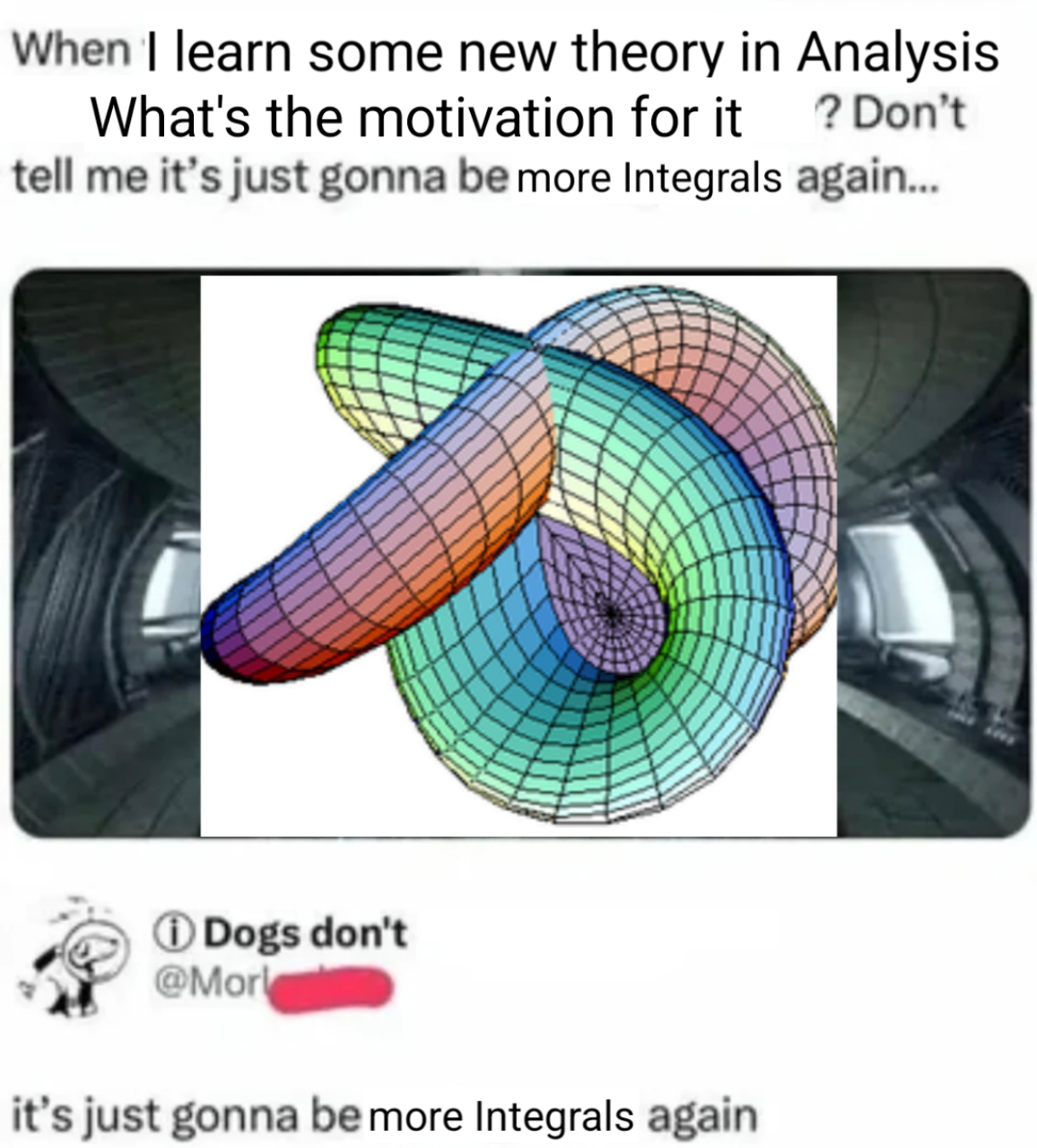
Math students everywhere feel the pain! You excitedly dive into a new mathematical theory hoping for something revolutionary, only to discover it's yet another way to calculate integrals. The colorful 3D shape represents some fancy new technique that professors introduce with great enthusiasm, but deep down, it's just calculus wearing a party hat. The eternal mathematical bait-and-switch where "exciting new approaches" always circle back to integration. Group theory students just want to study their beautiful abstract structures in peace without everything turning into another integration exercise!

The Bell Curve Of Mathematical Understanding

The Bell Curve Of Mathematical Understanding
The bell curve of mathematical understanding strikes again! In the middle, we have the screaming purist who understands that integrals and infinite sums are fundamentally different mathematical constructs (despite their connections). Meanwhile, at both tails of the distribution, we find the "geniuses" who confidently declare they're the same thing. This is the mathematical equivalent of watching someone put pineapple on pizza – technically possible, but it'll make certain people lose their minds. The beauty here is that both the clueless beginners and the advanced mathematicians reach the same conclusion, just for wildly different reasons. One through ignorance, the other through some esoteric measure theory that the rest of us mere mortals will never comprehend.

What A Harmless Integral

What A Harmless Integral
Professor: "The test will be easy." The test: Find the integral of square root of cosine x from 0 to 1 EXACTLY. That's like saying "This swimming pool is shallow" and then dropping you into the Mariana Trench. This integral is the mathematical equivalent of trying to fold a fitted sheet—theoretically possible but will leave you questioning your life choices. No standard substitution works here. You'll need special functions, possibly a sacrifice to the math gods, and therapy afterward. Even Wolfram Alpha is silently judging you for attempting this.

The Generalized Doakes Theorem Of Mathematical Despair

The Generalized Doakes Theorem Of Mathematical Despair
Ever stared at a math problem for hours and just KNEW the answer but couldn't get there? That's the Generalized Doakes Theorem in action! 😂 This mathematical masterpiece shows that the integral of disappointment equals the integral of partial disappointment. The faces are basically every mathematician's journey from "I've got this!" to "What have I done with my life?" Pure genius for anyone who's ever written "proof left as an exercise for the reader" when they actually had no clue how to finish it!

Integral Utopia: The Mathematical Dream

Integral Utopia: The Mathematical Dream
The futuristic utopia depicted is what mathematicians dream about at night! While derivatives are the "downhill skiing" of calculus (just follow the rules and zoom to the answer), integrals are like solving a puzzle where someone hid half the pieces. Every math student knows that heart-stopping moment when you see ∫ on an exam and suddenly forget every integration technique you've ever learned. The meme brilliantly suggests we'd have flying cities and advanced civilization if integration was as straightforward as differentiation. Imagine skipping all those hours of substitution methods, integration by parts, and those awful partial fractions!