

Geometry Memes

Posts tagged with Geometry
Brain Breaking Looking At This

Brain Breaking Looking At This
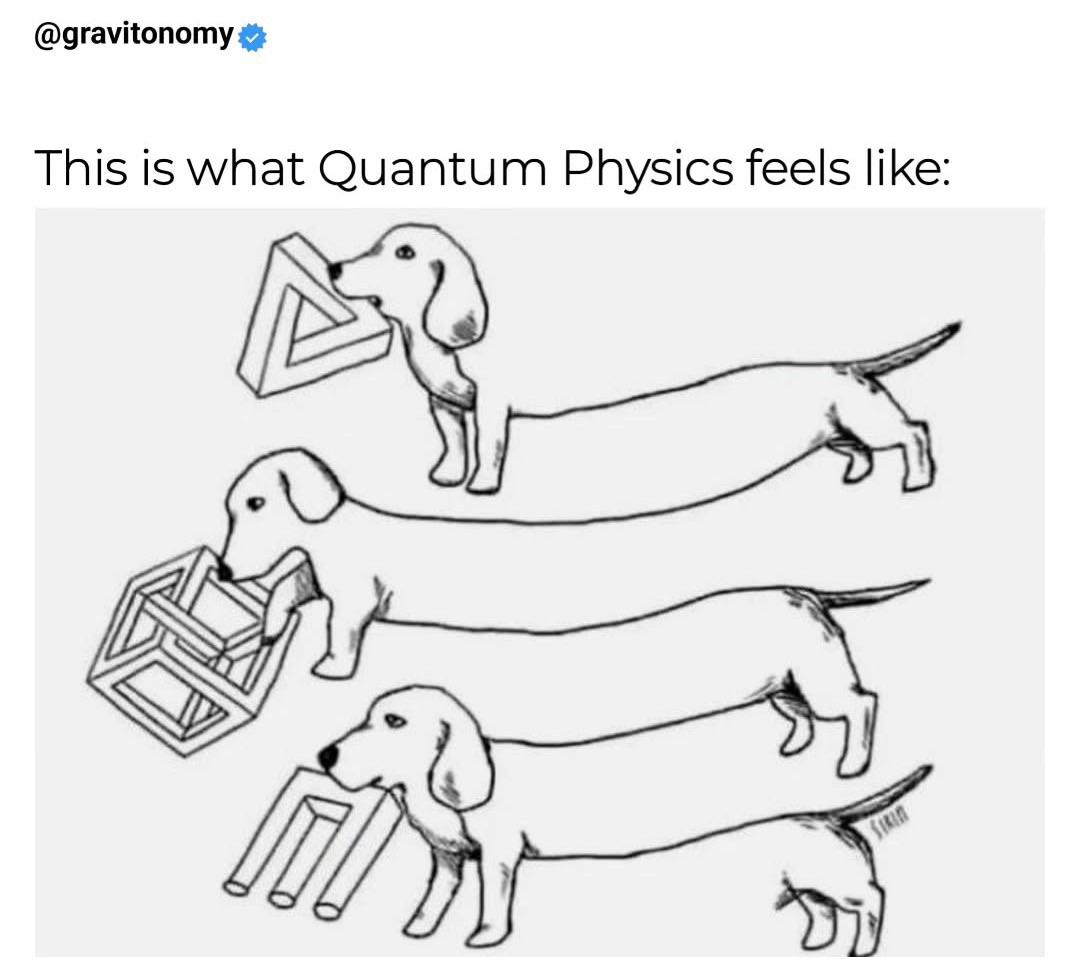
Three dachshunds, three impossible objects, one perfect metaphor. The dogs are carrying the Penrose triangle, an impossible cube, and another geometrically paradoxical structure—all of which can exist on paper but would make a 3D printer have an existential crisis. Quantum physics operates on similar brain-melting principles: particles can be in two places at once (superposition), affect each other instantly across vast distances (entanglement), and generally refuse to follow the common-sense rules that govern our everyday world. Just like these impossible objects look fine from one angle but fall apart when you try to construct them in reality, quantum mechanics works mathematically but defies our intuitive understanding of how things should behave. The dachshunds themselves are perfect for this—their impossibly long bodies already look like someone stretched the dog blueprint beyond reasonable limits. They're just casually trotting along with geometric impossibilities like it's no big deal, which is exactly how quantum physicists present wave-particle duality at conferences while everyone else's brain quietly leaks out their ears.

Fibonacci Week

Fibonacci Week
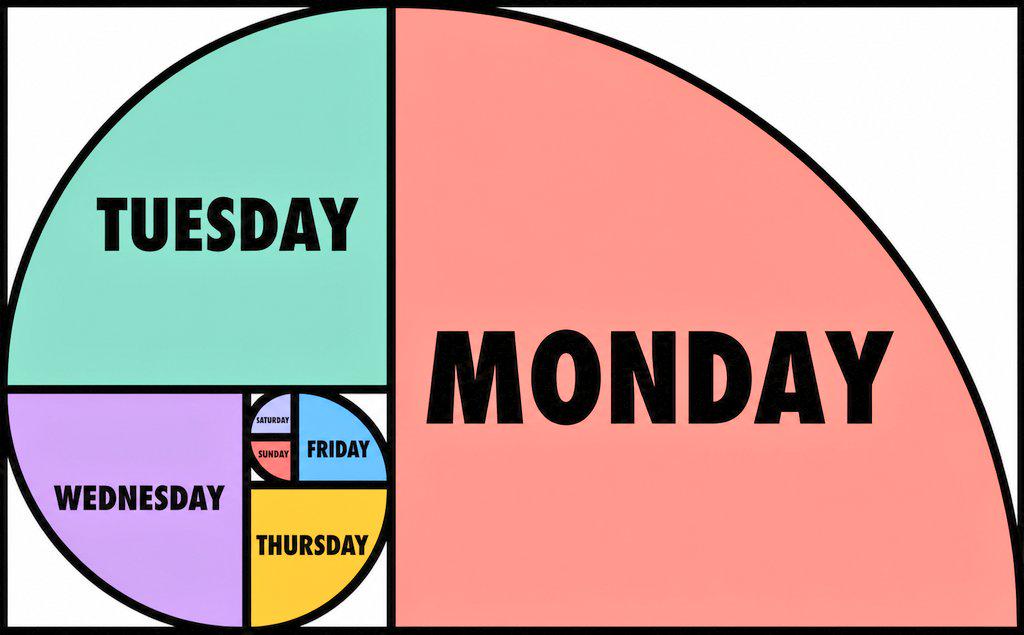
Someone just visualized how the week actually feels using the Fibonacci spiral, and honestly? The math checks out. Monday dominates like it's the final boss of weekdays, swallowing up most of your emotional bandwidth. Tuesday gets a decent chunk because you're still recovering from Monday's existential dread. By Wednesday, you're in survival mode with a modest square. Thursday and Friday are squeezed into progressively tinier spaces as you coast toward the weekend. Saturday and Sunday? Basically quantum-sized—they exist in theory but vanish before you can measure them. The Fibonacci sequence (1, 1, 2, 3, 5, 8, 13...) appears everywhere in nature—sunflower seeds, nautilus shells, galaxy spirals—but apparently also in our collective weekday suffering. Each number is the sum of the previous two, creating that iconic golden spiral. Turns out it's not just for pinecones and Renaissance paintings; it's also the perfect mathematical model for why Mondays feel like they last approximately 47 hours.

Gauss Wished To Communicate With Aliens

Gauss Wished To Communicate With Aliens
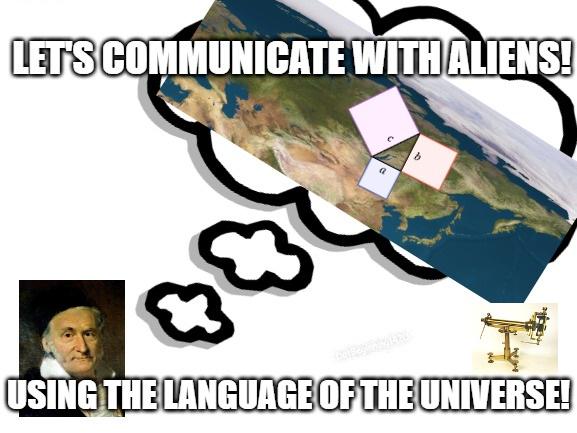
Carl Friedrich Gauss really said "let's just plant massive geometric forests visible from space" because he figured any intelligent aliens would recognize the Pythagorean theorem. The dude wanted to carve GIANT triangles into Siberia to prove we're not total idiots down here. Because nothing says "we're advanced" like deforestation in the shape of math proofs, right? The beauty here is that Gauss genuinely believed mathematics was the universal language—transcending culture, species, and planetary origin. And honestly? He wasn't wrong. While we're out here arguing about metric vs imperial, math stays consistent whether you're in Germany or the Andromeda galaxy. His plan was basically cosmic show-and-tell with geometry. Too bad the project never happened—probably for the best since aliens would've just seen it and thought "oh great, another species obsessed with right angles." 📐👽

Topologists Will Look At This And Say It Is A Donut With No Hole

Topologists Will Look At This And Say It Is A Donut With No Hole
Topologists are the mad lads of mathematics who think a coffee mug and a donut are literally the same thing. Why? Because both have exactly ONE hole (the handle loop = the donut hole). They study shapes based on what you can squish, stretch, and morph without tearing or gluing. But here's where it gets bonkers: someone designed a mug where the handle connects BACK to the base, creating a continuous loop. To us normies, it's just a fancy mug with a weird handle. To a topologist? It's a sphere. Zero holes. Topologically equivalent to a ball. They've basically removed the "mug-ness" by closing that loop! So yeah, topologists would look at your morning coffee vessel and be like "that's not even a mug anymore, that's just a sphere with a depression." Meanwhile, you're just trying to drink your coffee and wondering why mathematicians are like this.

Spherical Geometry

Spherical Geometry
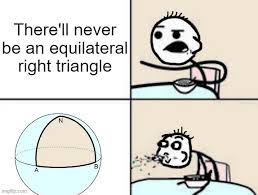
Euclidean geometry walks into a bar and confidently declares that equilateral right triangles are impossible. Then spherical geometry enters the chat. On a sphere's surface, you can absolutely construct a triangle with three 90-degree angles—just take three great circle arcs connecting the poles to equator points. Each corner? A perfect right angle. Euclidean geometry's smug certainty gets obliterated faster than a grad student's confidence during their first committee meeting. The beauty here is that on curved surfaces, all those rules you memorized in high school geometry become adorably quaint suggestions. Triangle angles summing to 180°? Not on my spherical watch. Parallel lines never meeting? Try again. It's like discovering your entire mathematical childhood was a lie, but in the most geometrically satisfying way possible.

All Represents A Circle

All Represents A Circle
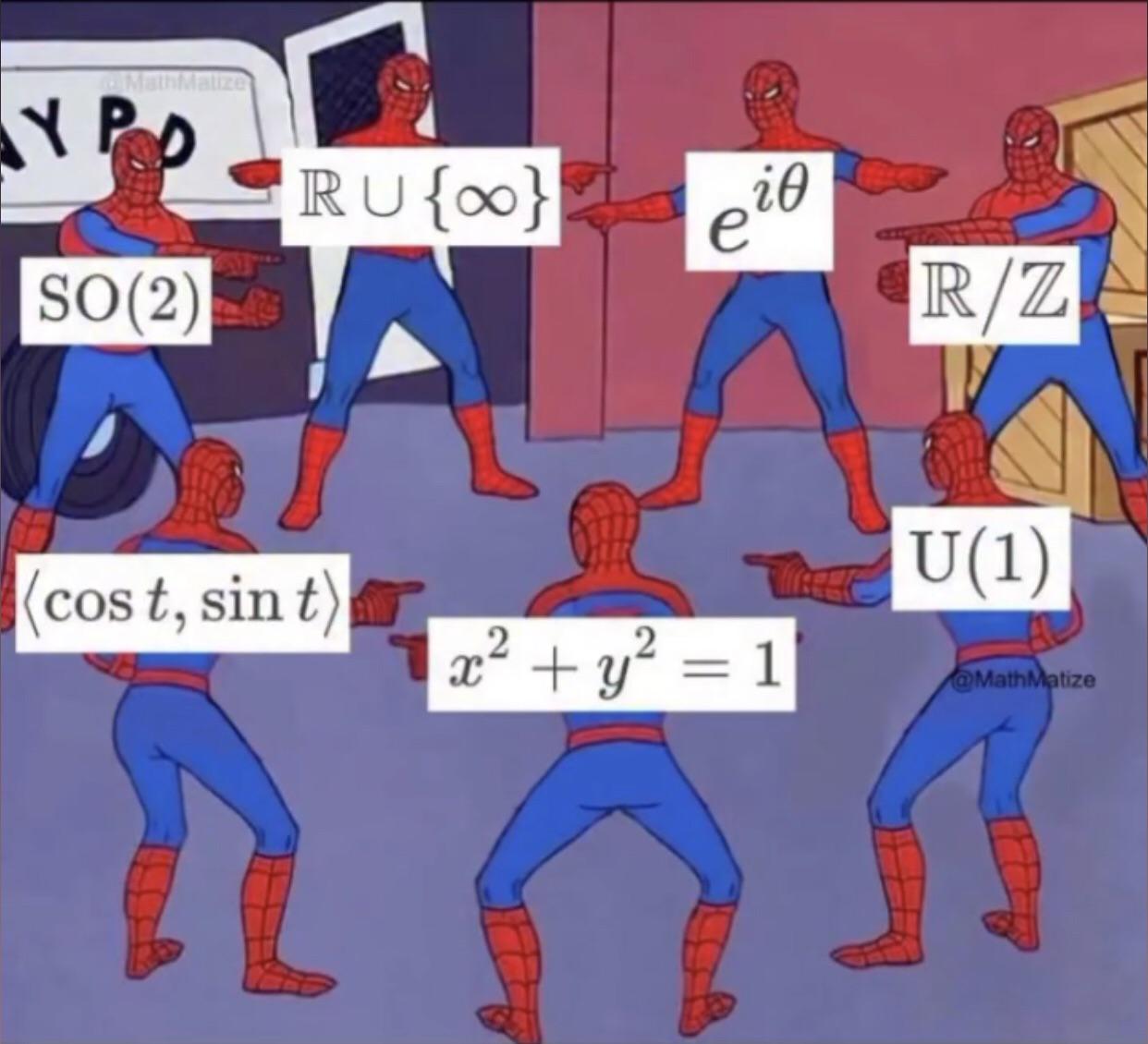
Six different mathematical representations of a circle walk into a bar, and they're all pointing at each other like "you're me!" The classic equation x² + y² = 1 is the unit circle everyone learns in algebra, while SO(2) is the special orthogonal group representing rotations in 2D space. Then we've got the parametric form ⟨cos t, sin t⟩ tracing out that perfect loop, and e^(iθ) is Euler's formula doing its complex plane magic. R∪{∞} is the Riemann sphere (one-point compactification), and U(1) is the unitary group of complex numbers with magnitude 1. What's beautiful here is that these aren't just similar—they're literally isomorphic to each other. Whether you're doing geometry, topology, group theory, or complex analysis, you keep bumping into the same circular structure wearing different mathematical outfits. It's like discovering your coworker from accounting is also in your kickboxing class, your book club, AND your D&D campaign. The circle is basically the most popular kid in mathematics, showing up everywhere from Fourier transforms to quantum mechanics.

You're The Only Point I Want In My Neighborhood

You're The Only Point I Want In My Neighborhood
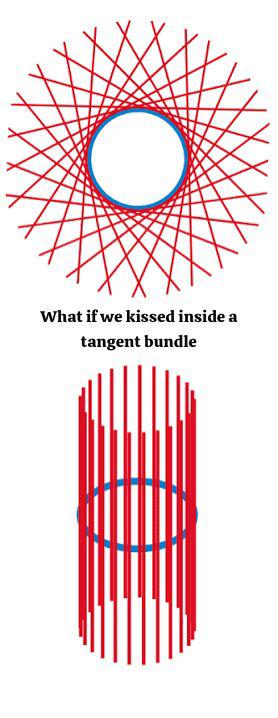
This is honestly the most romantic thing topology has ever produced. We're looking at a tangent bundle—basically a collection of tangent vectors at every point on a circle—getting all cozy and intimate. In the first image, you've got tangent lines shooting out from every point on the circle like some mathematical firework display. Each line is just barely touching the circle at exactly one point. But then someone had the brilliant idea: "What if we kissed inside a tangent bundle?" 💋 The result? Pure mathematical magic. When you bring all those tangent spaces together and look at them from the right angle, they form a cylinder! Two circles just vibing in parallel, connected by all those vertical lines. It's like the tangent bundle said "let me show you my true form" and transformed into something way more elegant. The title hits different too—in topology, a "neighborhood" is literally the set of points around a given point. So this is basically saying "you're the only point I care about in my entire mathematical space." Peak nerd romance right there.

Where Y

Where Y
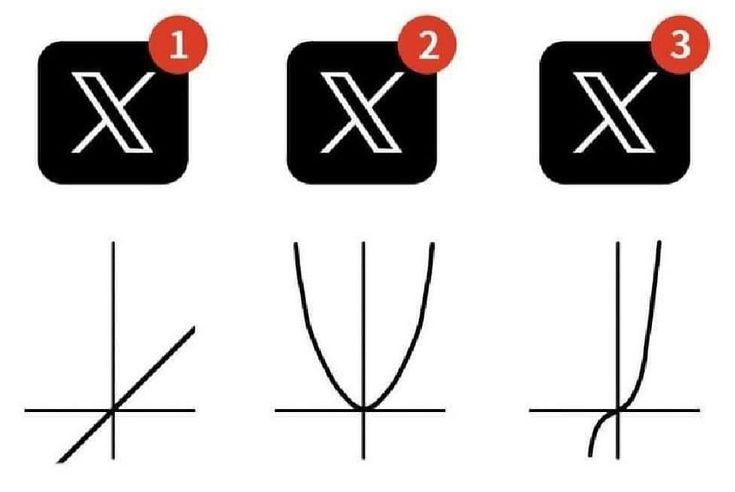
You've got three X notifications staring you down, and naturally your brain goes: "But where's the Y-axis?" Classic mathematician move right there. Each notification shows an X, and below them are different graph shapes that look suspiciously like they're missing their vertical buddy. It's like your coordinate system is having an identity crisis—one axis showed up to the party but forgot to bring its perpendicular friend. The pun works on two levels: you're literally asking where the Y-axis is on these graphs, AND you're questioning why you have so many X notifications. Mathematics meets social media anxiety in the most geometrically confusing way possible.

The Ellipse Equation Emotional Rollercoaster

The Ellipse Equation Emotional Rollercoaster
The pure joy of calculating an ellipse's area (πab, so elegant!) vs the absolute HORROR of trying to compute its circumference with that nightmare integral! Every math student knows this pain. The simple formula gives you that beautiful smile, but then the circumference equation shows up and suddenly you're questioning all your life choices. Even mathematicians avoid that integral like it's finals week!

The Pi-radox Of Intelligence

The Pi-radox Of Intelligence
The perfect mathematical horseshoe theory! On both extremes of the IQ bell curve, people casually dismiss π as "just some arbitrary constant," while the passionate middle-grounders are having a full-blown existential crisis about it. That tearful mathematician in the center knows the truth—π isn't just a number, it's the sacred ratio connecting diameter to circumference that appears mysteriously throughout nature! The mathematical equivalent of finding out Santa isn't real is realizing π can never be written as a simple fraction. The duality is *chef's kiss* perfect—the extremely low and high IQ folks accidentally reach the same conclusion through completely different paths of ignorance and transcendence!

Not A Coincidence, Just Engineering

Not A Coincidence, Just Engineering
Behold the humble Pringles chip—supposedly requiring supercomputers and a mathematical equation that looks like it could calculate interstellar trajectories! The meme shows the famous hyperbolic paraboloid shape (fancy term for "saddle") alongside its mathematical formula, making snack food sound like rocket science. Truth bomb: While Pringles ARE cleverly engineered to stack perfectly and minimize breakage, they didn't need NASA-level computing power. That mathematical equation? It's just showing off the saddle curve shape that happens to make your potato chips fit perfectly in their tube and your mouth! Next time someone asks what you're eating, just say "I'm consuming hyperbolic paraboloids" and watch their reaction!

What Even Is A Pentagonal Trapezohedron

What Even Is A Pentagonal Trapezohedron
The nerdiest of geometry jokes has entered the chat! This meme captures that special brand of disappointment when you realize the d10 (ten-sided die) in Dungeons & Dragons isn't actually a Platonic solid. It's a pentagonal trapezohedron—basically the geometric equivalent of finding out your favorite band isn't technically indie. For the uninitiated: Platonic solids are the geometric rock stars of 3D shapes—perfectly symmetrical polyhedra where all faces are identical regular polygons. There are exactly five (tetrahedron, cube, octahedron, dodecahedron, and icosahedron), and they're mathematical perfection. Meanwhile, the d10 is that weird cousin who didn't make the cut but still shows up to family reunions. The crushing disappointment in the last panels is pure mathematical heartbreak. Geometry nerds and DnD players unite in shared trauma!