

Epistemology Memes

Posts tagged with Epistemology
If She Thinks He Is Thinking About Others, Is He?

If She Thinks He Is Thinking About Others, Is He?
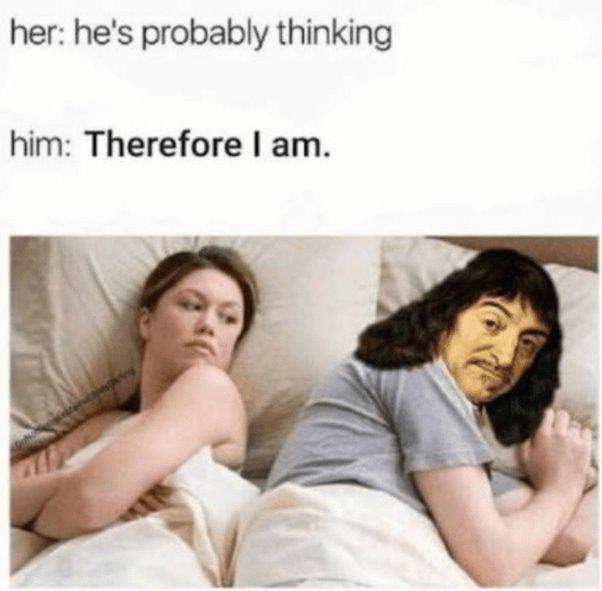
Descartes just rolled over in his grave... and then questioned whether he actually did. This brilliant philosophical mashup takes the classic "boyfriend thinking about other girls" meme format and slaps Descartes' famous "Cogito, ergo sum" right in the middle of relationship anxiety. She's worried he's contemplating other romantic interests, but plot twist—he's actually having an existential crisis about the nature of consciousness itself. Because nothing says "romance" quite like pondering whether your existence is validated through the act of thinking. The observer effect meets bedroom dynamics: does her thinking about his thinking make his thinking real? Or is he only thinking because she thinks he's thinking? Fun fact: Descartes developed his philosophy while lying in bed late into the mornings (he was famously lazy about getting up), so this meme is historically accurate in the weirdest way possible. The man literally philosophized his way through bed rest.

Problem Of Induction Meme

Problem Of Induction Meme
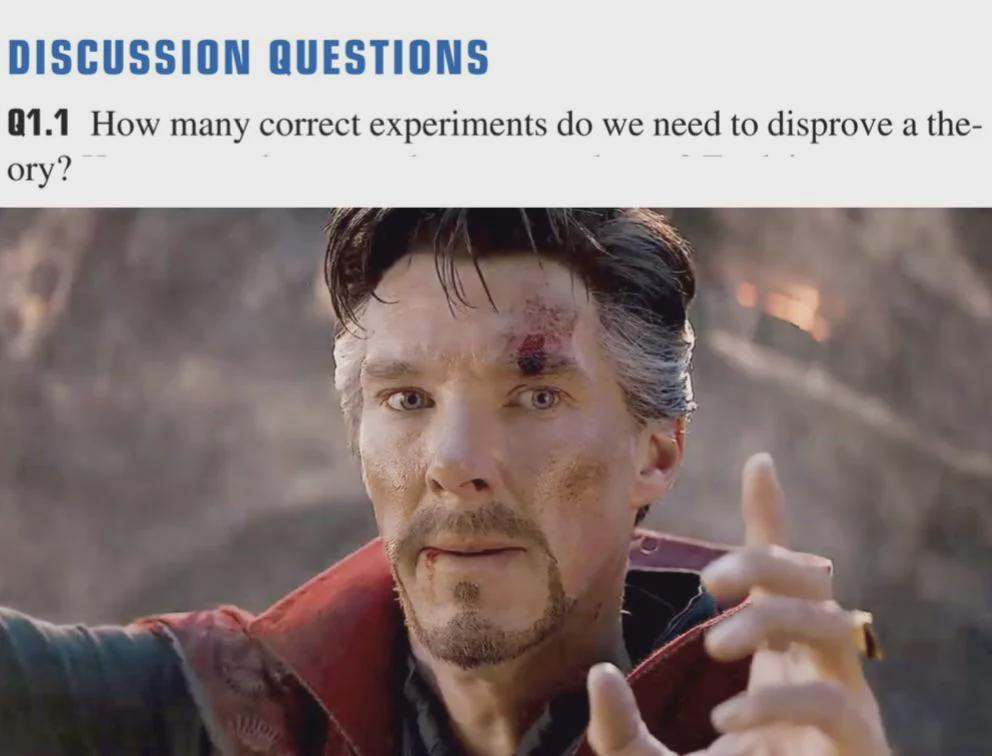
The beautiful irony here is that the question itself reveals a fundamental misunderstanding of how science works. You don't need multiple experiments to disprove a theory—you need exactly one that contradicts it. Meanwhile, you could run a million confirming experiments and still not "prove" the theory true, because that's the problem of induction David Hume warned us about centuries ago. The problem of induction is basically this: just because something has happened repeatedly in the past doesn't logically guarantee it'll happen in the future. The sun rose yesterday, today, and a billion times before, but that doesn't prove it'll rise tomorrow—we just have really strong inductive reasoning to believe it will. So the answer to Q1.1? One. Just one contradictory experiment can shatter a theory. But the student asking probably expects some large number, which is why Doctor Strange here is holding up that iconic finger like "buddy, we need to talk about falsification."

Our Understanding Of The Physical World Is So Fragile. Thanks Hume. Now I Have Anxiety

Our Understanding Of The Physical World Is So Fragile. Thanks Hume. Now I Have Anxiety
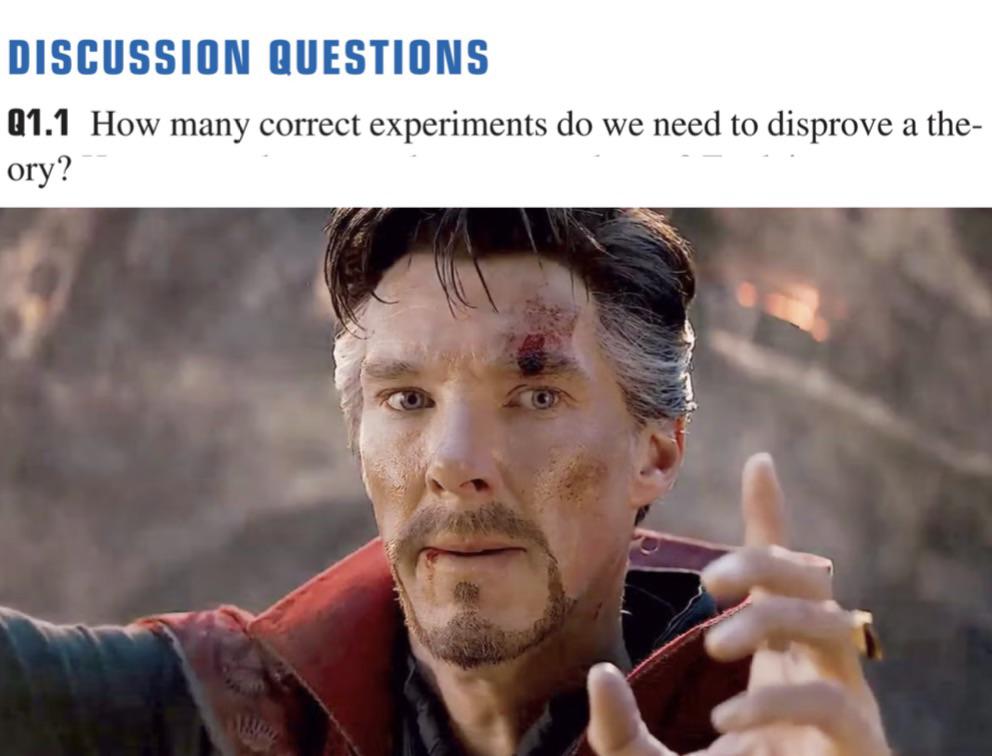
David Hume really woke up one day and said "hey, you know how you think the sun will rise tomorrow because it always has? Yeah, you can't actually prove that." And scientists have been having existential crises ever since. The brutal truth is that it only takes ONE experiment to completely demolish a theory, but you could run a million successful experiments and still not prove it's universally true. You're just building confidence on a foundation of "well, it hasn't failed YET." This is the problem of induction that keeps philosophers of science up at night. We assume nature follows consistent patterns, but that assumption itself can't be proven—it's just something we kinda have to accept to do science at all. Doctor Strange here holding up one finger perfectly captures that sinking feeling when you realize your entire understanding of reality is built on observations that could theoretically be wrong tomorrow. Sleep tight!

The Four Stages Of Physics Enlightenment

The Four Stages Of Physics Enlightenment
The four stages of physics enlightenment! First, your dim brain thinks physics isn't real (probably after failing that first exam). Then your neurons start firing and you declare "physics IS reality" with the confidence of someone who just discovered coffee. But wait! Your third-eye opens to realize physics is merely modeling reality—like trying to explain your weird uncle with a flowchart. Finally, MAXIMUM BRAIN EXPLOSION when you grasp that physics is just fancy math describing what we can measure, not reality itself! It's like realizing we're all just poking reality with sticks and writing down what happens. *maniacal scientist laugh*

Let's Spice Things Up With Bell Curve Existentialism

Let's Spice Things Up With Bell Curve Existentialism
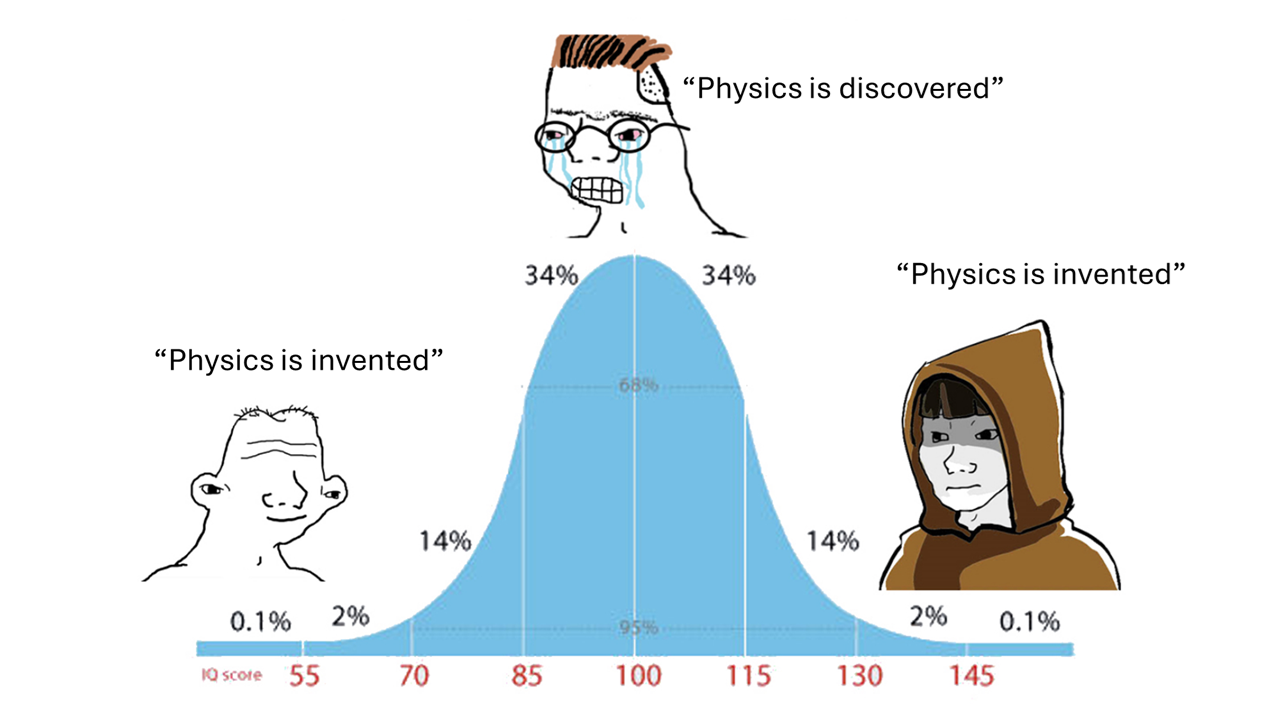
The perfect marriage of statistics and existential dread! This bell curve meme brilliantly captures how intelligence relates to our perception of physics. The average folks (68% in the middle) think "physics is discovered" - blissfully accepting that natural laws exist independently of human thought. Meanwhile, both the statistically challenged (left tail) and the frighteningly brilliant minds (right tail) converge on "physics is invented" - just for completely different reasons. One group can't grasp basic concepts, while the other has delved so deep into theoretical physics they've realized it's all just mathematical models we created to explain observations. Nothing like a normal distribution to remind you that being too smart or too dumb leads to the same unsettling conclusion!

The Ontological Cat-astrophe

The Ontological Cat-astrophe
The face you make when someone starts treating science as "what exists" rather than "how we know what exists." Nothing triggers a philosophy of science researcher quite like watching someone confuse ontology (the study of what exists) with epistemology (how we gain knowledge). That cat's existential crisis is exactly how I look during interdepartmental meetings when someone says "science proves reality."

The Eternal Knowledge Paradox

The Eternal Knowledge Paradox
The eternal dance between scientists and philosophers captured perfectly! Scientists are out here collecting data, running experiments, and discovering new particles while barely stopping to ponder "but what does it all mean , man?" Meanwhile, philosophers are crafting elaborate theories about the nature of reality without ever picking up a test tube. It's like one person building a house without blueprints while another draws beautiful blueprints for houses they'll never build. The scientific method and philosophical inquiry: two ships passing in the intellectual night, desperately needing each other but too stubborn to admit it.

We Have A Fundamental Epistemological Problem

We Have A Fundamental Epistemological Problem
The bell curve of intellectual humility strikes again! This meme perfectly captures the paradox of AI consciousness debates. People with average intelligence (the peak of the curve) confidently declare "ChatGPT is just code predicting tokens, not sentient!" Meanwhile, those at both extremes—whether they're intellectual lightweights or heavyweight thinkers—are asking the same profound question: "How are we sure ChatGPT is not sentient?" It's the classic Dunning-Kruger effect meets the hard problem of consciousness! The people who know just enough to be dangerous have absolute certainty, while those who understand the depth of our ignorance about consciousness recognize we can't even define sentience properly, let alone test for it in a system we built but don't fully understand. The real joke? We're all just collections of neurons predicting the next input too. Maybe the real fundamental epistemological problem is inside us all along!

The Crown Of Ignorance

The Crown Of Ignorance
The Dunning-Kruger effect strikes again! This comic brilliantly skewers the paradox of people who reject scientific expertise while simultaneously crowning themselves as intellectual royalty. The character literally wearing a crown while proclaiming "I'm the DUMBEST MAN ALIVE" only to follow it up with "I'm a critical thinker who thinks for themself because I distrust everything experts and scientists say" is *chef's kiss* perfect irony. True critical thinking requires evaluating evidence, not reflexively rejecting expertise. It's like bragging about your swimming skills while actively avoiding water!

Some People Believe It To Be A Myth

Some People Believe It To Be A Myth
This statistical masterpiece showcases the three types of people on the scientific belief spectrum. In the middle, we have the casual "I believe in science" guy, representing the average person who accepts scientific consensus without diving into methodology. On the left, the science denier who rejects evidence entirely. But the real hero is on the right—the scientist who doesn't "believe" in science because science isn't about belief! It's about evidence, testing hypotheses, and statistical significance. The bell curve brilliantly illustrates how most people fall into the middle "believer" category, while both deniers and actual scientists occupy the tails of the distribution. The quotation marks around "believe" are doing some heavy lifting here!

The Unholy Trinity: Facts, Opinions, And Lies

The Unholy Trinity: Facts, Opinions, And Lies
The scientific method just had a stroke watching this meme. While we're busy debating p-values and statistical significance, the real world is playing a game of "three-card monte" with information. Ever notice how conspiracy theories follow the same pattern? They start with a kernel of truth, wrap it in a blanket of misinterpretation, and serve it with a side of "just asking questions." Next time someone tells you their "opinion" that gravity is a government conspiracy, remember: not all statements deserve equal airtime in the marketplace of ideas. Some belong in the intellectual dumpster behind the marketplace.

First Grader Demands Rigorous Mathematical Proof

First Grader Demands Rigorous Mathematical Proof
That moment when a 6-year-old demands rigorous mathematical proof instead of accepting definitions. The kid's basically Kant with a cigar, refusing to accept synthetic a priori knowledge without empirical verification. First grade geometry class suddenly turns into an epistemological battleground. Somewhere, Euclid is slow-clapping while Descartes questions if first grade even exists.