

Education Memes

Posts tagged with Education
What Is Your Favorite Trilogy?

What Is Your Favorite Trilogy?
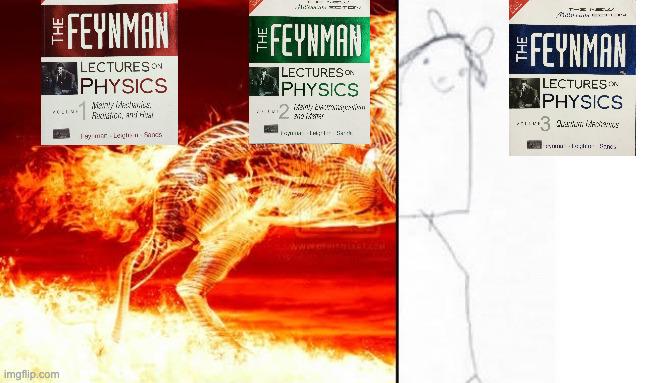
While everyone else is debating Star Wars vs. Lord of the Rings, physics nerds are over here like "actually, have you considered three volumes of lecture transcripts?" The Feynman Lectures on Physics are basically the holy grail of physics education—Richard Feynman had this uncanny ability to explain complex physics concepts like he was just casually chatting over coffee. The dramatic fire background really captures the burning passion physics students feel when they finally understand quantum mechanics... or maybe it's just their brain overheating from trying to follow Feynman's bongo-playing genius through electromagnetic theory. Either way, these three books have converted more people to physics than any Marvel movie ever could.

What A Great Teacher

What A Great Teacher
Finally, a teacher who gets it. The assignment says "Create a Math Meme" but this student went straight for the universal truth: that sinking feeling when your mom uses your full government name. You know you're in trouble when it's not just "hey" but the whole birth certificate rollout. The teacher's response? A big red line through the whole thing with "haha 39/35" — which is over 100% for those keeping track. That's right, this kid got extra credit for abandoning math entirely and going for relatable comedy gold. The "oh crap" annotation really seals the deal. This is the kind of grading philosophy we need more of in education. Who cares about quadratic equations when you can perfectly capture the primal fear of hearing "a² + 2ab + b²" morph into your full legal name echoing through the house?

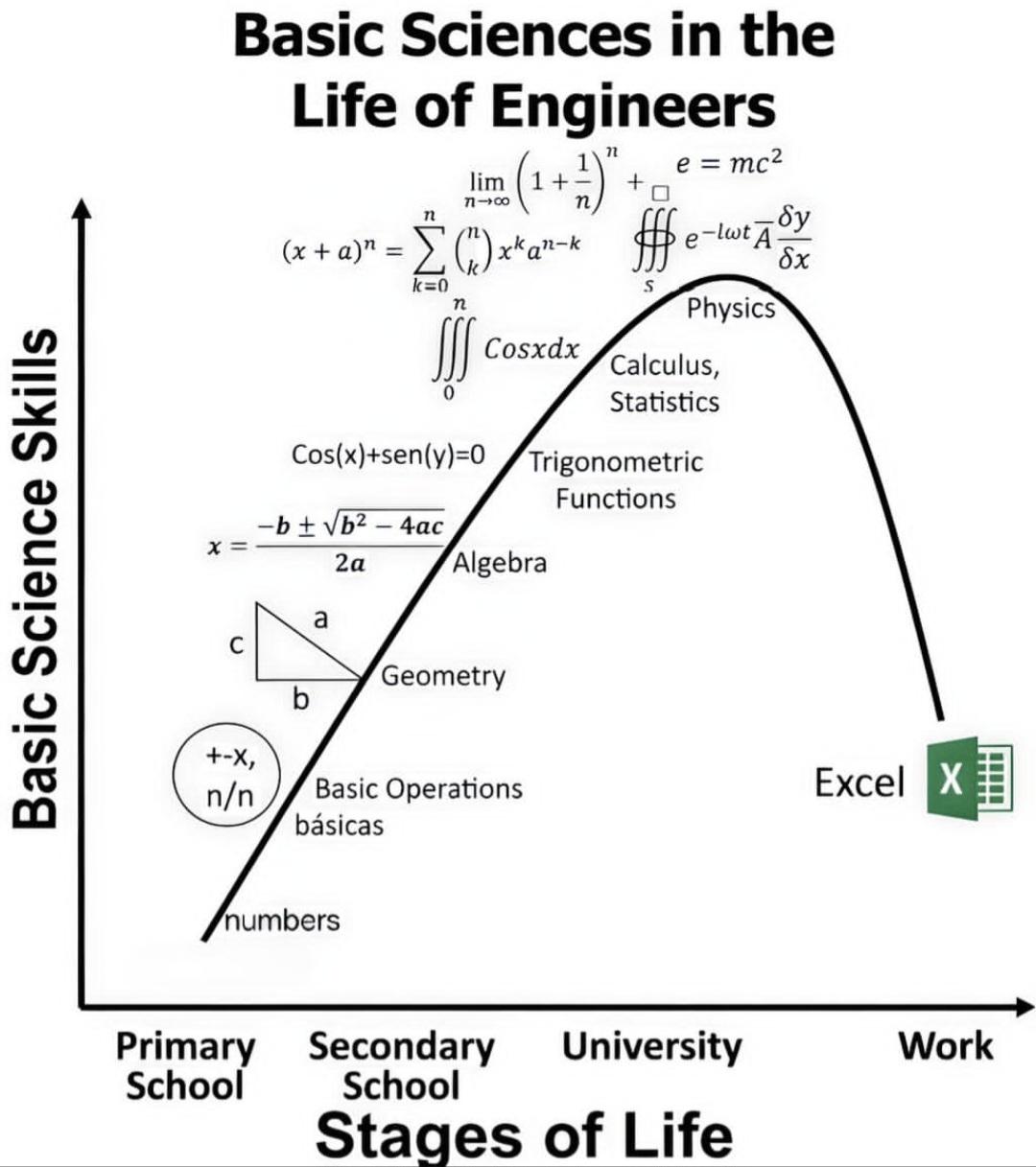
Evolution Of Scientific Competencies In Engineering

Evolution Of Scientific Competencies In Engineering
You spend years climbing the mountain of mathematical enlightenment—from basic arithmetic to the quadratic formula, through trig functions that haunt your dreams, all the way to calculus, physics, and those terrifying triple integrals. You're basically a mathematical demigod by graduation. Then you enter the workforce and... Excel. Just Excel. That's it. All those years of mathematical torture reduced to clicking cells and maybe, if you're feeling fancy, writing a SUM formula. The brutal irony is that your most-used "advanced" skill becomes Ctrl+C and Ctrl+V. Your professors warned you about forgetting everything after the exam, but they never mentioned you'd be using less math than a middle schooler while having a PhD-level education collecting dust in your brain. At least those pivot tables won't create themselves... or will they with AI now?

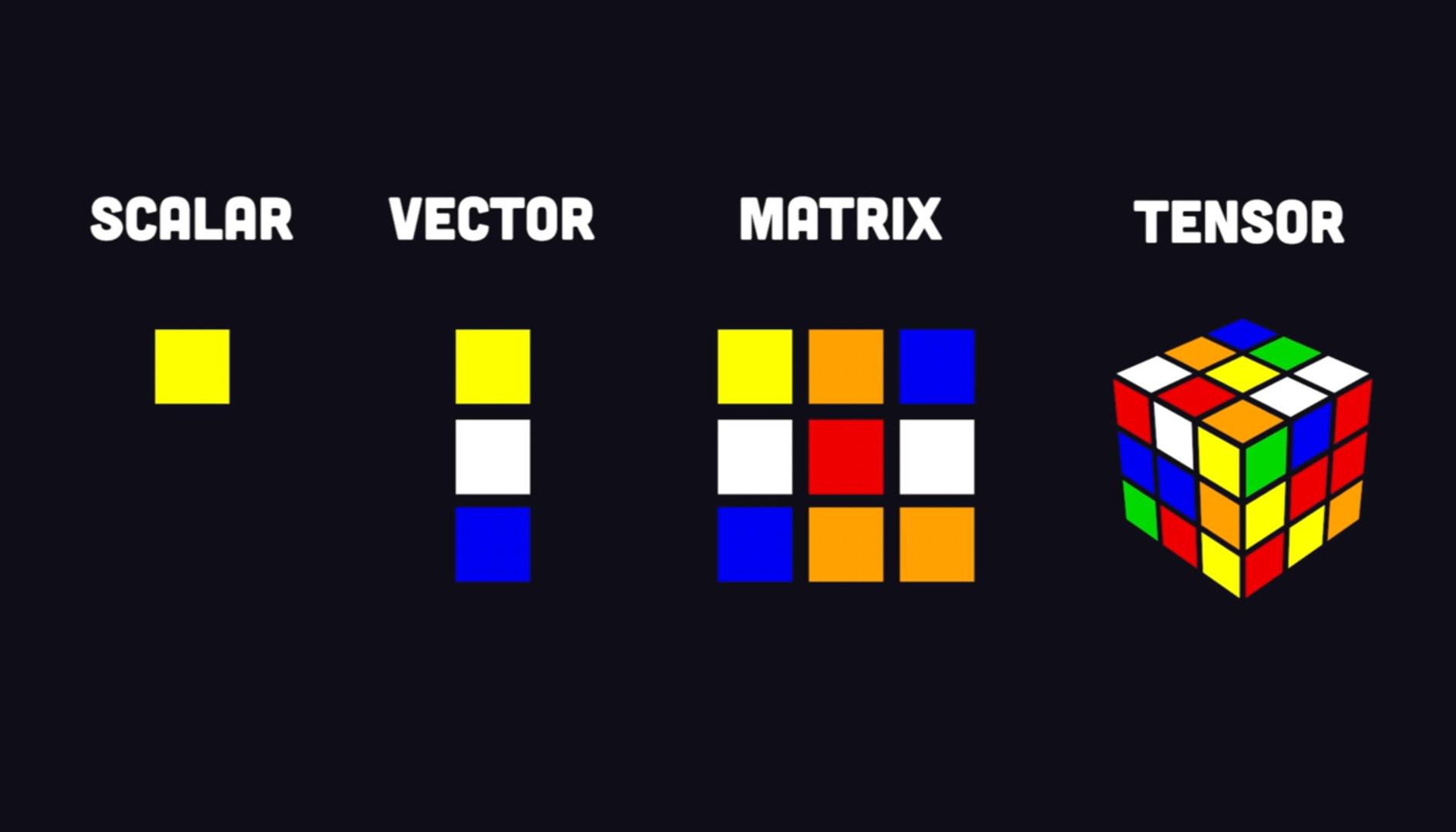
Was It Really That Hard To Explain It Like This?

Was It Really That Hard To Explain It Like This?
Every linear algebra student has stared at their textbook wondering why professors insist on drowning them in abstract notation when they could just... show this. A scalar is one lonely square. A vector? Stack 'em vertically. A matrix? Boom, grid of squares. But a tensor? That's when your professor pulls out the Rubik's Cube and watches you suffer. Tensors are basically multi-dimensional arrays that extend beyond the 2D matrix world into 3D and beyond. They're essential in physics (stress tensors, anyone?) and machine learning, but textbooks love to introduce them with enough indices and subscripts to make your eyes bleed. Meanwhile, someone could've just said "it's like a Rubik's Cube of numbers" and saved us all three therapy sessions. The real kicker? Your professor definitely understood it this way but chose violence instead.

Years Of Academy Training Wasted!

Years Of Academy Training Wasted!
Imagine spending decades mastering quantum mechanics, particle physics, and sophisticated mathematical models, only to find out that J.J. Thomson's 1904 "plum pudding" model—where electrons are just scattered through a blob of positive charge like raisins in a dessert—was somehow the accurate one all along. You know, the model we literally teach in intro physics as "here's what people thought before they knew better." The existential horror of realizing your entire career of increasingly complex atomic models (Rutherford, Bohr, quantum mechanical) was just humanity overcomplicating a Victorian-era pudding analogy. All those particle accelerators? Unnecessary. That PhD thesis on electron orbitals? Worthless. Should've just stuck with dessert-based physics. Plot twist: this will never happen because Rutherford's gold foil experiment definitively yeeted the plum pudding model into the scientific graveyard in 1909, but the fantasy of all that education being pointless? That's the real nightmare fuel for any physicist.

Proof By "Go Take Another Math Class For The Proof"

Proof By "Go Take Another Math Class For The Proof"
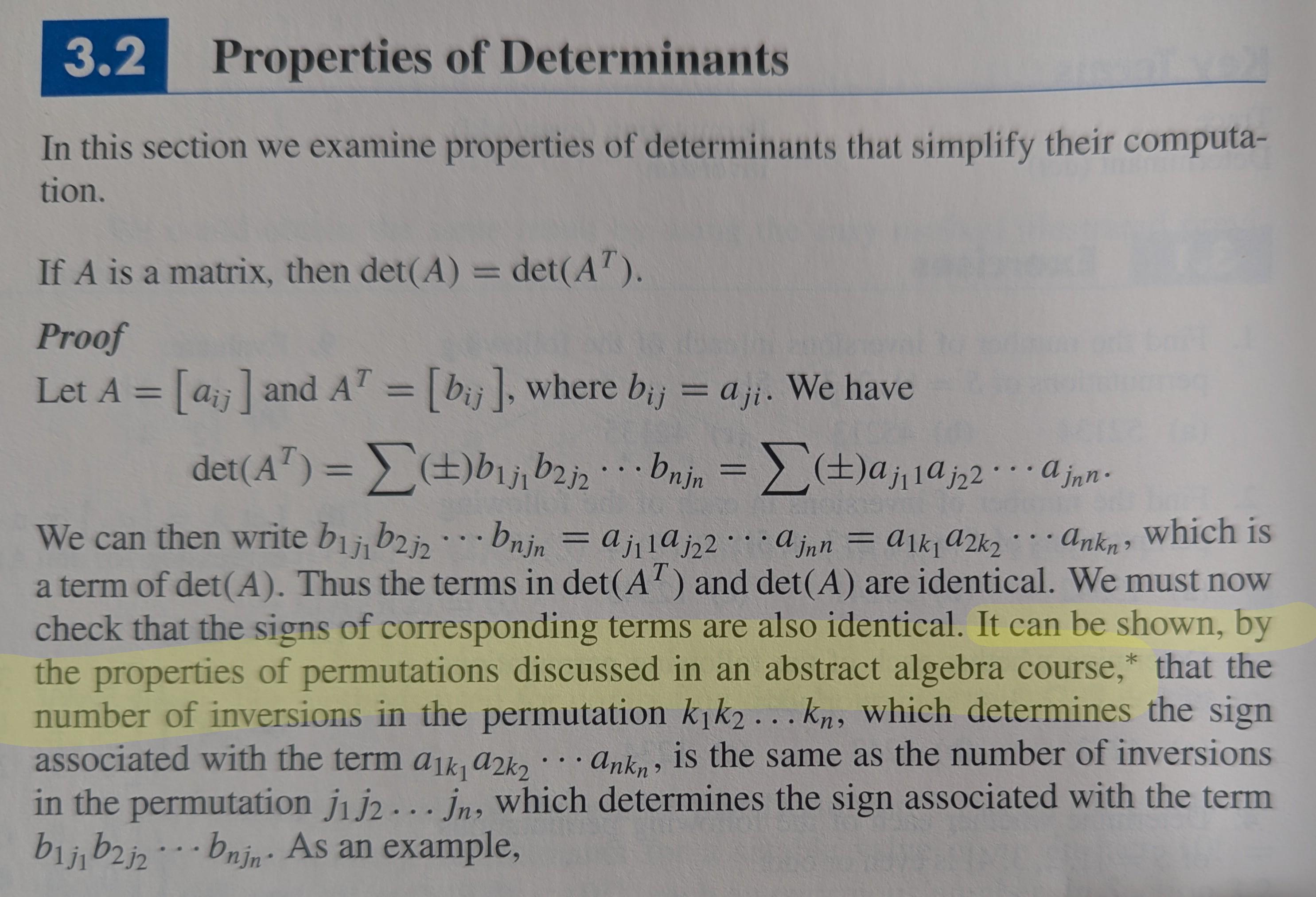
You know that feeling when your linear algebra textbook is almost done proving something, and then suddenly drops "It can be shown, by the properties of permutations discussed in an abstract algebra course,*" with a little asterisk like it's no big deal? That's basically the mathematical equivalent of "trust me bro" but with extra steps and a reading list. The textbook is literally saying "yeah we COULD prove this determinant property right here, but nah—go take an entirely different upper-level math course first." It's the academic version of gatekeeping, except instead of a bouncer at a club, it's your textbook casually suggesting you need another semester of coursework to understand one sentence. Nothing says "simplifying computation" quite like requiring knowledge from a completely different branch of mathematics! The highlighted section is basically math's way of saying "the proof is left as an exercise for the reader" but with more passive-aggressive energy. Classic textbook move.

Every Week Takes Me One Step Closer To The Edge

Every Week Takes Me One Step Closer To The Edge
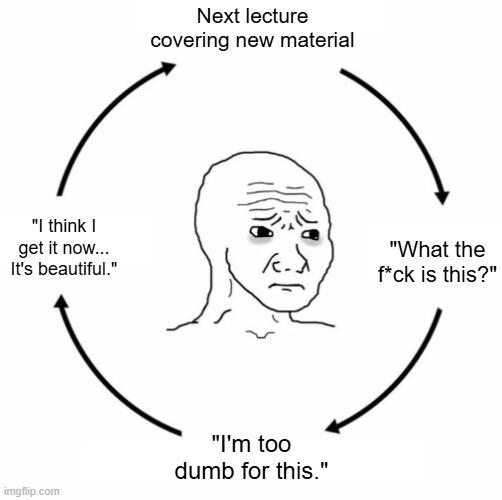
Welcome to the academic cycle of despair, where confidence has a half-life shorter than francium-223. You walk into Monday's lecture thinking you've finally cracked the code, feeling like Newton under that apple tree. Fast forward 48 hours and you're staring at your notes like they're written in ancient Sumerian. By Thursday, you've accepted your fate as an intellectual fraud who somehow fooled the admissions committee. The real kicker? Next week the professor drops another knowledge bomb, you understand approximately 30% of it, and boom—you're back at "I think I get it now" like some kind of academic Sisyphus. Rinse, repeat, question your life choices, wonder if it's too late to become a barista. Pro tip: Everyone in your class is trapped in the same cycle. That person who always asks questions? Also clueless. Your professor? Probably felt this way during their PhD. It's the circle of academic life, and it moves us all toward imposter syndrome and caffeine dependency.

10 Has Been In Shambles Since Then, Bro Suffered From A Coma

10 Has Been In Shambles Since Then, Bro Suffered From A Coma
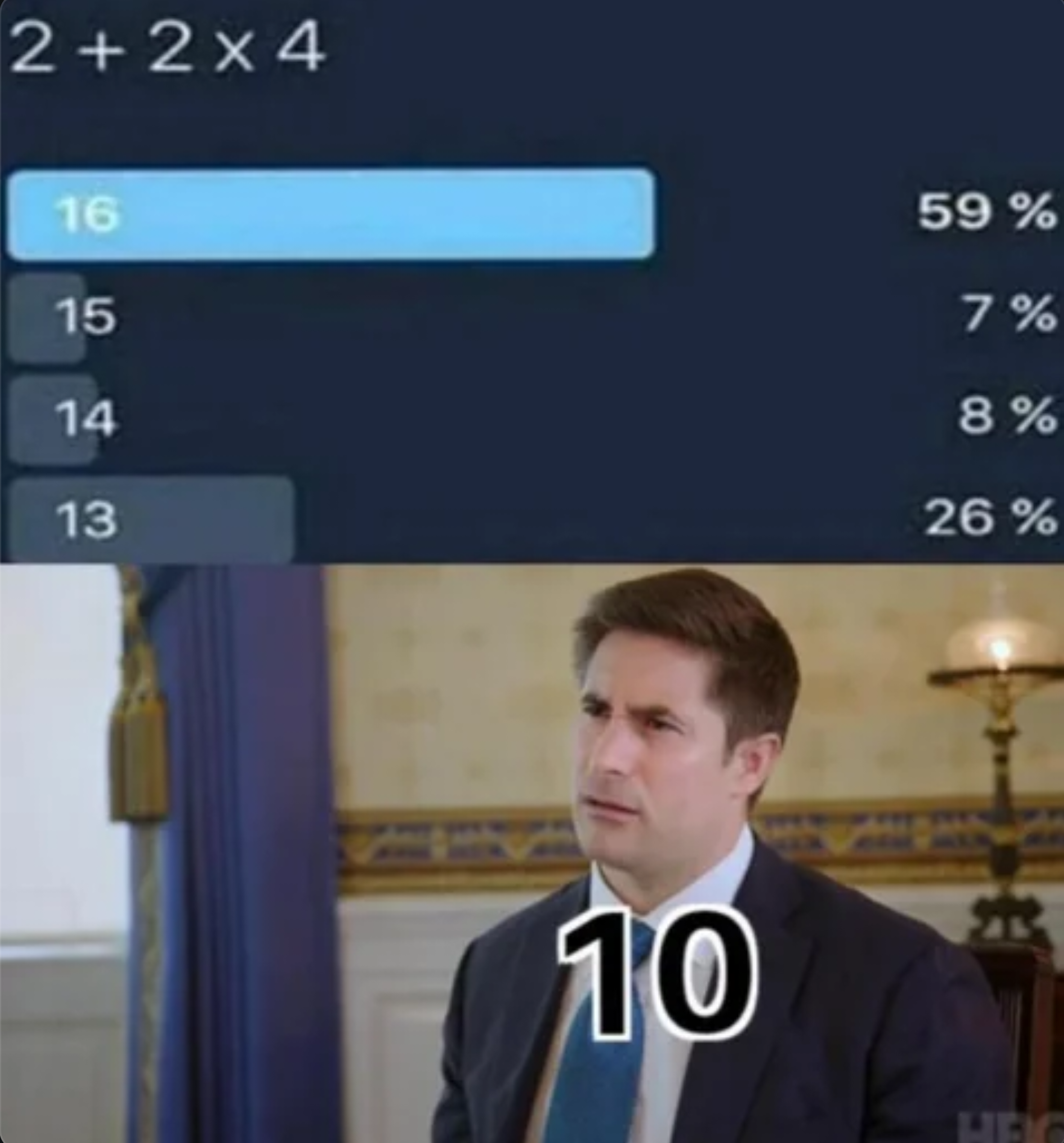
The question is literally 2 + 2 × 4, and thanks to PEMDAS (order of operations), the correct answer is 10. Multiplication comes before addition, so it's 2 + 8 = 10. Simple enough, right? Except 59% of people confidently chose 16, presumably by just going left to right like they're reading a cereal box. They did 2 + 2 = 4, then 4 × 4 = 16, completely ignoring the mathematical hierarchy that's been around since forever. Meanwhile, poor 10 is sitting there watching itself get absolutely demolished in the polls, wondering what it did to deserve this disrespect. The real tragedy? The other 33% of people split between 15, 14, and 13—answers so wrong they require creative interpretation of basic arithmetic. It's like watching someone confidently solve 2 + 2 and getting 5. The number 10 really did suffer a coma watching humanity collectively forget elementary school math.

Biology Students Please Stand Up

Biology Students Please Stand Up
Every biology student knows that frogs are basically the sacrificial lambs of undergraduate education. The moment you mention frogs in any biology context, there's an immediate Pavlovian response involving dissection trays, formaldehyde flashbacks, and the haunting memory of pinning down those poor amphibians in anatomy lab. The Christian Bale axe-wielding maniac energy perfectly captures that slightly unhinged enthusiasm biology students develop after spending countless hours identifying every muscle, nerve, and organ system in Rana pipiens . You go from "aww, cute froggy" to "let me show you the sciatic nerve and gastrocnemius muscle" real quick. Fun fact: frogs have been the go-to dissection specimen since the 1800s because their organ systems are similar enough to mammals to be educational, but different enough that students don't get too squeamish. Plus, they're abundant and easy to preserve. Sorry, frogs—your anatomical accessibility is your curse.

Acceleration Meme

Acceleration Meme
This hits different when you realize that acceleration isn't just "going faster" – it's any change in velocity, which includes direction! So when those BMX riders are whipping around that curve at constant speed, they're absolutely accelerating because their direction is constantly changing. The acceleration vector? It's pointing toward the center of the curve (centripetal acceleration, baby!). But try explaining that to your 14-year-old self who just learned that acceleration = speeding up, and you get the Bugs Bunny "NO" treatment. Physics teachers everywhere feel this pain when students insist that constant speed = zero acceleration, completely forgetting that velocity is a vector with both magnitude AND direction. Fun fact: This is why you feel pushed to the side of your car during turns even though you're not changing speed. Your body wants to go straight (thanks, Newton), but the car is accelerating you sideways into the curve!

Teenagers Vs. Basic Algebra

Teenagers Vs. Basic Algebra
Let's set up the equation: x = $1 + 0.5x. Subtract 0.5x from both sides, get 0.5x = $1, therefore x = $2. It's literally one of the simplest algebra problems you can give someone. But here's where it gets beautiful: 4,200 teenagers confidently voted for $1.50, which would mean the book costs $1.50 and half its cost is $0.75, giving us a total of... $2.25. Not $1.50. The math isn't mathing, folks. The 1,800 people who voted $2 are sitting there like "did everyone else skip 7th grade?" Meanwhile, 169 brave souls chose $1, presumably thinking the book just costs itself plus... nothing? The confidence-to-correctness ratio in online polls never fails to deliver existential dread about our collective future.

Today I Woke Up And Realized Mind Your Decisions Is Pure Math Slop

Today I Woke Up And Realized Mind Your Decisions Is Pure Math Slop
The eternal battle between clickbait math content and actual mathematical rigor. MindYourDecisions has mastered the art of making viral "brain teaser" videos that are basically just arithmetic dressed up as profound puzzles, while channels like Andy Math are out here doing the unglamorous work of teaching actual mathematical concepts that require, you know, thinking beyond third grade. It's like comparing fast food to a home-cooked meal. Sure, MindYourDecisions will get millions of views with "97% of people can't solve this!" thumbnails featuring some basic algebra problem, but Andy Math is teaching calculus, linear algebra, and differential equations to students who actually need to pass their exams. One's optimized for the algorithm, the other's optimized for learning. The "send him 2-3 years and forget" part is chef's kiss—because that's exactly how long it takes to realize that those viral math puzzles didn't actually teach you anything useful when you're staring down a real analysis exam.