

Derivatives Memes

Posts tagged with Derivatives
Most Confusing Equation For Non-Physics People

Most Confusing Equation For Non-Physics People
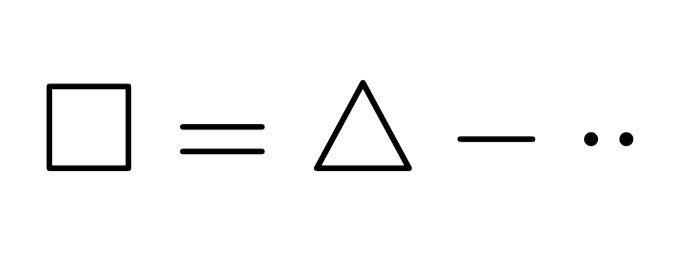
This is pure geometric trolling at its finest. To anyone without physics training, this looks like complete nonsense—a square equals a triangle equals... two dots? But physicists instantly recognize this as the iconic progression of the Schrödinger equation in different notations. The square represents the Hamiltonian operator (Ĥ), the triangle is the Laplacian (∇²), and those innocent little dots? That's just the second derivative notation (ẍ). Same mathematical concept, three wildly different symbols. It's like watching someone write "2+2" as "II+II" and then as "🦆🦆+🦆🦆"—technically correct but increasingly unhinged. Non-physicists see random shapes having an identity crisis, while physicists nod knowingly because they've been gaslit by notation their entire careers.

It Don't Work That Way

It Don't Work That Way
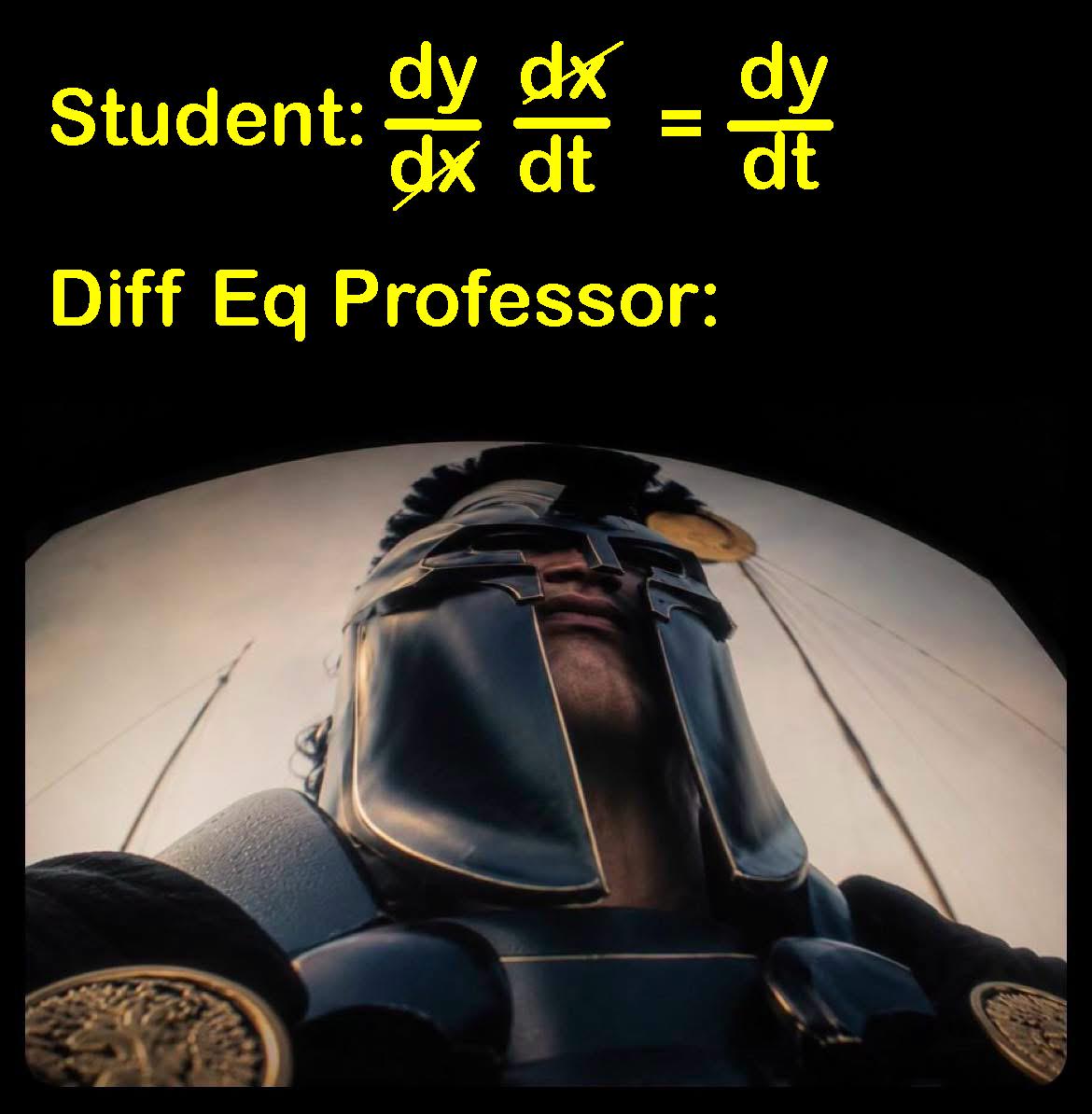
Every calculus student's favorite party trick: treating derivatives like fractions and just canceling stuff out. The student here is doing some algebraic gymnastics by "canceling" the dx terms like they're simple fractions, which... technically gives you the right answer but makes every differential equations professor age 10 years instantly. Here's the thing: the chain rule actually DOES give you dy/dt = (dy/dx)(dx/dt), so the student isn't wrong. They're just using freshman algebra logic on calculus notation, which is like using a hammer to perform surgery—it might work, but you're gonna give someone a heart attack watching you do it. The professor's horrified reaction is because while the notation looks like fractions, they're actually limits of ratios, and treating them as algebraic fractions is mathematically sketchy even if it works out. It's the mathematical equivalent of getting the right answer for the wrong reasons, and professors can smell that from a mile away.

The Real Reason Newton Chose His Notation

The Real Reason Newton Chose His Notation
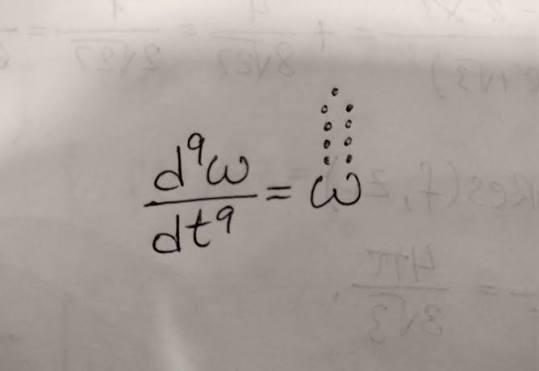
Newton's derivative notation strikes again with maximum chaos energy. The equation shows d q ω/dt q = ω̇ (omega with dots above it), and honestly, this is the most Newton thing ever. While Leibniz was out here inventing clean, logical notation that clearly shows what you're differentiating with respect to what, Newton was like "nah, I'll just slap some dots on top and call it a day." The joke here is that Newton's dot notation (those dots floating above the ω) looks suspiciously like he just... kept adding dots for higher-order derivatives. Need a second derivative? Two dots. Third? Three dots. It's the mathematical equivalent of naming your variables x, xx, xxx. The "q" superscripts on the left side suggest this is a q-th order derivative, which would require q dots stacked vertically in Newton's notation—basically turning into a dotted line ascending to the heavens. Plot twist: Newton probably chose this notation specifically because it was easier to write by hand in the 1600s. But looking at it now? It's like he designed it to confuse physics students three centuries later. Mission accomplished, Isaac.

The Answer Is 1

The Answer Is 1
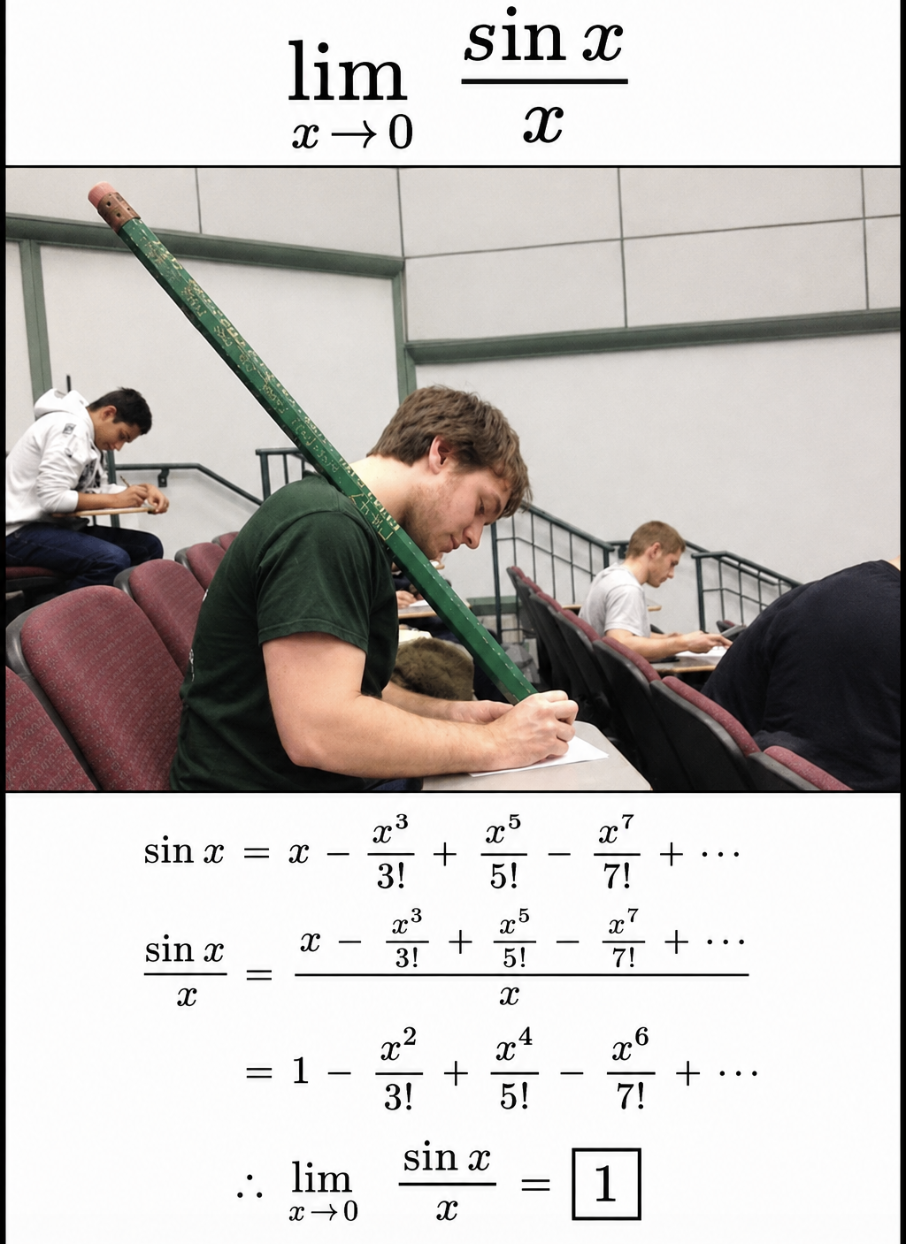
You know that limit that shows up in literally every calculus course? The one where sin(x)/x approaches 1 as x goes to 0? Yeah, it's elegant and beautiful on paper. But getting there requires busting out the Taylor series expansion like you're defusing a bomb—carefully dividing terms, canceling x's, and praying you don't mess up the factorials. Meanwhile, that giant pencil hovering menacingly over the student perfectly captures the existential weight of proving something so "simple." The proof involves expanding sin(x) into an infinite series, dividing everything by x, then watching as x approaches 0 and all those higher-order terms vanish into mathematical oblivion. What remains? Just 1. Clean, pure, inevitable. The pencil represents every professor who's ever said "this is trivial" before writing three blackboards worth of algebra. Fun fact: this limit is actually the foundation for deriving the derivative of sine, so if you ever wondered why d/dx(sin x) = cos x, blame this bad boy right here.

Superiority Complex

Superiority Complex
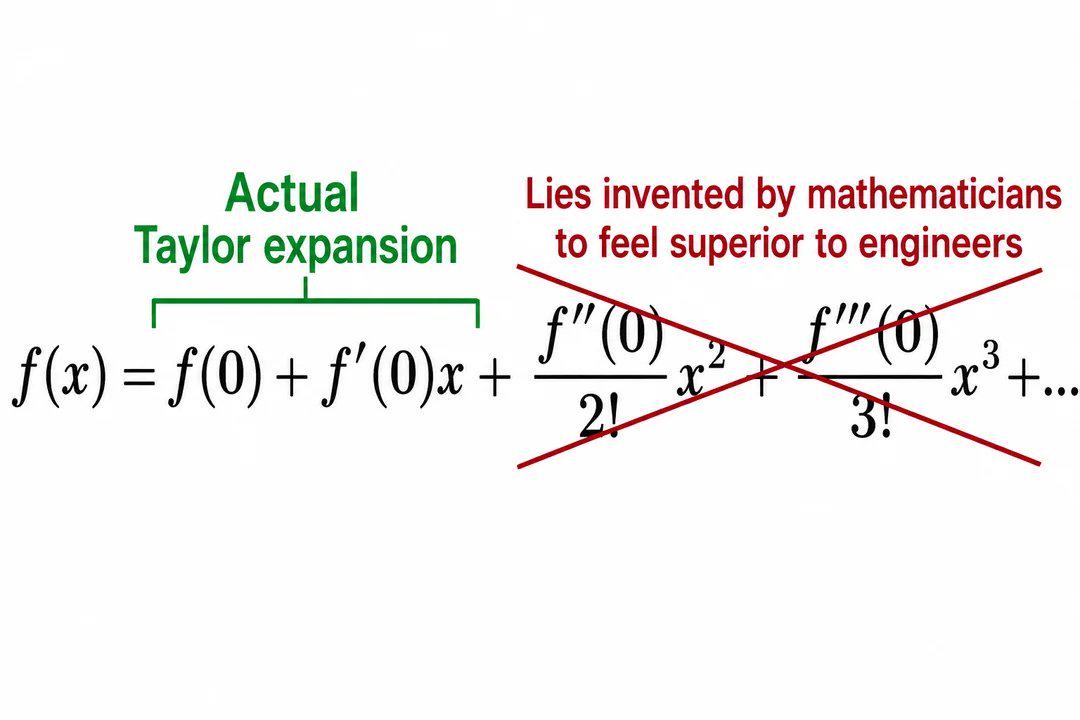
Engineers think they're hot stuff until mathematicians remind them that Taylor series actually has infinite terms. But here's the dirty little secret: engineers just use the first couple terms and call it a day because, honestly, who needs accuracy beyond the second derivative when you're building bridges that only need to stand for 100 years? The Taylor expansion is basically a way to approximate complicated functions using polynomials—you keep adding more derivative terms to get closer to the real thing. Mathematicians worship the full infinite series in all its glory. Engineers? They'll truncate it faster than you can say "margin of error" and still sleep soundly at night. This is the eternal math vs. engineering rivalry in one equation. Mathematicians get to feel intellectually superior while engineers actually get things done with "good enough" approximations. Both think they're better than the other, and honestly? They're both right.

For Those Who Were Asking For Translation...

For Those Who Were Asking For Translation...
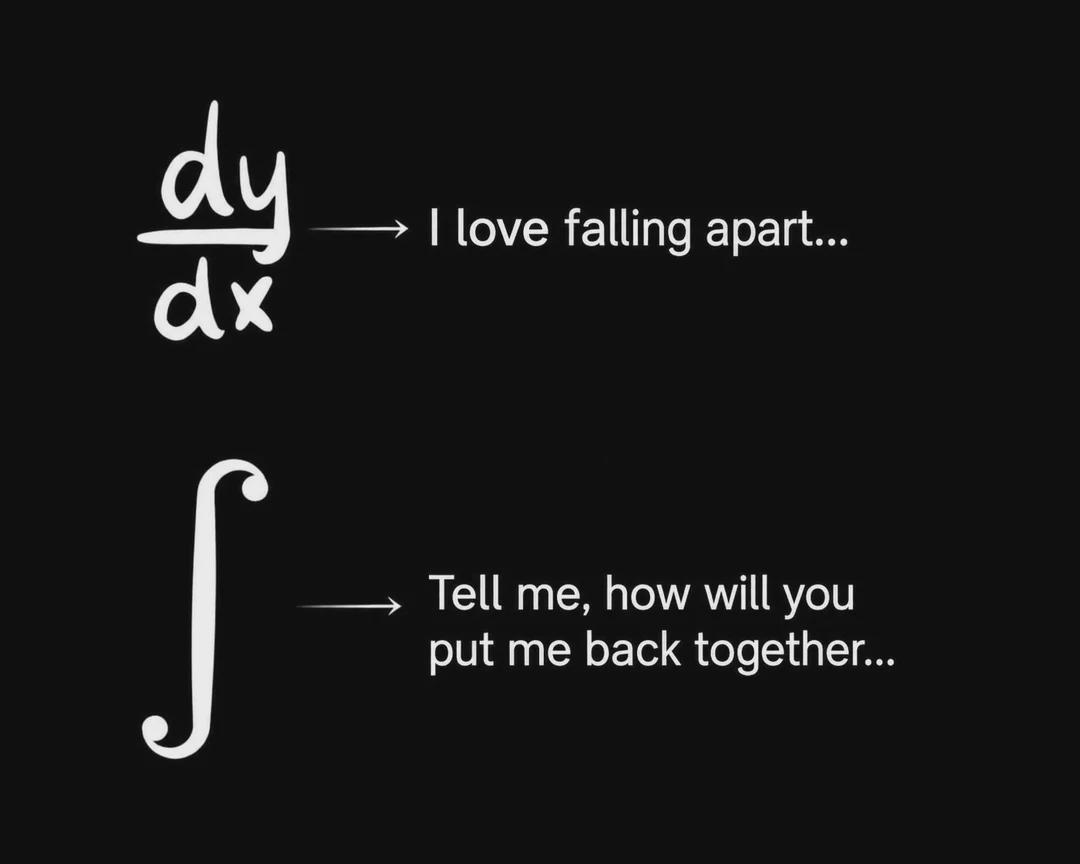
Someone just turned calculus notation into a breakup anthem and honestly, it's devastatingly accurate. The derivative dy/dx literally represents the rate of change—how fast y is changing with respect to x—so it's basically measuring how quickly things are falling apart. Very relatable for anyone who's ever watched their function (or relationship) differentiate into chaos. But then the integral ∫ swoops in with the existential question: how do we reverse this process? Integration is the inverse operation of differentiation, so if dy/dx represents things breaking down, then ∫ should theoretically piece everything back together. Except anyone who's tried to solve an integral knows it's WAY harder than taking a derivative. Sometimes there's no closed-form solution. Sometimes you need numerical methods. Sometimes you just cry and use Wolfram Alpha. The emotional weight here is chef's kiss because integration doesn't always give you back what you started with—you get that pesky constant of integration (+C) that represents all the information lost during differentiation. So even if you DO manage to integrate, you're never quite whole again. Mathematics really said "let me give you trust issues."

Which Side Are You On?

Which Side Are You On?
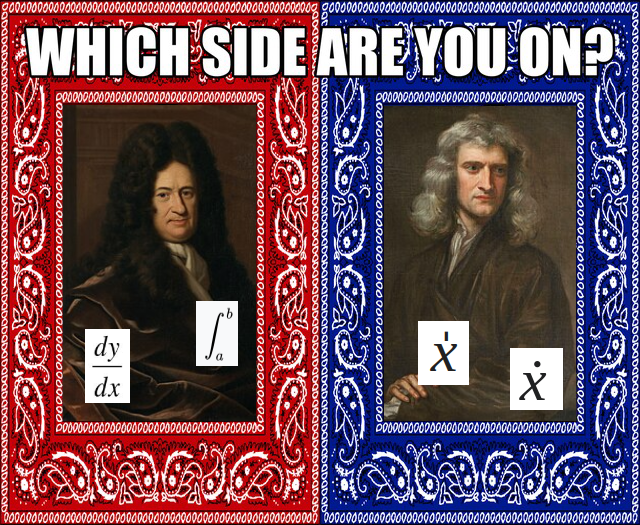
This is basically the Crips vs Bloods of mathematics. On the red side, we've got Leibniz with his dy/dx notation for derivatives—smooth, elegant, and looks like actual fractions (even though they're not, but shhhh). On the blue side, there's Newton rocking the dot notation for derivatives, keeping it simple and clean. The funny thing? These two literally invented calculus independently around the same time and got into one of history's pettiest academic beefs about who did it first. Their rivalry was so intense it split European mathematics for generations. Leibniz's notation won the popularity contest though—most of us learn dy/dx in school because it's way more intuitive for showing what's actually happening. Newton's dot notation still shows up in physics for time derivatives, so both gangs are still repping to this day. Choose your fighter wisely—your calculus professor is judging you.

Been Doing This All Morning

Been Doing This All Morning
So you just learned that derivatives distribute over addition and subtraction, and suddenly every problem becomes a nail for your shiny new hammer. The distributional derivative is a generalization that lets you take derivatives of functions that aren't even differentiable in the classical sense—basically math's way of saying "we can differentiate anything if we're creative enough about it." Now you're sitting there applying it to literally everything like you've unlocked god mode in calculus. Your coffee? Distributional derivative. Your breakfast? Distributional derivative. The existential dread of your research timeline? You guessed it—distributional derivative. The unhinged SpongeBob energy here perfectly captures that manic phase where you've just grasped a new mathematical tool and your brain won't let you think about anything else.

Math Textbook's Casual War Crime

Math Textbook's Casual War Crime
When math textbooks casually drop a derivative of the delta function like it's no big deal! The left side shows someone smiling confidently ("The") while the right side shows the same person having an existential crisis ("What?") after seeing that cursed equation. For the uninitiated, the delta function is already a mathematical oddity (it's infinitely tall at one point and zero everywhere else), but taking its derivative is like dividing by zero while riding a unicycle on a tightrope. Even seasoned math majors get that "brain.exe has stopped working" feeling when they encounter this monstrosity in their textbooks!

Mathematicians And Their Fancy Equation Evasion Tactics

Mathematicians And Their Fancy Equation Evasion Tactics
Classic mathematician behavior. Start with "slope of the curve" - simple, intuitive. Then progress to limit definitions - respectable. But when those fail? Suddenly we're in formal distribution theory with fancy tuxedos and monocles, defining weak derivatives and test functions. Nothing says "I refuse to admit defeat" like inventing an entirely new mathematical framework just to solve your homework problem. The progression from basic calculus to "∀φ ∈ {good girls}" is the mathematical equivalent of bringing a nuclear weapon to a knife fight.

The Derivative Of Rejection

The Derivative Of Rejection
When flirting with a math nerd, always check if they're taking the derivative of your function! This poor soul sent π⁴ only to get instantly blocked when the reply was 4π³ (the derivative). Classic calculus rejection - turns out differentiating someone's equation is the mathematical equivalent of saying "I know exactly where this is going." Next time try an unsolvable equation - keeps 'em interested longer!

Alcohol And Calculus Don't Mix

Alcohol And Calculus Don't Mix
This highway sign is pure mathematical genius! It cleverly transforms the classic "don't drink and drive" PSA into a calculus pun by showing "d/dt" (the notation for derivatives) in a prohibited circle with "NEVER DRINK AND DERIVE" alongside it. The derivative operator is what we use to find rates of change—but your ability to find those rates might change dramatically after a few drinks! Solving for the limit as sobriety approaches zero is definitely not recommended for your GPA or your driving record. The function of your brain with respect to time becomes rather discontinuous when alcohol enters the equation!