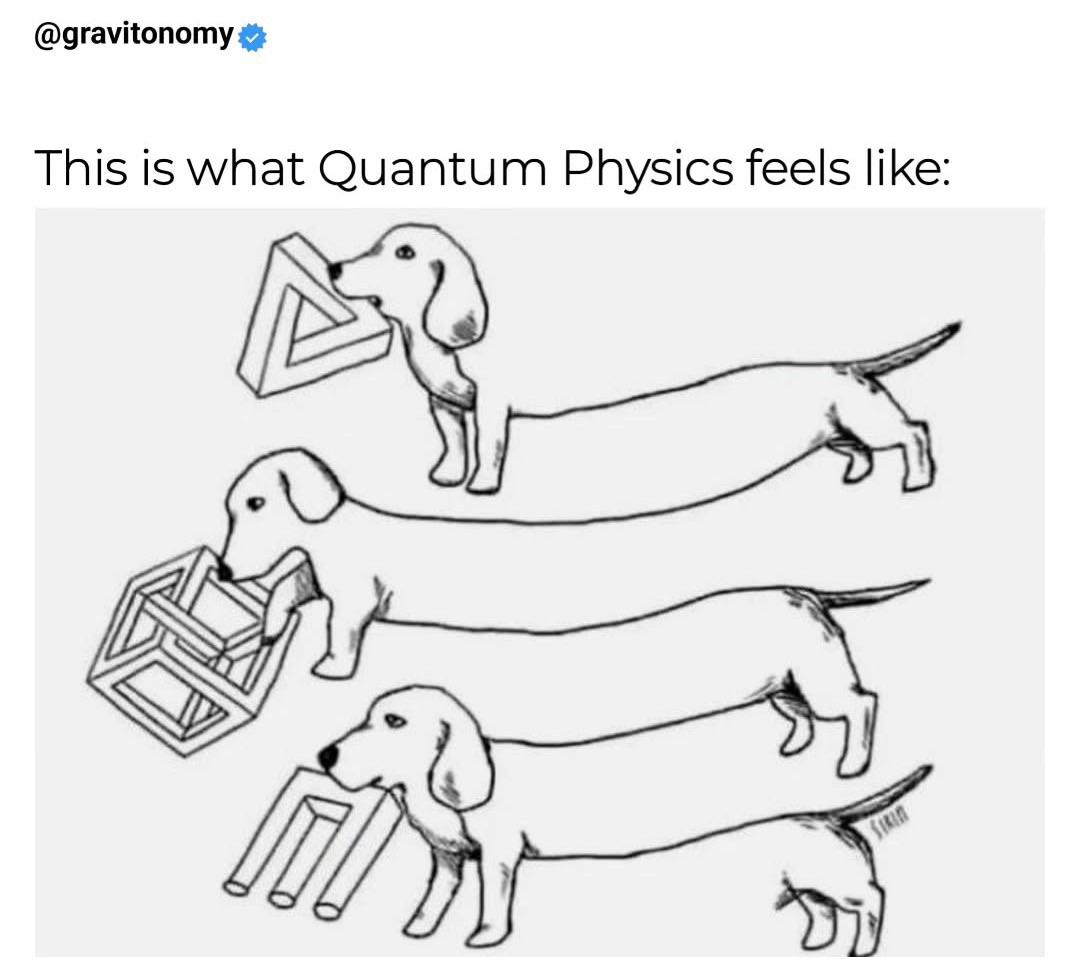
Three dachshunds, three impossible objects, one perfect metaphor. The dogs are carrying the Penrose triangle, an impossible cube, and another geometrically paradoxical structure—all of which can exist on paper but would make a 3D printer have an existential crisis. Quantum physics operates on similar brain-melting principles: particles can be in two places at once (superposition), affect each other instantly across vast distances (entanglement), and generally refuse to follow the common-sense rules that govern our everyday world. Just like these impossible objects look fine from one angle but fall apart when you try to construct them in reality, quantum mechanics works mathematically but defies our intuitive understanding of how things should behave. The dachshunds themselves are perfect for this—their impossibly long bodies already look like someone stretched the dog blueprint beyond reasonable limits. They're just casually trotting along with geometric impossibilities like it's no big deal, which is exactly how quantum physicists present wave-particle duality at conferences while everyone else's brain quietly leaks out their ears.
 Academia
 Ai
 Astronomy
 Biology
 Chemistry
 Climate
 Conspiracy
 Earth-science
 Engineering
 Evolution
 Geology