
Complex numbers Memes

Posts tagged with Complex numbers
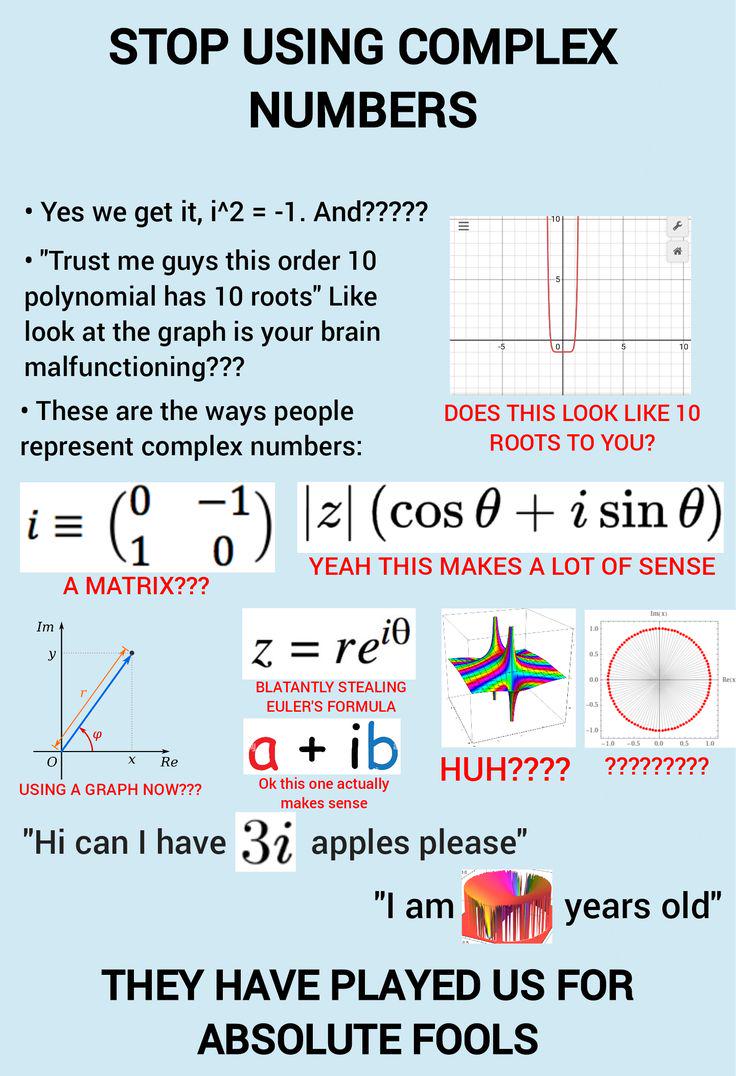
"Stop Using Complex Numbers" They Say

"Stop Using Complex Numbers" They Say
Imagine telling mathematicians and physicists to stop using complex numbers. That's like asking a chef to stop using salt—technically possible, but why would you torture yourself? The beautiful chaos here showcases every possible way to represent complex numbers, and people STILL get confused. You've got the algebraic form (a + bi), Euler's magnificent formula (which is basically the mathematical equivalent of a mic drop), polar coordinates, matrix representation, and some absolutely cursed 3D visualizations that look like modern art had a baby with a calculus textbook. The real kicker? That polynomial graph showing what LOOKS like only 2 roots when there are actually 10 hiding in the complex plane. It's like playing hide-and-seek where most of the players are invisible to people who refuse to acknowledge imaginary numbers exist. And don't even get me started on "3i apples" and being "weird colorful graph" years old. Complex numbers are literally everywhere in quantum mechanics, electrical engineering, and signal processing. Without them, your WiFi wouldn't work and Schrödinger's cat would be very disappointed.

Complex Number Meme

Complex Number Meme
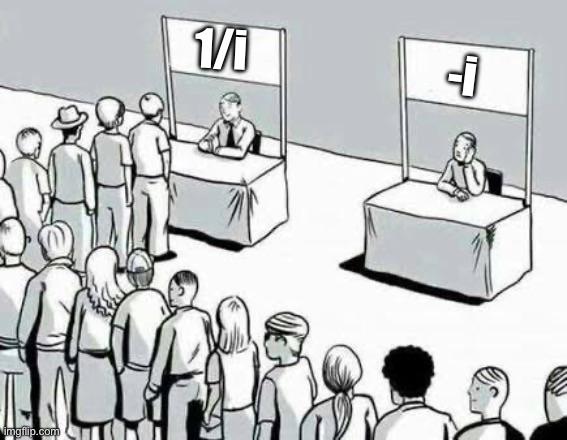
So you've got two mathematicians at convention booths here, and the popularity difference is BRUTAL. The booth for 1/i is absolutely packed with fans, while poor -i is sitting alone like the loneliest number (which is technically one, not -i, but whatever). Here's the kicker: 1/i and -i are literally the SAME number! If you multiply both numerator and denominator of 1/i by i, you get i/i² = i/(-1) = -i. They're identical, just wearing different outfits. It's like when a band releases the exact same song under two different names and one goes viral while the other flops. Marketing matters, even in mathematics! The fraction form 1/i just LOOKS more approachable and less intimidating than that grumpy negative sign in front of i. Perception is everything, folks—even when you're dealing with imaginary numbers that don't exist on the real number line anyway. 😂

Thanks Math Book, I Totally Remember My "Basic" Sheaf Cohomology

Thanks Math Book, I Totally Remember My "Basic" Sheaf Cohomology
Ever opened a math textbook that casually drops "as we know from basic sheaf cohomology" like you learned it in kindergarten? Meanwhile, your brain is struggling to recall that i=√-1, the imaginary unit we learned in high school! Advanced math textbooks exist in a parallel universe where everyone apparently has a PhD before reading chapter 1. Sheaf cohomology is literally a graduate-level topic involving abstract algebra and topology, but sure, let's pretend that's "basic" while we're still trying to remember if negative times negative equals positive.

The Imaginary Mind-Blow

The Imaginary Mind-Blow
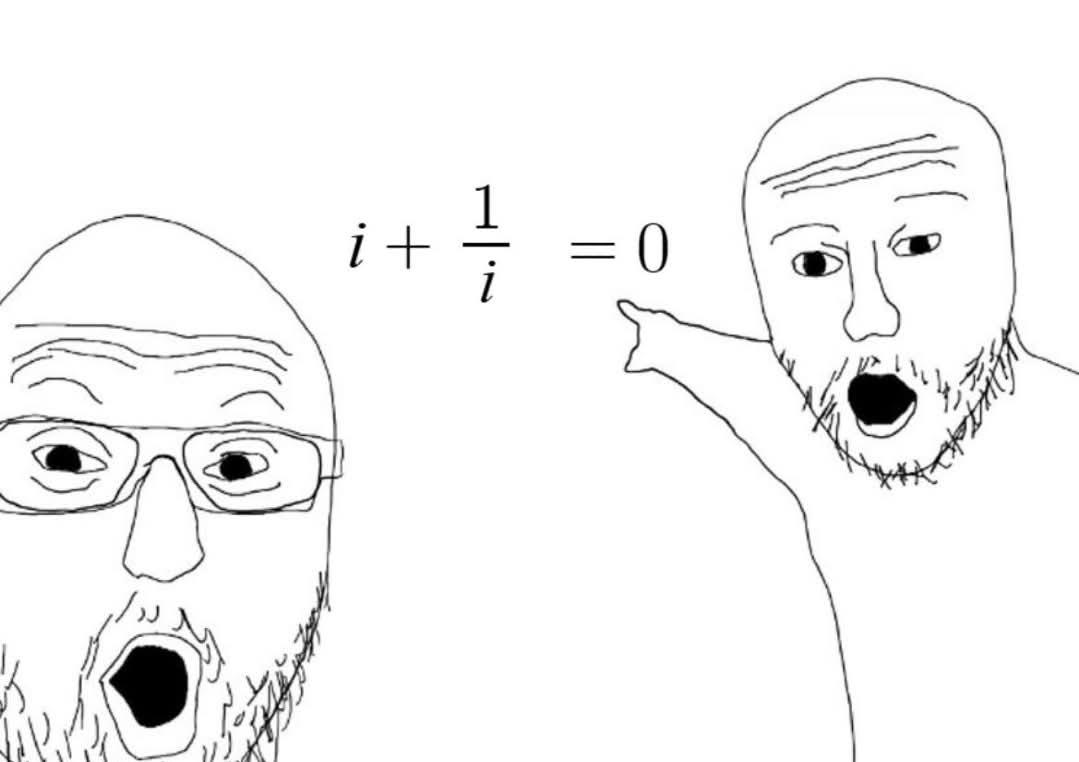
The equation i + 1/i = 0 is blowing these mathematicians' minds because it actually works! When you substitute i (the square root of -1) into this equation, you get i + (-i) = 0, which simplifies to zero. It's like finding out your imaginary friend has been paying your real taxes. The beauty of complex numbers is that they follow rules that seem impossible yet work perfectly—kind of like how academics somehow survive on coffee and deadline panic.

The Mathematical Metamorphosis

The Mathematical Metamorphosis
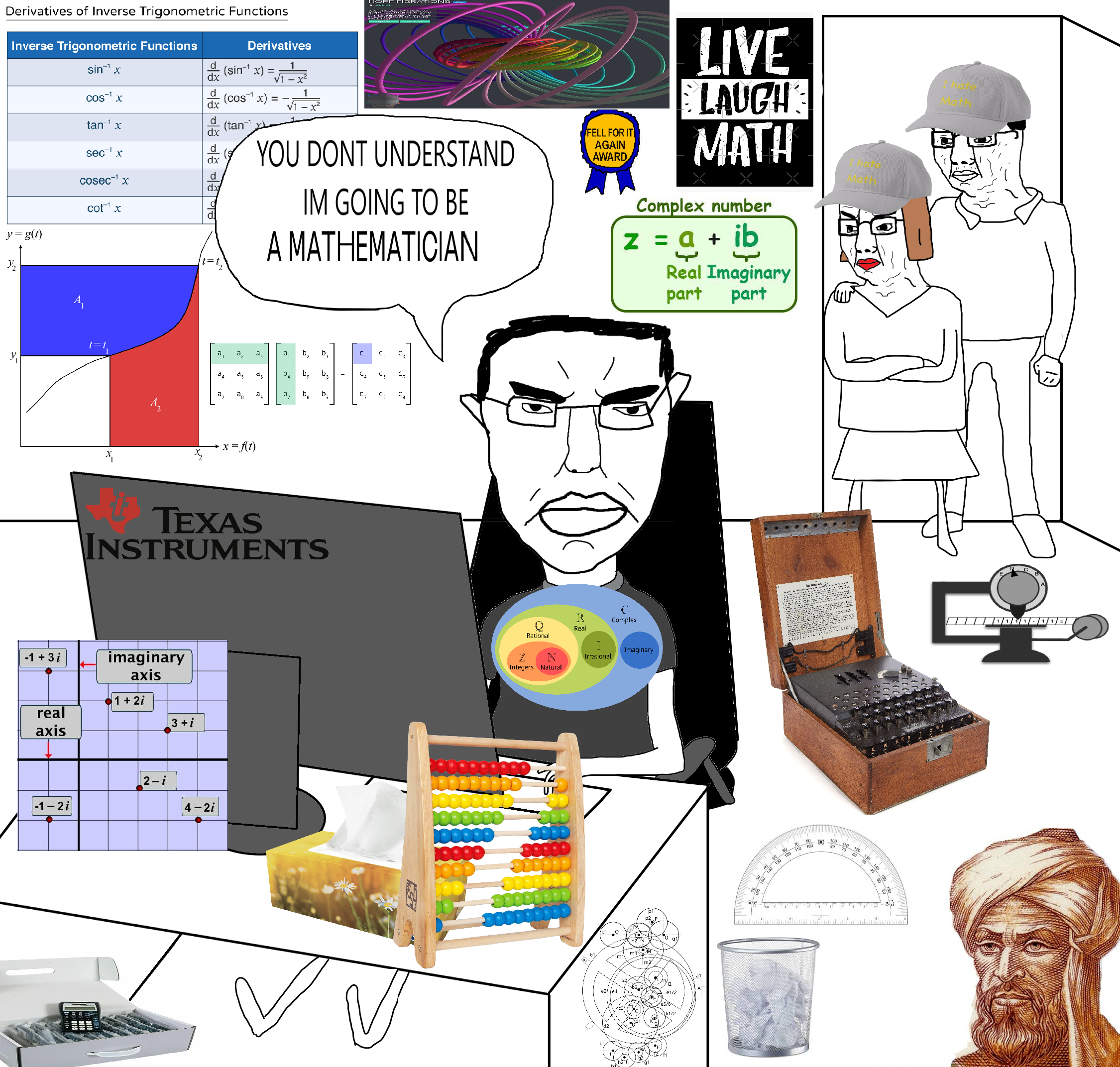
The mathematical rebellion has begun! This glorious collage captures that moment when you've stared at inverse trig derivatives for so long that your brain decides "THAT'S IT, I'M BECOMING A MATHEMATICIAN" with the intensity of someone who just discovered coffee has been decaf all along. The chaotic blend of complex numbers, imaginary axes, and that abacus (which is clearly there for emotional support) represents the beautiful madness that happens when math consumes your soul. The ancient calculator and portrait of Al-Khwarizmi watching in the corner? They're just there to witness your transformation into the final math boss!

Complex Time Travel Solutions

Complex Time Travel Solutions
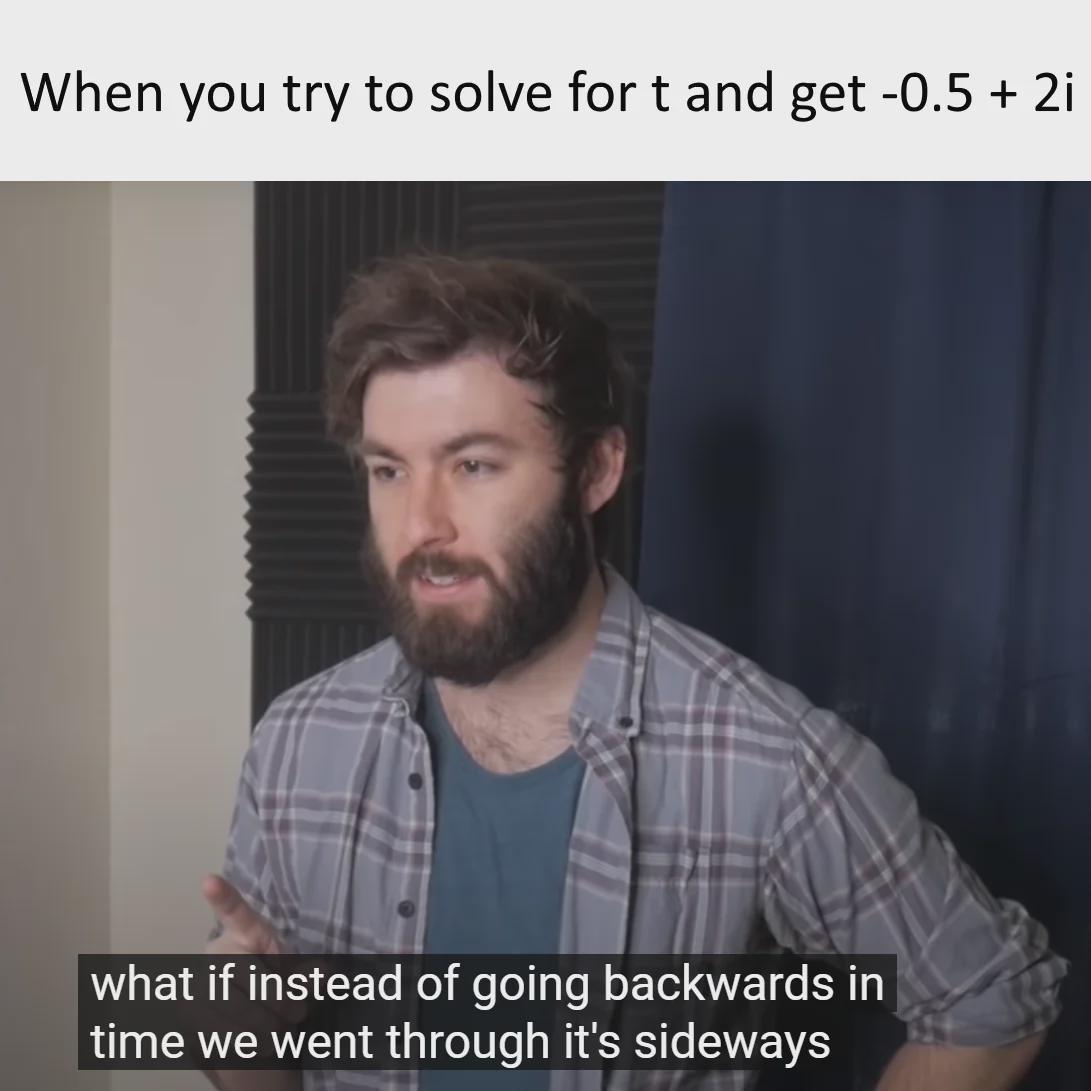
The math-physics crossover we never knew we needed! When solving for time (t) yields a complex number (-0.5 + 2i), you're not just failing at algebra—you're discovering interdimensional travel! The imaginary component (2i) suggests time isn't just moving backward or forward, but literally sideways into another dimension. Next time your differential equation gives you "impossible" answers, don't erase them... you might be erasing your ticket to the multiverse! Einstein would be both confused and impressed.

Which Side Are You On: Physics Gang War

Which Side Are You On: Physics Gang War
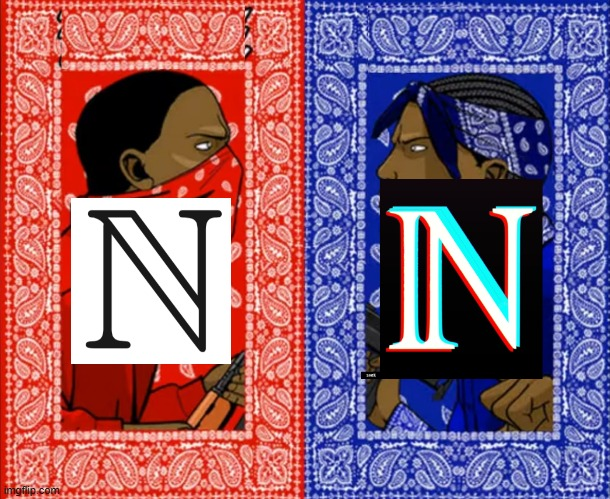
The eternal scientific gang war! On the left, we have the Newton gang representing classical physics with a standard "N" symbol. On the right, the quantum mechanics crew flashing their fancy complex number "iN" sign. Classical physicists be like "Force equals mass times acceleration, simple!" while quantum physicists roll up with "Actually, reality is probabilistic and particles exist in superposition until observed." The scientific turf war that's been raging since Schrödinger's cat simultaneously joined both gangs! Choose your physics faction wisely - your reality depends on it! 😂

Imaginary Age Crisis

Imaginary Age Crisis
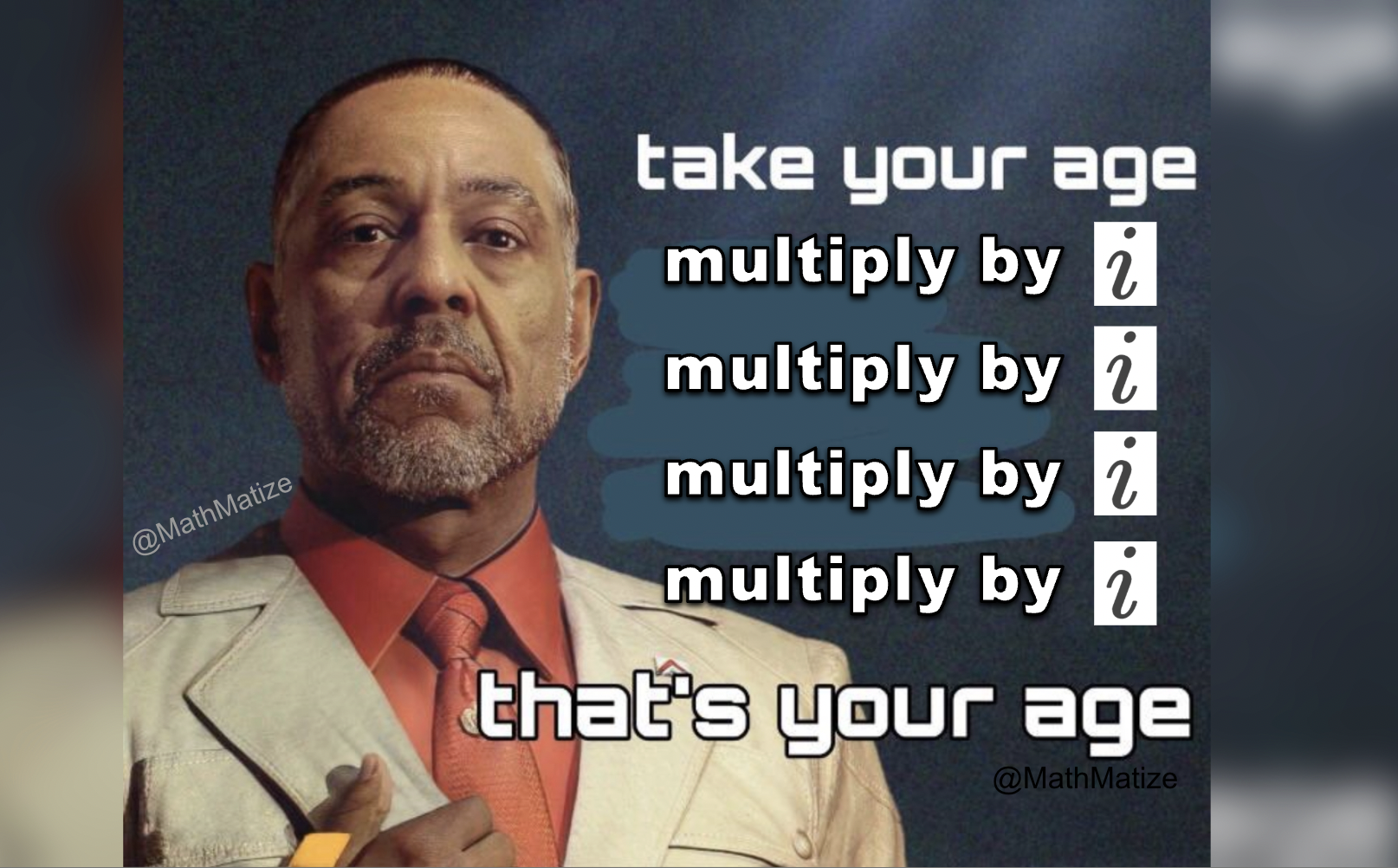
The math genius strikes again! This meme is playing with the mathematical constant i , which represents the square root of -1. When you multiply any number by i four times, you get back to your original number (because i × i × i × i = 1). So taking your age, multiplying it by i four times, and ending up with your age again isn't actually impressive—it's just how complex numbers work! It's like saying "add zero to your age four times and—GASP—you get your age!" The smug expression makes it even better, like he's dropping the most mind-blowing math fact ever. Pure mathematical trolling at its finest!

Imaginary Fractal For Christmas

Imaginary Fractal For Christmas
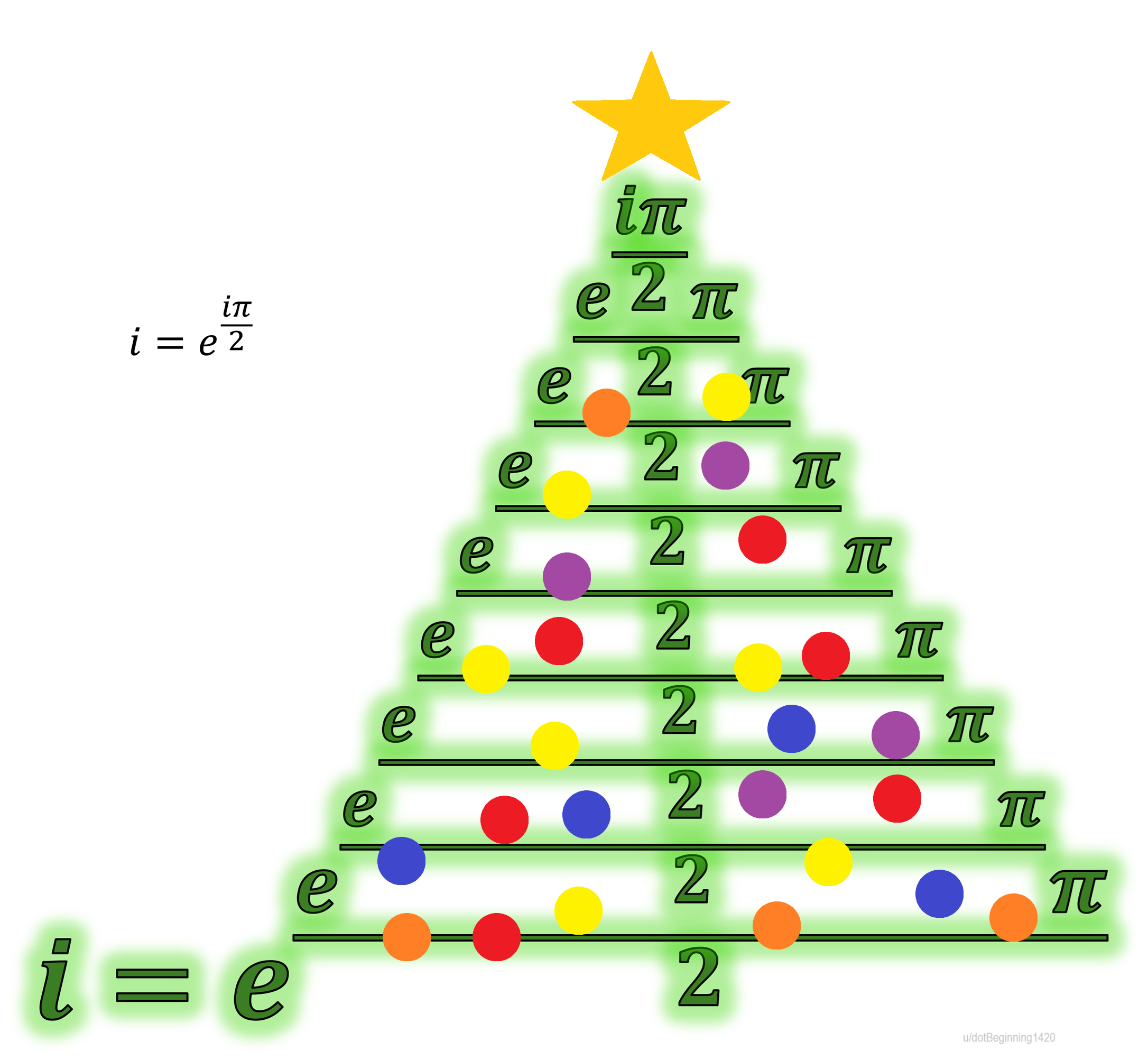
The most mathematically elegant Christmas tree ever created! This brilliant tree is constructed from the famous Euler's identity (i = e^(iπ/2)), which connects the imaginary unit i with e and π. The tree itself is formed by repeatedly writing out the equation, creating a fractal-like pattern decorated with colorful "ornaments." For the math nerds wondering: yes, e^(iπ/2) does equal i, making this not just festive but mathematically correct! It's the perfect holiday decoration for mathematicians who want to celebrate Christmas while still flexing their complex number knowledge. Nothing says "holiday spirit" quite like combining trigonometric functions with the complex plane!

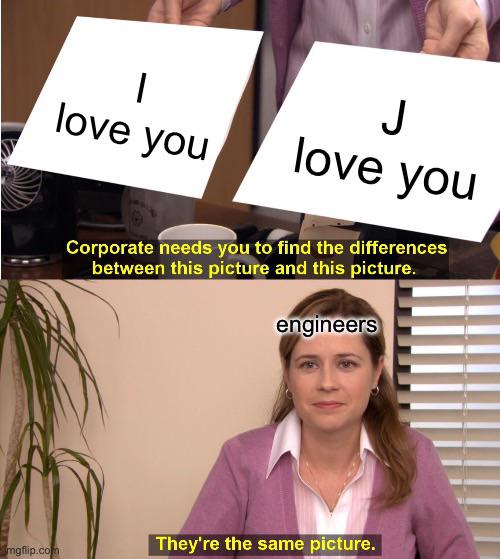
I Versus J: Engineers Spot The Difference

I Versus J: Engineers Spot The Difference
Engineers spotting the difference between "I love you" and "J love you" is peak math nerd territory! In complex numbers, i represents the imaginary unit (√-1), while j is the engineer's version of the same thing. Mathematicians use "i" but electrical engineers use "j" because they already use "i" for current. Two identical expressions to normal humans, but completely different universes to the pocket-protector crowd. It's like getting excited about different fonts of the same letter—but with MATH!

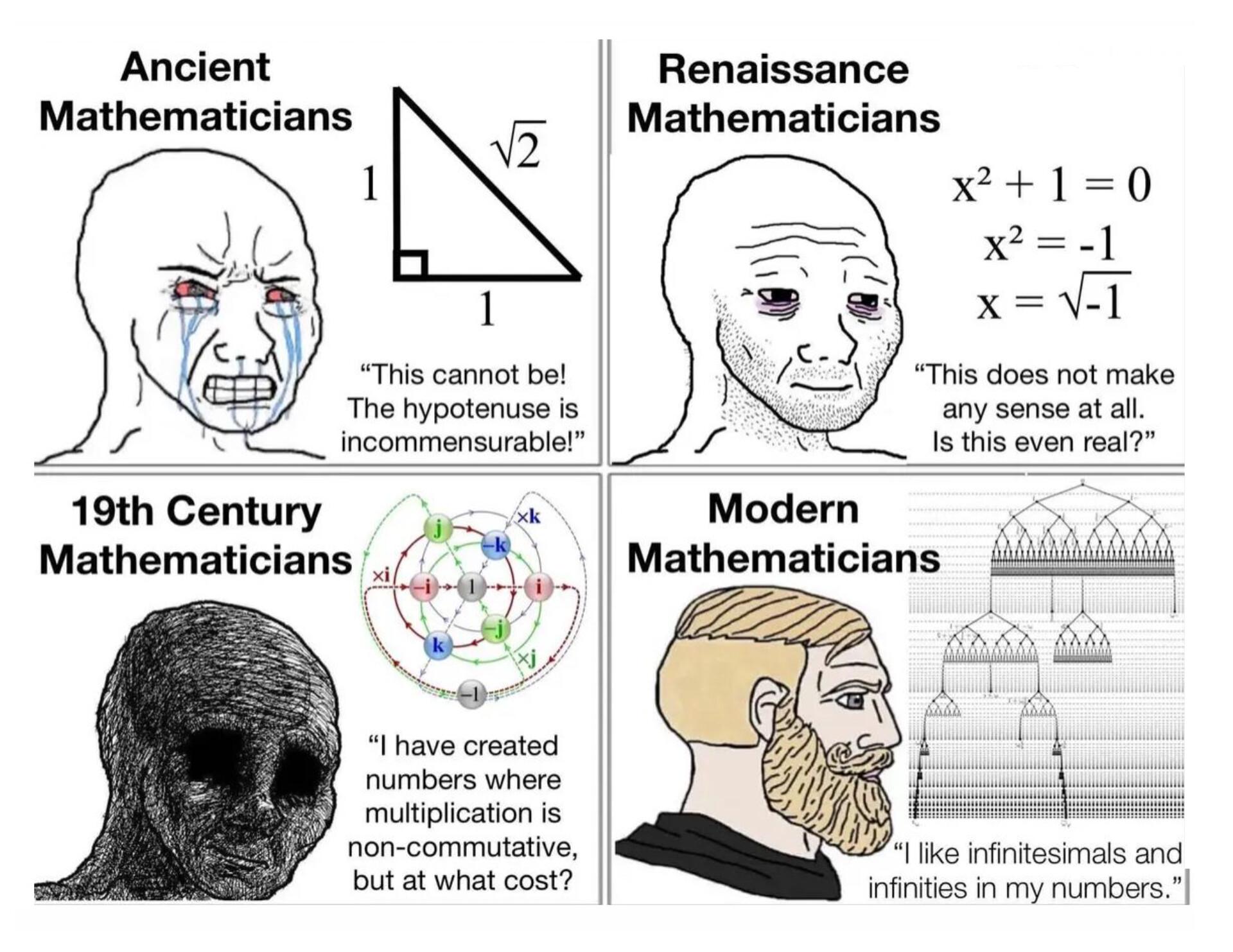
Foundations Are Getting Easier

Foundations Are Getting Easier
The evolution of mathematicians' mental breakdowns is pure comedy gold! Ancient Greeks were literally sobbing over √2 being irrational ("The hypotenuse is incommensurable!"). Fast forward to Renaissance folks having existential crises over imaginary numbers like √-1. By the 19th century, mathematicians invented non-commutative multiplication and stared into the void wondering what unholy abomination they'd unleashed. Now? Modern mathematicians casually toss infinities and infinitesimals into their morning coffee like "no big deal." Each generation's nightmare becomes the next generation's basic homework problem. Math trauma through the ages!

The Mathematician's Dating Preferences

The Mathematician's Dating Preferences
The meme shows a list of mathematical number types as checkboxes: Imaginary, Complex, [redacted], Irrational, Transcendental, Cardinal, and Ordinal. It's basically a mathematician's dating profile preferences! Instead of "seeking someone who loves hiking and cooking," they're filtering for numbers with specific properties. The joke works on multiple levels since many of these number types have relationships - like how all imaginary numbers are complex, and transcendental numbers are also irrational. Dating in the math world is just as complicated as the numbers themselves!