
Basel problem Memes

Posts tagged with Basel problem
The Ultimate Mathematical Flex

The Ultimate Mathematical Flex
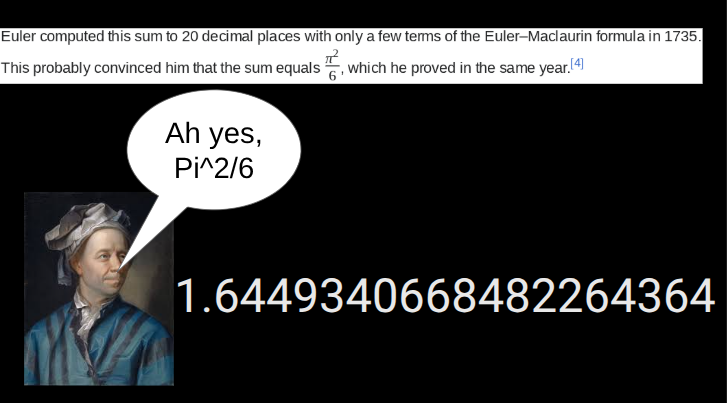
The mathematical flex to end all flexes! Leonhard Euler casually looking at 1.64493406684822643640... and immediately recognizing it as π²/6. This is like someone glancing at your 20-digit phone password and saying "Oh that's just the square root of your birthday multiplied by your social security number." For the curious nerds: π²/6 ≈ 1.6449... is actually the sum of the infinite series 1 + 1/4 + 1/9 + 1/16 + ... (or Σ 1/n² from n=1 to ∞). Euler solved this in 1735 after mathematicians had been stumped for nearly a century. The man didn't just calculate numbers—he recognized them like old friends at a party.

The Selective Mathematician

The Selective Mathematician
The mathematical hypocrisy is strong with this one. Our bearded friend dismisses the Basel problem (Σ 1/n² = π²/6) as "made up nonsense" but gleefully accepts the geometric series (Σ (1/2)ⁿ = 1). Classic case of mathematical cherry-picking—rejecting a proven result from 1734 while embracing another equally valid infinite series. The selective skepticism is what happens when you only attend half the lectures in advanced calculus. Next week he'll probably argue that imaginary numbers aren't real.

Euler's Infinite Flex

Euler's Infinite Flex
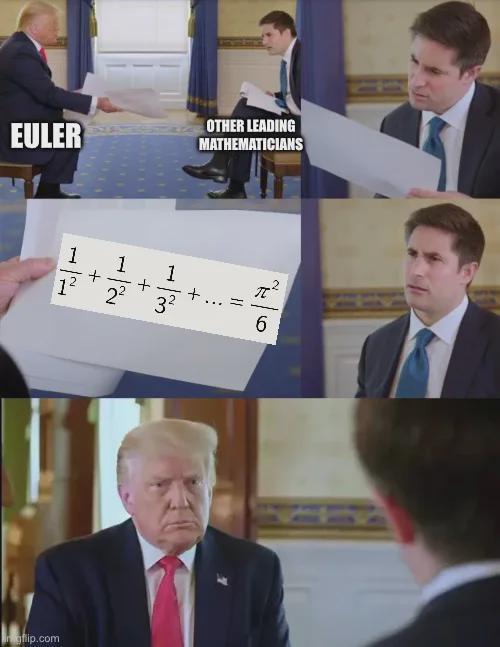
Leonhard Euler casually dropping the solution to an impossible-looking infinite series like it's nothing while other mathematicians stare in disbelief. The Basel Problem had mathematicians stumped for decades until Euler swooped in with π²/6 and basically mic-dropped on the entire mathematical community. That face when you solve an infinite sum that everyone thought was impossible and the answer turns out to be surprisingly elegant. Pure mathematical flex. The other mathematicians are just sitting there like "Did this dude just... with π... how even..."

Basel Problems: When Math Breaks Your Brain

Basel Problems: When Math Breaks Your Brain
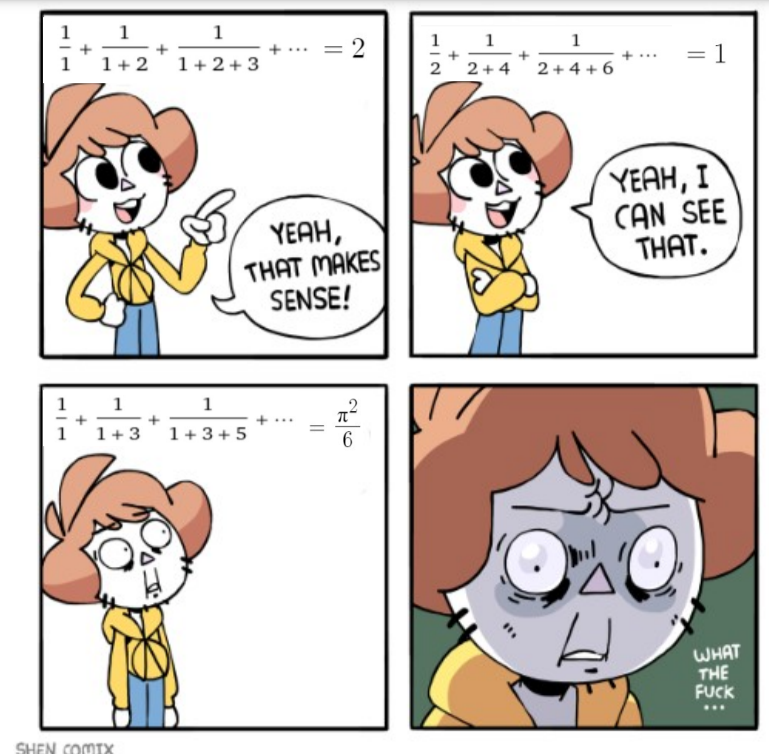
The first two infinite series follow a nice, predictable pattern—the first equals 2, the second equals 1. All is well in math land. Then the third series hits with π²/6 as the answer, and our mathematician's brain short-circuits. This is the infamous Basel Problem, solved by Euler in 1734. Mathematicians had been banging their heads against walls for decades trying to figure out why this seemingly simple series produces an irrational number involving π squared. Just another day in mathematics where things make perfect sense until they absolutely, horrifyingly don't. The universe's way of saying "you thought you understood patterns?"