

Stellar evolution Memes

Posts tagged with Stellar evolution
Which Is More Cooler To U?

Which Is More Cooler To U?
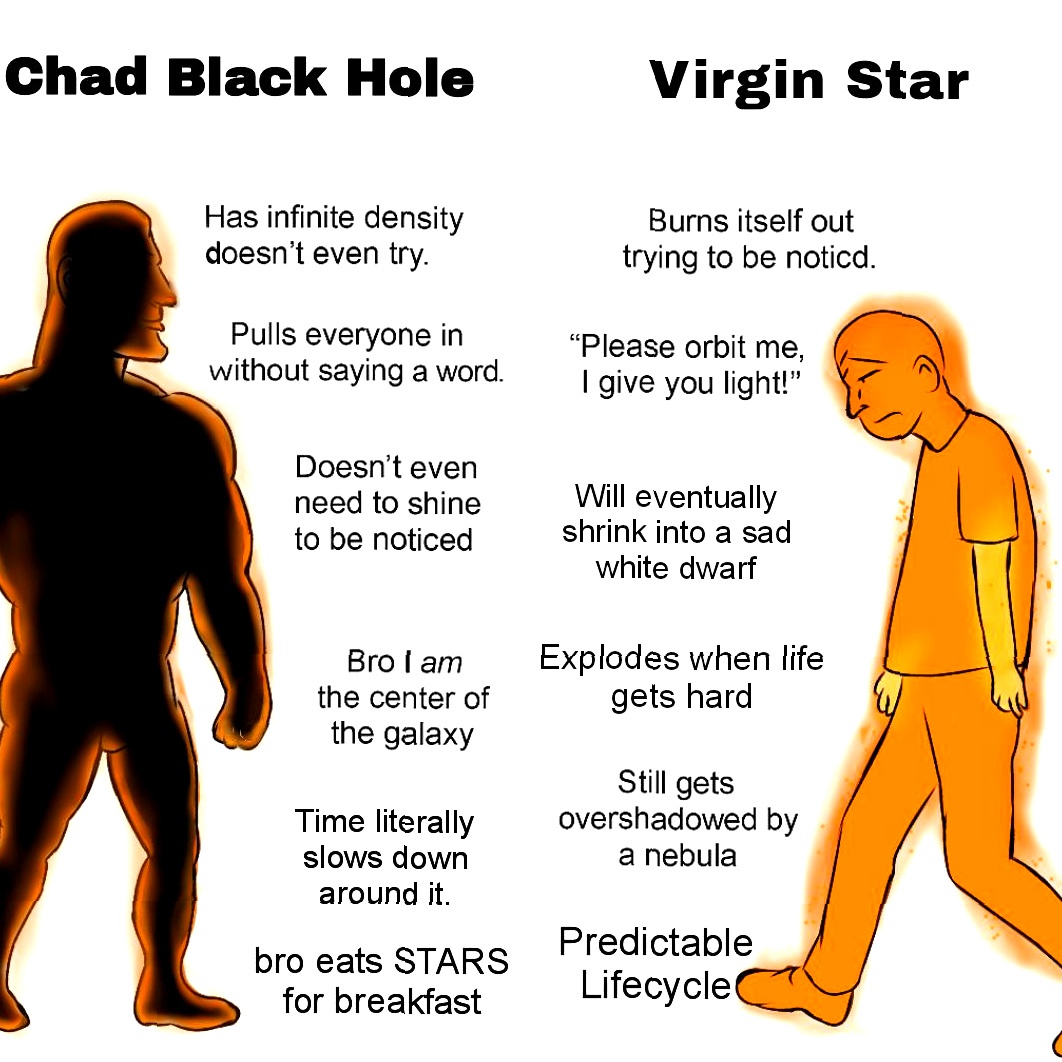
Black holes really are the ultimate cosmic flex. They just exist with infinite density, warping spacetime so hard that time literally slows down near them, and they don't need to do anything to get attention—their gravitational pull does all the talking. Meanwhile, stars are out here desperately begging planets to orbit them, burning through their fuel like they're on a cosmic deadline, and still ending up as sad white dwarfs or getting completely upstaged by the pretty nebulae they create when they explode. And let's not forget: black holes literally eat stars for breakfast. That's not a metaphor in this meme—that's just what they DO. You can't compete with something that consumes your entire species as a light snack. The virgin vs. chad format works perfectly here because it captures the existential drama of stellar objects. Stars work so hard for validation, while black holes are just vibing at the center of galaxies being absolute units of gravitational dominance.

But At Least I'm Vibing, I Guess

But At Least I'm Vibing, I Guess
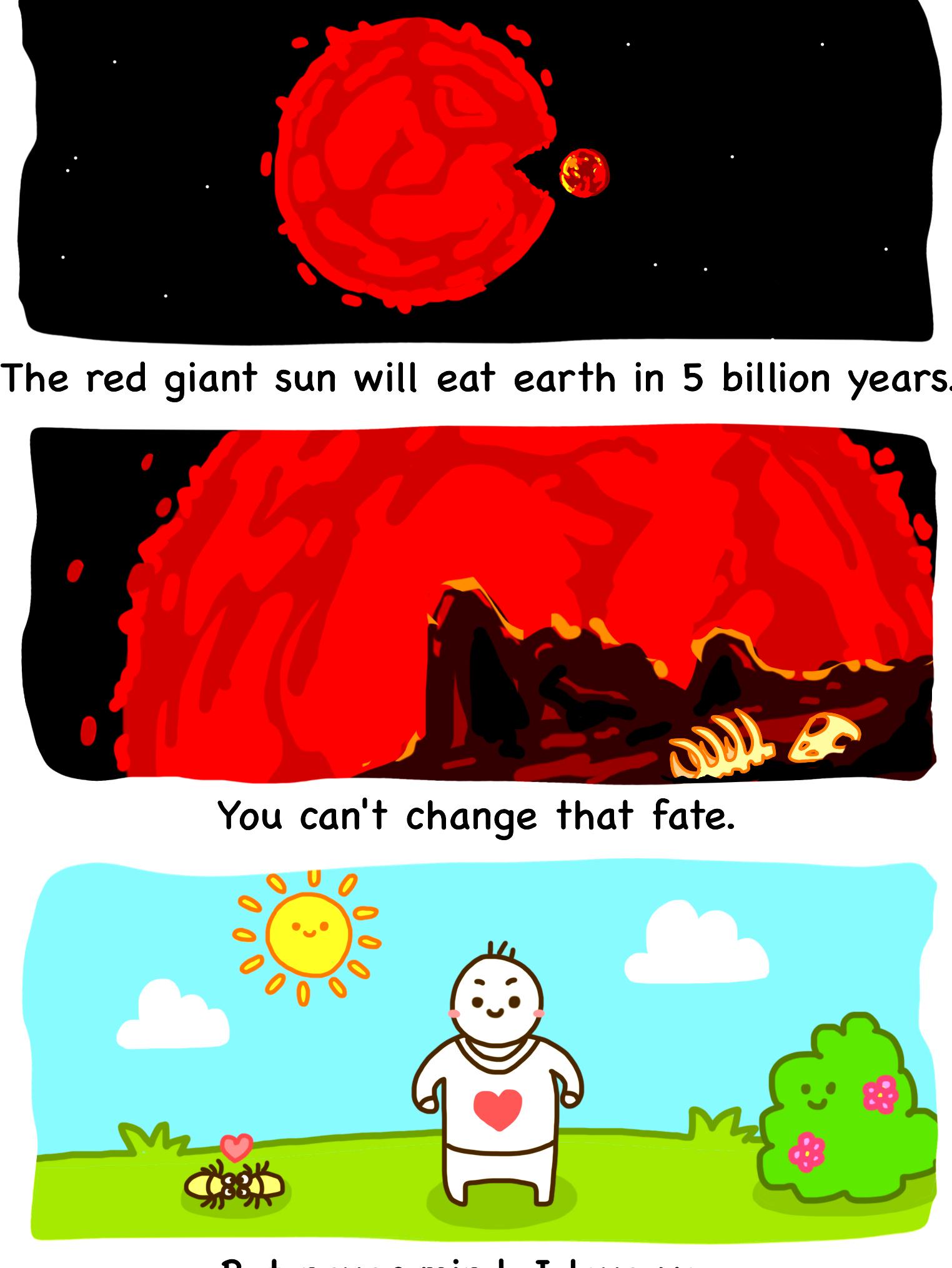
This meme captures the beautiful absurdity of human existence in the face of cosmic inevitability. In about 5 billion years, our Sun will expand into a red giant and engulf Earth, turning everything into vaporized particles. That's a scientific certainty. Can't negotiate with stellar evolution, can't file a complaint with physics. But here's the thing: instead of spiraling into existential dread, the meme pivots to a wholesome little dude just... existing. Enjoying the sunshine. Appreciating the flowers. Living his best life despite the universe's long-term plans for planetary annihilation. It's the ultimate "live in the moment" philosophy backed by astrophysics. Sure, the Sun will eventually betray us in the most dramatic way possible, but that's billions of years away. Right now? Touch grass. Smell flowers. The heat death of our planet can wait.

Born Too Late To Be A Useful Pole Star, Eh Sigma Octantis?

Born Too Late To Be A Useful Pole Star, Eh Sigma Octantis?
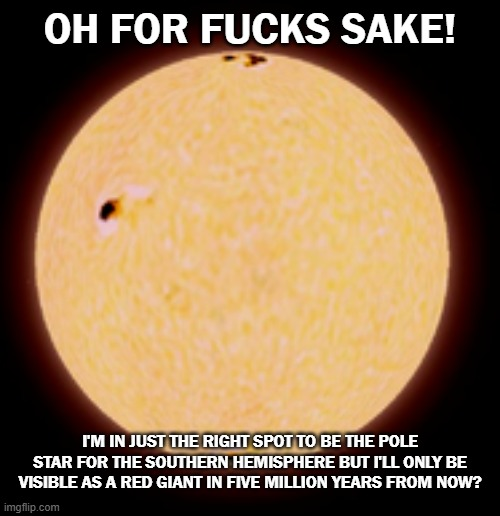
Poor Sigma Octantis drew the short straw in the cosmic lottery. While Polaris up north gets all the glory as THE navigation star, Sigma Octantis is technically the southern pole star but it's so dim (magnitude 5.4) that you can barely see it with the naked eye. It's like being cast as the lead actor but the theater forgot to turn on the spotlight. But wait, there's more existential dread! Due to Earth's axial precession (the wobble in our planet's rotation), different stars take turns being the pole star over thousands of years. In about 5 billion years, when our Sun becomes a red giant and balloons up to swallow the inner planets, Sigma Octantis will FINALLY be bright enough to see clearly. Except, you know, there won't be anyone left on Earth to appreciate it. Talk about bad timing. It's like showing up to the party with the perfect outfit... after everyone's already left and the venue is on fire. Classic universe humor.

Some Things Don't Change In Seven Billion Years

Some Things Don't Change In Seven Billion Years
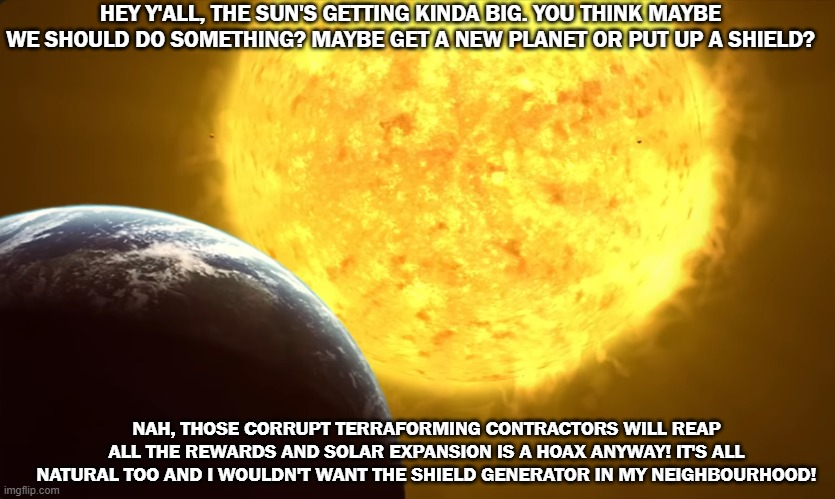
The meme perfectly captures humanity's approach to existential threats. In about 7 billion years, our sun will enter its red giant phase and expand enough to engulf Earth's orbit. Yet here we are, depicted as having the same climate change debate even as the apocalypse looms. One person suggests reasonable action while another dismisses it as a hoax with some classic NIMBY attitude. Stellar evolution doesn't care about your political stance, unfortunately. The universe's timescale makes our procrastination look particularly absurd - like waiting until the day before your dissertation is due to start writing it, except the dissertation is planetary survival.

It Has Just A Little More Hydrogen Than Us...

It Has Just A Little More Hydrogen Than Us...
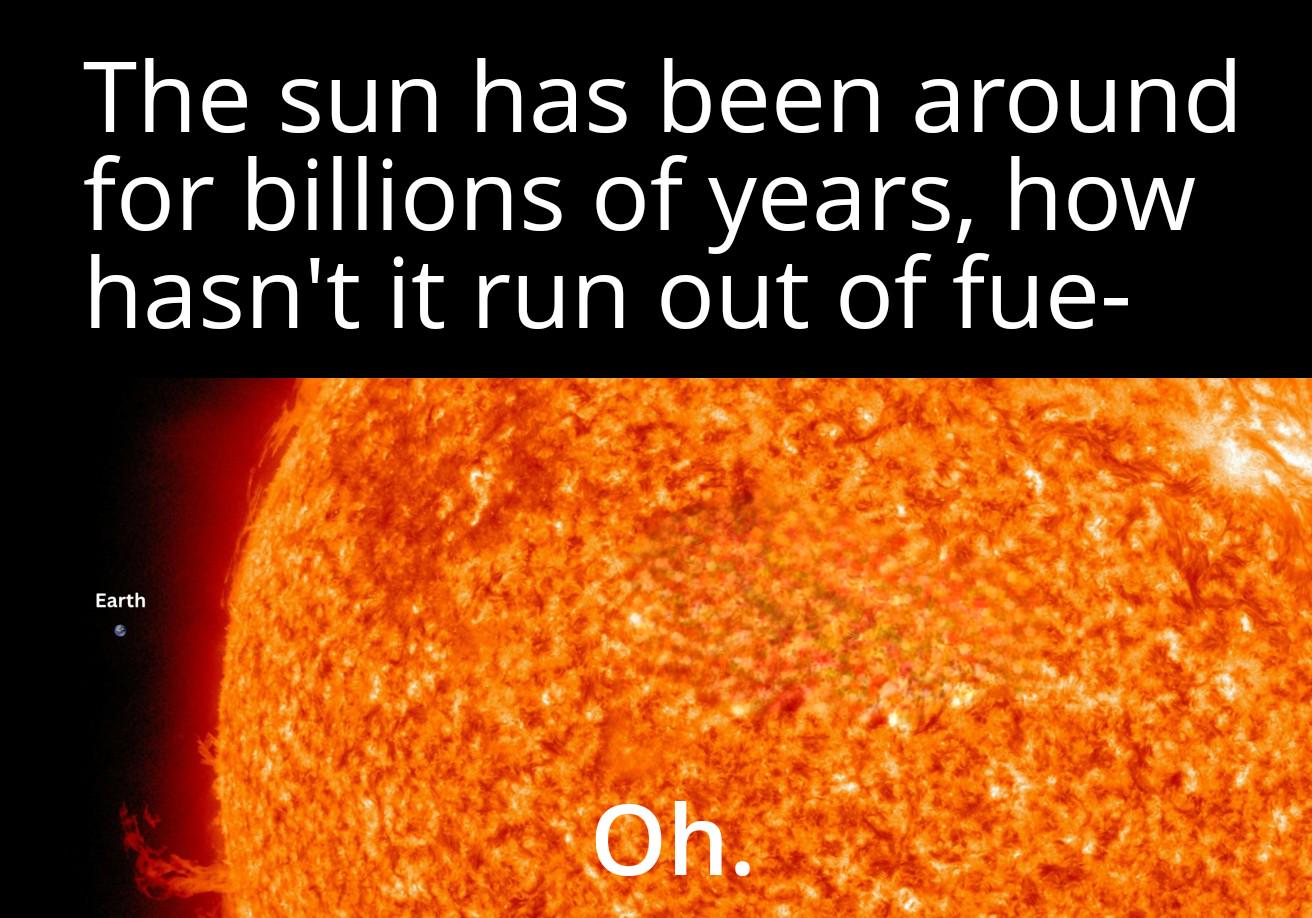
The classic "Oh" moment when you realize the sun isn't burning like your campfire, but rather fusing hydrogen into helium in a massive thermonuclear reactor. That awkward silence when someone discovers nuclear fusion doesn't "use up fuel" the same way their car does. The sun just casually converts 600 million tons of hydrogen into energy every second and has enough to last another 5 billion years. Meanwhile, I'm rationing coffee beans until payday.

The Sun's Unsolicited Fusion Flex

The Sun's Unsolicited Fusion Flex
The Sun, just sitting there in space, casually turning 600 million tons of hydrogen into helium every second without anyone asking. Nuclear fusion so intense it's literally visible from 93 million miles away. Meanwhile, humans struggle to keep fusion reactors running for more than a few seconds without them exploding. The Sun's been flexing on us for 4.6 billion years and plans to continue this unnecessary power move for another 5 billion. Such a show-off.

Stellar Death By Excessive Expansion

Stellar Death By Excessive Expansion
Stellar evolution meets historical misrepresentation. The meme juxtaposes a diagram of a red giant star's internal structure with a historical figure, suggesting they died from "getting blown too hard." What we're actually looking at is the final evolutionary stages of a massive star before it goes supernova—expanding its outer layers while compressing its core. The star literally gets "blown up" as it dies. Scientifically inaccurate? Yes. But tell that to the star that's about to violently expel its outer layers into space while collapsing in on itself. Talk about pressure in the workplace.

Stars Have Feelings Too

Stars Have Feelings Too
The internal struggle of Asymptotic Giant Branch stars is REAL! On one side, you've got these adorable hydrogen and helium burning shells just vibing and being AWESOME. On the other side? That menacing carbon-oxygen core plotting its stellar domination like some cosmic supervillain! 🌟 This is basically the stellar equivalent of having both an angel and devil on your shoulders, except they're nuclear fusion processes! The AGB phase is when aging stars get all dramatic before their final cosmic curtain call. Those tiny measurements (0.0056R, 0.0029R) show just how incredibly compact these processes are in cosmic terms - we're talking about nuclear furnaces crammed into spaces smaller than Earth!

Any Time Betelgeuse Is Mentioned In The Media

Any Time Betelgeuse Is Mentioned In The Media
Poor Betelgeuse can't catch a break. Every time this red supergiant star dims slightly, astronomers and media outlets practically throw a supernova watch party. The meme perfectly captures the star's perspective—a glowing SpongeBob skeleton sarcastically saying "You just can't wait for me to die, can you?" Meanwhile, astronomers are sitting at their telescopes with popcorn, hoping to witness the celestial equivalent of a fireworks finale. Truth is, Betelgeuse could explode tomorrow or 100,000 years from now. Stellar death-watching might be the longest stakeout in scientific history.

The Stellar Procrastinator

The Stellar Procrastinator
Astronomers staring at Betelgeuse like impatient kids waiting for fireworks. The star's been threatening to go supernova for millennia, but keeps blue-balling the scientific community. We've got telescopes ready, papers pre-written, and champagne on ice for when this cosmic senior citizen finally kicks the bucket. Some researchers have literally built entire careers around a stellar explosion that refuses to happen. Talk about stellar procrastination.

Cosmic Grief Support Group

Cosmic Grief Support Group
Getting emotional about cosmic timescales is peak astronomy nerd behavior! The meme captures that bizarre feeling when you're suddenly hit with existential dread over events that will happen long after humanity is gone. Like, why am I tearing up about stars dying in 100 trillion years? I won't even be around when my milk expires next week! Yet here I am, mourning celestial bodies that have lifespans billions of times longer than our entire species. The universe's inevitable heat death shouldn't make me sad, but somehow it does. It's that special kind of science melancholy that makes you want to hug a telescope.

K-Stars Are The Best Stars

K-Stars Are The Best Stars
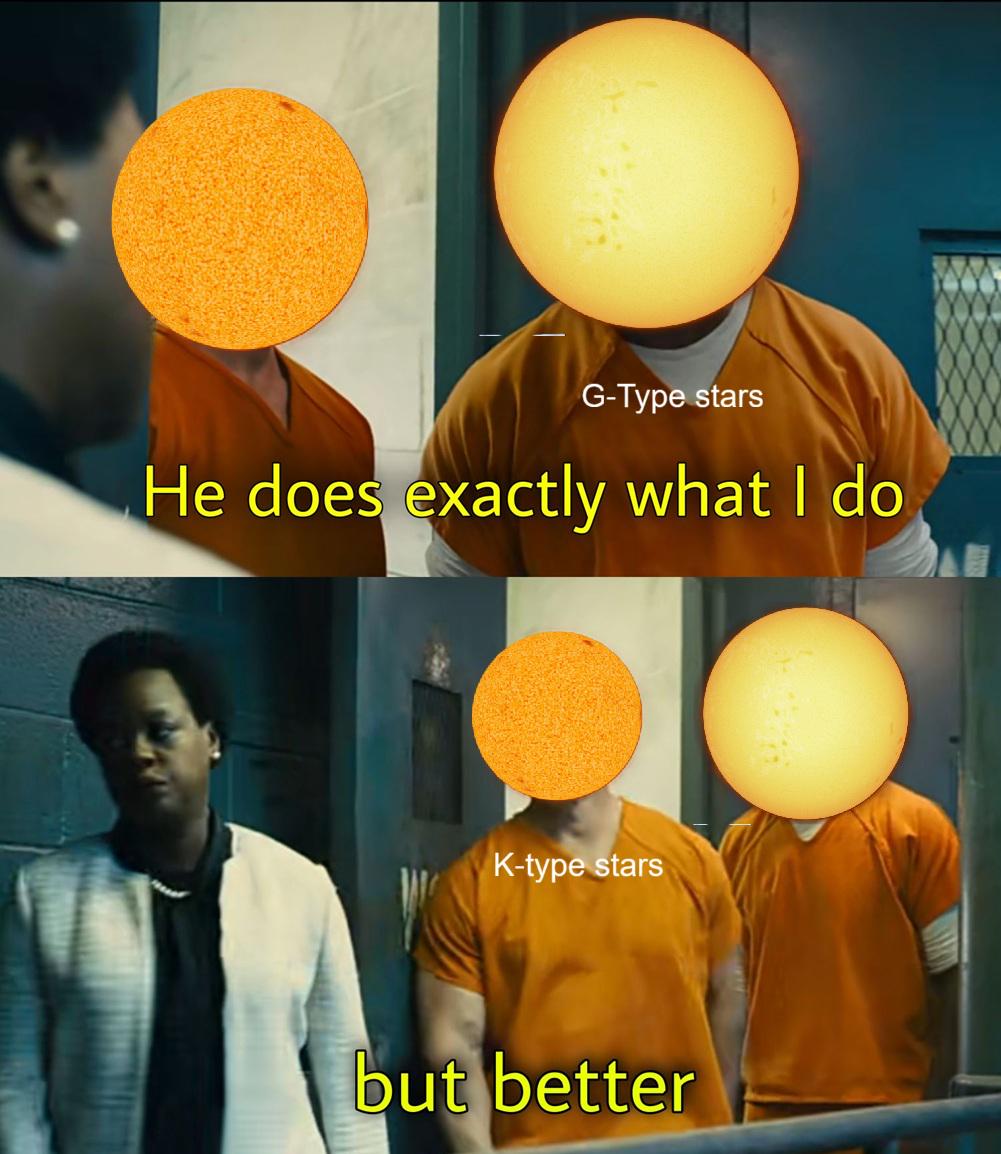
Stellar classification humor at its finest! G-type stars (like our sun) think they're hot stuff, but K-type stars are basically saying "hold my beer." While G-types get all the fame for hosting Earth, K-types are actually more stable, live longer, emit less harmful UV radiation, and might be better candidates for habitable planets. It's like comparing that flashy professor who publishes in Nature once and never shuts up about it versus the quiet workhorse who actually gets meaningful research done. The astronomical equivalent of "same job description, superior performance review."