

Stars Memes

Posts tagged with Stars

First Ever Meme

First Ever Meme
Red giants and red supergiants having a stellar identity crisis, and it escalates exactly how you'd expect—with nuclear fusion going absolutely bonkers. The difference between a red giant and red supergiant? Starting mass, baby. Red giants are your average stars (like our Sun will be in ~5 billion years) that puffed up after exhausting their hydrogen core. Red supergiants? Those absolute units started with at least 8-10 solar masses and are now fusing heavier elements like it's a cosmic chemistry speedrun. The punchline here is brutally accurate: when you've got more starting mass, you don't just go supernova—you go supernova with style . Red supergiants can explode as Type II supernovae, briefly outshining entire galaxies and forging elements heavier than iron. Meanwhile, red giants just... shed their outer layers and become white dwarfs. It's the astronomical equivalent of retiring to Florida versus going out in a blaze of glory. Fun fact: Betelgeuse, everyone's favorite "is it gonna explode yet?" star, is a red supergiant that could go supernova literally any day now (or in 100,000 years—stellar timescales are weird).

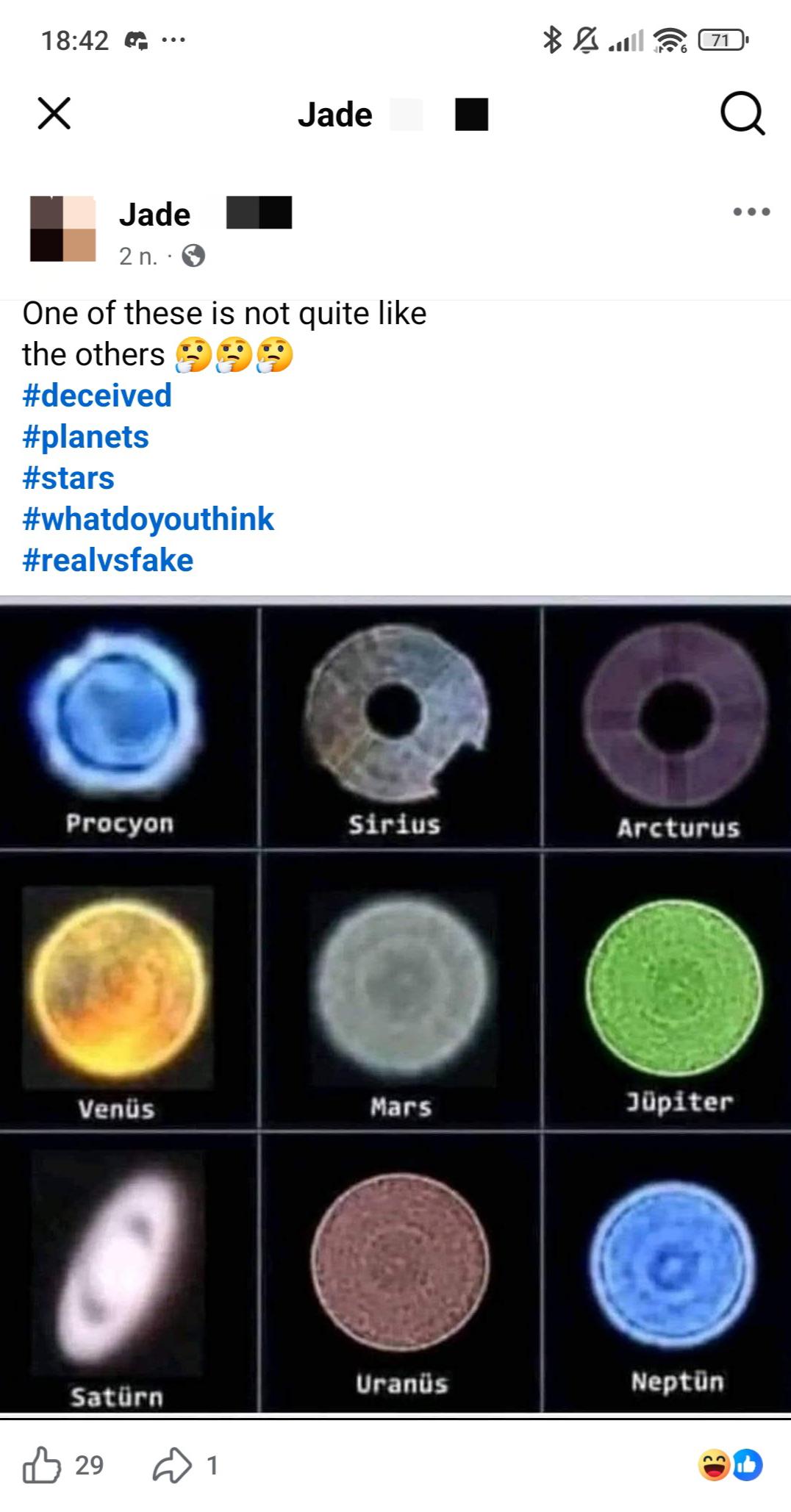
One Of These Is Not Quite Like The Others

One Of These Is Not Quite Like The Others
Someone decided to play "spot the difference" with celestial objects and just casually threw in what appears to be microscope slides or eyeball close-ups. We've got Procyon, Sirius, and Arcturus looking suspiciously like iris scans at an ophthalmologist's office. Meanwhile Venus, Mars, Jupiter, Saturn, Uranus, and Neptune are just sitting there being actual planets like they're supposed to. The hashtags #deceived and #realvsfake really sell the conspiracy energy here. Plot twist: stars aren't actually giant eyeballs in space watching us. They're massive balls of plasma undergoing nuclear fusion. Though honestly, given how surveillance technology is going, I wouldn't be shocked if someone tried to pitch "cosmic iris recognition" as the next big thing. Pro tip: if your astronomy textbook shows stars that look like they need Visine, maybe get a refund.

Extremely Common Red Dwarf L

Extremely Common Red Dwarf L
M-class star fans really thought they had something special going on, didn't they? Red dwarfs are the most abundant stars in the universe—making up about 70% of all stars—but their dim, cool nature means they're basically the worst candidates for hosting life in their habitable zones. The problem? Their habitable zones are SO close to the star that any planet there would likely be tidally locked (one side always facing the star) and get absolutely roasted by stellar flares. Plus they're so faint that planets need to orbit super close just to stay warm, which creates all sorts of problems for atmospheric stability. Meanwhile, everyone's out here simping for G-type stars like our Sun—the Goldilocks zone champions. Red dwarfs really took the L on this one. They'll live for trillions of years but spend it all alone. That's rough, buddy.

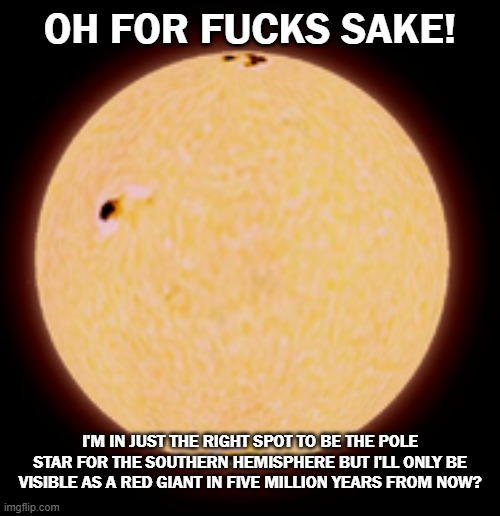
Born Too Late To Be A Useful Pole Star, Eh Sigma Octantis?

Born Too Late To Be A Useful Pole Star, Eh Sigma Octantis?
Poor Sigma Octantis. Currently the "South Star" by technicality alone—it's so dim (magnitude 5.5) that you basically need binoculars to even find it. Meanwhile, Polaris up north is out here being the MVP of celestial navigation for millennia. But here's the cosmic joke: due to axial precession (Earth's 26,000-year wobble), in about 5 million years Sigma Octantis will actually be positioned perfectly as the south pole star. Except by then it'll have evolved into a red giant, making it super visible but also completely useless for navigation because, you know, humanity probably won't be around to appreciate it. Talk about terrible timing. Born in the right location, wrong era. It's like showing up to a party exactly when everyone's leaving, except the party is 5 million years away and you're a giant ball of expanding plasma. The universe really said "here's your moment" and then scheduled it for the heat death equivalent of career opportunities.

Which Is More Cooler To U?

Which Is More Cooler To U?
Black holes really are the ultimate cosmic flex. They just exist with infinite density, warping spacetime so hard that time literally slows down near them, and they don't need to do anything to get attention—their gravitational pull does all the talking. Meanwhile, stars are out here desperately begging planets to orbit them, burning through their fuel like they're on a cosmic deadline, and still ending up as sad white dwarfs or getting completely upstaged by the pretty nebulae they create when they explode. And let's not forget: black holes literally eat stars for breakfast. That's not a metaphor in this meme—that's just what they DO. You can't compete with something that consumes your entire species as a light snack. The virgin vs. chad format works perfectly here because it captures the existential drama of stellar objects. Stars work so hard for validation, while black holes are just vibing at the center of galaxies being absolute units of gravitational dominance.

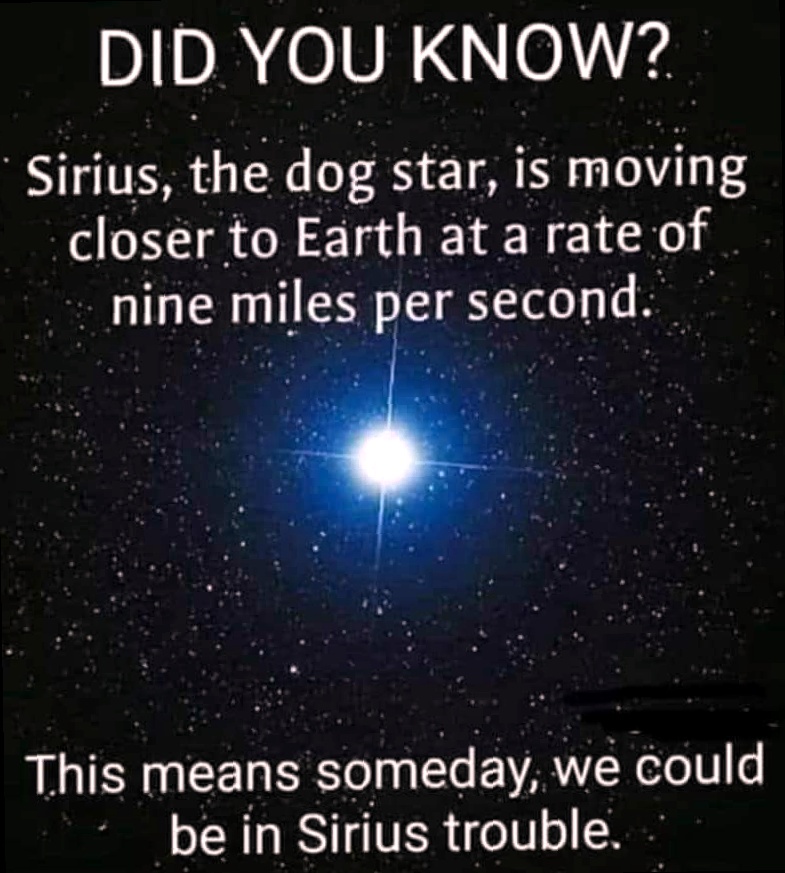
Oh-Ryan Come Check This!

Oh-Ryan Come Check This!
Okay so someone clearly failed their astronomy homework because Sirius isn't moving toward us at all—it's actually moving away at about 5.5 km/s! But let's play along with the joke: "Sirius trouble" is genuinely one of the best astronomy puns I've seen in a while. The idea that our brightest night star could somehow zoom toward Earth like a cosmic missile is absolutely ridiculous, but also hilarious. Fun fact: Sirius is only 8.6 light-years away and is called the "Dog Star" because it's in the constellation Canis Major (Big Dog). So if it WERE coming at us at 9 miles per second, we'd have about 60,000 years to prepare for our "Sirius trouble." Plenty of time to stock up on dog treats, I guess?

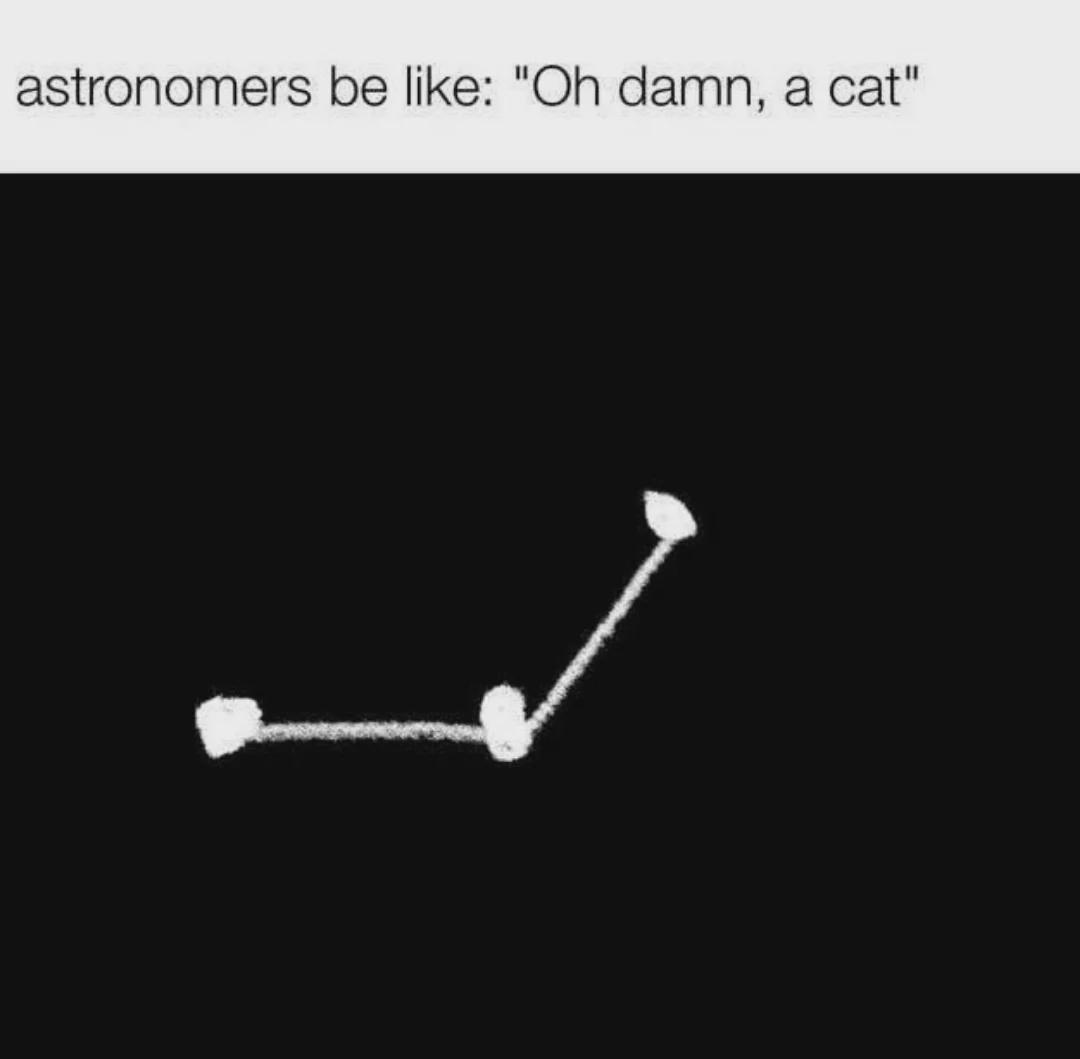
Astronomers Are A The Stupid

Astronomers Are A The Stupid
You spend decades studying celestial mechanics, mapping the cosmos, calculating the trajectories of distant galaxies... and then you see three dots in the night sky that vaguely resemble a cat and suddenly your entire career makes sense. Forget exoplanets and dark matter—this constellation is clearly a cosmic feline, and naming it anything else would be scientifically irresponsible. The ancient Greeks saw hunters and bears in the stars. Modern astronomers? Cats. Because when you're staring into the void for hours on end, pattern recognition goes into overdrive and your brain starts seeing what it wants to see. It's pareidolia with a PhD.

Betelgeuse Alert: The 3 AM Astronomy False Alarm

Betelgeuse Alert: The 3 AM Astronomy False Alarm
Your brain at 3 AM: "IT GOT BRIGHTER OUTSIDE!" Your body: "Shut up, I'm sleeping." Your brain: "We live in the middle of nowhere with no lights." *Brain frantically doing stellar calculations* "The full moon was two weeks ago... It's not a meteor... The light's been there too long... Orion is right outside the window..." *GASP* "BETELGEUSE IS GOING SUPERNOVA RIGHT NOW!!!" Plot twist: It's just your neighbor's new motion-sensor floodlight. But for one glorious moment, you thought you were witnessing one of astronomy's most anticipated stellar explosions from your bed. Dreams crushed by suburban security measures yet again!

Extremely Common Red Dwarf L

Extremely Common Red Dwarf L
M-star enthusiasts confidently chopping onions one minute, then completely losing it when they learn red dwarf stars might not support complex life. The astronomical equivalent of "I'm not crying, YOU'RE crying!" Red dwarfs make up about 75% of all stars in our galaxy, so finding out they're probably uninhabitable is like discovering 3/4 of your dating pool has a deal-breaking flaw. Those tears aren't from the onion—they're from crushed exoplanet dreams!

Damn These Red Dwarfs

Damn These Red Dwarfs
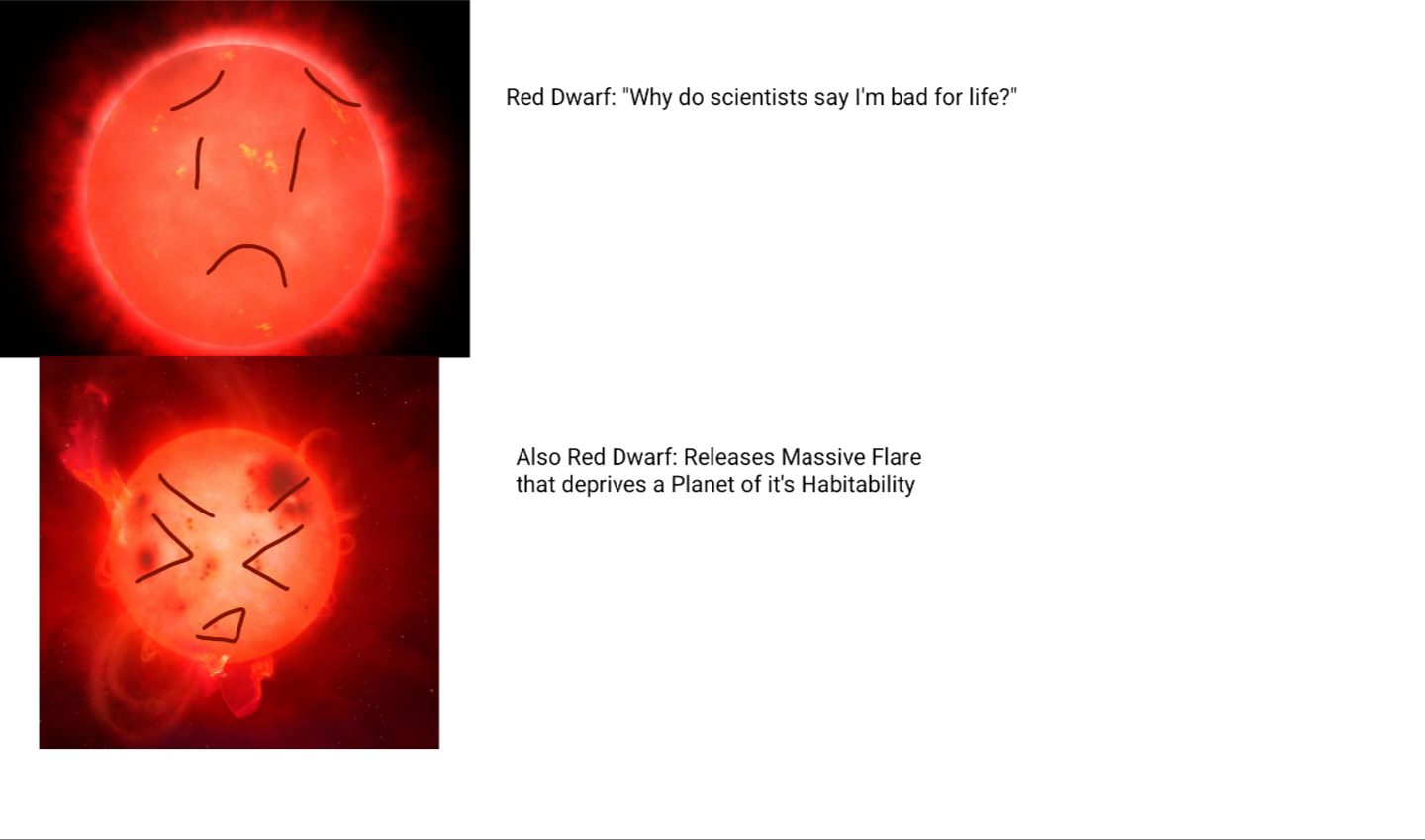
The cosmic irony of red dwarf stars in one perfect meme. These stars act like that one friend who asks why nobody likes them, then immediately demonstrates exactly why. Red dwarfs are the universe's biggest hypocrites—wondering why scientists don't consider them good candidates for hosting life while simultaneously unleashing apocalyptic flares that would strip any nearby planet faster than a freshman strips electrons from sodium. The kicker? These temperamental little stars live for trillions of years, giving them plenty of time to repeatedly sterilize any planet unfortunate enough to orbit them. Talk about a toxic relationship!

Ancient Greeks: The Original Constellation Conspirators

Ancient Greeks: The Original Constellation Conspirators
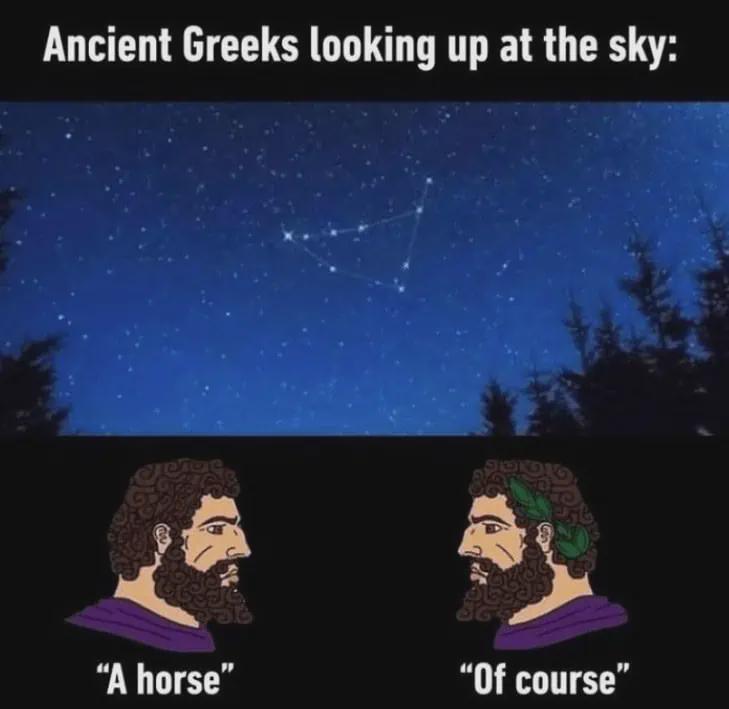
Two ancient Greeks stare at a random cluster of stars and immediately decide it's a horse. Because why not? When you've got no Netflix and your entertainment options are "stare at sky" or "invent democracy," you make do with what you've got. The Greeks basically invented celestial connect-the-dots, turning perfectly innocent star arrangements into elaborate mythological creatures and heroes. "See those seven stars? That's clearly a warrior fighting a two-headed dragon while riding a dolphin." Sure, buddy. Whatever helps you get through those long Mediterranean nights.

Red Is Colder Blue Is Hotter - Blackbody Radiation

Red Is Colder Blue Is Hotter - Blackbody Radiation
Ever notice how movies portray blue flames as "cold" when physics is screaming internally? In reality, blue flames are the hottest part of a fire (around 2,600°F), while red flames are cooler (about 1,000°F). Blackbody radiation is physics' way of saying "the hotter something gets, the bluer its light becomes." Stars work the same way - red stars are cooler, blue stars are ready to melt your face off at 50,000°F. So next time you see a "freezing blue flame" in a movie, just remember SpongeBob's expression of existential terror. That's the appropriate response to such scientific blasphemy.