Rayleigh scattering Memes

Posts tagged with Rayleigh scattering

Rayleigh Scattering

Rayleigh Scattering
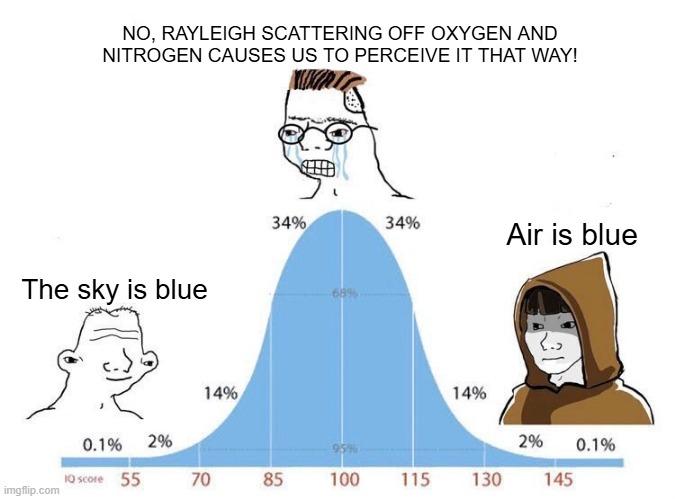
This bell curve perfectly captures the intellectual journey of understanding why things are blue. The casual observer sees the sky and goes "yep, blue sky." The person who just learned about Rayleigh scattering in their intro physics class becomes insufferable, ready to correct anyone who dares suggest the sky is simply blue without mentioning the wavelength-dependent scattering of sunlight by atmospheric molecules. Then you reach enlightenment and realize that air itself appears blue when you look at enough of it—mountains in the distance, thick atmosphere, same principle, less pretension. For context: Rayleigh scattering happens because shorter wavelengths (blue light) scatter more strongly than longer wavelengths (red light) when interacting with particles much smaller than the wavelength of light. So yes, oxygen and nitrogen molecules scatter blue light more, making the sky blue. But here's the kicker—if you stack enough air molecules together, like when looking at distant mountains or a thick layer of atmosphere, the cumulative effect makes the air itself look blue. Same physics, different framing, way less annoying at parties.

Crushing Childhood Curiosity With Quantum Physics

Crushing Childhood Curiosity With Quantum Physics
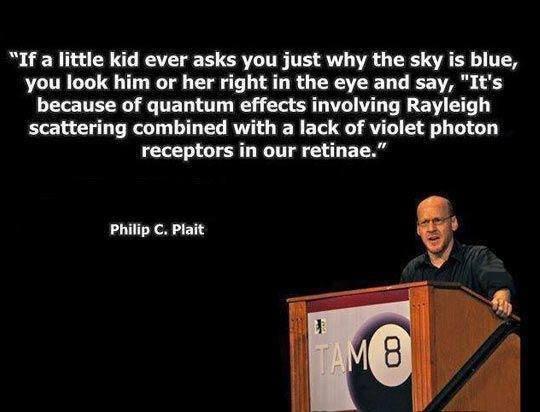
Nothing says "I love science education" like traumatizing a curious child with graduate-level physics! Phil Plait's advice is peak scientist humor - why give a simple "the sky scatters blue light more" when you can drop Rayleigh scattering and retinal physiology on a 5-year-old? This is exactly how we create the next generation of therapy patients with science anxiety. Bonus points for maintaining unblinking eye contact while delivering this explanation. That kid will either become the next Feynman or develop a lifelong fear of looking upward.

When Your Kid Finds The Edge Case In Your Scientific Explanation

When Your Kid Finds The Edge Case In Your Scientific Explanation
Kid: "Mommy, why is the sky blue?" Scientist mom: *instantly switches to lecture mode* "Rayleigh scattering! Short wavelengths get scattered way more (proportional to 1/λ⁴). Blue light dominates because it's so short." Kid: "Oh. So why isn't the sky violet?" Mom: *brain.exe has stopped working* "Well, because, uh... hmm." The true scientific flex isn't knowing why the sky is blue—it's explaining why it's not violet despite violet having an even shorter wavelength! (It's actually because of solar spectrum distribution and human eye sensitivity, but watching scientist parents get stumped by follow-up questions is pure comedy gold.)