
Logo
Why don't scientists trust atoms? Because they make up everything!
  • Home
  • Hot
  • Random
  • Search

Browse

  • Academia Academia
  • Ai Ai
  • Astronomy Astronomy
  • Biology Biology
  • Chemistry Chemistry
  • Climate Climate
  • Conspiracy Conspiracy
  • Earth-science Earth-science
  • Engineering Engineering
  • Evolution Evolution
  • Geology Geology
  • All Categories

HTTP 418: I'm a teapot

The server identifies as a teapot now and is on a tea break, brb

HTTP 418: I'm a teapot

The server identifies as a teapot now and is on a tea break, brb

Radiation-pressure Memes

Posts tagged with Radiation-pressure
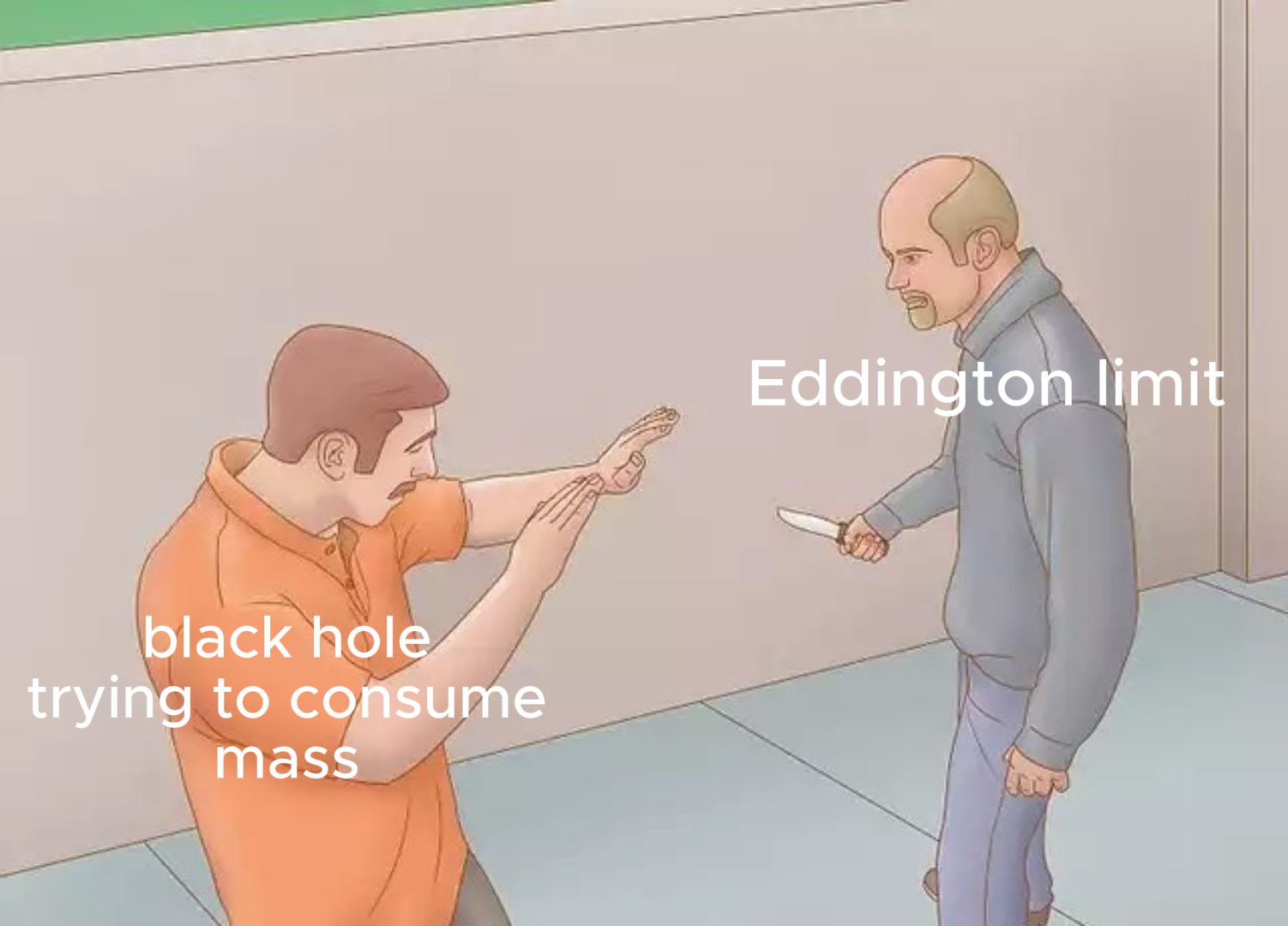
When Black Holes Meet Their Match

Astronomy Physics Universe
14 hours ago 9.5K views 0 shares
When Black Holes Meet Their Match
Black holes are basically the universe's vacuum cleaners on steroids—they'll devour anything that gets too close. But even these cosmic gluttons have their limits. Enter the Eddington limit, the ultimate "no, you've had enough" boundary that stops a black hole from eating faster than it can handle. When a black hole tries to consume mass too quickly, the radiation pressure from all that superheated infalling material pushes back against gravity. It's like trying to chug a milkshake through a tiny straw—at some point, physics just says "nope" and stops you. The Eddington limit is that cosmic bouncer keeping black holes from gorging themselves into oblivion. So here we have a black hole aggressively reaching for more mass, only to be politely but firmly rejected by one of the fundamental laws of astrophysics. Even the most powerful objects in the universe have to respect the rules sometimes.

Spotlight

My mini PC costs $3 a month. The VPS math for 2026

Two months of smart-plug data from my home mini PC: 22 kWh and CA$3.08 in August, priced against DigitalOcean, Hetzner and Oracle's free tier ... Read article →

Ad Breville Barista Express

Turn your kitchen into a hipster café
Breville Barista Express espresso machine
Each purchase brings us closer to affording that chemistry course where they explain orbitals once and for all. ⚛️